November 2005 archives

How to Buy Vanilla and Vanilla FAQs

Vanilla is the ‘salt’ of the pastry world.

It’s the background flavor to just about everything I make, and I add a few drops of pure vanilla extract to whatever I’m baking.

Fresh Apricots Roasted with Vanilla Bean

Vanilla is reputedly the world’s most popular flavor but many of us who use it know little about it, except that it smells and tastes great, and sometimes seems outrageously expensive for such a tiny bottle.

Here’s the answers to some of the questions that you might have about vanilla…

What’s the difference between the three ‘origins’ of vanilla available?

Bourbon: This doesn’t mean the vanilla contains whiskey, it refers to the I’le de Bourbon, now known as Réunion. Most Bourbon vanilla is now grown on the island of Madagascar, the largest vanilla-producing region on the world. Bourbon vanilla is the strongest and most full-flavored of all the vanillas and give you the most ‘bang-for-your-buck’. I use Bourbon vanilla for baking, since it’s assertive flavor doesn’t lose potency when cooked.

Tahiti: Tahitian vanilla gained popularity a decade ago; its shockingly-high cost perhaps fanned its fame. Tahitian vanilla has a more delicate flavor; very floral and tropical. I use it in fruit salads or scenting tropical fruit desserts since baking with it seems a waste of it’s subtle flavor. Tahitian vanilla used to be far more expensive than Bourbon, but recent socio-political and economic events equalized the prices somewhat. Tahitian vanilla beans are plumper than others, although that doesn’t necessarily mean they have more flavor or are a better value. They’re just naturally moister.

vanilla ice cream

Mexico: If you think that quart bottle you bought in Mexico for $1 was a great bargain, think again (then dump it down the drain.) Real Mexican vanilla is perhaps the best in the world, and the price of pure Mexican vanilla is similar to other pure vanilla extracts. Labeling laws in Mexico differ than those in other countries, so that jumbo bottle of ‘Real Mexican Vanilla’ you bought at the tourist shop is likely a synthetic and contains coumarin, a substance banned in the United States by the FDA since it’s considered toxic, like tonka beans. I love pure Mexican extract, it’s sweet-spicy scent reminds me of just-churned vanilla ice cream and is versatile for every baking and cooking application.

Other vanilla growing regions include Bali, Sumatra, Java, China, and Indonesia. Often in some of these countries, vanilla beans are dried over fires to speed up the process, giving the vanilla beans a smoky aroma. I sniff the vanilla before buying (if I can) when it’s been produced in any of these countries but in general, I avoid vanilla from these regions. The prices are generally lower but the quality is often inferior.

uncured Mexican vanilla beans vanilla powder

Why is vanilla so expensive?

You may have noticed wild fluctuations in vanilla prices over the last several years. Political unrest and commercial reliance on pure vanilla (such as Vanilla Coke) increased demand and raised the prices worldwide. Vanilla cultivation is also the most labor-intensive of all food crops. Each orchid stalk can take a two to three years to produce it’s first flower then each flower needs to be hand-pollinated. Then the beans are branded (to prevent theft), harvested, cured and air-dried for up to one month (during that time they’re rolled up and stored away each evening to prevent condensation and theft.)
Vanilla cultivation is also dangerous business. Because this valuable crop is cultivated in impoverished countries, looting, theft and violence are unfortunately common.
Considering how little vanilla is used in baking, I don’t mind buy top-quality vanilla, which costs little more than commercial varieties but is infinitely better.

How do I substitute vanilla bean paste for vanilla beans or vanilla extract?

There are no hard and fast rules, as some pastes are stronger than others. Generally speaking, you can use 1 teaspoon of vanilla bean paste instead of 1 teaspoon vanilla extract. To replace 1 vanilla bean, use 2 teaspoons of vanilla bean paste.

What is single-fold and double-fold vanilla?

Vanilla extract is made by soaking vanilla beans in alcohol. Commercially-available extract has a very high ratio of beans-to-alcohol: single-fold vanilla has 12 ounces of vanilla beans (about 100 beans) per gallon of alcohol. Double-fold has twice as many and is mostly used for professional applications.

vanilla beans

How do you store vanilla extract?

Vanilla extracts are generally packed in amber-colored bottles, since light and heat are the biggest enemies of extracts. Store then in a dark place (not the refrigerator, since condensation can cause them to spoil.) Most extracts will retain their potency for a year.
Buy pure vanilla extracts from sources that sell lots of extract, since stock rotates frequently.

Vanilla beans should be moist, never brittle, when you buy them.

To keep vanilla beans moist and plump, store them in airtight bags in a cool, dark place (not the refrigerator, since moisture can cause them to mold.) Once used, you can rinse and dry vanilla beans and re-use them for infusing, as they still contain lots of precious flavor. Well-dried vanilla beans can also be buried and stored in a container of sugar for a few weeks to make vanilla sugar.

Why is there alcohol in vanilla?

Alcohol is an excellent base for infusing and for preserving, and it doesn’t spoil. Most vanilla extracts are in an base of about 35% alcohol. There are vanilla extracts without alcohol for those wishing to avoid it (most does cook out during baking, but trace amounts do remain.)

Remarkably, alcohol also changes the way your senses ‘taste’ flavors, so I add a bit of vanilla extract to recipes even if I’ve infused them with vanilla beans.

Want more information?

vanilla_bookcover.jpg

Read one of the best books on vanilla, where you’ll find historical and cultural information in this useful volume, from Patricia Rain, one of the world’s leading experts on vanilla.

Continue Reading How to Buy Vanilla and Vanilla FAQs…

Paris Cooking Classes, Schools, and Wine Tastings

milk chocolate spatula

Many folks coming to Paris have asked about cooking classes on the non-professional level. Here’s a list of cooking programs offered around town. Some offer professional-level classes lasting a week or several months, while others are for dedicated home cooks where you can prepare a meal with a local cook in their Parisian kitchen and perhaps visit a market. Click on the links to find their scheduled classes and what language they’re taught in.

Because I haven’t gone to most of them, I can’t offer personal recommendations. But a visit to their website should give you an idea of the nature of their classes. For professional-level classes outside of Paris, there’s a list below of some that specialize in pastry.

jam in tart
Cooking Classes in Paris

Atelier des Chefs

Atelier des Sens

Atelier Gastronomique de Alain Ducasse: The cooking school of super-chef Alain Ducasse

Cook ‘n With Class

Cordon Bleu

Ecole Ferrandi: Paris’ school for professionals who want to cook, classes in English and French

Ecole Bellouet Conseil

Ecole Lenôtre: One-day classes for home cooks, and professional programs

Elegant Home Cooking

Les Coulisses du Chef

Françoise Meunier

Chef Martial

Chez Bogato (Offers kids classes as well)

Cucina di Terresa: Organic & vegetarian cooking

La Belle Ecole

La Cuisine: English & French classes

L’Atelier de Fred

Gourmet Promenades: With Paule Caillat (in English)

La Cuisine de Marie Blanche

Ecole Escoffier: at the Ritz Carlton

On Rue Tatin with Susan Loomis: Classes in Paris & Normandy

Patricia Wells: Weeklong cooking programs

spatulas chocolate
Specialized Chocolate Classes For Professionals Outside of Paris

Ecole Chocolat

Pam Williams offers an online course in chocolate-making, with the option of coming to France (and Italy) and learning with selected professionals.

Chocolate Academy of Barry-Callebaut

Ecole du Grand Chocolat at Valrhona

Read about my visit to Valrhona’s Chocolate School

Ecole Nationale Supérieure de la Pâtisserie

Wine Tastings and Classes in Paris
Never An Empty Glass

David in Paris

Musée du Vin

Ecole du vin

Jacques Vivet’s Centre de Désgustation

Lavina

O-Château: Wine tasting in English with sommelier Oliver Magny.

Continue Reading Paris Cooking Classes, Schools, and Wine Tastings…

Sweet ‘N Stinky: Pierre Herme’s White Truffle Macaron

pierrehermetrufflemacaronpa.jpg

Le macaron truffle blanche

The White truffle Macaron from Pierre Hermé, is part of his fall collection of désires. From the first bite, this little cookie of almond-enriched meringue reveals sweet and reassuring buttercream…then the disconcerting jolt of musky, earthy white truffles. Nestled inside is a dry-roasted nugget of crunchy Piedmontese hazelnut, whose flavor provokes you into realizing that this combination of sweet and savory is surely the work of brilliance.


Pierre Hermé (Available seasonally)
72, rue Bonaparte
and
185, rue de Vaugirard

At the Market in Paris

At my local marché this week…

romanescoparisfrancemarket.jpg

Grown in Brittany, one of the weirdest vegetables found in France is Romanesco, a relative of broccoli. It’s cooked the same way, a la vapeur, simply steamed and tossed with a pad of rich French butter.

pariscarrotsfrance.jpg

Sand-grown carrots are sweeter (and dirtier) than ordinary carrots.

thymetimeparis.jpg

French (and American) cooks can find lots of thyme at the markets, which is much stronger than the thyme I’m used to. When I moved to France, I’d add big handfuls of thyme to everything I could since it’s so abundant and fragrant. It’s my favorite herb. Eventually a regular dinner guest bluntly told me I put too much thyme in things. (French people believe they’re doing you a favor when they criticize you, and I’ve had to explain to a few of them that Americans are a bit more subtle in our approach.)

fishwomanparis.jpg

The wonderful, sparkling-fresh seafood at the markets is something I’ve always stop and take a good look at. I’m always fascinated (and sometimes a bit freaked out) by bizarre sea life; slithery eels, shark meat displayed alongside the toothy shark head, bulots or little sea whelks that you pop from the shells with a pin, octopus (which some day I will work up the nerve to try…or perhaps not), and tiny grey shrimp, known as grises that are simply boiled in aromatic fish stock known as court bouillon then eaten cold, like popcorn. I really admire the fish people I shop from at the market, since I think their job is the most difficult and gruesome (although last week I saw an enormous wild boar, larger than I was, hanging upside down at the boucherie, which was soon to be evicerated for Civet de Sanglier, a long-cooked savory stew of wild boar, the sauce thickened with red wine and blood.)

Come Christmas the fish mongers are especially busy folks, since French people are insane for fresh oysters and buy them by the crate. Almost all the oysters come from Brittany, and before motorized transportation, horses would gallop wildly towards Paris from the coastal regions until they collapsed from exhaustion. Then there’d be another horse along the route to take over from there. This ensured that the briny oysters made it to Paris fresh and cold. My favorite oysters are the flat Belons, which I like with a bit of shallot-vinegar sauce wiht a few grinds of black pepper, sauce mignonette, along with a well-chilled glass, or two, of Sancerre and tangy rye bread smeared with lots of salted butter. It makes the cold, grey winter that’s quickly approaching us here in Paris bearable.

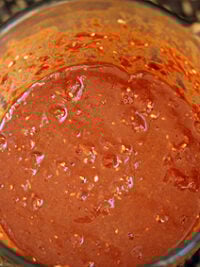
Chocolate Mole Recipe

mole

There’s nothing I like better than a big batch of mole, the famed Mexican sauce, spiked with chiles, spices, and a hint of bitter chocolate.

carnitas

Mole is excellent spooned over baked or poached chicken, and I’m especially fond of slathering it over a pot of crispy-cooked carnitas, too.

Mole Recipe

Recipes adapted from The Sweet Life in Paris (Broadway Books) by David Lebovitz

Makes enough for smothering one cooked chicken or a pork shoulder.

5 dried ancho dried chiles
1/3 cup sliced almonds
1 small onion, chopped
1-2 tomatoes, peeled, seeded and chopped
1/4 cup raisins or diced prunes
1 tablespoon toasted sesame seeds
1 clove garlic, chopped
¼ teaspoon each: cinnamon, ground cloves, dried oregano, powdered cumin, ground coriander, ground anise seeds
3/4 teaspoon salt, or to taste
freshly ground pepper
1 cup water (or more, as needed)
1 oz unsweetened chocolate, melted

Soak chiles in very hot water until soft, about 30 minutes or so. (Make sure they’re submerged by setting a lightweight bowl on top of the chiles.)

In a small skillet, sauté onion in vegetable oil until soft and translucent. Add garlic and sauté another minute. Add spices and herbs and cook, stirring constantly, for about 30 seconds, being careful not to let them burn.

In a blender, grind together the almonds, cooked onions, tomatoes, spices, raisins or prunes, sesame seeds, salt, pepper, and water. Puree until smooth.

Remove seeds and stems from the chiles and puree very finely, passing the chiles through a food mill. (If you don’t have a food mill, press the puree through a mesh strainer to make remove any skins. Some people just puree them in, but they can be tough.) Blend the chile paste into the mole along with the melted chocolate and add additional water, as necessary, until the consistency is smooth and slightly pourable.

Store in the refrigerator until ready to use.

To make Chicken with Mole Sauce:

Brown poultry pieces quite well in a large casserole in vegetable oil. Once nice and brown, remove the chicken pieces from the pan and saute one chopped onion in the casserole and cook until translucent. Deglaze the casserole with some wine or stock, and scrape in any browned bits from the bottom with a flat wooden spatula.

Add the chicken back to the casserole along with a cinnamon stick or two, and add enough chicken stock, water, or white wine to cover chicken pieces. Cover the casserole, and gently simmer chicken until tender throughout.

Once cooked, remove chicken pieces from the liquid and arrange them in a shallow baking dish. Smear chicken pieces generously with mole and bake in a moderate oven, turning once or twice during baking, for about 30 minutes.
Serve with a sprinkling of toasted sesame seeds.

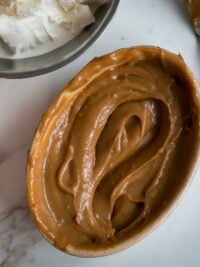
Dulce de Leche Recipe

dulce de leche

The first time I had Dulce de Leche I began spooning it directly from the jar and into my mouth and before I knew it, I had made it almost all the way through the jar.
It was that good!

I scraped it off the spoon with my teeth, savoring every sticky, sugary mouthful. The jar of Dulce de Leche I was given had a picture of a goat on the label and was called Cajeta. I had developed a fondness for goat milk since I lived very near a goat dairy in upstate New York, and while perhaps not to everyone’s taste, the farmhouse tang of it I found very appealing.

Once in a while they’d invite me over for some homemade goat milk ice cream which was so delicious that any ice cream I ate with cow’s milk after that seemed bland and one-dimensional. Since I also love anything caramelized, coupled with the barnyardy taste of goat milk, I’d found heaven in this sweet-silky paste…conveniently packed in a nice glass jar from our friends south-of-the-border.

Eventually the rest of the world discovered Dulce de Leche and now there’s scores of Dulce de Leche (or is that Dulces des Leches?) on the market…although nowadays most of what’s available is made from the more public-friendly cow’s milk.

If you do come across some made from goat milk, I urge you to try it: it’s incredible!

Continue Reading Dulce de Leche Recipe…

The Biggest Bottle of Red Wine in Paris?

redbottleparis.jpg

Culinary Contest: A Winner!

We have a winner!
Everyone did their best, and most of you got the 3. Fruitcakes and 4. Tube of Sweetened Condensed Milk correct, but only one could figure out one of the other two.
So after much guessing about the items, here are the answers for the Culinary Contest…

farzparis.jpg

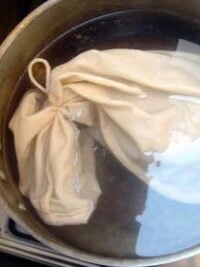
1. Le farz.
This is a linen sack specifically made for making Kig ha Farz, a buckwheat dumpling from Brittany that’s simmered for an hour, then rolled to make little couscous-like nuggets. Although the bag doesn’t look very pretty simmering away, I’ve added a new of starch to my repertoire!
You can view my previous entry here for Kig ha Farz, and I use the recipe from Susan Loomis’ excellent book, The French Farmhouse Cookbook.

mysteryitem2paris.jpg

2. Hello Judith and Judy?
No one got this one at all.

This is orzo, deep, dark-roasted barley powder that’s becoming widely known in Italy (of all places), as a coffee substitute. It’s brewed like espresso and I bought this sack from Slitti, a great chocolate-maker in Tuscany. Orzo is becoming common in caffès and restaurants since some Italians are concerned about the amount of coffee they’re drinking…if you can believe it. I guess if I lived in Italy and had unlimited access to that extraordinary espresso each and every day, I’d get a bit concerned as well.

fruitcakesparis.jpg

3. Date, Candied Ginger, and Pineapple Fruitcakes.
Since both my internet AND cable television have been down for over two long weeks although they finally gave me an appointment…in three weeks, at the end of November! You may now stop sending me comments like, “You’re so lucky to live in France!“)
So consequently, I’ve had lots and lots and lots of time on my hands and, like, what am I gonna do, read a book and get all literate? Well, okay, I did go to the Musee de Picasso yesterday in the Marais which was amazing…and I read a great book, yes a real book, The Confessions of Max Tivoli, which I loved, and started another book about a hermaphrodite that everyone tells me is great, and got a new baking book in the mail from Nick Malgieri, and I was going to see A History of Violence today but thought it might freak me out, and I’ve been so out-of-sorts not having any connection to the outside world.
What riots?
Who’s been indicted?
Who’s Jennifer Aniston dating?
Can Madonna’s career be resuscitated?

Anyhow…so I’ve been baking up a storm: Persimmon Breads, Apple and Cranberry Crisp with Polenta Topping, Dulce de Leche Ice Cream (two times), and Vanilla-Buttermilk Pound Cakes…plus I made Kig ha Farz…two more times.
And I decided to make a bakery-sized batch of the Date, Candied Ginger, and Pineapple Fruitcake from Ripe For Dessert.

Cheesecloth, as I know it, doesn’t exist in Paris (like customer service from your internet provider.)
But I found the French version in the fabulous fabric market of the Marché St. Pierre at the foot of Montmarte…étamine, a lovely, gauze-like cotton cloth that makes a far more beautiful wrapper for holiday cake gift-giving. I soaked the étamine in lots of whisky and wrapped the cakes and now they’re happily resting on shelves all around my apartment, soaking in their boozy blankets.
I have a feeling around Christmas, I’m going to have a lot of very happy friends…if the cakes stick around that long.

nestlelaitconcentratetubepa.jpg

4. Nestlé Sweetened Condensed Milk
Even though France is justly famous for the most amazing dairy products on earth, for some reason, the milk selection is sorely lacking. More often than not, you’ll find ultra-sterilized (UHT) milk and cream, as well as an assortment of other Franken-dairy products, with happy names like Gloria™, a canned sweetened milk intended for coffee, as well as little packets of maybe-once-upon-a-dairy products that make Kraft Singles™ look like triple-crème Brie de Meaux.

But I was intrigued by this tube of sweetened condensed milk and wondered why anyone would put it in a tube? So I flipped it over, and there was a serving suggestion, a picture of someone squeezing it directly into their mouths. Ick! Would someone really do that?
(Ok, I did…hey, hmm, hey not too bad….)

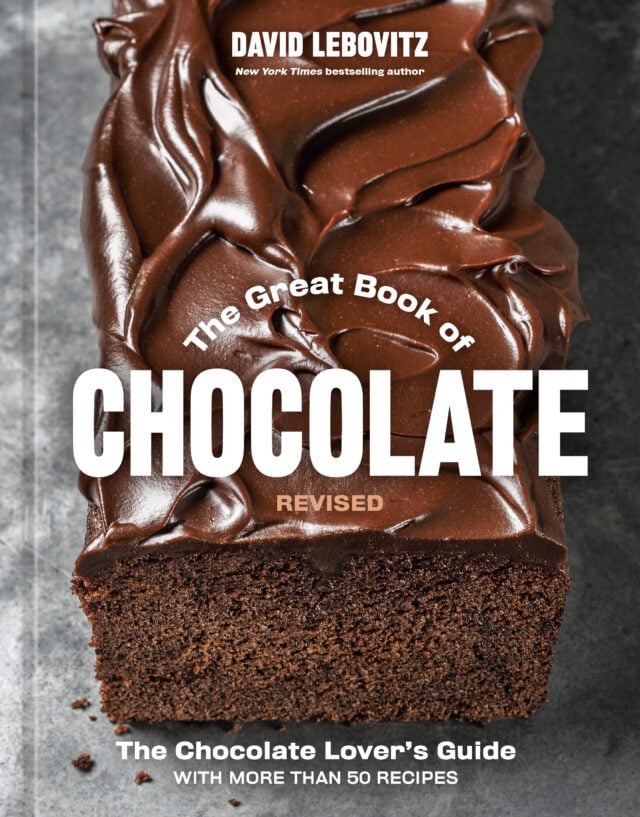
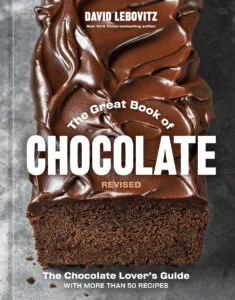
So our lucky winner will get a personalized copy of The Great Book of Chocolate as a holiday gift.
The rest of you may just have to gift yourself a copy!…

GTCH.jpg