David Lebovitz
circle  Home My Books Bio Chocolate Tours My Paris Schedule Recipes Links
corner Circle     corner
 
Search My Blog:


The Perfect Scoop


Tours
Click Here For Exciting Information About Upcoming Chocolate and Culinary Tours


Visit the Travel Blogs Ad Network and the Food Blog Ad Network to advertise here.


Categories...


Add me to your RSS:


Room For Dessert


Read My FAQs


Ripe For Dessert


Visit David's Flickr Page
www.flickr.com
This is a Flickr badge showing public photos from daveleb. Make your own badge here.


Archives
April 2008
March 2008
February 2008
January 2008
December 2007
November 2007
October 2007
September 2007
August 2007
July 2007
June 2007
May 2007
April 2007
March 2007
February 2007
January 2007
December 2006
November 2006
October 2006
September 2006
August 2006
July 2006
June 2006
May 2006
April 2006
March 2006
February 2006
January 2006
December 2005
November 2005
October 2005
September 2005
August 2005
July 2005
June 2005
May 2005
April 2005


Best Chef's Food Blog 2006
"Best Chef's Food Blog 2006"


The Independent
"The best food blog in the world"


The Wall Street Journal
"Blog Watch 2006"


About
"Top Ten Food Blogs" by About.com


WellFed.com Best City Food Blog
"Best City Food Blog 2005"


« What Is Gelato?
Main
Planet of the (Buckwheat) Crepes »

Eating My Words?
line

July 20, 2007

You might recall I recently posted the question: Is American Food Better Than French?*


tunaverrine.jpgstrawberryverrine.jpg


There were some very thoughtful comments on both sides of the piece de monnie, but in the post I laid a bit of blame on the French zeal for creating trendy food at the expense of sourcing local, fresh, and seasonal ingredients and I picked on les verrines as a current example. Like crème brûlée and warm individual chocolate cakes, which are both fine desserts, les verrines have become a cliché and you even can find them, for your convenience, in the frozen food section at your local supermarket here in France.

But after a recent lunch at Minipalais, Louisa, my dining companion asked (as I was wolfing one down) something to the effect of, "So who doesn't like verrines now?"

Indeed these were better than most, although not necessarily verrines, but individual courses served in glasses.
Got that?

Chef Gilles Choukroun (follow link ayor...why not the theme from Rocky, dude?), who is part of Générations.C, or the 'Cornered Generation'; a group of young French chefs on a mission to 'open up' French cuisine to new ideas. He created these first courses and desserts for this temporary restaurant in the Grand Palais, which is only open for the next six months.
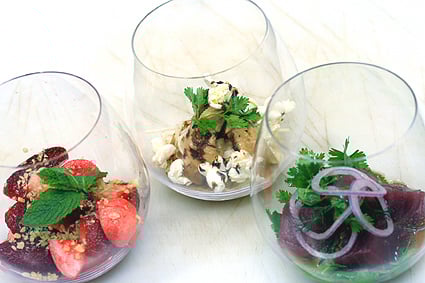

3verrines


Here's what was in nos verrines, with ratings...


First Courses:

  • Rémoulade de foie gras, pop corn et caramel balsamique

    Celery in mustard sauce with foie gras, popcorn and caramel balsamic: Good, but we both agreed the artfully-curled foie gras could have been a lot tastier and would have made this verrine a hit.
    5/10


  • Cubes de thons crus 'orange et sel', salade d'herbes au piment d'Espelette

    Raw tuna cubes with oranges and salt, salad of fresh herbs and pimente d'Espelette: I didn't taste any orange but this was excellent. Nice cubes of fresh tuna and a lively 'salad' of fresh herbs including chervil and flat-leaf parsley.
    9/10


  • Poireau 'crudité', oignons rouges et vinaigrette au curry

    Leeks with red onions and curry vinaiagrette: I don't remember anything about this one.
    Someone revoke my journalist/blogger card...
    (no rating)


    Desserts:

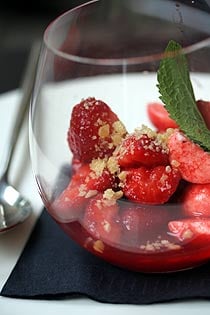
  • Salade de fraises toutes rouges

    Salad of red strawberries with pop-rocks and Tagada (store-bought strawberry-flavored marshmallows, which reportedly is the most popular candy in France): Fun! Although 'tagada' have become a bit trendy—I recently was served a custard with one melted into the top. Yuck. In this dessert, the strawberries were excellent and red all the way through, as promised, and the pop-rocks were fun although they kept hitting the side of the glass which I kept thinking was cracking and kind of freaked me out. Still I overcame my fears and polished it off.
    8.1/10


  • Tarte au citron 'à l'Envers'

    Lemon 'tart': This verrine was composed of a billowy-soft lemon cream with buttery crumbled cookies and tart dough scattered around. Not the most inventive thing I've had (it would have been more interesting with some lime or raspberry jelly, crispy slices of cassonade-soaked dried figs, or something like that), but I scraped it up nevertheless.
    Lemme in the kitchen!...to work on this one.
    7/10


  • Les agrumes comme au café de délices, pistaches et rose...

    Citrus with rose and pistachios: Inexplicably, in July, a dessert made with sections of grapefruit and oranges? Refreshing but in the midst of the barrage of summer fruits, why not use peaches, nectarines, plums, apricots, or fresh berries?
    5/10


    I did appreciate the creativity that went into them (and how do they keep their glassware so sparkling clean?) Some were successful and others less so. But I couldn't help but think that it would be fun to work on these ideas a bit more and incorporate truly seasonal ingredients into the mix. The brightness of chervil, the tang of lemon, and the crunch of popcorn and pop-rocks are certainly whimsical and intriguing tastes and sensations, but I was impressed by their beauty and simplicity and the way the concept of the verrine forces the diner to focus on the flavors, textures, and interplay of ingredients assembled in the glass.

    So I've had to re-think my aversion to les verrines. I'm still not entirely convinced, but I'm keeping an open mind.
    And stomach.


    Minipalais
    Avenue Winston Churchill (8th)

    Tél: 01 42 56 42 42
    Open daily.
    Each verrine costs between 6 and 8€.

    (For some reason, even though the restaurant is only open for six months, the web site isn't up and running. Hurry up, folks! Minipalais is located on the corner of the Grand Palais, the side facing the Seine.)


    *I just finished reading an excellent book, The Perfectionist: Life and Death in Haute Cuisine by Rudolph Chelminsky about the life and death of Bernard Loiseau, the chef who worked furiously all his life, driven to achieve what some consider the pinnacle of success: three Michelin stars. Once he got them, his obsessive-compulsiveness got the best of him and unable to overcome his slavish insistence on perfection he committed suicide in 2003, which stunned France.

    I wasn't certain I'd like the book as much as I did, since I knew little about the man and his cooking prior to reading it. And to be honest, I'm not all that interested in haute cuisine and all the gossip and hype that's built up around it. But his story prompted much of my re-thinking about the state of cooking in France today.

    Part of the premise was that he killed himself because his style of by-the-book classical cooking had fallen out of favor and he feared he was losing his third Michelin star, which was unfounded—although another dining guide, Gault-Millau, took him down a few points which devastated him to the point of clinical depression.

    Loiseau was unable (or unwilling) to change his style of cooking and to keep up with the upcoming trends during the 90's, like fusion-cooking and cuisine tendance, which promoted creativity and embraced global ingredients over the emphasis on classical techniques and preparations. It was something he simply was unable to cope with and as he watched his restaurant and style of cooking begin to lose its relevance and luster he fell into a deep depression which led to his suicide.

    Some of the new cooking here in France is indeed borrowed from other cultures (sometimes with good results but not always...) and dining has became less about perfectly-executed sauces and sourcing regional ingredients and more about surprising guests with something new and unexpected.

    "Étonne-moi!", as the author says, which became the name of the game...and perhaps explains the motivation behind much of modern French cuisine. For better or worse.


  • Permalink

    Comments
    line

    I like how the verrines look, but frankly, I don't have the space to store all that glassware. I recently had bought some tiny 3.5" hand painted plates to do something similar, and ended up giving them to someone as a gift. The idea made me tired.

    I like small tastes of things. I hate making lots of different little things. I'd rather pull out one big soufflé from the oven than sheet after sheet of cookies. Sue me. Besides I wear a tiny necklace that burns my neck from oven heat and I am feeling branded.

    You know, it's too hot at 40C to have patience for these things unless they are being eaten at a restaurant, which is exactly what you did, smart feller.

    Posted by Judith in Umbria at July 20, 2007 3:22 AM

    You may want to have a look at Gusto Magazine: issue 1 was asking whether French cuisine was still creative, while issue 2 was about foreign influences, which seems to fit your current interests. It's a French publication, but articles are all in French AND English.

    Here is the colophon:

    "gusto Magazine is a quarterly magazine for all who regard gastronomy as a continuously evolving heritage.

    Food lovers, the curious, travelers, food professionals, chefs and academics, gusto finally puts culture at the heart of cuisine and tackles the important questions surrounding it: its creativity, its influences, its transmission but, too, its challenges and its prevarications.

    Initiated by IEHCA, The European Institute of the History of Food Culture, gusto reports on the annual round table discussions held in Tours which bring together the leading players in the field of cuisine, not just those that create it but those that reflect upon it. Within this framework, the magazine plays an active role in the French procedure to request that French cuisine be recognized by UNESCO as intangible cultural heritage.

    Bilingual (French/English), elevated in quality through its graphics and layout, original through its editorial line and decision to put in the forefront the work of an artist in each issue, the magazine offers a unique place for debate and reflection. Bringing together well-known personalities, but, too, giving space to those who are less well known but equally pertinent, Gusto is a cultural implement, accessible and readily available."

    And the link: Gusto Press

    It's not a cheap magazine (10 euros) and I'm not sure it's easy to find, but it's well worth the read.

    Posted by Arnaud at July 20, 2007 9:02 AM

    My understanding is that verrines are layered. Being served in a glass, maybe they can be called quasi-verrines?

    Looks wise, all the action seems centred on the bowl of the glass. It would be nice to have some action on the rim, like a paper umbrella ;) or at least some trailing herb leaves or a chervil flower. Or glasses with stems. I am not against verrines per se, just that the idea doesn't get stretched more, although these are definitely an improvement.

    Posted by umami at July 20, 2007 9:17 AM

    Judith: If you see pasta in little tiny glasses....run!

    Arnaud: Thanks for the link. I'll check it out.

    Umami: I always thought they were layered too, but Louisa's smarter than I am (or just wanted to make me feel like an idiot) and she called them verrines.

    Posted by David at July 20, 2007 10:10 AM

    I'm going to head out and buy that book about Bernard Loiseau, it sounds really interesting... and I think that's perfectly hilarious about the "verrines" but I agree with you that it seems strange that they didn't use summer fruit in that citrus verrine although it's funny because the combination immediately evoked persian cooking for me.

    Posted by Hilda at July 20, 2007 2:54 PM

    interesting way to dine... and only for 6 months? talk about exclusivity! right, i must swing by when i head over to paris for salon du chocolat... thanks for the heads up!

    Posted by Lil at July 20, 2007 3:09 PM

    Hi David,
    A question that has nothing to do with this post...I consider myself a decent baker and I've tried making your Almond Cake, but it keeps sinking in the center. I've tried adapting the recipe to high altitude reducing a little the sugar and the baking powder (I'm using 3/4 tsp.) with no success. It keeps sinking. It's positively fully cooked and it tastes great but it looks deflated. Any thoughts?. Thanks for your time.

    Posted by Karla at July 20, 2007 4:54 PM

    Please feel free to answer Karla before you read any further.

    This way of serving makes perfect sense in those restaurants with small table surfaces. Much more sensible than a huge plate taking up half the available table.

    Posted by barbara at July 20, 2007 8:50 PM

    Hi Karla: I have little experience with high-altitude baking, so I suggest you visit the site of Letty Flatt, a pastry whiz in Utah. If your cake is sinking a lot, there's not enough structure, or there's too much leavening. Also be sure to really whip up the ingredients: almond paste is fairly heavy.

    Posted by David at July 21, 2007 4:38 AM

    Thanks so much for your suggestion. It wasn't my intention to post my question a million times yesterday. It's not that I was desperate to get an answer...I just kept getting a message saying that I had failed posting my question. Anyway, love your blog. Thanks again

    Karla

    Posted by karla at July 21, 2007 1:12 PM

    « What Is Gelato?
    Main
    Planet of the (Buckwheat) Crepes »

    David's Amazon Store


    David Lebovitz
    Photo courtesy of
    Christopher Hirsheimer


    BlogHer Ad Network
    More from BlogHer
    Advertise here
    BlogHer Privacy Policy


    The Great Book of Chocolate


    Subscribe to Receive Periodic Email Updates from David
    enter your email address
       subscribe
       unsubscribe


    Corner       corner
         

    homemy booksbiochocolate toursmy parisschedulerecipeslinks

    © 1999 - 2008 David Lebovitz, All Rights Reserved