David Lebovitz
circle  Home My Books Bio Chocolate Tours My Paris Schedule Recipes Links
corner Circle     corner
 
Search My Blog:


The Perfect Scoop


Tours
Click Here For Exciting Information About Upcoming Chocolate and Culinary Tours


Visit the Travel Blogs Ad Network and the Food Blog Ad Network to advertise here.


Categories...


Add me to your RSS:


Room For Dessert


Read My FAQs


Ripe For Dessert


Visit David's Flickr Page
www.flickr.com
This is a Flickr badge showing public photos from daveleb. Make your own badge here.


Archives
July 2008
June 2008
May 2008
April 2008
March 2008
February 2008
January 2008
December 2007
November 2007
October 2007
September 2007
August 2007
July 2007
June 2007
May 2007
April 2007
March 2007
February 2007
January 2007
December 2006
November 2006
October 2006
September 2006
August 2006
July 2006
June 2006
May 2006
April 2006
March 2006
February 2006
January 2006
December 2005
November 2005
October 2005
September 2005
August 2005
July 2005
June 2005
May 2005
April 2005


Best Chef's Food Blog 2006
"Best Chef's Food Blog 2006"


The Independent
"The best food blog in the world"


The Wall Street Journal
"Blog Watch 2006"


About
"Top Ten Food Blogs" by About.com


WellFed.com Best City Food Blog
"Best City Food Blog 2005"


David Lebovitz Archives: Food Markets

Main
Parisian Culture »

What Got Me Really Excited at My Market Today
line

July 6, 2008 | Comments (25)

You might think it was these gorgeous, glowing yellow limes...


limes


...which I'm not sure what I'm going to do with, but their sweet-tangy juice might make a refreshing summertime sorbet.

Or a batch of frosty Mojito Granita?


poulet crapaudine


It wouldn't be a stretch to think it was coming home with a just-roasted poulet crapaudine, a chicken rubbed with herbs, spices, and a generous amount for salt, which seasons the crackly skin. I'm always wary about buying a whole one, since I'm certain I'd eat it all by myself—in one sitting.

(Not that I've ever done that. But I've heard about people that do.)

Continue reading "What Got Me Really Excited at My Market Today" »

Permalink


I Found The Butter!
line

June 6, 2008 | Comments (34)

I finally got a chance to track down that butter I found worthy of rapture from Le Jules Verne. Oddly, when I searched the name, I found out that I actually commented on way back in 2006. How I forgot about it, I’ll never, ever know.

bread & butter

It’s from Pascal Beillevaire, a chain of cheese shops in France. While their cheeses are very good, I have a little bit of difficulty getting past the beret-wearing salesclerks, theatrical straw mats, and hyper-bright lighting.

Continue reading "I Found The Butter!" »

Permalink


Sunday Dining in Paris
line

May 25, 2008 | Comments (18)

Couscous


Here's a list of some restaurants in Paris that are open on Sunday. Note that some are quite basic while others may fall into the slightly touristy category. Nevertheless, I still think they're worthy of a visit. All but the most basic restaurants prefer that diners make reservations.

Another Sunday dining option is to visit one of the outdoor markets and make up a picnic. Markets open on Sunday morning (9am-2pm) include Richard Lenoir (M: Bastille), Aligre (M: Ledru-Rollin), Raspail (M: Sèvres-Babylon), and Place Monge (M: Place Monge).

Feel free to add any favorites restaurants of yours in the comments.


Breizh Café
109, rue Vieille du Temple (3rd)
01 42 72 13 77

Excellent buckwheat crêpes served in a casual, yet sparse setting. Especially busy at prime lunch hours.


Chez Paul
13, rue de Charonne (11th)
01 47 00 34 57

This traditional French bistro flies under the radar of many but is a great choice for Sunday lunch, especially after a visit to the nearby Richard Lenoir market. Hearty fare.

Continue reading "Sunday Dining in Paris" »

Permalink


G. Detou
line

November 5, 2007 | Comments (38)

If G. Detou didn't exist, I couldn't live in Paris.

G. Detou

Seriously. The overstocked, but impeccably neat shelves at G. Detou do indeed have everything, as the name implies in French (J. Detou is a play-on-words, meaning "I have everything".) But when you're someone like me that does an inordinate amount of baking, plus loves...and I mean loves...to discover new and unusual foods and chocolates, a place like G. Detou is truly pastry paradise.

Chocolate

This little shop near Les Halles is stocked, literally, floor-to-ceiling with everything a cook or baker could want. There's chocolates from across France, including a huge (and I mean huge) selection of bars including Michel Cluizel, Valrhona, Voisin, Weiss, Bonnat, Cacao Barry—the best of l'hexagone.

But even better are the big tablets and sacks that range from 3 to 5 kilos, that hard-cores bakers like me depend on. Although I'm not the only avid chocolate baker in town: When I was in last week, a tiny, meek little old lady came by and left hefting a 3-kilo sack of white chocolate, and a man in a hurry, who didn't remove the cell phone from his ear while he rattled off his order to the red-coated salesclerk, left with five enormous sacks of chocolate, as well as assorted other goodies.

Continue reading "G. Detou" »

Permalink


Salonenque Olives
line

September 23, 2007 | Comments (10)

Olives


Flavored with crushed branches of fennel, these avocado-green olives are harvested very early and only available for an extremely short time. I've been anticipating them ever since Jacques, my favorite olive merchant, started getting excited when he told me about their arrival a few weeks back. So I knew they'd be special.

(If someone who's been selling olives for twenty-plus years is still excited about a specific olive, believe me, I pay attention.)

Les olives Salonenques are very fresh with a firm, meaty texture and a whiff of aromatic fennel. But these Provencal olives don't last long, which is why you won't likely find them outside of France. Jacques will ladle some into a sack, weight them, then add extra liquid to guard against them discoloring, which they do quickly because of their freshness.

You'll need to eat them relatively soon after you buy them. So get 'em while you can.

And since I can get 'em, believe me, I'm eating as many as I can before they're gone.


Le Soleil Provencal
Richard Lenoir/Bastille Market
Thursday and Sunday
Jacques' stand is at the center, on the east side, near Le Préau café

(He's often at the Maubert-Mutualité market in Paris as well.)


Permalink


10 Insanely Delicious Things You Shouldn't Miss in Paris
line

August 9, 2007 | Comments (66)

Pain aux ceriales


How about a pain aux cereales?


Here's my list of Ten Great Things To Eat in Paris. Not all the ideas are new or radical nor are they in any particular order of preference. Some I've mentioned before and others are new.


Lemon Tartlets

Lemon Tartlets from La Fougasse


I'm not sending you in search of wasabi-carrot-pistachio-veal verrines topped with fennel-durian marshmallows or raw sesame-crusted tuna towers with filo triangles served on square plates with a dusting of dried porcini powder and a scribble of sauce in the corner. Instead, these are some tried-and-true places and things that I like to eat around town and confidently recommend to all visitors.

And seriously, you shouldn't miss them if you come.


1. Arabesque Macarons at Pierre Hermé

I love les macarons and although I still think the classic ones at Ladurée are tops in town, Over at Pierre Hermé, he's always experimenting with unusual flavor combinations so you never quite know what you'll find here. But if you happen to be there and see pastel-orange cookies the color of apricot with a soft, creamy filling oozing out, hiding a nugget of crackly almond croquant covered with fine pieces of pistachio dust, I urge you to try one.

Although each time I go in, the amount of filling seems to be increasing to the point of excess, I can't resist popping one in my mouth. And in fact, when I go in now, my favorite saleswoman there instinctively hands me one over the counter.

(And people ask me why I live here all the time as well...)

One tip: The shop on the rue Bonaparte is usually mobbed and it's difficult to see anything or linger. Head over to the Pierre Hermé shop at 185, rue Vaugirard, which is much more spacious. And while you're there, stop in at des Gâteaux & du Pain at 63, boulevard Pasteur; the pastries and breads are drop-dead gorgeous there as well.


Baguette Monge

Les Baguettes Monge from Kayser

Continue reading "10 Insanely Delicious Things You Shouldn't Miss in Paris" »

Permalink


Tuesdays With Dorie
line

July 31, 2007 | Comments (26)

First I came up with the title for this post, since I thought it would be a fun jeu de mots. But then I realized I had to figure out what the heck I was going write about. So I put on my long-neglected thinking cap, scrolled through the email addresses of my last few remaining friends, and scanned my agenda, desperately searching for inspiration.
Then it hit me.

And then I thought, "Hey, what don't I give Dorie Greenspan a call?"


Dorie Greenspan


Thankfully Madame Greenspan agreed to go along on this ruse with me so I could get this post up and running. But there was also the promise of something buttery and sweet, rubber-clad fish boys, just-roasted coffee, prowling through my favorite Arab épicerie with floor-to-ceiling dried fruits and nuts, and finishing it up with verrines at a trendy restaurant. How could she refuse?

And refuse she did not.
So off we went.

Our first stop last Tuesday was blé sucré, en route to the Marche d'Aligre.

Continue reading "Tuesdays With Dorie" »

Permalink


Cantal
line

April 26, 2007 | Comments (26)

It's pretty overwhelming visiting a fromagerie.

After years of trying as many French cheeses as I could, I've settled on a few favorites that I go back to over and over, which include moist, piquant Roquefort de Carles, which I like drizzled with chestnut honey, little rounds of tangy chèvre and ash-covered Selles-sur-Cher, and nutty Comté from the French alps, which if you taste one that's been aged 30 months, I assure you you'll never buy any other affinage (ripeness) of Comté.

When people ask me which cheese to buy, though, I turn the tables on them, asking them what kind of cheese they like. Do they like dry, sharp, nutty, or powerful cheeses? Thankfully because there's so many choices out there, there's no right or wrong answers. Only what you like. Unfortunately, I pretty much like them all.

Ok, scratch pretty much...and let's just say I like..er..love them all.


cantalblog.jpg


But I rarely visit a fromagerie with a laundry list of cheeses I want to buy.

Instead, while waiting every-so-patiently in line, I crane my neck around madame in front of me and use that time to see what looks the best that day. Often the fromager will leave the most popular cheeses, like brie de Meaux, within easy reach of her since invariably just about everyone wants a wedge of that. Especially if it's so oozingly-ripe and pungent that just lifting the big, gooey wheel is virtually impossible. Camembert du Normandie is another cheese that's popular, but I'm always sure to get one that's not industrial, since the artisanal and AOC ones are invariably more delicious.

(I don't understand why anyone buys the crummy ones when the excellent ones are so easily-available. But I guess the same holds true in the states: people choose American-singles over the decent cheddar that's widely available. Tant pis, as they say...)

Continue reading "Cantal" »

Permalink


Hot Chocolate With Caramel-Beurre-Salé
line

February 14, 2007 | Comments (26)

My ultra-special mix for Hot Chocolate with Salted Butter Caramel is now available at several outdoor markets in Paris, and we hope to make it available to our friends in the US and elsewhere.


hotchocolatemix.jpg

Each basket contains a pot of handmade salted butter caramel, French bittersweet chocolate, fleur de sel, and a wooden salt shovel


One kit (12€) makes 6 warming cups of the most luscious hot chocolate you'll ever have since it's infused with smooth, buttery salted caramel (made with Breton butter), bittersweet French chocolate, and a soupçon of hand-harvested fleur de sel. It's equally delicious made with whole or low-fat milk.
I love it, and I hope you will too!

You can inquire about overseas shipping at Traditions Guérande, or visit Régis Dion at one of these markets in Paris this weekend at times noted, and on a regularly scheduled basis thereafter.


Richard Lenoir Market
Bastille (11th)
Thursday & Sunday mornings
Métro: Bastille

Cours de Vincennes Market
Place de la Nation (12th)
Wednesday & Saturday mornings
Métro: Nation

Popincourt Market
Oberkampf (11th)
Third friday morning of each month
Métro: Oberkampf

Permalink


Browsing in Paris
line

February 8, 2007 | Comments (29)

Yesterday, I decided that since I was the last person in the world to be using Safari as a web browser, I should switch to Firefox. Everyone says it's better and since I use Movable Type for the blog, Firefox has little buttons to make things bold or to italicize, so I don't need to type in a bazillion symbols everytime I do that.


stiltonbread.jpg


About twenty years ago, which I hope means the statutes of limitations has run out, when working in that vegetarian restaurant I mentioned, someone brought in something for us to, er...well...let's just say, it was something that was designed to change your perception of reality if you took it.
So of course, we did.

When you work in a restaurant, you develop a rhythm, especially when it comes to setting up your statio in preparation for the rush of customers. If you have a fixed menu and you've been working in the same place for a while, when you arrive, you can almost work on auto-pilot to make sure everything's in place (called mis-en-place), so when the rush comes, you're full-organized and never get buried under orders (or as they say, 'in the weeds'). If you've done it right, the evening runs like a finely-tuned Swiss watch. If not, you've got no business in a restaurant kitchen.
And your night will be a catastrophe (not to mention the customer's as well).

So one evening, someone brought in something which we ingested that was terribly strong and radically alerted our 'perception of reality' (yes, even vegetarians have their vices). As we started our work, though, the owner arrived and surprised us with a brand-new menu, full of items we'd never seen before. So we had to completely change our set-ups and prepare all new dishes.
It was a massive bummer, to put it mildly.

It's like your computer crashing, taking everything with it, and you need to re set-up everything again. To make a long (long) story short, once the customers arrived, it was like your worst dream coming true, the kind where you're running towards something, but the faster you run, the farther away it gets. So as the order tickets started coming in, we all panicked and found ourselves seriously in the weeds (in more ways than one), and the evening was a catastrophe.

When I installed my new browser yesterday, everything changed on my little Mac.

My beloved bookmarks, which I've spent years collecting, I cherished as your grandmother cherishes her Hümmel figurines, were gone. And the look of my blog platform changed: Yes there were those terrific little buttons that add links, italics, and what-not, but each time I used one, it jumped up to the top of the document, meaning I had to re-scroll back to where I was typing, prompting a mad dash to find where I left off. So like coming down from a bad high, back to my familiar reality, I've returned to Safari.

I guess old habits die hard. Like my love for rustically grainy breads, and had a chance to return to one of my favorite bakeries in Paris yesterday when I had a doctor's appointment on the other side of the city.

Continue reading "Browsing in Paris" »

Permalink


Hot Chocolate with Salted-Butter Caramel
line

January 12, 2007 | Comments (37)

Starting this weekend, you'll be able to buy my delectable Chocolat Chaud au Caramel-Beurre-Salé, aka Hot Chocolate with Salted-Butter Caramel, right here in Paris.

In partnership with Régis Dion, of La Farandole des Sels, we've put together a packet using a special recipe I've created for making the richest, most luscious hot chocolate in your own home using his silky-smooth creamy caramel-beurre-salé and fleur de sel, the fine salt hand-raked from his family's salt marshes off the coast of Brittany.

My Hot Chocolate with Salted Butter Caramel mixture will be available for a limited time at the outdoor markets (below) where Régis offers his fine salts, or you can order through his web site for delivery in Europe.


Bastille Market
Boulevard Richard Lenoir
(Between rue Amelot and rue Saint-Sabin)
Thursday and Sunday mornings
Métro: Bastille or Bréguet-Sabin

Cours de Vincennes
Cours de Vincennes
(Between Blvd de Picpus and rue A. Netter
Wednesday and Saturday mornings
Métro: Nation or Porte de Vincennes

Continue reading "Hot Chocolate with Salted-Butter Caramel" »

Permalink


What Do You Do With A Drunken (French) Sailor?
line

December 23, 2006 | Comments (14)

There's a style of writing, called "The Confessional", where the writer talks about their personal life, often in great detail. Sometimes the stories may include spouses or partners. Other times, there might be scenes of intimate family gatherings. Or in extreme instances, they could involve, say, drunken French sailors. And on a less-titillating note, cats for some reason frequently show up as well.

I don't write like that for several reasons: a) Because I don't have a cat, b) Because my apartment is too small for anything very exciting to happen, and c) I'm a good boy.

(That is, unless you count that weekend when I first moved here and a friend shared the secret for having beaucoup de relations internationaux.)

Oh-la-la! C'est magnifiq...

Oops. Sorry. I digress...

So I'm ready to admit who I'm sharing my apartment with right now. I thought the time was right to let you all in on it, since it's gotten to the point where I can no longer contain myself.


leg-o-pig.jpg


I've had this big, hairy hunk lying around my apartment for the past few weeks, and let me tell you, this is the best piece of meat I've ever had around here.

Jamón Ibérico is the most delicious ham in the world, cured from black-footed pigs which forage around the forests in Spain, snorting up wild acorns, which gives the meat has a distinctly nutty, earthy, yet robust flavor. The ham needs to be hand sliced, and ultra-thin, s'il vous plait, which is rather difficult since the meat is moist and for some reason (which I don't remember from high-school biology) the pig leg has a bunch of wavy bones and joints that curve in more directions than a French driver does navigating around the Arc de Triomphe.

Continue reading "What Do You Do With A Drunken (French) Sailor?" »

Permalink


The World's Cheapest Caviar
line

November 18, 2006 | Comments (8)

What f I told you that there was a caviar you can buy for around 3 bucks per pound?

You might say, "David, you're crazy!"

Well call me fou...(which wouldn't be the first time) but lentilles de Puy, the French green lentils from the Auvergne, are not called 'the caviar of lentils' for nothing.


lentilsdeput.jpg


I'm sure many of your out there might lie awake at night, staring at the ceiling, thinking, "Gee, I wonder if David's right and there really is a different between ordinary green French lentils and lentilles de Puy?"

Continue reading "The World's Cheapest Caviar" »

Permalink


Reine Claude Plums
line

August 6, 2006 | Comments (12)

The first of the Reine Claude plums are at the market.


reineclaude2.jpg


These tiny, super-sweet little green plums are 18% sugar, one of the highest percentages of all fruits. The true French Reine Claude plums are grown in Moissac, near Toulouse, and are available for just a short time during August.

Get 'em while you can...

Permalink


Seaweed Sandwiches
line

August 1, 2006 | Comments (14)

My first experience with eating seaweed was when my fourth-grade teacher, Mrs. Barnett, brought in a big bag of gnarled dried Japanese seaweed, presumably to familiarize us with foods from other cultures. Few of us kids growing up in sheltered New England would touch the stuff, although I took a little taste, but didn't share her enthusiasm for the sea-scented tangle of salty greens.

So she ate the whole bag herself.

Later that day, Mrs. Barnett went home early, doubled-over, and clutching her stomach.


seaweed.jpg


As an adult, I've broadened my horizons, overcome any aversion, but most of the seaweed I consume comes surrounding tekka-make rolls, or other sushis as they're called in France. (They add the "s" to pluralize them, even though you don't pronounce it.)

My salt man, Monsieur Dion, who I get my fleur de sel and grey sea salt from, appeared at my market on Sunday with a big barrel of Salicornes Fraîches, pickled in vinaigre de vin blanc with carrots, onions, and a few branches of thyme, which his brother made in Brittany. When I visited Brittany last summer, we visited Algoplus, where I tasted the locally-harvested salicornes, which had the curious taste of green beans. And in fact, the French call them haricots de mer, or green beans of the sea. In English, they're called 'glasswort'. According to Judy Rodgers in, The Zuni Cookbook (a book anyone interested in cooking should own) she includes a recipe for Pickled Glasswort and says the English used to call them "chicken claws".

While the haricots de mer were tasty, just a forkful was enough, although perhaps anything served with a dollop of crème fraîche, as they were served, certainly seems more appealing. And although I conceded that they were tasty, I resisted the tempation to buy a jar, assuming they'd end up in my 'Too Good To Use' shelf (which I feel will soon collapse.)


seaweedsandwiches.jpg


After considering their vinegary, cornichon-like taste, I mentioned to Monsieur Dion that they'd be good served alongside or atop something fatty and meaty, like pâte or a rich smear of rillettes, and before I could finish my sentance (which, as a rule, takes much longer for me in French than in English), he produced a platter bearing slices of crusty baguette spread with rillettes de porc, topped with a piece of salicorn. The next day, I used a few slices of toasted pain aux ceriales to make my own sandwich layered with juicy, vibrant-yellow slices of tomato, cured salmon with lots of fragrant dill, a thin layer of coarse-grained mustard, all finished with a squeeze of puckery lemon juice. I topped them off with a few 'sprigs' (I guess they're sprigs, although in French, there's probably a special word used exclusively for 'sprigs' of les salicornes.)

My sandwiches were terrific, and I spent the afternoon not clutching my stomach, but visiting the breathtaking Musée de l'Orangerie, then walking home along the Seine, without incident...and nary a rumble from below.


Régis Dion
23, rue Bouton d'Or
Guérande, France

Algoplus
Zone du Bloscon
Roscoff, France
Tél: 02 98 61 14 14

Permalink


This Week At The Market
line

July 9, 2006 | Comments (27)

sourcherriesparis.jpg

Griottes
Like many things in French, there can be several names for the same thing. Chicken breasts can be blanc de poulet, suprême de poulet, or poitrine de poulet. And there are 7 different ways to say "because of" (a cause de, grace a, car, parce que, etc...) When people ask me how long it took to learn French, I tell them that even the French don't know how to speak French! They're always learning more, consulting their dictionaries and checking their verb guides. Some French business people actually go back to school to improve their language skills. (Hmm, on second thought, I can think of a few Americans who could use a couple of language lessons too.)

Griottes, for example, are sour cherries. Yet there's also Montmorency which are slightly smaller cherries, but can't they just call them all sour cherries for bakers who are trying to learn the language?

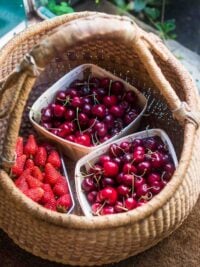
So I bought a nice little sack of them to make Adam's Sour Cherry Frozen Yogurt. If you're lucky enough to live somewhere that sour cherries are available, I suggest you take advantage of them. They don't last very long and should be used within a day of purchase. Most of the time, they'll look kinda funky, somewhat dinged up, and a bit dark, which is normal and since most Americans stopped making fresh sour cherry pie (and the French don't make pies), they can be hard to find.

Many year ago, trying to figure out what to do with the surplus, an enterprising man from a company called American Spoon Foods decided to dry the excess, hence the proliferation of dried sour cherries. I bring hoards back to Paris when I return to the states. We're just beginning to see them here, but they're pricey. My French friends love 'em and I use them for special occasions. If you ever want to bring a gift to a French friend, or to me, I recommend dried sour cherries.

I also like caramel corn (thanks M.N.!)


butterfretoy.jpg

Salted Butter
Holy s@%#t!
Life doesn't get any better than this. Look at all that salt! Every pore of this hunk of butter is oozing salt. To those of us who've been trained to use only unsalted butter, we forget how much better salted butter tastes. A chocolatier friend who just visited New York City to meet with investors who wanted him to open a chocolate shop, came back to Paris and told me he didn't know if he could do it since the butter was so lame.

This is called beurre salé, and whenever I see those big streaks of Breton salt embedded in a mound at a fromagerie, I always end up taking a slab home. The smell is incredible. I can only describe it as similar to the smell that comes from when you melt butter on the stovetop, and there's that lovely sweet-cream, dewy scent.
I can't wait for breakfast tomorrow! In fact, maybe I'll dig in right now.


tapenadeparis.jpg

Tapenade
I used to make my own tapenade, thinking that my own...um, well...something doesn't stink. That my homemade tapenade was always better. But I've been buying mine from a great olive vendor and it's excellent. I eat it simply spread on bread, like a baguette tradition from Eric Kayser, a favorite bakery of mine.


brugnonparis.jpg

Brugnons
Brugnons look like white nectarines, but are considered a cross between a nectarine and a peach, which originated in France. There seems to be a lot of conflicting information about how they were hybridized, but I'll leave that up to other foodies to argue. All I know if that they sure are good. They taste like a full-flavored white nectarine but are more complex and not as sweet, with a rather nectar-like taste.


oliveoilparisallicante.jpg

Arbequina Olive Oil
I'm gonna channel Rachel Ray and say... yum! (sorry). I was visiting one of my favorite huileries in Paris (Allicante at 26 Blvd Beaumarchais), and tasting a few of the new olive oils that she just received. This Arbequina olive oil from Spain was sensational; super-fruity, buttery, aromatic...everything a guy could want in an olive oil.

So yesterday I made a salad of tomatoes, roquette, flat-leaf parsley, and ricotta salatta that I got from the Italian épicerie, which my French friends had never tasted. If you've never had it, it's a dried sheep's-milk cheese similar to feta, but without all the salt and milder. I love it in the summer and crumble it recklessly over pastas and salads. Or bake tiny fingerling-like potatoes in it. I can't wait to play around with my new oil.


haricotbeurre.jpg

Haricot Beurre
Although people seem to associate French with haricots verts, I can't resist their paler, and sometimes more curious, cousins.

Permalink


Green Almonds and Jam
line

June 13, 2006 | Comments (22)

Unless you live in an almond-growing region in the US, I'm sorry to tell you that it's rather unlikely you'll come across green almonds in your market. They don't seem to be as popular in America as they are here in France. And right now in Paris, they're heaped up in big mounds at the outdoor markets.


greenalmondcracked.jpg


In San Francisco, I would find green almonds at Monterey Market in Berkeley, and they were plentiful and abundant in the late spring. What is a green almond? They're unripe almonds, picked before the shell has a chance to harden, and before the almond has had a chance to become crisp and mature (I'm still waiting for both, myself. Does that make me 'green' too?)

To extract the almond meat, take a large knife and embed the blade in the fuzzy green outer husk. Lift the knife and the almond and crack both down with modest force on a cutting board, making sure your fingers are safely out of the way. The Italian woman at my market cracks green almonds using her teeth, a method countless dentists probably don't recommend. Her teeth are not exactly a stellar advertisement for that method either. But do watch your fingers and keep them away from the blade of the knife. You'll find typing very difficult with just 9 fingers.

Once split open, pluck out the little almond in the center with the tip of a knife and peel back the rubbery, shiny-smooth skin, a task which many people find pleasurable. I sprinkle green almonds over summer fresh-fruit compotes that include sliced nectarines, tart apricots, and juicy berries. They also liven up a simple scoop of ice cream as well, but I know many French people that just snack on them as they are, a nibble before dinner with an aperitif accompanied by a glass of icy-cold, fruity rosé.


peachjam.jpg


If a French cooks makes you a gift of a jar of homemade jam, you'll often find a few green almonds tucked in, as I did yesterday when I made a few jars of Peach Jam. If you'd like to taste green almonds, visit your local farmer's market and see if they're available. If not, ask any nuts farmers there to bring you some. Otherwise, you'll have to come to Paris.

But don't wait too long; the season is short and they'll only be around another few weeks.

Permalink


A Salt With A Deadly Weapon
line

May 29, 2006 | Comments (27)

"You're A Winner!" said the email.
"You've won a Katana Series Nakiri knife, from Calphalon."


knives.jpg


While I seem to be the quintessential person who never wins anything (except the fabulous no-expense paid trip to Paris that I'm enjoying), and I don't remember putting my business card in the raffle fishbowl, I was happy to accept. And the knife made a lovely addition to my Katana kollection, joining the smaller one that I already owned. I've been using both, and they're really rather incredible knifes. I love the handles, and the blades are scary-sharp. Which is good.

While we're on the subject of deadly weapons, let's talk about salt. Everyone is scared of salt.
I don't pay much attention to hot-shot chefs, but I'd read that Thomas Keller was once asked what makes a good cook, and he replied, "salt". He summed it all up in one simple word, and that's truly what it all comes down to...and that's why he's a great chef and I bought his French Laundry book even though there's no way in h-e-double-toothpicks I'm ever going to make anything from it. But if he can use it, so can you.
So no matter what you do to food, whether you whip it into a foam, toss it on the grill, spend 17 hours cutting it into little itty-bitty cubes that people wait 6 months to taste, or churn it in your ice cream maker, salting makes all the difference in cooking and baking.

A lot of people are afraid of salt, citing health concerns. Yet experts tell us that if you stay away from pre-packaged convenience foods, the average person only consumes about 1 1/2 teaspoons to salt per day. Although I should talk...I can't have enough of it and sometimes buy it by the kilo. So maybe at this point you'd be wise to just scroll down to the recipe.


fleurdeselenorme.jpg


I mostly sprinkle top-quality salt on top of things, as a finish, where you're going to taste it rather than adding it all at the beginning of the recipe where it can get lost. Whatever salt you use, I recommend coarse salt crystals, since the larger pieces take longer to dissolve, thereby giving your palate more time to experience the complexity of flavors, rather than just dissolving into a salty mouthful like fine salt does. Plus most commercial salt has additives which give the salt a bitter, acrid taste.

If you don't know what fleur de sel is, you should. It's fine crystals of salt that's hand-harvested in marshes in Brittany, off the Atlantic coast of France. Although lots of fleur de sel-style salts have been showing up from Italy, Portugal, and elsewhere, the best fleur de sel is from the Guérande. I use it on everything; its fine, delicate taste is best appreciated when sprinkled over things, as mentioned above, rather than dissolved (like in soups) so it's best to save it for places where it can be appreciated.

Fleur de sel is admittedly pricier than ordinary table salt, but when people balk at paying 5 or 6€ for a container of salt, that will cost them pennies (or centimes per day), they get all freaked-out. (Hey, it's cheaper than gas, and lasts longer.) Just a last-minute flurry over a slab of foie gras or dark chocolate bark will give it a curious, other dimension. When you start using it, you'll be as hooked as I am. You'll never go back to ordinary table salt again.

I only buy fleur de sel harvested in Brittany, and I've recently befriended a récolteur who invited me to his marshes this summer to rake and harvest salt. His salt is incredible; light and flaky, with the fine, delicate taste of the sea. He sells his salt in Paris and I always tell guests to stock up here, since it's one of the true bargains in Paris. A 250 g bag costs just 4€ ($5), which translates to .0136986 cents per day.

fleurdesel.jpg


So I hereby give you permission to spend a little bit more on salt. It will improve your cooking, just like upgrading to a good olive oil will improve your salads (and really, how much do you use?) If you don't believe me, take this simple test: Taste a few grains of fleur de sel. Then taste a few grains of commerically-available fine table salt. I can almost guarantee that you'll never use ordinary table salt again.

This is one of my favorite recipes for using fleur de sel, crispy Salt-Roasted Peanuts. These are terrific with cocktails or aperitifs, but I also like to enrobe them in bittersweet chocolate and if you're making Hot Fudge Sundaes, they dynamite sprinkled over the top.
They also make a great snack when you're updating your blog.


peanutsblog.jpg


Salt-Roasted Peanuts

2 cups (300 g) raw peanuts
1/4 cup (80 g) light corn syrup
2 tablespoons (30 g) light brown sugar or cassonade
1 1/2 teaspoons fleur de sel

Preheat the oven to 350 degrees F (175 C).

Lightly oil a baking sheet or line it with a silicone baking mat.

In a bowl, mix togther the peanuts, corn syrup, and light brown sugar, until the peanuts are well-coated.
Sprinkle the salt over the peanuts and stir just a few times, but not enough to dissolve the salt.

Spread the peanuts evenly on the baking sheet and bake for 25-30 minutes, stirring three times during baking, until the nuts are deep-golden brown and glazed.

Cool completely, then store in an airtight container immediately, to preserve their crispness.

Store in an airtight container for up to 1 week. Makes 2 cups.


FAQ's

I can't find raw peanuts.

You can use roasted, unsalted peanuts, and reduce the baking time to 15 minutes. I buy raw peanuts in Asian markets.

Can I use other nuts?

I never have, but let me know how they turn out if you do.

What if I can't get light corn syrup where I live?

Use glucose, available at professional pastry supply shops.

Can I use honey or golden syrup?

Yes, but they'll be stickier and not as crisp.

Can I use another salt?

You can use any coarse sea salt, but choose one that's light-tasting. I like Maldon salt from England very much, as well.


Permalink


Paris Organics
line

May 22, 2006 | Comments (34)

When I take Americans to a market here in Paris, a common query is, "What do they think about organics in France?"

The two markets I shop at regularly, the Richard Lenoir Market and the Marche d'Aligre, don't have much in the way of anything organic. There is one vendor who regularly shows up at the Richard Lenoir market with a gorgeous array of fruits and vegetables. The downside is the price is much, much higher than conventional produce, often 3 to 6 times higher. Still, I always stop to take a look and admire what she has and since it can be difficult to find unusual vegetables here, such as parsnips and multicolored Swiss chard, I sometimes buy from her, but wish that I wasn't so frugal.
*sigh*, I am my mother's son.


bioasparagus.jpg

Asperge Sauvage: Delicate Wild Asparagus


I've spoken to a several French chefs about organics, inquiring why it's not really a movement here in France like it is in the United States.

Surprisingly, every response is similar; "Why are Americans so obsessed with organics? We use very little pesticides on the produce in France."

While I don't have exact facts and figures, from the looks of fruits and vegetables, I would take an educated guess that the French probably use as much, or as few, pesticides as any other industrialized nation. Is the movement really a major cultural change in the United States? Are Americans finally taking a much closer look at the foods we eat? I would definitely say "yes", as evidenced by the popularity of natural-foods megastores, artisan chocolates, and the like, but that doesn't seem to be happening here. Maybe it's because the French never strayed that much from their agricultural roots to begin with. Farmhouse cheeses and good breads are easily available, even in supermarkets, and wine is chosen based on the region, not by the grape variety (which is changing, in a rare nod to globalization.)

Most French chefs seem primarily interested in the terroir, that vaguely-translatable term that means that the product is a sum of the elements from where it's grown; the soil, the climate, the cultivation techniques...the 'territory' of origin, gives food its certain "Je ne sais quoi." That's why the sweet corn in New England will always taste different than the corn in California, even if it's the same variety. Or brownies in America taste better than the ones in Paris (I think I'm the first person to ascribe terroir to brownies). And why baguettes taste much more authentic in Paris than the ones in America.


biochips.jpg

Going bio in Paris? No need to deprive yourself of les chips.


I seem to be one of those people who goes organic when it's truly better tasting, when buying or eating American beef, or isn't priced stratospherically high. The organic carrot juice at Trader Joe's that's 50 cents more seems to be a price difference I can live with. But there's no Trader Joe's in Paris, yet, and I don't forsee their arrival anytime soon. And I try to live responsibly; I bring my own basket to the market, I schlep my lettuce-washing water to my plants after washing salad greens, I don't drive in Paris (which is why I'm still alive), and I've never, ever thrown away a twist-tie in my life, and guard my stash of them with my life (...thanks for that one too, mom.)

But then I worry if washing my plastic bags for re-use wastes more energy in water usage than simply tossing them out. Is sporting a wicker basket at the market mark me as a tourist? And my first (and last) experience buying 'green' toilet paper made from recycled wood pulp was, um, rather unpleasant.

I spent over 13 years working at Chez Panisse, where Alice Waters insisted that we forage as much of our ingredients as possible from organic producers and sources. At first we had some difficulties, but soon we found we were able to get most of what we wanted organically and developed wonderful relationships with farmers. Since we paid more, they'd spend more time growing what we wanted. Alice didn't mind that food costs were very high, spending $5 per pound for organic butter, and the like. She encouraged us to be leaders in a global movement, which was possible due to the high profile and popularity of Chez Panisse. Being in sympathetic Berkeley perhaps didn't hurt either.


biobreads.jpg

Organic Breads


But it seems now it's fashionable to complain about organics and there's lot of articles I've read lately that attack organics. I wonder about the backlash that's happening. Yes, the organic movement is criticized for being hi-jacked by big business. But don't we want Frosted Flakes to go organic? (Not that I eat Frosted Flakes...) And don't we want Coke without all the preservatives? (Not that I drink Coke either...) But isn't it better than all those chemical being dumped into our eco-system?

The same people who joke about the high price of shopping at "Whole Paycheck" don't seem to remember that a little over a decade ago, finding anything like radicchio, goat cheese, espresso, blood oranges, and hearth-baked breads was practically unheard of. And they also don't seem to mind spending a fortune on cars, gym memberships, and watery soy lattes. Just a few years back, if you wanted anything organic or 'natural', you had to brave getting trampled by Birkenstocks or getting strangled by someone's dashiki drawstrings while sorting through crinkly apples rotting in wooden bins at the health food store.

There's been lots of press about the downside of organic. We've all been saying how we wanted better foods available to all (Safeway has introduced an organic line) and how it's out-of-reach for the less well-off (Wal-Mart is soon to introduce several lines of organic goods.) But the scare to small farmers and growers is that the large corporations will flex their muscles to force down prices, and the little guys will go out of business, who can't compete with corporate organic agri-giants. That's why I'm a 'local trumps organic' kinda mec. I feel it's far more important to keep local businesses and neighbors afloat. Still, I can't help but give credit to large corporations for responding to the public and expanding the availability of organics to the masses.


green&blacks.jpg

Green & Black's organic chocolate...coming soon to a superstore near you.


We have two thriving organic markets here in Paris and even though they're across town, I'm trying to visit them more often. One is the Batignolles market in the 17th, and the other at Boulevard Raspail, which draws a bit more of an upscale crowd, including an occasional Brangelina sighting. On Saturday, we braved the intense rainstorm, which alternated with moments of brilliant sunshine, and sloshed around the Marché Biologique Batignolles.


biovegetables.jpg

Organic vegetables at the Batignolles market.


There were beautiful vegetables everywhere, that the crowd seemed to be buying. Yes, prices were higher, but to me, they seemed proportional to the exceptional quality of most of what was available: rounds of organic camemberts and wheels of brie de meaux, mounds of golden-yellow butter riddled with flecks of sea salt from Brittany, and meaty pâtes and pintades, of Guinea fowl, raised in the open-air of the French countryside.

One of the most curious things we saw people frying up the globally-loathed veggie-and-lentil patties, which resembled what people used to think of as 'health food' back in the days of yore....although I'm probably guilty of frying up perhaps a few of them a while back as well. Still, to do it publicly should be a crime. Especially here in Paris.

There's a certain amount of potions, creams, and tinctures for what ails you, as well as lots of beautiful, dense, grainy breads. One vendor had wood-oven baked breads made with everything from kamut to buckwheat, quinoa to cornmeal, and dark Russian rye that was as black as charcoal, which I would have bought except I had three loaves of bread sitting in my kitchen. My 'French Bread Crisis', as I call it...how can I possibly eat all the bread I seem to collect?

So there is a thriving organic movement here, although I got the feeling that most people were like me; shopping there because of the exceptional quality of the food. Now that the weather's nicer (mostly), I'm going to venture across town more often to the Batignolles market on Saturdays, to support the local producteurs.

Perhaps if I support organic cheesemakers and boulangers, I won't feel quite so guilty buying non-recycled toilet paper.

Now if I could only find some that was locally-produced, then I'd be in business.


Marché Biologique Batignolles
Every Saturday morning
Métro: Rome

Marché Biologique Raspail
Every Sunday morning
Métro: Sèvres-Babylon

Permalink


May Day Market and Strawberry Frozen Yogurt Recipe
line

April 30, 2006 | Comments (35)

Spring is always an exciting time at the outdoor markets no matter where you live, but here in Paris, there seems to be a collective sigh of relief that we've emerged victorious from a dreary winter. Monday is May 1st, a national holiday here in France. So todays market was a mob scene since most things will be closed tomorrow and we're all stocking up for the holiday weekend. But in spite of the crowds, and having my feet run over too many times by too many dames with their wheeled chariots (the SUV's of Paris), I managed to make it home with most of my toes intact...and made a batch of Strawberry Frozen Yogurt.


tomatoessavoie.jpg


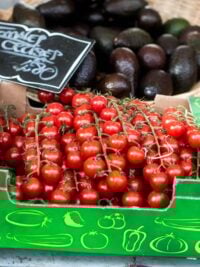
I saw these tomatoes and came to a grinding halt, as did the woman next to me (so we had a petit accident), but we were both transfixed on these tomatoes. And I'm sure you can see why. We poked and sniffed, discussing the merits of them and she walked away with a nice sack of them. I was lugging a few kilos of rhubarb and couldn't manage the crowds carrying a sack of fragile tomatoes since I seem to have rather bad luck carrying anything fragile amongst Paris.


nefle.jpg


These are called Nèfles in French. In English, they're Loquats. When I worked at Chez Panisse, neighbors would bring us cases of them thinking they were doing us a big favor, but we never could figure out what to do with them except pass them out amongst our coworkers in the kitchen to snack on. But I was never a big fan. They have little flesh and a big pit, and they don't have the unctuousness of fresh apricots nor much sweetness. Still, I think they're beautiful and if someone has any ideas for how to use them, let me know.


sponges.jpg


Some schoolchildren were selling sea sponges to raise money for something. Did you know that in France, kids go to school 6 days a week? They having Wednesday afternoon off, but have to attend classes on Saturdays. That like totally sucks for kids. I should have bought a sponge.


buyingwine.jpg


It's vital to make sure you have wine, since May 1st is a national holiday and everything is closed for the long weekend. Of course, there will be the prerequisite manifestation, or demonstration, for workers rights. Since I live in the Bastille, I'm at ground-zero for all strikes and demonstrations. One would think they would be more effective shouting (and drinking beer) in the streets of the more bourgeois neighborhoods, but I once tried to translate "Preaching To The Converted", but it just got blank stares back.
I guess that hasn't crossed anyone's mind but I think it would be nice if maybe they'd 'spread the wealth' and head over to the 7th or 16th arrondisements once in a while.

And what I also don't understand is if people are taking to the streets in fraternité with their co-workers, why do they plaster paper stickers promoting their causes on store windows, mail boxes, métro and bus stations, and any other surface they can, when they know that their compatriots are going to spend the next few days laboring at scraping them off?
(Not to mention picking up all the empty beer cans.)


strawberries4-yogurt.jpg


At the markets right now there are piles and mounds of strawberries. The sweet, fruity scent pervades the air as you get closer to the stands. I always come home with a kilo (2 pounds), which costs about 3 euros (about $3.50) and I eat as many as I can during their season. Some people swoon for the pale gariguette berries, which are slender and pointed, although I've tried them several times and don't find them much better than the everyday Chandler variety that's normally available.

While at the market this week, being such a good customer, I got a deal on a large flat of strawberries so after much jam-making, I decided to take my ice cream maker out for a spin and whip up a batch of Strawberry Frozen Yogurt.


scoopyogurt.jpg


Unlike the crap at the mall, real frozen yogurt is made from plain, whole-milk yogurt, fresh fruits, and some sweetener. Although some people like to drain their yogurt first for a richer end-result, I prefer the lighter style of frozen yogurt. You can use Greek-style yogurt, which is three times richer than whole milk yogurt. Slicing the berries and tossing them in sugar makes the strawberries bright red in color and can make ho-hum berries quite delicious.


dasher.jpg


Strawberry Frozen Yogurt
About 1 quart (1 liter)

French yogurt is astoundingly good and I suggest you use a good-quality, locally-produced yogurt for similar results.

1 pound (450 g) strawberries, rinsed and hulled
2/3 cup (130 g) sugar
optional: 2 teaspoons vodka or kirsch
1 cup (240 g) plain, whole milk yogurt
1 teaspoon fresh lemon juice

Slice the strawberries into small pieces. Toss in a bowl with the sugar and vodka or kirsch (if using) until the sugar begins to dissolve. Cover with plastic wrap and let stand at room temperature for 2 hours, stirring every so often.

Transfer the strawberries and their juice to a blender or food processor. Add the yogurt and fresh lemon juice. Pulse the machine until the mixture is almost smooth. If you wish, press mixture through a mesh strainer to remove any seeds.

Chill for 1 hour, then freeze in your ice cream maker according to the manufacturer's instructions.

Note: My newest toy around here is my Cuisinart ICE 50 Ice Cream Maker. It has built-in refrigeration so you just switch it on and pour in your mixture, so you can have freshly-made ice cream or sorbet just about anytime you want. It's priced far less than other comparable units and I've been using mine frequently for the past few months and truly love it. It's a bit of an investment, but mine's been terrific.
A more economical model, which produces great ice cream as well, is the Cuisinart Ice Cream and Sorbet Maker, which requires pre-freezing.

Permalink


Lucques Olives
line

April 28, 2006 | Comments (13)

While at the market yesterday looking for things to snitch, I bought a sack of my favorite olives, les Lucques.


lucques.jpg


Lucques olives are originally from Italy, but are now most closely associated with France and they're unlike any other olive you're likely to sample, free or otherwise. Grown in the Hérault region in the south of France, the Languedoc, they're harvested in the fall and can be difficult to find depending on the time of the year. These olives are meaty and sweet, not soft, salty, or mushy like some olives can be. The green flesh is firm and bright, and the olives themselves must be kept submerged in their light brine since they discolor very easily.

While they are available in jars, I am lucky to have a prime source for these green beauties just steps away from where I live. And they are certainly one of the best things you can possibly eat. The first time you try one, you're likely to be very surprised to find they're unlike any other olives you're used to eating.

These fine olives are meant to be eaten just as they are, perhaps accompanied by thin slices of jambon and a bowl of crisp radishes with a glass of rosés as an aperitif. I buy small sacks of Lucques olives at the market weekly, since if I keep too many around, I tend to eat them all at once; they're that good.


Jars of Lucques olives can be ordered in the US here and here's an excellent guide to olives.

Permalink


Saucisse/Saucisson
line

March 5, 2006 | Comments (20)

An extraordinary tarte Tatin, the one I consider the best in Paris...


tartetatinberthillonparis.jpg


A clever ruse, and now that I've gotten your attention with something sweet and luscious, I decided I wanted to show how I got to the bottom of something that's been bugging me all week: the difference between saucisse and saucisson.

So this morning I braved the biting cold and went to my local market with a real Frenchman, aka Romain, hoping to have him explain the difference between the two. And being 100% Parisian, I learned to set a few hours aside if I want something explained.

So bundled up in our wool coats, sweaters, long underwear (me), thermal shirts, gloves (him), a hat (him: I look funny in hats), mitten (me: my hands get cold, I don't care how funny I look), and scarves (both), we wandered the market, first stopping at the stall with my favorite women from the Savoie, the mountainous region encompassing France and Switzerland, home to many of the finest sausages (and Comté cheese as well.) As we perused the piles of dried and fresh sausages, his explanation was this; "Saucisse is any little sausage, fresh or dried. Saucisse seche is the term used when it's dried. Saucisson is any sausage that's dried, but big."

It all seemed a bit confusing, so I decided to ask a Parisian foodie Clotilde what was correct, someone who understands French ingredients but also has a fine understanding of American food as well as an excellent grasp of the English language.

Ok, so I didn't actually ask her.
But instead checked out her useful Bloxicon of French-to-English food translations.
Her definition:


  • Saucisson: dry sausage.


So I had confirmation that saucisson was dry sausage.
But what about saucisse seche?
What's the dif?

Still grasping for knowledge (and a glass of Sancerre, which will come later) I checked my trusty Le Robert et Collins dictionnaire. You would think a volume that boasts 120,000 translations would have a bit more information about one of the most important and meatiest items in French cuisine.
Realizing perhaps that they're treading on extremely thin ice, they offer these rather sketchy and non-committal responses:


  • Saucisson: (slicing) sausage
  • Saucisse: sausage


Patricia Wells, in The Food Lover's Guide to Paris gets a bit more in-depth, although there's a touch of confusion:


  • Saucisson: Most often a large air-dried cured sausage, such as salami, eaten sliced as a cold cut; when fresh, usually called saucisson chaud
  • Saucisse: Small fresh sausage


Wait a minute. When 'fresh' it's called saucisson chaud (presumably when cooked), and saucisse if it's small?
I know the truth is out there, but I needed to find it.


So I turned to a little volume that claims to be "An exhaustive compilation of terms from French gastronomy...", The A-Z of French Food. I picked up a copy of this book years ago when I was at cooking school at Ecole Lenôtre and struggling with the subtle difference between Suprême de poulet and blanc de poulet and poitrine de poulet...
Geez, how many words for chicken breast does one language need?

Very informative, here's what the The A-Z of French Food had to say:


  • Saucisson: A large variety of sausage preparations of minced or chopped meats and organ meats, which are seasoned, cooked, or dried (often called saucisson sec. Saucisson is eaten sliced , and usually cold, as it is bought.
  • Saucisse: The generic term for sausage (cooked, uncooked, or cured) which is served hot or re-heated, as opposed to saucisson which is generally eaten cold in slices.


So there you have it.
I hope that helps you next time you're at the market in France and it's your turn to order and the pressure's on and everyone's waiting for you to decide and madame behind you is not-so-gently pressing you forward and all you want to do is turn around and smack her upside the head which you can't do (but boy, would that make you feel better.)


sausagesparis.jpg


So now that we all completely and unequivocally understood the difference between the two (right?), I decided to reward myself with a nice Sunday lunch of chipolatas, highly-seasoned, meaty, and slender sausages, along with a few dozen fresh oysters.
(To be honest, by this point I was thoroughly confused and a bit terrified, so I let him do the ordering. But I did offer to stand guard and smack-down any ofles dames that tried to take cuts.)


openingoystersparis.jpg


Our next stop was for the oysters, and since we needed help making up our minds, the vendeuse was more than happy to pry open a few and let us pop them in our mouths. After much discussion (which always happens in France when there's food involved) we chose 2 dozen No. 2 Huîtres de Normandie with the fresh, briny taste of the sea.


huitresparis.jpg


Once home, Romain expertly shucked the oysters while the chipolatas sizzled and the bottle of Sancerre, also chosen at the market (after the obligatory tasting), chilled quickly in the freezer (although with the freezing temperatures in Paris, the rooftop outside would have been faster.) The crusty baguette de pavot was sliced and each piece smeared with salted butter then I mixed up a simple sauce mignonette of white wine vinegar, cracked pepper, and lots of finely-chopped shallots.

And there we had it. A rather excellent Sunday lunch, my only consolation for another unsuccessful attempt at comprehending the nuances of the French language.


sausagesandoystersparis.jpg


And the tarte Tatin?
Dessert from Berthillon, who I think makes the best tarte Tatin in Paris. An enormous wedge of caramelized apples resting on crisp pastry, served with a big, melting scoop of their amazing caramel ice cream alongside.

Now that's something I have no trouble understanding...


Berthillon
31, rue de St. Louis-en-I'le
Tel: 01 43 54 31 61

Permalink


The Sunday Market
line

February 26, 2006 | Comments (21)

I'm very lucky that I live just one block from the biggest outdoor market in Paris, the Richard Lenoir Market. Beginning at the Place de la Bastille and radiating northward, Sunday is a particularly lively day, since almost all other shops are closed in Paris on Sunday. I guess the alternative, going to church, is a less-popular option here, even in this predominantly Catholic country. If God is everywhere, I suppose, he'll find the heathen at the market, lugging around our loaves and fishes.

You can find just about anything at the Richard Lenoir market. (In fact, I found packaging tape this morning. I did look for thermometer batteries, but no luck.) I always set out with an empty basket with the intention of buying a few vegetables and maybe a slab of fish. But by the time I'm done, I've almost dislocated my shoulder hauling my market basket home.

It's obligatory for me, and just about everyone else shopping the market, to stop at the stand of Jackie Lorenzo, one of the best fishmongers in Paris. His stand is always a buzz of activity and you need to push your way to the front to get help. I've nudged little old ladies out of the way in order to get served (and they're not so kindly here, and are far tougher than they look; I've come home with bruises!)

Being the resourceful American that has to use his God-given talents to good use to get what he wants around this city, I've been known to ply the young men and women who work for M. Lorenzo with chocolate chip cookies on select occassions in the past, so l'americain sometimes gets priority placement in line. Consider it a job perk. The young men and women who work there are always friendly and willing to give advice about preparation too, as is the person behind you (...unless it's madame that you shoved out of the way. Then it's best to slide away without making eye contact.)


scallopsparis.jpg

It's scallop season, or as they're called, les coquilles St. Jacques. At the stand today they were piled high, almost up to the top of my head! They're normally sold in their shells with their orange 'foot' attached in France. and I bought four live 'uns, which cost around 4 euros. For lunch, I pried them open with my oyster knife, removed all the gooey stuff, and sautéed them briefly with garlic and butter.


lotte.jpg

Monkfish is very popular in France, often referred to in America as "Poor Man's Lobster". It's common for fish merchants in France to leave the heads on fish to prove they're fresh (the eyes should always be clear). But monkfish are so ugly, they lop off the tête. I've never bought one. They scare me, even without their heads.


saucisse.jpg

I don't know if anyone purposely displays their dry sausages like a cobra, but that's what they look like to me. One confusing thing for us non-native French speakers is the difference is the words for saucisson, which is a dry-cured sausage, and saucisse, the fresh sausage. Invariably I screw it up and they give me funny looks (another thing I've gotten used to around here.)


slicesofmeat.jpg

Since sunday is so busy, often the butchers will just put out some slices of...ok, quick!...it is saucisse or saucisson?...
They make a nice snack while roving the market too.


bloodorangesparis.jpg

When I began cooking at Chez Panisse in the early 80's, we would buy imported blood oranges from Italy and diners invariably would ask, "How do you get the oranges that color?". If I was in a particular mood, I'd make up a good story. People would also ask if the goat cheese was tofu. Nowadays, I presume, goat cheese is more common than tofu in America. Even (or especially) in Berkeley.


beefstew.jpg

If you don't feel like cooking, you can buy long-simmered boeuf Bourguignon already made. Since the weather's been especially cold here in Paris, you can see it's rather popular.


cabbagefarci.jpg

Another take-out item, stuffed cabbage. I see bacon peeking out...


leeks.jpg

Leeks are very popular in France and almost everyone's shopping basket has a plume of green leaves poking out. Leeks are gets par-boiled, cooled to room temperature, then doused in vinaigrette. I also crumble hard-cooked eggs over the top, or mash some good anchovies into the dressing.


terrinegascogne.jpg

I know this isn't good for me, but I can't resist bringing home a perhaps not-too-healthy slab of terrine Gascogne. The butchers grind together long-simmered pork confit with savory bits of duck liver and duck confit, packed in it's own fat. It's one of the best things I've ever tasted and they always sell me too much. When they hover the knife over the terrine, so I can tell them where to slice, they invariably move the knife in the opposite direction that I tell them. I am sure they do it on purpose but when I get home and take my first bite from the rich slab, I know it will be gone within a few days so I'm happy to have it all.


Richard Lenoir Market
Begins at the Place de la Bastille
Mètro: Bastille or Bréguet Sabin
Market is Thursday and Sunday, between (approximately) 9am to 1pm

Permalink


Passion Fruit
line

February 10, 2006 | Comments (13)

Have you ever tasted passion fruit?


3nicepassionfruitparis.jpg


If not, I suggest you do as soon as possible since now is their primary season in many parts of the world. If it's your first taste of this amazing fruit, you're in for a real treat. Slice one in half and spoon the seeds and pulp right into your mouth. That explosion of flavor is indescribable; a melange of every other tropical flavor that exists, all in one tidy purple orb.

There's many different kinds of passion fruit. If you live in Hawaii, you'll find brilliant-yellow lilikoi which grow prolifically everywhere, and in the southern hemisphere, there's maricuja, which are large, russet-colored passion fruits. But most of the time you see Passiflora edulis, dark violet fruits, and the best tasting of them all. When sliced open, they reveal crunchy seeds and thick, luscious, fragrant pulp. But just in case you think this fruit was given the name 'passion' because of the lovely flavor, the name actually refers to the flower of the vine, which is said to tell the story of the Passion Play with it's multiple tendrils and stamens.


passionfruitparis.jpg

Spoon passion fruit over icy-cold slices of blood oranges for an instant, and beautiful, dessert


When buying passion fruit, unless you're lucky enough to live in a climate where they're abundant, they're likely to be pricey (depending on the season.) Fortunately a little goes a long way: the pulp and seeds of one or two fruits will assert it's powerful flavor into a cake, sorbet, or tropical beverage (with a shot or two of dark rum!)
Buy fruits when they're inexpensive and freeze the pulp and seeds together. It freezes beautifully.

Don't be put off by punky-looking fruits. Lots of wrinkles means they're very ripe and at their peak. (I've found perfectly wonderful passion fruits in produce bargain bins, since people pass them over.) Signs of mold, however, usually means they're too far gone and I'd take a pass on 'em too.

If you're making a beverage and wish to use just the pulp, slice your passion fruits in half and spoon the pulp into a non-reactive strainer set over a bowl. Use a flexible rubber spatula to force the pulp through the strainer, then discard the seeds. With a little searching, you can find pure frozen passion fruit pulp if you search though Asian markets or places that specialize in tropical products.


Tropical Fruit Soup with Passion Fruit
4 servings

Use whatever combination of tropical fruits you like or follow my suggestions. This is a fun chance to visit your nearest ethnic market and experiment with any unusual fruit you might find there. Don't be put off if the soup base tastes strangely spicy by itself. Combined with the tropical fruits, the flavors work. Chill the serving bowls in advance so everything stays refreshingly icy-cold.

The soup base:
1 3/4 cups water
1/2 cup sugar
1 small cinnamon stick
1 star anise
4 whole cloves
4 black peppercorns
1/4 vanilla bean, split lengthwise
Zest of 1 orange
1 piece lemongrass, 2 inches long, sliced (use the white part from the root end)
2 thin slices fresh ginger
2 teaspoons dark rum

The assembly:
6 kumquats, sliced and seeded
1 kiwi, peeled and diced
1 basket strawberries, sliced
2 blood oranges, peeled and sectioned
1 mango, peeled and diced
1/4 pineapple, diced
1 banana
2 passion fruit, pulp and seeds
Sugar, if necessary
Fresh mint to garnish

1. To make the soup base, bring the water and sugar to a boil. Coarsely crush the cinnamon, star anise, cloves, and black peppercorns in a mortar, or put them in a plastic bag and crush them with a rolling pin or a hammer. Add the spices to the water then add the vanilla bean, orange zest, lemongrass, and ginger. Cover the pan, and steep for 1 hour.
2. Strain the soup base and discard the flavorings. Add the rum and chill thoroughly.
3. Toss all the prepared fruits together in a bowl. Taste for sweetness, and add a sprinkling of sugar if they're too tart.
4. Divide the fruits into four wide soup bowls and ladle the chilled soup base over them.
5. Tear some mint leaves into tiny pieces and scatter them over the soup. Place a scoop of a favorite tropical fruit sherbet in the center.

Permalink


Roquefort
line

February 1, 2006 | Comments (22)

Cheese experts (and me) agree that Roquefort is one of the top, all-time-greatest cheeses in the world.


slabroquefort.jpg


All Roquefort is produced in the southwestern region of France and is designated as AOC, the first product ever to do so in 1925, and is a designation meant to denote quality and provenance from a certain region made in a certain manner.

Roquefort is a raw-milk cheese, aged between 3 to 9 months in caves. It gets its unique flavor and mold as a result of some very old rye bread; jumbo-sized loaves are baked, then left to sit for two months, during which time they become encrusted with mold. The mold is scraped, then introduced into the caves, where the cheese becomes encrusted by the greenish powder, then inoculated with the spores (called penicillium roqueforti) by resting the wheels of cheese on spikes. That's why often you see 'lines' of mold in Roquefort, as in many other bleu cheeses. But unlike other bleu cheeses, Roquefort has a very special, sweet and tangy flavor that lingers and excites.
(And yes, I'm excited by cheese...)

Roquefort goes very well with winter foods, such as pears, dates, oranges, toasted nuts like walnuts and pecans, sweet Sauternes, or with bitter seasonal greens like frisée, radicchio, or escarole. A simple winter salad can be made with chunks of Roquefort, slices of ripe Comice pears, leaves of Belgian endive, and a drizzle of good walnut oil.
And why not add a handful of chopped Italian parsley while you're at it?

But sometimes Roquefort's best enjoyed just smeared on a piece of hearty levain bread...and that's lunch.


roquefortbreadparis.jpg


When you buy Roquefort, it should be moist and creamy without any red mold and the cut surface should glisten with milky freshness. It usually comes with a piece of foil around its exterior, and whether or not to eat the rind underneath is entirely up to you (don't eat the foil...especially if you have lots of dental fillings.) If the rind looks dark and funky, skip it. It's probably going to be too pungent and dank-tasting. But most of the time it's fine to eat and as delicious as the rest of the wedge.

Here in France, there's almost too many brands to choose from when you visit your fromager. There's the omnipresent Société (who produce more than half of all Roquefort made) and my favorite, Le Papillon. But I don't think I've ever had a Roquefort that was not wonderful, so it's hard to go wrong when buying from a reputable cheese vendor.

Here's a recipe of mine that will surprise you: Roquefort and Honey Ice Cream.
Try roasting some pear slices in the oven with some strong-flavored honey and spices and maybe a strip of lemon peel. Serves warm, with a scoop of this ice cream melting alongside. I also like this with a spoonful of dark honey on top, served with a sweet dessert wine, like Barzac or Sauternes.


Roquefort and Honey Ice Cream

6 tablespoons honey
4 ounces (110 gr) Roquefort
1 cup (250 ml) heavy cream
1 cup (250 ml) milk
4 large egg yolks
a few turns freshly-ground black pepper

1. In a small saucepan warm the honey, then set aside.
2. Crumble the Roquefort into a large bowl. Set a mesh strainer over the top.
3. In a medium saucepan, warm the milk.
4. In a separate bowl, whisk together the egg yolks. Slowly pour the warm milk into the egg yolks, whisking constantly.
5. Scrape the warmed egg yolks back into the saucepan.
6. Over medium heat, stir the mixture constantly with a wooden spoon or heatproof spatula, scraping the bottom as you stir, until the mixture thickens and coats the spoon.
7. Pour the custard through the strainer and stir it into the cheese. Stir until most of the cheese is melted (some small bits are fine, and rather nice in the finished ice cream.) Stir in the cream and the honey, and add a few turns of black pepper.
8. Chill custard thoroughly, then freeze in your ice cream maker according to the manufacturer's instructions.

Permalink


Winter Fruits
line

January 23, 2006 | Comments (16)

comicepears.jpg


Pears

Good pears are in danger of disappearing. The best-tasting varieties (Comice, Bartlett, and French Butter) become easily bruised as they ripen, so large stores are reluctant to carry them. So what can you do? Buy them when you see them. Don't be afraid to purchase rock-hard pears of these varieties: unlike most other fruits, pears don't ripen well on the tree and should be ripened at home for the most succulent, juicy flavor. I carefully cradle my pears when I carry them home, then let them rest on the countertop, standing upright on a kitchen towel, until slightly soft to the touch.

Bartlett pears are amazingly aromatic, and in Normandy, folks who distill Calvados add a few along with the apples (about 10%) to heighten the aroma. Pear eau-de-vie, or Pear William (sometimes recognized as the clear liquor with the whole pear in the bottle) is a distillation of Bartlett pears. It takes about 60 pounds of pears to make a small, precious bottle of Pear William. The steam of the cooking pears is captured and that little trickle of liquid is bottled as eau-de-vie.
So stop complaining about the price.

Most pears can also be checked for ripeness by sniffing the stem end. I bought some perfectly-ripe Comice pears last week that were as perfumed as the most divine roses (which are relatives of apples and pears.) Each time I passed them on my countertop, I couldn't resist picking one up for a sniff.

For cooking and poaching, Bosc and Winter Nellis pears are the best choice as they hold their shape once cooked. These varieties have little fragrance. Although other cooks use them, I've never tasted an Anjou pear that was any good.

(And don't curse those little plastic labels that are stuck on pears. Without those, many of the supermarkets wouldn't sell the lesser-known varieties of pears, since it's difficult for the cashiers to know which are which. )


driedapricots.jpg


Dried Apricots

When I visit the United States, I always return loaded down with at least three or four pounds of California dried apricots (right). I'm not xenophobic, but the Turkish apricots (left) are tasteless, bland, and sugary-sweet. If you come visit me, that's what I ask my friends to pack for me.

I grew up snacking on California dried apricots and I used to call them 'dried monkey ears'. Their puckery tang makes them ideal when simmered in a light sugar syrup until soft (1 part sugar or honey to 4 parts water, perhaps with a stick of cinnamon or vanilla bean) and served alongside a savory meat or chicken stew. I love them in desserts and I'll often make a simple (and healthy) soufflé of dried apricots plumped in white wine. Once cooked, I puree them, fold in some whipped egg whites and sugar, and minutes later I pull from the oven a tray of apricot soufflés.

Although the Turkish (and Chinese) varieties are less than half the price, they're no bargain. If you substitute them in a recipe that calls for dried apricots, you'll be sadly disappointed. The California growers are having a hard time competing, since so many people seem to shop solely on price, not quality.
So have one less Vente Mocchachino a year and splurge on good-tasting dried fruit. Please.


limes.jpg


Limes

The most widely available lime in the US is the Persian lime. Since it's seedless, it's the one most commercial growers cultivate. Often found solidly green and bullet-hard (they're picked underripe and gassed to preserve their unripe green color), they yield little juice.

As with all citrus, select limes that feel heavy for their size. If you live in France, where they vendors don't like it when you handle the produce, you risk getting scolded with, "Monseur! Ne touchez pas!" (and in the old days, they would add a petit slap if you were in striking distance). So to avoid the humiliation, I scout around ethnic markets and root around the citrus bins, elbowing aside the Arabic and Chinese women, touching every fruit, and tossing back those that don't feel hefty and full of juice.

If you pick one up and it feels light, that's an indication there's little juice inside. Look for limes that are yellow-golden with a greenish hue. As mentioned, ethnic markets seem to offer golden limes that are valued for their taste, not their looks. And don't be put of by appearances: older, punky-looking citrus often tastes best since it's spent the maximum time ripening on the tree rather than sitting in cold storage.

To get the most juice from limes, make sure your limes are at room temperature. Roll them firmly on the countertop with your hand to rupture the juice sacs, then squeeze. While some cookbook authors advise popping them in the microwave for a few seconds, I'd feel funny about heating fresh limes. It jus doesn't seem right.


pineapple.jpg


Pineapples

While everyone loves pineapple, no one seems to remember the last time they actually bought one. They seem to make an appearance only for special occasions. So next time you're at the market, why not pick one up? Personally, it makes me feel better to have something around the house that's a reminder of the tropics during the long, grey days of winter. (Especially if I pick up a bottle of dark rum at the same time!)

I buy pineapples often during the winter. I like to cut them up and keep pieces in the refrigerator for snacking or to add to a fruit salad with grapes and tangerines. And blended with some dark rum and lime juice, served in a nice glass with some chips and guacamole, I don't know of a better way to beat the winter blahs. (Luckily, for some reason, they have the best tortilla chips in France. Avocados are plentiful as well.)

The most common varieties of pineapple are the Cayenne and Esmerelda, although you'll rarely find pineapples listed by variety. Harold McGee suggests buying pineapples grown as close to the equator as possible, although I've had exceptional pineapples from Hawaii, the Ivory Coast of Africa, and Costa Rica.

Contrary to popular belief, there's nothing that plucking out the center leaf of a pineapple will tell you about ripeness. Pineapples don't ripen after picking so buy one labeled Jet-Fresh, or with a ticket stating that it's been picked ripe, if possible. Take a sniff: a good pineapple will reveal if it's ripe by a tropical aroma at the stem end. Lots of yellow on the skin is another indication of ripeness. Avoid fruits with soft spots and mold.

Permalink


Les Fromages du Jour
line

January 6, 2006 | Comments (13)

As you may know, I've been nominated for the Best City Blog. Someone wrote that I wasn't really writing enough about Paris to be qualified, so I thought I'd better get on le stick about that!

The pressure! La pression!
Hmm, what's very French and very Parisian that I can write about?

Um...How about my lunch...?


3cheeseplateparis.jpg


Yes! That's a few slices of my pain aux ceriales from Le Grenier à Pain paired with some delightful cheeses that I discovered when visiting one of my absolute favorite fromagers here in Paris this morning.

Disclaimer:
I confess to a secret and unfulfilled ambition.

Except for working outside in the icy-cold winter and freezing my bourse off, getting up at a godawful hour, and lifting heavy wheels of cheese, my fantasy job is to work as a fromager. Being surrounded by big wheels of cheese and small pyramids of goat cheese, the smell of all those gooey, runny, and nutty cheeses...it all makes me delirious with pleasure
Ok, I guess I could deal with lifting the wheels of cheese, but getting up at 4am?
Now that's another story...

As a fromager, I would make recommendations to les clients. "Qu'est-ce que vous desirez, madame?", I would ask, ready to council the customer. (Using my perfect French, of course...this is my fantasy, remember?) I'd slice and wrap a fine selection of cheeses to serve to her her family after a well-prepared supper of roast pintade and pommes des terres rôti with a fine, crisp Sancerre or gravely, full-flavored Pomerol.

We'd make witty banter about Johnny Halliday and socks with whimsical cartoon figures on them while I selected a few fine cheeses, perhaps a dead-ripe Camembert de Normandie and a Corsican Brin d'Amour, covered with fragrant mountain herbs.

Ah, je rêve...

I visit many cheese shops, oops, I mean fromageries here in Paris. I search for shops that have unusual cheeses, since many of the best ones seem to focus on a particular region or type of cheese like les chèvres or fine mountain cheeses from the Savoie.

Although many of the outdoor markets have people selling cheese, I've found none better than N. Caillère at the Popincourt Market in the 11th arrondissement on the Boulevard Richard Lenoir. Twice a week, the two cheery women who run their stand never fail to prompt me to discover a cheese I've never tasted.
Such as this triple-crème Délice de Saint-Cyr...


2stcyr.jpg


Triple-cream means the cheese has a minimum fat content of a whopping 75% (although that percentage refers to the amount of fat in the solids, and most cheeses are about 50% water and 50% solids...still, it ain't no rice cake.)
Although I ate it at it gooiest best, at room temperature, the cheese left a sweet, suprisingly cool aftertaste.

They also had a lovely, and well-aged Comté de Jura, a marvelously-nutty, full-flavored cheese made from raw cow's milk and is the most widely-produced cheese in France.
And it's popular for good reason; it's always excellent and pairs well with most other cheeses on a cheese plate as well as both white and red wines.


comteparis.jpg


I'm in love most goat cheeses; I seem to like them all. With their smooth, dreamy-white interior and their soft, gentle aroma of the farm, it doesn't matter to me whether they're fresh or aged. It's a rare day at the market for me if I don't have one tucked into my market basket.


tommechevreparis.jpg


This Tomme de Chèvre is from a small farm and is called Vendômois. Although the outside has the fine crust of mold, I was told the cheese is rather young and the elasticity and suppleness of the p&acurc;te indeed suggests less affinage, or cave ripening.

N. Caillère
Fromager

-Popincourt Market
(Tuesday and Friday)

-Place Réunion Market
(Sunday)

Permalink


The Simple Life: Paris
line

December 26, 2005 | Comments (8)

adamknowswhathedid.jpg


"Adam knows what he did, and that's all I'm ever going to say about it."
-David 'Paris' Lebovitz


Watch David and Adam à Paris...


Permalink


Santa Monica Farmer's Market
line

December 16, 2005 | Comments (10)

cauliflower.jpg

Tiny little heads of cauliflower, no bigger than a dolls-head. These were the most colorful I'd ever seen in magnificent shades of vivid purple and deep orange.


babycarrots.jpg

Although America is known as the land of HUGE food, these tiny baby carrots are tender and very sweet. My first week as a cook at Chez Panisse, I spent a few hours peeling a case of them...only to discover later they were going to be blended up and made into soup!


carrotssantamonica.jpg

The actresses (and wannabes) trolling around Hollywood aren't the only things nicely stacked in LA...


potatoes.jpg

Potatoes


improvedmeyerlemons.jpg

These are Improved Meyer lemons. The original Meyer lemons were disease-prone so they were re-hybridized, hence the name Improved Meyer lemon. They're often mistakenly called a cross between an orange and a Eureka lemon since they're as sweet, juicy, and aromatic as an orange, but with a lemony tang. But they're not.


squash.jpg

Beautiful winter squash


nettles.jpg

Stinging Nettles, which have lots of tiny prickers...ne touchez pas!


For more information on the market, visit the Santa Monica Farmer's Market web site.

Permalink


At the Market
line

November 11, 2005 | Comments (6)

At my local marché this week...


romanescoparisfrancemarket.jpg

Grown in Brittany, one of the weirdest vegetables found in France is Romanesco, a relative of broccoli. It's cooked the same way, a la vapeur, simply steamed and tossed with a pad of rich French butter.


pariscarrotsfrance.jpg

Sand-grown carrots are sweeter (and dirtier) than ordinary carrots.


thymetimeparis.jpg

French (and American) cooks can find lots of thyme at the markets, which is much stronger than the thyme I'm used to. When I moved to France, I'd add big handfuls of thyme to everything I could since it's so abundant and fragrant. It's my favorite herb. Eventually a regular dinner guest bluntly told me I put too much thyme in things. (French people believe they're doing you a favor when they criticize you, and I've had to explain to a few of them that Americans are a bit more subtle in our approach.)


fishwomanparis.jpg

The wonderful, sparkling-fresh seafood at the markets is something I've always stop and take a good look at. I'm always fascinated (and sometimes a bit freaked out) by bizarre sea life; slithery eels, shark meat displayed alongside the toothy shark head, bulots or little sea whelks that you pop from the shells with a pin, octopus (which some day I will work up the nerve to try...or perhaps not), and tiny grey shrimp, known as grises that are simply boiled in aromatic fish stock known as court bouillon then eaten cold, like popcorn. I really admire the fish people I shop from at the market, since I think their job is the most difficult and gruesome (although last week I saw an enormous wild boar, larger than I was, hanging upside down at the boucherie, which was soon to be evicerated for Civet de Sanglier, a long-cooked savory stew of wild boar, the sauce thickened with red wine and blood.)

Come Christmas the fish mongers are especially busy folks, since French people are insane for fresh oysters and buy them by the crate. Almost all the oysters come from Brittany, and before motorized transportation, horses would gallop wildly towards Paris from the coastal regions until they collapsed from exhaustion. Then there'd be another horse along the route to take over from there. This ensured that the briny oysters made it to Paris fresh and cold. My favorite oysters are the flat Belons, which I like with a bit of shallot-vinegar sauce wiht a few grinds of black pepper, sauce mignonette, along with a well-chilled glass, or two, of Sancerre and tangy rye bread smeared with lots of salted butter. It makes the cold, grey winter that's quickly approaching us here in Paris bearable.

Permalink


Main
Parisian Culture »

David's Amazon Store


David Lebovitz
Photo courtesy of
Christopher Hirsheimer


BlogHer Ad Network
More from BlogHer
Advertise here
BlogHer Privacy Policy


The Great Book of Chocolate


Subscribe to Receive Periodic Email Updates from David
enter your email address
   subscribe
   unsubscribe


Corner       corner
     

homemy booksbiochocolate toursmy parisschedulerecipeslinks

© 1999 - 2008 David Lebovitz, All Rights Reserved