Results tagged agave from David Lebovitz

Vegan Strawberry Ice Cream

strawberries

I was thinking of having “If you change the ingredients in a recipe, results will vary” tattooed on my forehead, but there wasn’t enough room. (Although if my hairline keeps receding at this rapid pace, it may happen sooner than you think.) When I used to teach classes, folks were always wanting to tinker with recipes, especially ice cream, replacing the cream with what-have-you. Or to replace the sugar with something else. I’m not sure why, because I spend an inordinate amount of my life developing and testing recipes to get them just right.

strawberries

Unless I’ve personally tested it, it’s pretty hard to give my nod of approval and tell what will and what won’t work in recipes, especially when it comes to swapping out sweeteners and dairy products since their counterparts behave quite differently than one might think. Ice cream, of course, depends on cream to give it that particular texture and flavor. But I do like and use non-dairy alternatives at home on occasion and saw no reason why I couldn’t churn up a batch of ice cream without a drop of dairy.

Continue Reading Vegan Strawberry Ice Cream…

Why and When To Use (or Not Use) Corn Syrup

corn syrup

Because this comes up frequently, I’d like to take a moment to explain why and when one uses corn syrup in recipes. I use it judiciously, when I feel it will make a discernible difference in a recipe. For those of you who are regular readers of the site and my books, you’ll notice almost all of the time, I hardly ever use pre-packaged or convenience foods in my baking. So when I do call for something, like corn syrup, it’ll often be in amounts of one teaspoon or a tablespoon. And since most recipes feed eight-to-twelve people, proportionally, that’s a pretty small amount.

For example, the recipe for Peanut Butter Cookies with Salted Butter Caramel has one tablespoon of corn syrup added to the caramel, to keep it smooth. Since the recipe makes fifty cookies, that means each cookie contains less than 1/16th of a teaspoon of corn syrup.

Yes, people who live in America probably do eat too much corn syrup.

Continue Reading Why and When To Use (or Not Use) Corn Syrup…

Agave-Sweetened Chocolate Ice Cream Recipe

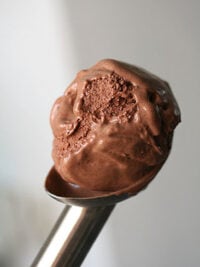
Scoop of Chocolate Ice Cream

As a cookbook author, whenever you do a cooking demonstration, there’s always ‘The Question’. It’s the one that’s the most frequently asked when you’re doing classes on a book tour. For me it’s often “Can that be frozen?”

Since my freezer is usually so crammed with stuff I can’t imagine wedging in a multi-layer cake amongst all the rock-hard frozen madness that I call “my freezer”…except for now, because I came home from the country last weekend and found my freezer door had nudged itself open, or more likely I accidentally left it ajar in my haste to get outta town, and when I came home, my freezer looked like an Antarctic blizzard had happened in there and had to be completely cleaned out…so now there’s plenty of room and I can start jamming it full all over again.

Anyhow, when you write a book completely devoted to frozen desserts and ice cream you can smugly think to yourself, “Ha! I’ve nipped that one in the bud.” Of course, all ice cream can be frozen. But little did I realize something insidious had taken ahold of my fellow Americans. “Can I use Splenda?” was The Question I was getting.

I don’t use artificial sweeteners in my cooking and don’t know how they behave so I’m not going to dole out advice on how to use them. But some people can’t have highly-refined or white sugar for health reasons, so I told those folks I’d “get back to them on that” – which I’m doing here and now. I wanted to come up with a recipe for ice cream-lovers who are looking for a sugar-free option that tastes every bit as good as regular ice cream. And this is it.

Chocolate Ice Cream

After my last book tour ended, I jettisoned home and decided to come up with a top-drawer recipe for Sugar-Free Chocolate Ice Cream that used no artificial ingredients. I made a trip to my local health food store in Paris, picked up a jar of agave nectar, and got churning.

I decided to create sugar-free chocolate ice cream, since the luscious, silky-smooth taste of dark chocolate was probably something that most folks on sugar-restricted diets were craving. But I didn’t want to make something that tasted like just an acceptable substitute for chocolate ice cream: I wanted it to be the real thing, smooth and creamy, with the luxurious flavor of rich, dark chocolate.

If you live outside the United States, you can often find tablets of unsweetened chocolate at some chocolate shops and specialty stores. In France it’s usually labeled, 100% pâte de cacao—100% chocolate paste.

Chocolate Ice Cream Bowl

Agave-Sweetened Chocolate Ice Cream
About 1 quart (1 liter)

Since the custard is made without sugar, keep an eye on things as it will cook rather quickly. You can either use a flame-tamer or cook the custard in bain-marie, a bowl set over a pan of simmering water, to avoid overcooking if you’ve never made a custard before. And because I don’t like washing dishes, I use the same saucepan for cooking the custard that I used for dissolving and blooming the cocoa powder, I simply scrape it as clean as possible and use it again for making the custard.

If you would like to reduce the quantity of agave nectar here, you can cut the amount to ½ cup (120 ml) if you wish.

  • 10 tablespoons (155 ml) agave nectar
  • 2 ounces (55 g) unsweetened chocolate, very finely chopped
  • 1/3 cup (35 g) unsweetened cocoa powder (I used Valrhona)
  • 3 cups (750 ml) half-and-half*, divided
  • 5 large egg yolks
  • pinch of salt

1. In a small saucepan, warm the agave syrup with the unsweetened chocolate over the lowest heat possible, stirring constantly, until the chocolate is melted. Remove from heat and transfer mixtures to a large bowl. Set aside.

2. In a medium saucepan, add 1½ cups (375 ml) of the half-and-half and whisk in the cocoa powder. Cook over moderate heat until the mixture begins to bubble, then simmer for 30 seconds, whisking frequently, making sure to break up any clumps of cocoa powder.

3. Remove from heat and scrape the mixture into the bowl with the chocolate-agave mixture. Stir them together, then set a mesh strainer over the top.

4. Add the remaining half-and-half to the saucepan with a pinch of salt, turn on the heat, and when warm, slowly pour the warm half-and-half into the yolks whisking constantly, then pour the warmed yolks back into the saucepan.

5. Cook, stirring constantly over moderate heat, until the mixture becomes steamy and thickens. If using an instant-read thermometer, it should read about 170F degrees. (76C).

6. Pour the mixture through the strainer into the chocolate mixture.

7. Stir, then let cool a few minutes until tepid. Once it’s not super hot, whiz the mixture in a blender for ten seconds until it’s smooth and velvety. (Never blend very hot liquids in a blender since it creates a hot vortex and can cause the liquid to blast out of the top.)

8. Chill thoroughly in the refrigerator, then freeze in your ice cream maker according to the manufacturer’s instructions.

perfectscoop.jpg


Related Posts and Recipes

Chocolate Ice Cream

Buying an Ice Cream Maker

What is half-and-half?

Freezing ice cream without a machine

Vegan Strawberry Ice Cream

Salt-Roasted Peanut Recipe

“You’re A Winner!” said the email.

“You’ve won a Katana Series Nakiri knife, from Calphalon.”

knives.jpg

While I seem to be the quintessential person who never wins anything (except the fabulous no-expense paid trip to Paris that I’m enjoying), and I don’t remember putting my business card in the raffle fishbowl, I was happy to accept. And the knife made a lovely addition to my Katana collection, joining the smaller one that I already owned. I’ve been using both, and they’re really rather incredible knifes. I love the handles, and the blades are scary-sharp. Which is good.

While we’re on the subject of deadly weapons, let’s talk about salt. Everyone is scared of salt.

I don’t pay much attention to hot-shot chefs, but I’d read that Thomas Keller was once asked what makes a good cook, and he replied, “salt”. He summed it all up in one simple word, and that’s truly what it all comes down to…and that’s why he’s a great chef and I bought his French Laundry book even though there’s no way in h-e-double-toothpicks I’m ever going to make anything from it. But if he can use it, so can you.
So no matter what you do to food, whether you whip it into a foam, toss it on the grill, spend 17 hours cutting it into little itty-bitty cubes that people wait 6 months to taste, or churn it in your ice cream maker, salting makes all the difference in cooking and baking.

A lot of people are afraid of salt, citing health concerns. Yet experts tell us that if you stay away from pre-packaged convenience foods, the average person only consumes about 1 1/2 teaspoons to salt per day. Although I should talk…I can’t have enough of it and sometimes buy it by the kilo. So maybe at this point you’d be wise to just scroll down to the recipe.

fleurdeselenorme.jpg

I mostly sprinkle top-quality salt on top of things, as a finish, where you’re going to taste it rather than adding it all at the beginning of the recipe where it can get lost. Whatever salt you use, I recommend coarse salt crystals, since the larger pieces take longer to dissolve, thereby giving your palate more time to experience the complexity of flavors, rather than just dissolving into a salty mouthful like fine salt does. Plus most commercial salt has additives which give the salt a bitter, acrid taste.

If you don’t know what fleur de sel is, you should. It’s fine crystals of salt that’s hand-harvested in marshes in Brittany, off the Atlantic coast of France. Although lots of fleur de sel-style salts have been showing up from Italy, Portugal, and elsewhere, the best fleur de sel is from the Guérande. I use it on everything; its fine, delicate taste is best appreciated when sprinkled over things, as mentioned above, rather than dissolved (like in soups) so it’s best to save it for places where it can be appreciated.

Fleur de sel is admittedly pricier than ordinary table salt, but when people balk at paying 5 or 6€ for a container of salt, that will cost them pennies (or centimes per day), they get all freaked-out. (Hey, it’s cheaper than gas, and lasts longer.) Just a last-minute flurry over a slab of foie gras or dark chocolate bark will give it a curious, other dimension. When you start using it, you’ll be as hooked as I am. You’ll never go back to ordinary table salt again.

I only buy fleur de sel harvested in Brittany, and I’ve recently befriended a récolteur who invited me to his marshes this summer to rake and harvest salt. His salt is incredible; light and flaky, with the fine, delicate taste of the sea. He sells his salt in Paris and I always tell guests to stock up here, since it’s one of the true bargains in Paris. A 250 g bag costs just 4€ ($5), which translates to .0136986 cents per day.

fleurdesel.jpg

So I hereby give you permission to spend a little bit more on salt. It will improve your cooking, just like upgrading to a good olive oil will improve your salads (and really, how much do you use?) If you don’t believe me, take this simple test: Taste a few grains of fleur de sel. Then taste a few grains of commercially-available fine table salt. I can almost guarantee that you’ll never use ordinary table salt again.

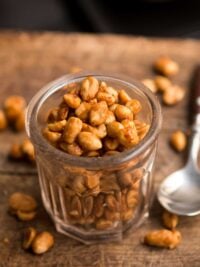
This is one of my favorite recipes for using fleur de sel, crispy Salt-Roasted Peanuts. These are terrific with cocktails or aperitifs, but I also like to enrobe them in bittersweet chocolate and if you’re making Hot Fudge Sundaes, they’re also dynamite sprinkled over the top.

peanutsblog.jpg

Salt-Roasted Peanuts

  • 2 cups (300 g) raw peanuts
  • 1/4 cup (80 g) light corn syrup, agave nectar, or rice syrup
  • 2 tablespoons (30 g) light brown sugar or cassonade
  • 1 1/2 teaspoons fleur de sel

Preheat the oven to 350 degrees F (175 C).

Lightly oil a baking sheet or line it with a silicone baking mat.

In a bowl, mix together the peanuts, corn syrup, and light brown sugar, until the peanuts are well-coated.

Sprinkle the salt over the peanuts and stir just a few times, but not enough to dissolve the salt.

Spread the peanuts evenly on the baking sheet and bake for 25-30 minutes, stirring three times during baking, until the nuts are deep-golden brown and glazed.

Cool completely, then store in an airtight container immediately, to preserve their crispness.

Store in an airtight container for up to 1 week. Makes 2 cups.

FAQ’s

I can’t find raw peanuts.

You can use roasted, unsalted peanuts, and reduce the baking time to 15 minutes. I buy raw peanuts in Asian markets.

Can I use other nuts?

I never have, but let me know how they turn out if you do.

What if I can’t get light corn syrup where I live?

Use glucose, available at professional pastry supply shops.

Can I use honey or golden syrup?

Yes, but they’ll be stickier and not as crisp. See the linked post under ‘corn syrup’.

Can I use another salt?

You can use any coarse sea salt, but choose one that’s light-tasting. I like Maldon salt from England very much, or you can use kosher salt.