Results tagged honey from David Lebovitz

10 Ideas for Food Trucks in Paris

Pierre Hermé Truck

Aside from a few crêpe stands here and there, Paris isn’t a city known for street food. And malheureusement, that Pierre Hermé truck isn’t open for business…although wouldn’t that be nice.

(However if it was, I would probably race around my house in search of spare change every time I heard it coming toward me, like I did when the Good Humor ice cream truck approached when I was a kid. Or haranguing my poor mother to dig furiously through her purse to dig up 40 cents for a toasted coconut ice cream bar to calm down her semi-hysterical child.)

Sure, come mid-day, the sidewalks of Paris are packed with people scarfing down les sandwichs (sic), which seem to have taken over as the lunch of choice in Paris. It’s nice to see the crowds and lines at the local bakeries, but it’s sad to see the long(er) lines at Subway sandwich shops, which I suspect are because people are craving a little creativity with what’s between the bread. And while the one Subway sandwich I had in my life was inedible – I didn’t realize you could screw up a sandwich…until then – I think the locals are fascinated by the varieties offered. Plus they’re made-to-order, and served warm.

The French do have versions of les ventes ambulantes, such as the pizza trucks parked alongside the roads in the countryside and there are the gorgeous spit-roasted chickens sold at the markets and butcher shops in Paris. But recently an American launched a roving food truck in Paris to staggering success, and a second one followed her lead. And judging from the line-up, it’s mostly French folks angling for a bite to eat.

While I’m happy for my fellow compatriots, and I love a good burger as much as the French seem to (judging from the crowds), I can’t help thinking how kooky it is that American cooks get to have all the fun, and some French cooks might want to get in on the action. Here’s a few ideas I’ve been thinking about…

Continue Reading 10 Ideas for Food Trucks in Paris…

Comme à Lisbonne

pasteis de nata

I remember with curiosity, walking by Comme à Lisbonne shortly after it opened. The shop was merely a tiny storefront that featured Pastéis de nata, the famous tartlets from Portugal that are often served by the platter since it’s often not possible to stop after eating just one. Interestingly, a number of bakeries in Paris do make pastéis de nata – some good, some just okay – but I don’t usually order them, preferring to stick to something French. But I was lunching with a friend in the Marais, and she’s a big fan of these Portuguese custard tarts, so I suggested we stop in for a taste.

We each took one of the two low stools and sat down, ordering a couple of coffees. (I noticed a clean, well cared-for coffee machine, which is an encouraging sign in Paris.) Then we were each handed a warm little tartlet. Taking my first bite was a revelation; I’d had the pastries in Lisbon and remember liking them a lot, but the ones at Comme à Lisbonne just might give any French pastry a run for its money.

Continue Reading Comme à Lisbonne…

Panforte

panforte

I’ve been going through my kitchen cabinets, and refrigerator…and freezer…and desk drawers, which has meant unearthing all sorts of odds and ends. Some were long-forgotten for a reason, and others brought back fond memories. Like the Pyrex glass container in my refrigerator encasing some remarkably well-preserved slices of candied citron. When I pulled the sticky citrus sections out, I realized that they don’t look quite as pretty as they did last year – which is okay, because neither do I – but they still tasted great. And the flavor of candied citron prompted me to make something I love: panforte.

honey, chile, cocoa powder

Continue Reading Panforte…

Roasted Figs

roasted figs

For some reason, fresh fig season seemed to have slipped right past me this year. Either that, or I wasn’t looking very hard because normally when I see fresh figs, I can’t help bringing home a big sack of them and snacking on them all week. Figs have two seasons; the first is usually late summer and the second begins mid-fall. The second crop is better-tasting and toward the end of the season, the prices drop as the bounty increases.

fresh figs

Last weekend at the market I saw some very nice looking figs and even though I thought the season had passed me by, I sneaked a squeeze when the vendor wasn’t looking and I could feel through their skin the juiciness of a ripe ‘n ready fig, so I took a gamble and bought a very big bag. And when I got home, I was happy to find that when sliced open, they were a bright ruby-red inside and indeed, just perfect. So to make them last a wee bit longer, I decided to oven-roast a portion of them to conserve my late season windfall.

Continue Reading Roasted Figs…

Marché des Producteurs

bacon

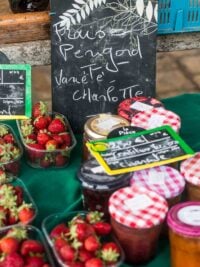
I was actually thrilled to see a market of producteurs that was happening this weekend in Paris. We have some great food available in Paris but I don’t get the opportunity often to meet and shop directly from the people who are producing the food. This is especially true with meat, which is sold by butchers and not the people who raise it, but I also wanted to see some of the more interesting roots and vegetables that don’t always find their way in to Paris from the countryside.

Generally speaking, a lot of these tasting salons that are held around the year in Paris are well-stocked with three things: foie gras, mountain cheeses, and sausages. Wine doesn’t count as one of the three, as that’s a given.

raw milk butter thyme

There are lots of people offering tastes of wine. It’s one of the few things where samples of it at markets are gladly given. I remember a few years ago at a wine fair I told the seller that I’d take a bottle of his Muscadet, since I was having oysters that night, and he was rather shocked that I didn’t want to try it first. (So I did, just to be polite.) But I’m actually happier sitting in a café and enjoying a glass rather than manoeuvering around other people en masse, Costco-style, jostling for a little sip.

Continue Reading Marché des Producteurs…

How to Poach Pears

poached pears

Every year I spend an inordinate amount of my time poaching fruit. It’s usually because I’m powerless to resist all the pears in baskets at my market, and buy far more than I need. Yes, much of my sweet bounty find its way into sorbets, cakes, ice creams, and jams. But one of my favorite ways to keep those pears around a little longer is to poach them.

poaching pears

Poaching is gentle, stove-top cooking, and winter pears are ideal candidates since they keep their shape. Poaching also improves the taste of ho-hum pears. That’s especially good news for you do-ahead folks out there; the longer the pears sit in the flavorful syrup after poaching, the better they’ll taste. Since there isn’t a big variety of fruit tumbling my way in the winter, to get my fruit-fix, I’ll keep some poached pears in the refrigerator and enjoy them diced and mixed with my mid-morning yogurt and granola.

Be sure to start with firm, ripe pears.

Continue Reading How to Poach Pears…

Why and When To Use (or Not Use) Corn Syrup

corn syrup

Because this comes up frequently, I’d like to take a moment to explain why and when one uses corn syrup in recipes. I use it judiciously, when I feel it will make a discernible difference in a recipe. For those of you who are regular readers of the site and my books, you’ll notice almost all of the time, I hardly ever use pre-packaged or convenience foods in my baking. So when I do call for something, like corn syrup, it’ll often be in amounts of one teaspoon or a tablespoon. And since most recipes feed eight-to-twelve people, proportionally, that’s a pretty small amount.

For example, the recipe for Peanut Butter Cookies with Salted Butter Caramel has one tablespoon of corn syrup added to the caramel, to keep it smooth. Since the recipe makes fifty cookies, that means each cookie contains less than 1/16th of a teaspoon of corn syrup.

Yes, people who live in America probably do eat too much corn syrup.

Continue Reading Why and When To Use (or Not Use) Corn Syrup…

Honey, Made in Paris

miel de paris

Americans have a funny relationship with honey. To many of us, it’s that sweet syrup in the jar with the feather-topped woman, or the gloopy stuff stuck inside the crevasses of a plastic bear.

In France, honey is a Big Deal and there’s boutiques like Maison du Miel, and vendors at the outdoor markets, which sell nothing but honey and honey-related products. (And believe me, you’d be surprised how many there are.)

Various types of honeys are said to have healing properties, although I don’t eat them for my health: I’ve learned to enjoy the many different varieties available in France, and I switch them around and use a particular kind, depending on what I’m baking or simply for eating.

In Paris, there’s a few ruchiers (beehives) in the city, the most well-known being in the Jardin du Luxembourg, whose honey is available sporadically. But few folks know that in our National Veterinary Museum, there are hives as well. And the good news is it’s almost in the middle of Paris.

Continue Reading Honey, Made in Paris…