The hardest of all foods to photograph, I've learned, are chocolate-covered marshmallows.
The bright, fluffy, vanilla-flecked cubes of sweet, airy marshmallow in contrast to the thin, intensely-flavored coating of bittersweet chocolate certainly presents a challenge.
I futzed around a bit, trying to figure out how to show the lofty-white cubes in juxtaposition to the coating of pure, dark chocolate. They're such diverse colors and textures that I tried several variations and lighting situations, until I decided that they'd looked best with a piece broked off.
We'll learn cooking tips and techniques from Susan in our hands-on classes and I'll be leading seminars focusing on all aspects of chocolate during special tastings and hands-on demonstrations: you'll learn everything from candymaking to making breakfast treats, and other ways to bake with chocolate in every way imaginable!
Susan is the author of On Rue Tatin, which chronicled her life moving to a village in France, restoring an ancient convent to become her cozy family home. Her other books include The French Farmhouse Cookbook (one of my French cooking bibles), and her latest, Cooking At Home On Rue Tatin.
There are just 2 spaces left for this culinary adventure and you can take advantage of some of the low airfares being offered right now to join us. You'll learn the secrets and techniques of French country cooking in Susan's stunning, professionally-equipped kitchen. Afterwards, we'll gather to dine by the fireplace with wines chosen from Susan's antique cave, and have a chance to savor a selection of Normandy cheeses, considered the finest in the world.
One evening our special guest will be Hervé Lestage, of Feuille de Vigne in Honfleur, who will lead us through a wine tasting, teaching you a new way to taste wine. My first tasting with Hervé changed everything I knew or thought about wine. Hervé is one of the most intriguing people I've met in France and we'll taste amazing wines from his cave which he'll specially select just for us.
As a grand finale to this culinary adventure, you'll have the option to spend a day and me and Susan exploring the gastronomic delights of Paris. We'll begin at an outdoor market, where you'll find an outstanding selection of Provencal olives, hearth-baked breads, artisan salt, raw-milk cheeses, luscious fruits, and sparkling-fresh seafood.
We'll dine in one of our most beloved Parisian bistros...but be sure to save room for all the chocolates we'll sample when we visit my favorite chocolate shops, bakeries and pastry shops in Paris afterwards!
Special Note: For this extra day on November 8th, we've made available 3 spaces available for people who aren't on our tour to join us, so if you live in Paris, or plan to be visiting then, you're welcome to come along! The price for the full-day gastronomic adventure, including lunch with wine, is just 225€. Contact me to reserve a space, using the email link on left.
I'm in the midst of the insanity that every cookbook, author dreads: reviewing the copyedited manuscript of my upcoming book. Writing a cookbook, especially one that needs to be precise like a baking book, is really a task. I started working on this book well over a year ago and it grew and grew to hundreds of recipes before I reined myself it. I just got so excited and I couldn't stop.
So this week I've locked myself in my apartment, taken the phone off the hook, and quit drinking wine. (Well, two outta three ain't bad.) One of the hardest parts was getting it actually delivered to me in the first place. It was sent overnight via Fed Ex.
Normally that means 'overnight'.
In France, it means 'soon'.
So I patiently waited and waited, until it eventually showed up.
Being a tad insane, but globally conscience, I've decided to write the recipes in both cups-and-tablespoons as well as in metrics, which was like writing two books at the same time. So for all you people who complain about American cookbooks not being in metrics, or by weight, if you don't buy this book, I going to come over, tie you up, and leave an endless loop video of back-to-back episodes of Rachael Ray shows on your television and force you to watch them over and over and over and over and...
So I've been working with my editor on-and-off for the past few months and it's finally down to the wire. I've never worked with her before but she's great and has worked with some of the best cookbook authors out there. We seem to agree on most things, and unlike most author/editor relationships, she listens to me and I listen to her. Rather strange I know, but so far so good and everything has been going along fine.
Well, that was until the frantic 67 emails I sent her yesterday.
(Since then, I haven't heard anything.)
In these final stages of writing a cookbook, both the editor and a copy editor goes over the book with a fine-toothed comb, looking for errors and making sure things jibe. (I should've hired some of my readers, come to think of it.) This is the stage that I generally refer to as 'hell'. You pore over each and every word and scan every recipe, jumping up to remeasure something in the kitchen, scrolling through the manuscript countless times making sure things are consistent, eat chocolate-coverd marshmallows from Pierre Marcolini, email all your old friends from college that you haven't seen in twenty-five years that you've been meaning to write to but haven't, checking to see if anyone's commented on your blog, and finding silly projects around the house to avoid the inevidable final edit on the manuscript...all in a concerted effort to procrastinate further.
But at least I finally got around to digging out an old toothbrush and cleaning all the grimy stuff that's collected around the buttons on my kitchen scale. I feel much better now.
Ok, so back editing.
Editors help rein-in authors like me, that sometimes have a tendancy to get inspiration from the most unusual places. Beauty pageants, childhood traumas, and naked men hurling coconuts on the sidewalk all made it's way into this book. As you can imagine, I really have a dislike for boring, dull headnotes, those comments authors make at the beginning of recipes to introduce them.
There's nothing worse than a headnote that reads like...."These cookies go well with tea in the afternoozzzzzzzzzzzzzzz"
Who has tea in the afternoon? I think I have, like, maybe once. And I was probably in bed with the flu. I usually eat cookies while waiting for my coffee to brew first thing in the morning. Or I leave cakes on the counter and hack away at them all day with a knife. Or rip pieces off with my hands and lick the icing off with my fingers.
With tea in the afternoon? I am so sure.
And it's hard writing a single-subject book as I'm doing, without using some of the same words again. For example, everything I put in my books are my favorite recipes. How many times am I allowed to say, "This is one of my favorite recipe for...."?
As mentioned, I generally reach into the deep, dark recesses of my mind to grasp something to write about that's curious and funny. But sometimes other people think they're odd or weird.
For example, in a recipe for something with bananas, there was a note from my editor...
"Replace this headnote....Too many bugs, not enough yum."
Frankly I'm so bleary from editing that last night I wrapped up a roast chicken carcass, which I ate like a crazed savage, to bring down to the trash room before racing out the door to meet Joy (who does not, by the way, have a potty-mouth in real life) for a late night rendez-vous over a bottle of wine in the Bastille. But when I woke up this morning, I realized I forgot to take the wrapped carcass downstairs and I couldn't find it anywhere. I've looked everywhere; the refrigerator, the freezer, in kitchen cabinets, my clothes closet, in the bathroom and the shower. I know I will find it someday. I just hope I do before it ends up looking like one of my fruitcakes.
As I was racing to meet up, I learned something that I thought I'd share before I get back to work: No matter how pressed you are for time, don't try to iron a shirt while you're still wearing it.
Although on second thought, perhaps that will make an interesting headnote...
In my previous post, a reader commented on the picture of a restaurant that I used, which obviously wasn't the restaurant that I visited (which would be both cool, but very Twilight Zone.) Still, you can't argue with a depiction of a restaurant where every table has a bottle of red wine on it and the parents are blowing cigarette smoke in their kids faces. The picture is called a carte scolaire and they're used in French classrooms to teach les enfants about life in France. The red wine I guess is there to get 'em started early and the kids seem oblivious to their parents puffing away.
How could I resist.
When I was on vacation in August, the weather was decidedly not too fabulous. You know that expression, "Everyone complains about the weather, but no one does anything about it."...well, we all complained about the heat wave, so something was done about it--August was cold and wet. And to top it off, I was on vacation along with the rest of Paris. So what do you do when the weather stinks and you're out in the countryside?
You visit the flea markets.
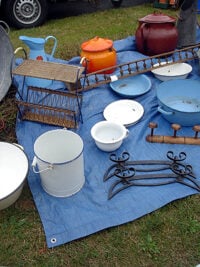
There's lots of brocantes in France, but the best bargains are when you find a vide grenier, which literally means 'empty attic', and that's what people do. While they hold them in Paris, the ones in the distant countryside, far from the scavenging Parisian antiquaires, are where you can get some good finds.
I like the pick through boxes of things, since they can yield unexpected treasures like old gratin dishes and terrines, but unfortunately, I've yet to come across any old Charo or Barry Manilow records. Have these people no taste?
Fotunately there are reassuring signs of the invasion of American pop culture, and this home-version of The Price Is Right caught my eye, but I eventually passed since "David Lebovitz...Come on down!" somehow sounds more fun than "Allez-y, Monsieur Lebovitz!"
Les brocanteurs (and brocanteuses?) here drive a very hard bargain and it's tough negotiating...especially when they get a whiff of my American accent. So I try to be discreet and just hold up an object nonchalantly, trying not to smile. My rack of gleaming-white American teeth and upbeat enthusiasm are always a dead give-away. Sometimes I try to get my French dude to ask the price, but he always winds up talking to the seller for 20 minutes, and I just want to cut my losses and run, thinking I'm missing out on the elusive Saarinen table basse at the next stand that I've been searching for, or some really cool antique chocolate molds that I'll buy in anticipation of using, but which will eventually get rusty sitting on the shelf, and I'll eventually sell myself at a future vide grenier.
Curiously if you decide you don't want something, each and every time you put it back down, the vendor will respond 100% of the time with, "C'est pas cher!", or "It's not expensive!" For some reason, it's difficult for them to fathom the connection between the fact you're not buying it with the fact that, yes, it is indeed trop cher.
Whenever I vacation in Brittany, I always end up eating way too many buckwheat galettes and crêpes, drinking too many bowls of cider, and eating way, way too many of those buttery Breton pastries (which I plan a round-up of in the near future.) Luckily there was only one sunny day that I had to don the 'ol Speed-o (thank God...) for a dip in the Atlantic, but I did find a diet book to help me shed those unwanted kilos.
Aside from all the plastic children's toys (a hazard of any vide grenier or tag sale), the most appealing things I found were these cartes scolaires, with depictions of of everyday scenarios in French life...
Here you can see the salt marshes where fleur de sel is harvested from the nearby Guérande...
.
..while this one shows the cooking tools used in the French kitchen...
...and if you need to know what a beauty salon is like...
...or a public pool.
You can find a comprehesive list of all brocantes across France in the monthly magazine Aladin, available at well-stocked newstands across France. The best way to find out when vide greniersand braderies are is to ask the locals or check for signs, which tend to get plastered everywhere about a week before.
And If you see a Knoll coffee table, or say, a Barry Manilow record, would you mind leaving them for me?
I don't do restaurant reviews very often here, simply because there's so few good places to eat in Paris.
Okay, I just had to say that since it's been a while since I got hostile comments in French, which incidentially is good for my language skills. So yes, there's lots of good food in Paris, but sometimes you have to travel to the outer neighborhoods to find the gems. But speaking of hostile comments, what about all those people coming at me right-and-left about having Barry Manilow on my Pandora list?
Gimme a break. Frederick wanted to hear a little bit of Mandy recently...so who am I to refuse?
But this week I had an excellent meal at Le Severo with some other friends at a little petit coin of a restaurant, a schlep from wherever you are in Paris, in the 14th arrondisement. There's only 10 or so simple tables and a lone cook in the open kitchen who presides over the dining room. An old zinc bar acts as a catch-all for bottles of water, wine carafes, and a big container of fleur de sel...which was a good omen.
One entire wall of Le Severo is a chalk-written wine list and menu. Notice I said 'wine list' first. That's because three-and-a half lengthy columns are up there, listing all sorts of wine, heavy on the reds. Somewhere in the midst of it all lurks a terse menu, and it's almost all about beef: steaks, Côte de Boeuf, Lyonnais Sausages, and Foie de Veau. First courses range from a salade Caprese, (a dish you shouldn't order outside of Italy) and a salad with goat cheese. But the real star here is le meat, so we started with a platter of glistening slices of cured jambon artisanal, which isn't really beef but I'm too revved up to go back and change that, and it came with a too-huge slab of yellow, ultra-buttery butter (which is the only way I could describe it...it was really, really buttery...I don't want to change that either) which we slathered on the bread, from the organic bakery, Moisan, then draped our slices with the ham. We then gobbled 'em down.
Delicious.
The other starter was a Terrine de pot au feu. Pot au feu is the French equivalent of a boiled-beef supper, complete with vegetables and broth. When done right, it's excellent, and at Le Severo, my hunch paid off. The terrine featured cubed, boiled beef parts, tender and neatly diced, loosely held in place with a light, jellied beef broth.
Since it's rather warm and humid here in Paris right now, I chose a bottle of Fleurie, which was an overwhelming task considering the size and scope of the wine list. But the prices were gentle enough to encourage experimentation and the list is full of curious wines, so I think whatever you chose would be the right choice. The Fleurie was light, upbeat, and fruity...yet sturdy enough to stand up to a slab of beef.
Kinda like how light and fruity superstars always stood up to their detractors, like Barry Manil....oh, never mind.
Anyhow, our steaks arrived flawlessly cooked.
The French love their beef bleu, practically raw. But I like mine rare to medium-rare, or saignant so you need to beware since somehow overcooked meat-loving Americans ruined things for the rest of us by insisting their meats be well-cooked, and sometimes French cooks overdo it a little to avoid potential American freak-outs. The chef-jacketed owner William Bernet, who is the singular server, assured me I'd be happy with saignant, and when he brought my faux filet, the rosy, juicy slices were indeed cooked just to the lower edge of my desired point of tenderness. To the side, my steak was accompanied by very, very good house-made French Fries, which have become as rare in Paris as a quiet evening by the fire listening to Barry Manilow with someone as wonderful as Fre...oh, never mind.
My only fault was that the fries could have spent an extra 48 seconds in the deep-fryer to get that deep-golden crust that everyone loves but cooks seem to have trouble attaining around here, a fault I find in too many restos in France. Does anyone really like undercooked French fries? But I didn't need to reach for that container of fleur de sel at all during dinner; everything was salted just-right. That to me, is the sign of a great cook, and a great restaurant. If you can't salt food properly, you should find another line of work. I mean, look what Charo did, after Xavier Cugat died. Do you think that girl just sat around on her duff? No sir-ee. She cuchi!-cuchi!'d her way onto The Love Boat as April Lopez and found fame, fortune, and happiness sailing the high seas.
I was able to talk my companions, who just moved here from Rome and were delighted to chow down on good, honest French cooking, into splitting a cushiony-round disk of St. Marcellin cheese, which was roll-you-eyes-back-in-your-head amazing. I had a simple Creme Caramel, which arrived properly ice-cold and floating in a slick of dreamy burnt sugar sauce. And because they were eating cheese, I didn't have to share one bite of it (Ha! My strategy worked.) My friends then had a Mousse au Chocolat, which they liked, but they were not as conniving as me and shared a bit, but I felt it could've used a wallop of more chocolate flavor, but that's how I am about chocolate desserts. The espresso served after dinner was quite good, and living in France, I've gained a new appreciation for Illy café, which is all but impossible to ruin. (Insert hostile French comments here.)
First courses at Le Severo are in the 10€ range, while main courses were priced 15 to 25€. The hefty Côte de Boeuf, which they'll prepare for 2 or 3 people, is 30€ per person and I'm going to have it on my next visit.
On the métro home after dinner, it suddenly dawned on my that my dining companions were macrobiotic. So if macrobiotic people can enjoy a beef restaurant like Le Severo, you can imagine how happy it makes us carnivores.
Le Severo
8, rue des Plantes
M: Mouton Duvernet
Tél: 01 45 40 40 91
People are goingnuts over Iciice cream, in Berkeley. Mary Canales rocks. Go eat her ice cream.
Tell her I said hi.
Not to upstage the timely importance of baby Suri, a reader sends me a link to this (a bit too) juicy history of Chez Panisse from Vanity Fair. Um, thanks for sharing, JT.
A chocolatier, looking at the comments to a recent interview, announces to me he's single...and looking.
David fears making the announcement on his blog will cause his traffic to spike, and cause his server to crash.
(Chocolatier offers to send chocolate bars studded with bacon bits. David accepts.)
Zagat Guide to Paris restaurants for 2006-2007 is released. Big party at George V with lots of free Champagne and mingling with top Paris chefs. Taillevent is still #1.
David wonders why French web sites always have that God-awful music, and waits for invitation to lunch.
While I know that many of you reading this blog are desperately searching for information on Tucker Carlson, so call me a lousy blogger as I beg your indulgence while I introduce you to someone who I consider if far more interesting and important (and judging from the comments, better-liked): Henri Le Roux.
If you don't know who Henri Le Roux is, it's time that you did.
Le Caramelier; Salted-Butter Caramel Spread
There's a lot of very talented chocolatiers and pastry chefs in France. Some are quite famous, and some just go to work everyday and do their jobs well. A few have rather large egos, others are more humble, preferring the lights of the kitchen to the ones in the television studio. (I was at a recent event with another food blogger who correctly noted that all the famous chefs mostly talk about is one thing: Themselves.) But if you mention the name 'Henri Le Roux' to any chocolatier or confiseur in France, they stand silent for a moment. Then nod agreeably. He is perhaps the most respected and admired pastry chef and candymaker I know.
The famous C.B.S. caramels in assorted flavors, including lime, black tea, orange-ginger and, of course, chocolate
I first met Monsieur Le Roux when I went to the Salon du Chocolat in Paris with my Thierry Lallet, who has an excellent (and highly-recommended) chocolate shop in Bordeaux, Saunion, one of the best in France.
Freshly-made C.B.S. caramels studded with hazelnuts, almonds, and walnuts
Before that day, I thought that caramels were caramels, and until that point, I'd tasted so many things in my life that there was little left that would deeply impress me. M. Le Roux is a very kind man, who basically changed the way pastry chefs, glaciers, and bakers everywhere think about caramel: he created caramel-buerre-salé (caramel-salt-butter), which he simply calls C.B.S.
And they are truly divine.
The 55-year old candywrapping machine barely keeps up with the demand for M. Le Roux's caramels
Salted-Caramel Buckwheat Florentines just-slathered in bittersweet chocolate
M. Le Roux was kind enough to let me explore his workshop with him when I paid a visit during my August vacation in Brittany. As he raced from room to room, he flipped open bins of almonds from Provence or hazelnuts from Turkey to give me a sample, later showing me how he grinds his own fresh nut pastes in his broyeuse with massive granite rollers which keep cool, while metal rollers would heat the nuts too much, losing some of the flavor. And a rarity in the pastry field nowadays, M. Le Roux uses true bitter almonds in his almond paste, which he sources from the Mediterranean. Almond extract is made from bitter almonds, even in America, but they're hardly used anymore since they're difficult to find (and those pesky toxicity issues.) But in the land sans lawsuits, M. Le Roux makes that effort and blends a few into his freshly-pressed almond paste which tastes like none other I've tasted in France.
Exceptional chocolates from Henri Le Roux, which were too good not to eat right away
I like to ask chocolatiers which chocolate they use.
Most are secretive, but M. Le Roux led me into a cool room packed floor to ceiling with boxes of various chocolates he gets from all over France and Belgium. He tore into them, breaking off chunks for me to taste and explaining how he uses some of each, blending them as he wishes to get the desired tastes he's after. Valrhona and Barry-Callebaut are used, but he also sources chocolate from François Pralus, an artisan chocolate-maker located in Roanne, just outside of Lyon, who specializes in single-origin chocolates, as well.
Henri and Lorraine Le Roux in their boutique, in Quiberon
I wanted to describe each and every chocolate in the box, but decided that that would constitute cruel and unusual punishment. (Actually, I ate them all and didn't feel like writing down what tasted as I was eating as I went. As mentioned, I'm a lousy blogger.) But I remember Harem, a filling of green tea and fresh mint, Sarrasine, infused with blé noir (buckwheat), and Yannick, blended dark cane sugar, salted butter and ground crêpes dentelle, hyper-thin, crackly lace cookies ground to a crunchy paste.
Oh yes, there's C.B.S. too, nutty salted-butter caramel enrobed in dark chocolate as well, which was my favorite.
Le Roux
18, rue de Pont Maria
56170 Quiberon, France
(Will ship internationally.)
Henri Le Roux's caramels and chocolates are available in Paris at:
A l'Etoile d'Or
30, rue Fontaine
Tél: 01 48 74 59 55
M: Blanche
M. Le Roux will also be at the Salon du Chocolat in Paris which takes place October 28-November 1st, 2006.
So I wondered why there were so many little flies buzzing around me?
Up until a few weeks ago, I never had a problem with insects, save for the nightly attacks of mosquitos (the bane of Parisian summers). So I was wondered why I had so many little visitors flitting about my kitchen.
Then batter gets divided into molds of various sizes and baked in anticipation of holiday gift-giving. (Note to future recipients: The size determines how much I feel indebted to you...so plan your gift-giving accordingly.)
Once-cooled, I soak the cakes with a heady pour of Cognac, then wrap them neatly in French linen, known as étamine. Then faithfully, each month, I brush the gauzy wrap with a fresh dose of Cognac, re-wrap them, then revisit them monthy to repeat the process.
Last week, I did my ritualistic unveiling of my lovely fruitcakes to give them their regular dose of Cognac.
As I pulled back the wrapping, something felt oddly unfamiliar, and an uneasy sense of dread spread over me.
The cakes didn't feel solid.
Nor did they even feel like cakes.
Well, words can't really describe what I was feeling, so I'll simply share...
Oh la vâche!, as we say.
This was perhaps the most horrible thing I'd seen in a long, long time.
Flies buzzed, hovered and swooped around the almost-unrecognizable bricks of cake, frothy mold seeped and fizzed from every pore, and little wriggly...well...since you may be eating while you read this, I'll stop there, but you get the message (and hopefully share my pain.)
I'm certain le canicule, the heatwave of July, was responsible. It heated everything up, including my cakes, and turned them into a messy mayhem of mold and mouches (flies).
I made a beeline for the elevator to the garbage area on the ground floor of my building, praying the elevator wouldn't stop to let someone else on. If it had, I don't know how I would have explained what happened. Or the stink. Luckily I arrived tout seule, and with semi-regret, flung the whole she-bang in la poubelle, slammed down the lid, and beat a hasty retreat.
There's been a lot of discussionlately on what is the best salt in the world. There's lots of opinions, tastings, and scientific studies floating around.
But I'm here to tell you, my absolute favorite salt is Fleur de Sel de Guérande.
And I think there's no finer salt in the world.
When I was invited to visit the salt marshes and learn to rake the highly-prized, precious crystals of fleur de sel, I decided that the Guérande, in Brittany, would make the perfect place to begin my August vacation. Brittany is a rugged part of France that faces the Atlantic and is unspoiled by tourists. The coastline is gorgeous: large rock formations are piled everywhere, giving one many opportunities to ascend the boulders and enjoy the magnificent views in all directions. The ocean was a bit too cold for me to swim in, but Bretons have no trouble diving right in.
(Trust me, it's freezing cold, which meant no swimming at the beach for me...especially the naturist beaches!)
But there's also lots of buckwheat crêpes and sparkling apple cider to keep your spirits up as well, just in case you get stuck in one of the rainstorms, as I often did. And although the Guérande lies in the south of the region, and in spite of Breton flags everywhere, I was curiously told by the locals that the Guérande was actually part of the Loire-Atlantique, not Brittany.
Like the numbered roadway signs that lead to nowhere (locals told us not to follow the signs since they're wrong), and in spite of the magnificent Michelin maps, driving in France provides its fair-share of frustrations.
Still, we managed to make it, and by the time we arrived I was ready to throttle someone. Yet looking out over the marshes did indeed have a calming effect—perhaps they can build a salt marsh in Paris, visible from my apartment?
Le Marais Salant of the Guérande.
These are the salt marshes of the Guérande, les œillets.
They're so prominent, that they're visible on the Michelin maps of France, although when I got home and tried to look on Google maps, viewing the region was prohibited. Perhaps there's a military installation nearby, since it's on the coast. The exceptional salt from the Guérande is justifiably famous since it tastes like no other salt in the world. Although the words 'fleur de sel' have been bantered around and used as marketing tools for many salts being promoted (nowadays you find salts labeled as such from Portugal, Italy, and elsewhere) nowhere else on earth does the salt have the same fine flavor and delicate crystals of Fleur de Sel de Guérande.
Yesterday was Blog Day 2006, which I'm a bit late for.
But here are my choices for 5 food blogs that were either newly created in 2006, or at least new to me this year, that I always enjoy:
I recently got this message from someone asking...
"It would be a great help to me if you would be so kind as to just note down some of the problems, bureaucratic and otherwise, you encountered while procuring visas, papers, lodgings, etc."
Since I don't have the enormous bandwidth to describe the entire process, nor the urge to re-visit those repressed memories, the very short answer is that the French certainly don't make it easy to get (or renew) a visa. I guess that's understandable since so many wholly undesirable people, like me, want to live here. But what I don't understand is why they don't make it easier to figure out.
So being a good, responsible person, to that young lady out there, since you asked, here's some answers your questions:
My first clue that something was a tad amiss was when I was starting the process back in San Francisco, while a friend in Boston was doing the same. Comparing notes, we realized the list of documents requested on the French Consulate of San Francisco's web site was different from the list of documents requested on the French Consulate of Boston's web site. When I went into the San Francisco consulate to ask, with both pages printed out (I learned that early on), and pointed out the bizarre discrepancy, the fellow behind the counter snidely replied, "Well, where do you live? In San Francisco...or Boston?"
When I pointed out that that would be like telling someone from Lyon that in order to get a US visa, they would need different documents from someone in Paris, he simply shrugged, and I handed over my dossier and went back home to wait.
The most important thing to realize is that there are two iron-clad rules that you'll come up against: One, is that the system is not designed for efficiency, but to employ as many people are possible.
And two, just because it's someone's job to help you, that doesn't mean they have to. Or want to. They're under no obligation. So you need to get them on your side using whatever means necessary.
(And if anyone out there wants to get rich really quick, open a photocopy shop in France, since everything needs to be copied in quadriplicate. And invariably no matter how prepared you are, they come up with something completely out-of-the-blue. "You didn't bring your mother's sixth-grade report card!? Mais oui, but of course you need that! And we need 5 copies too...oh, and all notarized within the past 30 days...from the town she was born in.")
An answer to the part of her question asking about "any problems I encountered procuring lodging": This was my apartment, the week I arrived Paris.
When I finally did get the paperwork granting me permission to come to France, I foolishly listened to them at the consulate and assumed that having gone dredging up every scrap of paper from my past, I was in free-and-clear. Not so fast, cowboy. Upon arriving in France, I was told, I needed to go to the police station and pick up the 'real' visa. But what's this official looking piece of paper I've waited 6 months to get? Oh, just permission to actually apply for a visa.
Okay.
I was not quite a free man in Paris. So once back in town, I head to my local police station. They know nothing, and send me to the main police station in my neighborhood. They know nothing either (This is about the time I started using the phrase, "Welcome to France", and repeating it over and over and over.) I finally discover that I need to go to this stifling, little dingy office out in the middle of nowhere, where I wait in a long, non-moving line for an hour to make an appointment at the main Préfécture de Police, only to be told that the one piece of paper that I don't have in my dossier (I forgot what it was, but it was something rather obscure), so I need so I'll need to come back. Incidentally the Préfécture de Police is located just around the corner from the Conciergerie, where Marie Antoinette and other less-fortunate souls, waited for the dreaded end to come. As you sit and wait in the crowded, hot room, hoping that if you sit in the last available seat, you won't be next to someone who doesn't have access to a weekly shower. And you wait until your name gets called. And you wait.
And wait. And wait. And...
You begin to feel as if you're about to meet a similar fate as poor Marie.
(Did you know the last time the guillotine was used was in 1975?)
To make a long story short, and to preserve bandwidth, I eventually got my visa, which I need to be renew yearly, and for the most part, everyone I had to deal with (except in San Francisco) was rather pleasant and helpful. (Must be the chocolate I brought them.)
You need to start the process about 8 month before its annual expiration date, so I've simply to re-start the process when I go pick up my visa. If anything, at least I am efficient. So today I come home, and there's an official letter from the government telling me they want the last 12 statements from my bank in the US translated into French (um...Can't you just look at the dollar amounts? Isn't that what you're looking for?) Trying to explain what bank 'interest' is to a French person always draws wide-eyed stares, since the idea of your bank actually doing something for you is a rather unusual concept. And trying to explain why there's ads on your bank statement draws more curious stares.
Welcome to America, I suppose.
So re-armed and re-ready, I head back to the Préfécture de Police to hand over my freshly-translated documents, where they tell me I have to wait a few more months, although my visa's set to expire at the end of this one. So I need to get a prolongation...at another bureau...way on the other side of Paris. Of course.
Then I need to come back. And do it all again.
Exhausted, I eventually made it back home where I decided that perhaps I should treat myself a glass of something with a high percentage of alcohol, polish off the box of chocolate-covered caramels that I was saving for a special occasion from Le Roux, and look at my picture of Frederick. And since I had the Cognac out, I decided to preserve the few kilos of Mirabelle plums I got at the market yesterday.
In August and September, the yellow Mirabelle plums abound in big bins at the markets. These tiny plums are small, roughly the size of a French bureaucrats petit boule, and are grown in various regions around France, but especially in the Lorraine, where the best ones are grown, and locals use them to make everything from tartes and jams to crystal-clear eau-de-vie. They're small and sweet, the perfect size for preserving. Using Judy Rodger's recipe in The Zuni Café Cookbook for inspiration, I began by rinsing and sterilizing my jars with boiling water.
But in case you're a stupid boy like me, I don't recommend making anything involving sticky, searing-hot liquid while wearing only a pair of shorts. As I swirled around the hot water and sugar in the jars, one with a faulty lid began spraying boiling-hot water in a grand arc across the kitchen, and me, eradicating a good amount of the hair from my stomach (couldn't it take some of the fat instead?), leaving a red welt roughly in the shape of Corsica.
Luckily I live in Paris and there's no less than five pharmacies within one block, and picked up the best minor burn remedy on the planet: Biogaze, which everyone should have in their medicine cabinet. (Buy some on your next visit if you don't live here.) After I explained to the wide-eyed pharmacist how I narrowly escaped the world's first Parisian Bikini Wax, I returned home, patched up my rosy tummy, and continued my project using the sterilized jars, happy that I didn't sterilize myself at the same time.
Depending on how many small plums you have, for each pound (450g) of plums, dissolve 3/4 cups (150g) of sugar in 3-4 tablespoons hot water in a 1-quart (1 liter) preserving jar with a well-fitting lid, (or dress more appropriately that I did.) Pour two scant cups of decent, but not outrageously expensive brandy or Cognac the plums. Secure the lid and tilt the jar to mix everything together.
Unlike my stomach, Judy recommends using fruit that's unblemished, and gives recipes and tips for other fruits including cherries, red currants, figs, and raisins too.
(LATE-BREAKING TIP: 3 days later I noticed the plums floating at the top, not submerged in liquor, were discoloring, so I removed them and slashed each one with a paring knife, hoping that would help them get saturated. Seems to have worked.
LATER-BREAKING TIP: another 2 days later, I noticed the tops of the plums were still floating above the liquor-line, so I drained 'em and made jam. I replaced them with sour cherries, and am waiting...)
Store the jar in a cool place for a few weeks, then refrigerate. There's no indication how long they'll keep, but I hope mine will be ready-and-waiting for me on the day that I finally get my visa renewed.
Hopefully the hair on my stomach should just about returning by then as well.
In this month's Hemispheres, the magazine of United Airlines, I was their guest author for their popular series, Three Perfect Days, where I share some of my favorite tips for three perfect days of travel, sightseeing, and...of course, eating.
If you're flying on United Airlines this month, be sure to pick up a copy.
The article is also online at the Hemispheres web site, and will be archived there as well.