January 2006 Archives

American's often wonder how French people know they're American before they even say one word. It used to be the sneakers; they were the dead giveaway. Nowadays, wearing sneakers, or les baskets, in Paris is as carrying a baguette.

The other way they can tell us-from-them, is that Americans tend to smile. A lot. We are a rather happy tribe. And Americans tend to eat and drink while walking (or while driving, which I've explained to some of my French friends, but they look at me in disbelief). Although in Paris it's becoming a bit more common, it's still unusual to see someone chowing down while walking on the street or in the métro. It's just not done and people will definitely give you funny looks if you're, say, cramming a Pierre Hermé pastry into your face while sitting on a sidewalk bench. Or shoving a sublime, cream-filled éclair au chocolat from La Maison du Chocolat into your mouth, trying to make sure not one precious drop of bittersweet chocolate pastry cream lands anywhere but in your tummy.

But one little nugget of Parisian tradition still amuses me every time I see it.
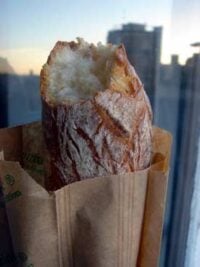
It's the yank, twist, and pull of le quignon.


bazinbaguetteparis.jpg


You'll see it 99% of the time someone leaves a bakery with a freshly-baked baguette. The moment they exit, they grab the crackly knob at the end of the loaf, le quignon. Parisians will absent-mindedly twist and snap it off and pop it into their mouth as they hurry on their way. I think of it as an instant, on-the-spot, quality-control check.

I usually end up with a mess of flour on my dark overcoat, since one of my favorite breads in Paris, le Bazinette, has a fine dusting of flour on it's crackly crust and permeating all the little brittle crevasses. If you're lucky enough to get to Bazin early in the day, a favorite baguette of mine is available with a hearty mixture of grains; flax, sesame, and poppy seeds.

The one shown above is their baguette de tradition, a hand-shaped baguette, slightly sour from the addition of un peu de levain, natural sourdough starter, which gives the bread a hearty, earthy character and allows it to remain fresher longer than the usual 4-hour lifespan of a good Parisian baguette.


Bazin


Bazin is one of the prettiest bakeries in Paris too, overlooking what I am sure is the smallest (and most unnecessary) traffic rotary in the city. In order to get a Bazinette with grains, you need to get to the bakery early in the day, since they always seem to sell them out quickly.


Bazin
85, bis rue de Charenton
Métro: Ledru-Rollin
Tel: 01 43 07 75 21
(Closed Wednesday and Thursday)


culinarycrime.jpg


It's perhaps not much of a secret anymore that some of the best places to eat in Paris are the wine bars. Unlike some of the 'wine bars' in the US (where that glass of icky-oaky California Chardonnay will run you $14...not including tax and tip), Paris' wine bars are gathering places, where people might stop in the morning after the market for a friendly chat with the counterperson or in the afternoon for quick glass of red to get you through the rest of your day...not that I ever do that...

After work, the wines bars in Paris hum as people leave their jobs, and you'll see businessmen in dapper suits (and the aformentioned cartoon-emblazoned socks) as well as salesclerks from the local shops propped up against le bar zinc, cigarette in hand, sipping a glass of red wine while thinking whatever it is they're thinking as they focus their gazes somewhere off into space.
It's a skill I've yet to master.


parilerubis.jpg


One of my favorite wine bars in Paris is Le Rubis. Located just off the fancy-schmancy rue Saint-Honoré, Le Rubis occupies a little corner of this quartier, better known for handbags, jewelery shops, and all the other necessities of life for les bourgeoisie.

I like to go at lunchtime, especially in the cold winter months, where the friendly owners will squeeze you into a seat at one of the tiny tables covered with crisp white paper, a folded napkin, some utilitarian silverware, and an overturned wine glass, ready to be filled. After lunch of later in the afternoon, Parisians gather outside by the wine barrels covered with red-checkered cloth, drinking, smoking, and talking on their mobile phones, while absentmindedly polishing off a couple of glasses of Brouilly or Beaujolais.

Most of the wine bars in Paris that serve food keep it authentic and simple: peek into the kitchen at any of them and you'll find most are the size of a phone booth. It's all charming and convivial, reminding me of the old diners that have mostly disappeared in America (except the bottomless cup of bad coffee's been replaced by red wine...and people still ask me why I live in France!)

Lunch can be anything from petit salé, braised salt pork on a bed of nutty green French lentils, or a rich wedge of tarte au legumes, a quiche-like slab of eggy-custard, baked with vegetables and diced smoked bacon, served with a mustardy green salad. (And no, all you wine folks, they don't care that the salad has vinegar and mustard in it.)

Of course, though, the wine is important here. But not so important that it draws wine snobs. Thankfully all he pretention from the neighborhood is left outside the door. I like to come in the afternoon when the place is empty. I sit with friends, or by myself, sipping a glass of fruity Chinon accompanied by a plate of their outstanding charcuterie, served on dark-crusted slices of pain Poilâne, from the nearby bakery of Max Poilâne. Country hams, fat-rich rillettes, and slices of dry sausage are always a treat, and a welcome accompaniment to the wine.
By the time I'm ready to leave, the table's covered with bread crumbs, the paper table covering is stained with red rings from the bottom of the wine glass, and I'm feeling much better, no matter where I'm going afterwards.

Usually it's straight home for une sieste, another jour perdu...


Le Rubis
10, rue Marché St. Honoré
Tel: 01 42 61 03 34
(Full-meals served only at lunch)


Last year I read about a pastry chef-turned-candymaker in Los Angeles. She was becoming known around those parts for her tender caramels, blended with sel de mer, (oh...well, gotta get some French in here somehow...), or le sea salt.


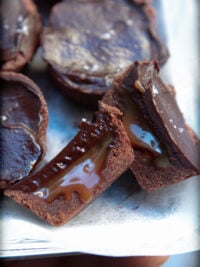
californiacaramelsparis.jpg


Inspired by the amazing CBS, caramel-beurre-salé caramels produced by the master himself, Henri LeRoux, Catherine Moore's caramels are indeed the best I've had in the US.

A friend drove me out to the Silverlake region of Los Angeles. It's a rather funky area, full of shoe shops, stores with second-hand clothing racks on sidewalks, just-opened bakeries, and a music studio that Flea (from the Red Hot Chili Peppers) opened for the young folks of the neighborhood.

And there's the The Cheesestore of Silverlake, a small shop with wheels of cheese piled high on the counter, and a carefully chosen selection of 'gourmet' foods...although I hate to use that word, which seems so pretentious, and this shop is anything but. They're incredibly friendly (and yes, I seem to be the only one who truly likes LA...) and we spoke a bit about what they carry, their cheese and wine selection, and, of course, the creamy caramels.

Although a few might consider them too salty for their taste (I love them), The Little Candy Company's caramels were cooked to just the right temperature...not too tough, not too sticky and meltingly-soft cooked just enough to that chewy stage to give them some 'bite'. As we ripped open the package, unwrapped a few tender morsels and popped them in our mouths, we did concede that it was impossible to reproduce the French ("there he goes again...") caramels since, we said in unison, "It's the butter."

French butter, that is. But boy, those caramels sure were good. No matter where they're made.


Sea Salt Caramels from The Little Flower Candy Company can be ordered by calling or visiting their website.

(If website is down, they may take telephone orders.)

Winter Fruits

16 comments - 01.23.2006
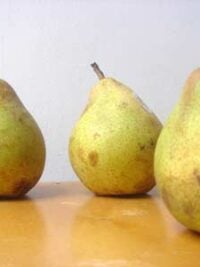
comicepears.jpg


Pears

Good pears are in danger of disappearing. The best-tasting varieties (Comice, Bartlett, and French Butter) become easily bruised as they ripen, so large stores are reluctant to carry them. So what can you do? Buy them when you see them. Don't be afraid to purchase rock-hard pears of these varieties: unlike most other fruits, pears don't ripen well on the tree and should be ripened at home for the most succulent, juicy flavor. I carefully cradle my pears when I carry them home, then let them rest on the countertop, standing upright on a kitchen towel, until slightly soft to the touch.

Bartlett pears are amazingly aromatic, and in Normandy, folks who distill Calvados add a few along with the apples (about 10%) to heighten the aroma. Pear eau-de-vie, or Pear William (sometimes recognized as the clear liquor with the whole pear in the bottle) is a distillation of Bartlett pears. It takes about 60 pounds of pears to make a small, precious bottle of Pear William. The steam of the cooking pears is captured and that little trickle of liquid is bottled as eau-de-vie.
So stop complaining about the price.

Most pears can also be checked for ripeness by sniffing the stem end. I bought some perfectly-ripe Comice pears last week that were as perfumed as the most divine roses (which are relatives of apples and pears.) Each time I passed them on my countertop, I couldn't resist picking one up for a sniff.

For cooking and poaching, Bosc and Winter Nellis pears are the best choice as they hold their shape once cooked. These varieties have little fragrance. Although other cooks use them, I've never tasted an Anjou pear that was any good.

(And don't curse those little plastic labels that are stuck on pears. Without those, many of the supermarkets wouldn't sell the lesser-known varieties of pears, since it's difficult for the cashiers to know which are which. )


driedapricots.jpg


Dried Apricots

When I visit the United States, I always return loaded down with at least three or four pounds of California dried apricots (right). I'm not xenophobic, but the Turkish apricots (left) are tasteless, bland, and sugary-sweet. If you come visit me, that's what I ask my friends to pack for me.

I grew up snacking on California dried apricots and I used to call them 'dried monkey ears'. Their puckery tang makes them ideal when simmered in a light sugar syrup until soft (1 part sugar or honey to 4 parts water, perhaps with a stick of cinnamon or vanilla bean) and served alongside a savory meat or chicken stew. I love them in desserts and I'll often make a simple (and healthy) soufflé of dried apricots plumped in white wine. Once cooked, I puree them, fold in some whipped egg whites and sugar, and minutes later I pull from the oven a tray of apricot soufflés.

Although the Turkish (and Chinese) varieties are less than half the price, they're no bargain. If you substitute them in a recipe that calls for dried apricots, you'll be sadly disappointed. The California growers are having a hard time competing, since so many people seem to shop solely on price, not quality.
So have one less Vente Mocchachino a year and splurge on good-tasting dried fruit. Please.


limes.jpg


Limes

The most widely available lime in the US is the Persian lime. Since it's seedless, it's the one most commercial growers cultivate. Often found solidly green and bullet-hard (they're picked underripe and gassed to preserve their unripe green color), they yield little juice.

As with all citrus, select limes that feel heavy for their size. If you live in France, where they vendors don't like it when you handle the produce, you risk getting scolded with, "Monseur! Ne touchez pas!" (and in the old days, they would add a petit slap if you were in striking distance). So to avoid the humiliation, I scout around ethnic markets and root around the citrus bins, elbowing aside the Arabic and Chinese women, touching every fruit, and tossing back those that don't feel hefty and full of juice.

If you pick one up and it feels light, that's an indication there's little juice inside. Look for limes that are yellow-golden with a greenish hue. As mentioned, ethnic markets seem to offer golden limes that are valued for their taste, not their looks. And don't be put of by appearances: older, punky-looking citrus often tastes best since it's spent the maximum time ripening on the tree rather than sitting in cold storage.

To get the most juice from limes, make sure your limes are at room temperature. Roll them firmly on the countertop with your hand to rupture the juice sacs, then squeeze. While some cookbook authors advise popping them in the microwave for a few seconds, I'd feel funny about heating fresh limes. It jus doesn't seem right.


pineapple.jpg


Pineapples

While everyone loves pineapple, no one seems to remember the last time they actually bought one. They seem to make an appearance only for special occasions. So next time you're at the market, why not pick one up? Personally, it makes me feel better to have something around the house that's a reminder of the tropics during the long, grey days of winter. (Especially if I pick up a bottle of dark rum at the same time!)

I buy pineapples often during the winter. I like to cut them up and keep pieces in the refrigerator for snacking or to add to a fruit salad with grapes and tangerines. And blended with some dark rum and lime juice, served in a nice glass with some chips and guacamole, I don't know of a better way to beat the winter blahs. (Luckily, for some reason, they have the best tortilla chips in France. Avocados are plentiful as well.)

The most common varieties of pineapple are the Cayenne and Esmerelda, although you'll rarely find pineapples listed by variety. Harold McGee suggests buying pineapples grown as close to the equator as possible, although I've had exceptional pineapples from Hawaii, the Ivory Coast of Africa, and Costa Rica.

Contrary to popular belief, there's nothing that plucking out the center leaf of a pineapple will tell you about ripeness. Pineapples don't ripen after picking so buy one labeled Jet-Fresh, or with a ticket stating that it's been picked ripe, if possible. Take a sniff: a good pineapple will reveal if it's ripe by a tropical aroma at the stem end. Lots of yellow on the skin is another indication of ripeness. Avoid fruits with soft spots and mold.

There's always much debate over when it's okay to telephone someone at home.
How late is too later? How early is okay to call? Are they friends, or family?

When I moved to Paris, a friend told me, "Never call anyone before noon on Sunday."
I made that mistake once, and that was all it took.

So I'm sound asleep at 8am this Saturday morning (after getting home from dinner last night at 2am), there I am tucked into my bed, so warm-and-cozy, nestled between my linen sheets and goose down duvet, by little head dreaming of....
....and...
".....brrring....brrring....brrring...brrring!....Bbrring!....

Grrrr....

So.
Since I was up, I decided to hit the Marché aux Puces, or flea market. By the time I finished my coffee and got there, I'm sure most of the good stuff was gone. But this week I managed to pick up something I've been admiring for a long time.


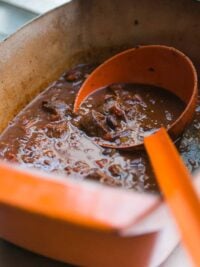
lecreuset.jpg


I've been eyeing this casserole whenever I'd come across one, for the past few years. Designed in the 1958 by Raymond Loewy for Le Creuset, I love the combination of modernity and French utilitarianism. Vintage examples in good condition are rarely found since most have been well-used by French cooks. And recently it's been re-issued, although in newer colors, not like the classic orange that you see.

Raymond Loewy was born in Paris at the end of the 1800's, but made his mark in corporate America. He became the most influential designer of our time and designed so many things that we just take for granted. But during his era, the Industrial Revolution, people were fascinated by all that was new and suggested a better, and more modern, future. What he designed suggested speed and forward-thinking, an emerging machine-age where everything was sleek and streamlined, and this casserole for Le Creuset is no exception.

(This piece of cookware is called La Coquelle and was recently reissued here in France in several colors, including this one, called 'Madarin Sorbet'.)

In addition to this casserole, Loewy designed the Studebaker, as well as the Lucky Strike, Nabisco, Shell, and Exxon logos. One of my favorites, though, was for New Man, a French clothing company...


images.jpg


Not many people realize this, but f you turn it over, it reads the same thing, "New Man".
Go ahead, flip over your computer and see.


Jean-Charles Rochoux has perhaps the tiniest chocolate shop in Paris, located on an unassuming side street off the Rue de Rennes. It's hard to see and easy to miss if you're not looking for it. But what causes most passers-by to stop are the window displays, filled with intricately-sculpted statues and figures, crafted entirely of chocolate.

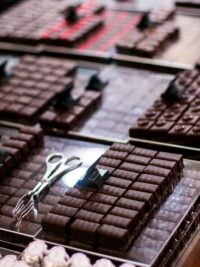
M. Rochoux spent many years in the workshop of Michel Chaudun, one of the best chocolatiers in Paris. And indeed, a look around this sleek boutique reveals much inspiration from M. Chaudin, including his version of Colomb, little disks of chocolate studded with cocoa nibs, and Les Pavés, tiny cubes of chocolate ganache that instantly dissolve in your mouth, the lingering pleasure lasting a few precious minutes. Then you decide it's time for another. I always buy at least six at a time for that reason.

But stacked discretely in the corner are stacks of chocolate bars, and after we had a lengthy discussion on chocolate one day, M. Rochoux handed me a tablet labeled noisettes to take home as a gift. When I got home, I tore open the wrapper and took a bite.
I was completely surprised by what I found inside.


hazelnutchocolateparis.jpg


Each individual roasted hazelnut was coated in crunchy, crackly caramel, then enrobed in the chocolate bar. The contrast of hyper-crisp hazelnuts and bittersweet chocolate makes this my new favorite chocolate bar in Paris.


Although I love finding something new, sometimes I have the opportunity to discover something nearly forgotten.

A few years ago I had the pleasure of touring the workshop and chocolate boutique of the world-famous Bernachon, in the city of Lyon.


minipresident.jpg

Bernachon's Signature Cake: 'Le President'


Not only does Bernachon make great chocolates, they actually make the chocolate itself. Let's say you go to a shop to buy filled chocolates, or bars of chocolate. You're buying chocolate that the chocolatier has bought (and perhaps mixed to his or her specifications). That's the difference between a chocolatier and a chocolate-maker. There are very few chocolate-makers in the world, only 14 exist in the United States at present. Bernachon is a small shop, but it's stunning what they're able to produce.


pipingbernachon.jpg

Piping 'Couronne Noisette': Hazelnut and Praline Paste Blended with Milk Chocolate


I love Bernachon chocolate, although it's nearly impossible to find outside of their shop in Lyon. But what great chocolate it is and it's certainly worth the 2-hour TGV ride from Paris.


bernachonroches.jpg

'Les Roches', Just-Dipped in Freshly-Made Dark Chocolate


Their most famous bonbons are the seriously-rich, ganache-filled palets d'Or flecked with bits of real gold. At the shop, they barely have time to keep them in the showcase, as customers come in, the saleswomen fill boxes directly from the decades-old wooden storage trays.


makingpresident.jpg

A Super-Skilled Chocolatier at Bernachon Making Chocolate Ruffles


But when I visit, I stock up on their chocolate bars, which allow me to commune with the pure chocolate all by my lonesome. I like the Nuit et Jour, the Night and Day bar, where one side is bittersweet dark chocolate. Flip it over, the reverse is smooth milk chocolate. Moka is made by grinding roasted coffee beans along with cocoa beans for a double-buzz, and Extra Amer is a super-dark bar of chocolate with very little sugar. It's bliss for some, and too intense for others.
I fall into the first category.
But my absolute favorite is Kalouga.


bernachonbar3.jpg

'Kalouga' Bar


Kalouga is a rather funny name for a chocolate bar. I'm told it's the Basque word for 'Caramel' (any scholars of the Basque language out there?) But I found the Basque word for tasty, gustagarri, and that's what this is. I first tasted one of these bars about 5 years ago, but was dismayed to find they stopped making it since. Too much of the luscious caramel would begin oozing out after the tablets were made and it was problematic to store them.

But I kept asking them to make them, and word got back to them that there was an American living in Paris who was insane for them. And lo and behold, they're back in production! (Yes, that was the story I was told...whether or not I believe it is another story...)
Either way, you may thank me later...once you've tried one.

Once you bite inside, the gooey salted caramel immediately begins spilling out, and it's hard not to eat the whole thing at once. If you're the generous type, I recommend opening it when you have a bunch of friends over to share the bouny.

Otherwise, you can just eat the whole thing yourself.

Guess which I did?


Jean-Charles Rochoux
16, rue d'Assas (6th)
Paris
Tél: 01 42 84 29 45

Bernachon
42, cours Franklin-Roosevelt
Lyon
Tél: 04 78 52 67 77
Lyon


wintercafeparis.jpg

Apparently the recent radio interview that I did with Evan Kleinman on National Public Radio's Good Food caused quite a commotion. The producer wrote they were innundated with requests for my recipe for Cocoa Nib Sausage, which I use to top my Chocolate Pizza Dough from The Great Book of Chocolate.


GTCH.jpg


I get a lot of quizzical looks from people when they hear the words 'chocolate' and 'pizza' in the same breath, but adding sugar to chocolate is a relatively new idea in the grand history of the bar (remember how your mother only kept unsweetened Baker's chocolate in the house?)
And there's many cultures that use chocolate in savory dishes whose origins go back hundreds and in some cases, thousands of years, including Mole and here in France, where it's not uncommon for many cooks to sneak a bit of grated a chocolate into their Coq au Vin.


cocoabeans.jpg

Roasted Cocoa Beans Before They're Broken Into Nibs


Many years ago, I became good friends with Joanne Weir, when we were young cooks starting out and before we knew any better. Now she's famous with a television career and many terrific books to her name and we try to see each other when we passes through each other's town. My favorite recollection of her is when she came to my house in San Francisco to make pizza. All I remember is there were a lot of empty bottles of Barolo the next day and a copy of this recipe on my counter that was splattered with garlic oil and a few flecks of parsley (and my oven was a mess too.) So when I was looking for the perfect topping for my pizza dough recipe, I adapted her recipe, adding crunchy and unsweetened cocoa nibs which gave it a nice savory crunch, as well as a bit of chocolate flavor...for those of you who can't wait for dessert.

And you know who you are...


Cocoa Nib and Spiced Lamb Sausage Pizza
Adapted from a recipe by Joanne Weir

Enough for two 9-inch pizzas, or 1 rectangular baking sheet pizza (approximately 11" by 17")

You can use this recipe to top your favorite pizza dough recipe if you'd like and I would imagine it would also be delicious simply cooked in a skillet then tossed with hot noodles, served with lots of freshly-grated Pecorino cheese shaved over the top.

1 recipe for Chocolate Pizza Dough, rolled out onto baking sheets

2 tablespoons olive oil
2 cloves garlic, finely minced

2 tablespoons olive oil
1 small onion, peeled and finely chopped
½ pound ground lamb
½ cup peeled, seeded, and chopped canned plum tomatoes
1 tablespoon tomato paste or harissa
¼ cup chopped flat-leaf parsley
3 tablespoons toasted pine nuts
large pinch (each) cinnamon, allspice and cloves
1/8 teaspoons red pepper flakes
salt and freshly ground pepper
fresh lemon juice
¼ cup cocoa nibs

4 ounces fontina cheese, grated
2 ounces mozzarella cheese, grated

In a small bowl, mix together 2 tablespoons olive oil and the minced garlic. Set aside.

Heat remaining olive oil in a skillet and cook the onions until soft and translucent. Add the lamb, tomatoes, tomato paste (or harissa), parsley, pine nuts, spices, and season with salt and freshly ground pepper. Cook slowly for 10 minutes (uncovered).

Remove from heat and add a squeeze or two of fresh lemon juice and let cool to room temperature.
Once cooled, stir in the cocoa nibs.


To make the pizzas: Brush top of pizza dough with garlic-infused olive oil. Sprinkle half of the cheese over the dough then spread the sausage over the cheeses. Finally top with the remaining cheese and bake the pizza in a very hot oven until the cheese is bubbling and deep-golden brown.

Cocoa Nibs are available from ScharffenBerger and Dagoba.

Sometimes I find food shopping in Paris like trying to catch a feather: the harder and more urgent you reach for something, the harder it seems to grasp.

And with the recent tanker spill of 800,000 pounds of cocoa beans, it seems like chocolate's going to be in short supply, so I'd better find another medium to work with.
So how about pork?


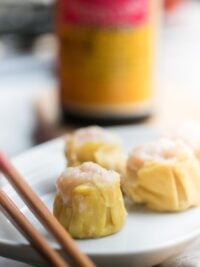
finishedsuimaiparis.jpg


...and after all, it's Pork Blogging Weekend.

So off I went to Tang Freres and found everything I needed for the Chinese dumplings known as Sui Mai. I found just about everything...except for The Most Common of All Of All Asian Ingredients Known To Mankind: cilantro, or coriandre.

Not a bunch in the bin, and I (along with 15 or so Chinese dames) mulled around in a daze, unbelievable that the largest Asian market in one of the largest cities in the world could possibly be out of cilantro. *sigh*

Few people know this but I'm a pretty decent Chinese cook. I owe that to Bruce Cost, who's the best and most gifted chef I've ever worked with. Dressed in knakis and a slightly-rumpled Oxford shirt, he'd hulk over the giant wok, moving slowly in his parallel universe, Lord knows what was going through his mind.

His trembling hands would drop some raw vegetables and chilis into the wok. Then casually he'd add some shrimp or strips of beef. It would sizzle and he'd stir. He'd add a few more things; maybe some strange, unknown vegetables, some sauce, and perhaps some rock sugar or vinegar Then he'd crank the heat to ultra-high, the flames would blaze up around the wok, and in spite of the drama of the roaring fire and the wok, he would just stand there, calmly stirring.
Then he'd simply slide the food on a plate and we'd all be dazzled.

Making the authentic food from many cuisines isn't all the difficult (unless you're making Chinese food and can't find cilantro...) It just requires you to have on hand a few essentials. Few cities I know of lack a Chinese grocer (and most do have huge bunches of cilantro), and in my experience, most well-stocked supermarkets have a decent selection of Asian products (unless you live in...oh, never mind...)

Some notes on a few Chinese ingredients:


  • Sesame Oil
    The best sesame oil is made only from roasted sesame seeds and nothing else. Check the ingredients, as some brands mix sesame oil with vegetable oil.

  • Fish Sauce
    At first whiff, you may say, "Man, this be some nasty shit."
    It smells vile, but tastes remarkable when mixed as a sauce or seasoning. I use the Squid Brand fish sauce from Thailand. In spite of the menacing-looking cephalopoda on the label, fish sauce is made from salted and fermented anchovies.

  • Fresh Ginger
    Fresh ginger should always be rock-hard with no signs of mold or soft spots. You can peel ginger with a paring knife or vegetable peeler, but scraping it with a soup spoon works well to get around the nooks-and-crannies.

  • Water Chestnuts
    Fresh chestnuts are quite expensive in Paris, where they're called chataigne d'eau. The only ones available were cryovac'd. When I got home, I tasted a few and they were so fermented that I had to toss them out. Luckily I bought some canned ones for insurance (proof that as you get older you get smarter), and used those. But the fresh are much better, and they're easily available and inexpensive in Asian markets in the United States. If using canned water chestnuts, double the amount called for.

  • Shrimp
    Fresh shrimp is expensive and I've found that good-quality peeled raw shrimp is fine to use for dumplings (in spite of what people insist, almost all the seafood labeled as 'fresh' has been previously-frozen. Sorry, Charlie...)


presteamedsuimai.jpg


Sui Mai
About 60 Dumplings
Adapted from the repertoire of Bruce Cost

This is a lot of pork to chop.
Yes, it took me about an hour and it's quite a good workout, but I didn't feel the need to go to yoga today...although chopping all that meat may be
bad karma
, so perhaps I should go tomorrow for redemption. (Can you 'bank' karma?)

But the dumplings have a much better texture if you han-chop the pork and shrimp, although you could use a food processor, or buy pre-ground pork.

2½ pounds (1 kilo) pork shoulder (palette de porc)
1 pound (450 gr) shelled raw shrimp
1 bunch scallions, well-chopped (use as much of the green part that's edible)
½ bunch cilantro, chopped
2 tablespoons fish sauce
2 tablespoon salt
2½ tablespoons cornstarch
1 large egg
1½ tablespoons roasted sesame oil
6 fresh water chestnuts, peeled and finely chopped
2 tablespoons finely-minced fresh ginger (peel before chopping)

Round won ton wrappers (or square ones...if the largest Asian market in your city doesn't carry round ones)


1. Using a large kitchen cleaver, cut the pork into slices, then finely chop all the pork up. Put into a bowl.

2. Chop up the shrimp into small pieces and add to the bowl.

3. Use your hands to mix in the scallions, cilantro, fish sauce, salt, corn starch, egg, sesame oil, water chestnuts, and fresh ginger.


filling.jpg

Yummy looking? Well, not yet...


4. Form the meat mixture into balls about 1-inch (3 cm) and place them on a baking sheet lined with parchment paper.


meatballs.jpg

Ok, much better...

5. Take a won ton wrapper and place a meatball in the center. Gather the edges up and press the wrapper against the meat making a little cylinder.

Repeat with remaining meatballs.

6. To steam the dumplings, line a bamboo steamer with banana leaves and oil them lightly. Turn on the heat, and once the steamer is hot, steam the dumplings until hot all the way through, which will take about 5 minutes. (You can also use a steamer basket lined with cheesecloth, or lightly oiled.)

Notes:
If you wish, the meatballs sans the won-ton wrappers can be gently dropped into simmering water and cooked for about 5 minutes, until cooked through, then served with the dipping sauce, or floating in soup.

Once steamed and cooled, the dumplings can be frozen in freezer-bags.


Dipping sauce

1 tablespoon finely chopped fresh ginger (peeled)
1 tablespoon finely chopped garlic
2 tablespoons fish sauce
2 tablespoons white Chinese vinegar
1 teaspoon sugar
½ teaspoon white pepper
3-4 teaspoons roasted sesame oil
1-2 teaspoons chili oil

Mix all the ingredients together. Serve with the hot, steamed dumplings.

Kevin at Seriously Good tagged me with this, The 2006 Food Challenge of This Year I Dare! You're supposed to talk about things you're going to do different in the kitchen this year.
Here's a few...


Garbage Bags
I'm only going to buy premium, top-quality garbage bags this year. No more el-cheapo, whisper-thin bags that you could read Le Monde through.
I generate mounds of fruit peelings, coffee grounds, egg shells, and all sorts of other icky stuff that doesn't exactly get any better if it sits around for a few days or so. The last thing I want on my trip to the garbage room in my building is another accident in the elevator. Trust me. Having your garbage spill in an enclosed space crammed full of your fancy Parisian neighbors, where your every single move is scrutized, really sucks.
Like cheap toilet paper, that's not one of the places you want to skimp on quality.


Madeleines
I'm going to master le Madeleine. And I promise not to mention 'Proust' in the same paragraph as the word 'madeleine'...ever.


mads.jpg


Yes, we all know he wrote extensively about eating one. But was he kind enough to include a recipe?
No.

What a jerk.


Vanilla Extract
I made the sorry error of buying cheap vanilla extract when I was in the US. Pure vanilla extract made from vanilla beans and alcohol is unavailable here. (Yes I do know, I've searched exhaustively. Please don't leave comments that I don't know where to look. The American-stores don't count; I'm not paying those prices for tiny bottles of vanilla, the way I go through it. Read the ingredients. They all contain sugar, or no alcohol, and area labeled arôme, which ain't pure extract.)

I was mesmorized by everything that's available at Trader Joe's on a recent visit to San Francisco.
People brag to me all the time, "I buy vanilla extract at Trader Joe's! It's so cheap! It's only $4.99 per bottle! What a bargain!", they go on and on and on and on...


tjvanilla.jpg


So I arrive back in Paris, twist off the top, and take a sniff. Phew!, this stuff smells like pure alcohol with maybe the idea of vanilla somewhere vaguely in the background.
Trader Joe's has a lot of very good things, but their vanilla isn't one of them. Nor is it a bargain. Cheap food that doesn't taste good is no bargain.
And you may quote me on that. Or have it tatooed on your chest.
Or wherever you want.


rainschoicevanilla.jpg


Then I checked at Vanilla.com and their Bourbon vanilla is the same price when you buy a quart. And believe me, it's amazing. And a quart lasts me about a month. Especially when I'm making all these madeleines.

(Yes, there is shipping, but since if you live somewhere that you don't get charged 10.21€ for calling customer service, you can afford to spring for it...)


Memes
I promised not to tag anyone for a meme anymore. It's like getting a chain letter. You feel guilty for not answering it, and you feel like an idiot if you do. So I'm not going to tag anyone.

Ok...on second thought, I'm going to tag Michele and Cindy, just to be a brat.


Is that bad?

When my internet service went down a few months ago, I telephoned the company to arrange an appointment for the repair. After three long weeks, service was restored.

Then this came with my phone bill:


holyshit!.jpg


In France you get charged to speak to someone in 'customer service', at 35 centimes per minute.
Let's say you're on hold for 30 minutes. You get a bill for 10.21€, about $12.50.


So next time, I should...


powerball2.jpg


    Ode To A Powerball™

    By David Lebovitz


    I think that I shall never see,
    A Powerball™ as lovely as ici.

    The rosy ball ensures success
    Against my dishes, which entered a mess.

    Inside the dishwasher, so full it is scary,
    But I just press the button! Could I be more merry?

    A sudsy froth, I'm sure it will yield,
    Behind the closed door, its fate has been sealed.

    An unequaled tablet, whose gift is released,
    Round and round goes each cycle, until all has ceased.

    Without it I know that my life would be worse,
    Washing dishes by hand is indeed quite a curse.

    A mess is made daily by fools just like me,
    So I give thanks to Calgon, for they make what you see.


    (...with apologies to Joyce Kilmer, 1886-1918)


Oy!

9 comments - 01.11.2006

To see something very sad, click here.

Yes. It finally happened.


(As seen in The Food Section)

I had an Epiphany this weekend...


ephiphany.jpg

140
140, rue de Belleville
M: Jourdain

Dada

29 comments - 01.09.2006

Today was the final day of the exhibition simply titled Dada at the Centre Pompidou. Paris is a city that doesn't really embrace modern art. I mean, when your history is thousands of years old, the last 100 years are nothing but a ripple.
But the Pompidou Center proudly holds it's place in the center of the spiral of Paris, the famous inside-out building which caused such a ruckus during the groundbreaking that women from Parisian society were reported to have thrown themselves in front of the bulldozers in protest.

Although it's not a far walk from anywhere no matter where you are in Paris, I rarely go to the Pompidou since the lines always seem formidable. But today something in me prompted me to brave the lengthy queue which (as you can perhaps surmise) began a bit too early for me this morning...


inline.jpg


I had an unconventional and artistic upbringing.
My mother was a weaver and a spinner. She went to art school with Andy Warhol and Barbara Feldon (best known for her role as Agent 99 on the television series Get Smart.) However, much to my star-struck chagrin, my mother never kept in touch with either. But she was really something. Even in our trappings of upper middle-class suburbia, I would stare wide-eyed as my mother would load up the Mercedes, don her Frye boots, toss her Louis Vuitton handbag in the passenger seat, and speed up to Vermont to spend the weekend on a farm with bearded hippies and shearing sheep with them, afterwards dying and weaving the soft, oily wool into beautiful fabrics.
She'd sometimes bring big, fluffy sacks of wool home and we'd sit on the front porch in the heat of summer (her wearing just a bra and shorts, drinking Miller beer from the bottle), scraping the wool between two wire-bristled brushes to remove any impurities (ie: thistles and sheep poop). Our hands were always dewy soft and fragrant from the lanolin and the lush softness lasted for days and days.

Luckily for me, I was exposed to a lot of art and creative expression, as well as a certain amount of kookiness during my life. How I ended up living in a little rooftop apartment in Paris, writing about baking cookies and cakes for a living is beyond me. I guess I wasn't destined to work at IBM or perform brain surgery, although I know deep-down that having a son who was a doctor would have made her very, very happy and kept her in far more Emilio Pucci than she could have imagined.

At the Pompidou, the show was astounding and really knocked me for a loop. It led me to think and reflect about so many things while I wandered through the galleries, transfixed by films of illuminated squares and rectangles, and floating mobiles made simply of wooden hangars, the creator managing to find beauty and simplicity in everyday objects we normally take for granted.

Dadaism was a movement, or counter-movement, against the art "establishment". It's similar to how the blog was, or is, a reaction against the established 'media', where a free-flow of ideas isn't restricted by economics or politics. It's where anyone can say and do whatever they please. The other parallel is that Dada was a reaction to the coming technological age and they were rebelling at values they felt were destructive to society and humanity.

There are many political blogs that confront many of the problems in media and politics that traditional sources of information often avoid.
Unfortunately, I don't read many of them. But I get a fair amount of other vital information from some of the others. For example, I am still trying to find deeper meaning in the break-up of Nick and Jessica. Or when Katie's gonna pop and Tom and her are actually going to get married.

At the beginning of the Dada movement, many of the artists refused to sign their works. They felt that art should not be about the artist, but about the art itself and the message. Indeed many of the works were collaborations, much like some of the fine collaborative web sites that have sprung up that aren't about the writer or the originator of the site, but about creating a discussion board and medium for a free-flow of ideas.

As I wandered through the exhibition, I noticed that many of the French artists, such as Duchamp and Picabia, were the most playful of the bunch and would use a urinal, a comb, or combine scraps of newspaper and typography into works of art. Artists from more disciplined cultures, like Switzerland and Germany, were more apt to play with industrial or mechanical themes. And American artists like Man Ray (who lived in Paris) used everyday objects like eyeglasses and cheese graters to make his 'rayographs' on photographic paper, combining both the industrial with the ordinary. He saw both in an entirely new way.

In their short time, the Dadaists knocked the establishment on its ear and I left the exhibition both stunned by their message and the magnitude of what they had accomplished. They were rebelling against everything people thought about art and the bourgeois values of their time. And now, even though their art is on display in a museum, valued at millions, it's still able to convey anger and a contempt for the stratification of the world of art and the greater society.

It's hard for us today to think that a major scandal could be caused by mounting a bicycle wheel on a stool and calling it 'art', or that a urinal simply signed by the artist would still cause rage in 2006. But it does. A man attacked the work of art with a hammer last week. He was the same one who attacked the work about 12 years ago. The piece, unfortunately, is no longer on display.

Once back home, I got to thinking more about why we do what we do. For example, here I use this website to communicate with readers impressions of my life in Paris and sometimes beyond. Wherever I travel and find something to savor and eat, I share it. It's fun, and I enjoy getting feedback from those of you who choose to leave comments. Some of you comment frequently, and others will pop me a message once in a while. And I read them all with great curiosity and interest.

I enjoy the spirited camaraderie of other people I've met who have blogs. I've had the good fortune to devour Pierre Hermé's desserts and tipple a glass of cool Sancerre with a few here in Paris. I got to star in a video, roaming the city streets in pursuit of fine chocolate with a very nice Jewish boy from New York (who, alas, is not a doctor either...sorry mom.) And I've swapped chocolate tips while oogling the most luscious photographs from fellow expats in Germany.
I've learned about well-aged, syrupy balsamic vinegar by lapping it up with fragrant wild strawberries in Florence. I tasted waffles and ice cream for breakfast along with bottomless cups of good ol' American coffee in Chicago. And I had a fireside lesson in the art of making confit de canard in Gascony, fueled by a glass, or two, of fine, locally-produced Armagnac.

On the internet there's few boundries. Want to write about gluten-free pizza? Go ahead! Did you find a magnificent ham at the market that you just had to photograph? Shoot it, and let's take a look. Was dinner last night amazing? Show us. Had a culinary catastrophe that's too funny to keep to yourself? Share the joke.

The internet allows us to keep in touch, bound by our love of good food, often accented by our appreciation of other cultures. You may be tethered to your desk at work or stuck in your apartment, but you can take a break and learn about a luscious sweet confection in Lyon, be intrigued enough to try a new recipe for Guacamole, drool as steaming noodles get ladled into bowls at an exotic outdoor market in Vietnam, and explore the vivid spices piled high in the markets of India and Africa.

I just don't want to get wacked by any hammers along the way.


Dada
The exhibition will be at the National Gallery of Art in Washington, DC from February 19th-May 14th, 2006. And at the Museum of Modern Art in New York from June 16-September 11th, 2006. Don't miss it.


(Oh, and by the way, thanks mom...wherever you are...)


mom.jpg

Sandra Purins is the lucky winner of an autographed copy of The Great Book of Chocolate.


f2lowersparis.jpg


The Menu For Hope II raffle raised over $17,000 for UNICEF to aid the people of Pakistan. Big thanks to the many generous people, like Sandra, who contributed in our effort. I'm thrilled to be able to take you (wherever you are!) to my favorite ice cream place in the world for a few scoops of my favorite flavors.
May I suggest chocolat amer and caramel?...that's what I'm having!

Sandra...email me...I'm getting hungry!

As you may know, I've been nominated for the Best City Blog. Someone wrote that I wasn't really writing enough about Paris to be qualified, so I thought I'd better get on le stick about that!

The pressure! La pression!
Hmm, what's very French and very Parisian that I can write about?

Um...How about my lunch...?


3cheeseplateparis.jpg


Yes! That's a few slices of my pain aux ceriales from Le Grenier à Pain paired with some delightful cheeses that I discovered when visiting one of my absolute favorite fromagers here in Paris this morning.

Disclaimer:
I confess to a secret and unfulfilled ambition.

Except for working outside in the icy-cold winter and freezing my bourse off, getting up at a godawful hour, and lifting heavy wheels of cheese, my fantasy job is to work as a fromager. Being surrounded by big wheels of cheese and small pyramids of goat cheese, the smell of all those gooey, runny, and nutty cheeses...it all makes me delirious with pleasure
Ok, I guess I could deal with lifting the wheels of cheese, but getting up at 4am?
Now that's another story...

As a fromager, I would make recommendations to les clients. "Qu'est-ce que vous desirez, madame?", I would ask, ready to council the customer. (Using my perfect French, of course...this is my fantasy, remember?) I'd slice and wrap a fine selection of cheeses to serve to her her family after a well-prepared supper of roast pintade and pommes des terres rôti with a fine, crisp Sancerre or gravely, full-flavored Pomerol.

We'd make witty banter about Johnny Halliday and socks with whimsical cartoon figures on them while I selected a few fine cheeses, perhaps a dead-ripe Camembert de Normandie and a Corsican Brin d'Amour, covered with fragrant mountain herbs.

Ah, je rêve...

I visit many cheese shops, oops, I mean fromageries here in Paris. I search for shops that have unusual cheeses, since many of the best ones seem to focus on a particular region or type of cheese like les chèvres or fine mountain cheeses from the Savoie.

Although many of the outdoor markets have people selling cheese, I've found none better than N. Caillère at the Popincourt Market in the 11th arrondissement on the Boulevard Richard Lenoir. Twice a week, the two cheery women who run their stand never fail to prompt me to discover a cheese I've never tasted.
Such as this triple-crème Délice de Saint-Cyr...


2stcyr.jpg


Triple-cream means the cheese has a minimum fat content of a whopping 75% (although that percentage refers to the amount of fat in the solids, and most cheeses are about 50% water and 50% solids...still, it ain't no rice cake.)
Although I ate it at it gooiest best, at room temperature, the cheese left a sweet, suprisingly cool aftertaste.

They also had a lovely, and well-aged Comté de Jura, a marvelously-nutty, full-flavored cheese made from raw cow's milk and is the most widely-produced cheese in France.
And it's popular for good reason; it's always excellent and pairs well with most other cheeses on a cheese plate as well as both white and red wines.


comteparis.jpg


I'm in love most goat cheeses; I seem to like them all. With their smooth, dreamy-white interior and their soft, gentle aroma of the farm, it doesn't matter to me whether they're fresh or aged. It's a rare day at the market for me if I don't have one tucked into my market basket.


tommechevreparis.jpg


This Tomme de Chèvre is from a small farm and is called Vendômois. Although the outside has the fine crust of mold, I was told the cheese is rather young and the elasticity and suppleness of the p&acurc;te indeed suggests less affinage, or cave ripening.

N. Caillère
Fromager

-Popincourt Market
(Tuesday and Friday)

-Place Réunion Market
(Sunday)

News Flash!

This blog has been named one of the Top 10 Food Blogs Good Enough To Eat by About.com, a division of The New York Times.


abT.gif


Check out the article, as well as the other food blogs listed.


Also final voting for the 2005 Food Blog Awards have been announced...cast your votes here.

One of the great things to do in Paris is to wander. I'll often catch a film, search for a monument, of just mètro to a far-off neighborhood...then walk.

The 13th arrondissement of Paris is a real cross-cultural quartier.
Part of it is the quartier Chinois, where there's huge and small shops selling exotic Asian fruits and vegetables, as well as unidentifiable cuts of meat (that are perhaps best left unidentifiable...)

Many Asians set up shops and restaurants in the area during the 1970's, when the neighborhood was neglected and rather dingy. But now there's much to be said for this area: there's the little village of Butte aux Cailles, a tiny village with convivial restaurants, and cafés and there's a fabulous natural-source piscine (swimming pool) where I've cooled off on more than one swelteringly hot summer afternoon in Paris. (Bathing caps are mandatory in public pools in Paris...even for men...even if you're bald!)

On a recent stroll through the neighborhood, I stopped by one of my favorite out-of-the-way boulangeries, Le Grenier à Pain and found these whimsical chocolate-covered Pain d'Epices...


paindeepiceparis.jpg


Almost before I could get out of the shop, I ripped into the sack, plucked one out, and took a bite. And boy, were they superb! Chewy and spicy-brown cake, fragrant with cinnamon, cloves, and ginger, all enrobed in a thin layer of bittersweet dark chocolate.

I turned around, considered getting another bag but instead spotted a beautiful loaf, le pain aux ceriales, on the wooden rack behind the counter.


painauxcerialsaparis.jpg


Of course, when I got it home I immediately sliced into the irregularly-shaped loaf. It was excellent and just like I imagined it would be. Rich with whole-grains, deeply-flavored with sour levain, and a firm crust, and wonderful paired with an assortment of cheese I had just selected from the fromager. I smeared the slices with a luscious and dangerously unctuous Délice de Saint-Cyr, a triple-cream raw milk cheese from the region of Brie I'd just selected on the excellent recommendation of my favorite fromager.


Le Grenier à Pain
52, avenue d'Italie
M: Place d'Italie or Tolbiac
Tel: 01 45 80 16 36

(Other locations throughout Paris.)

Sometimes I feel like I must be walking around with a sign on me that says...

"Even though it's obvious from the way I'm holding it, I'm carrying a fragile dessert that I've spent hours making...

...But please feel free to walk right into me anyways."


Yes, that was me trying to navigate Paris, tranversing the sidewalks and mètros of Paris, hoping to make it safely to the New Year's party I was invited to with my Almond Tart.


paris!2006.jpg


As those who read this blog regularly may recall, I'm a target for Parisians when carrying fragile cakes and tarts down the street. For some reason, they'll just walk right into me.

But this time, I got wise to their antics and thwarted their efforts to derail me by remembering a favorite recipe from my past, Lindsey's Almond Tart, one of the all-time great desserts that I made almost every day at Chez Panisse for years and years. Once baked, the tart is bullet-proof: and as anticipated, the disk of firm caramelized almonds successfully withstood both the Line #1 and #14 mètros.


almondtartparis.jpg


I made it safely to my New Year's Eve fête with the tart. I did get body-checked by a Parisian in the Bastille mètro, forcing me to crash into the tile wall, and heard the loud "Thwack" of the porcelain cake plate it was resting on.

"Zut!, I thought.
But the tart arrived safely and after dinner, everyone nibbled on it happily along with the last of the cold Champagne along with the Chocolate, Sour Cherry, and Toasted Almond Bark that I made with fleur de sel, which was equally a big hit.


So here's a few resolutions for my life in 2006...

-I'm going to avoid the black tar as much as I can...

cafemalongoparis.jpg


-I'm going to perfect my Madeleine recipe...

mad4madeleines.jpg


-I'm going to cut back on the amount of chocolate I eat...

toomuchchocolate!paris.jpg
(...not!)


-I'm going to get to work on my next cookbook...

sacsucrecrystalparis.jpg


-And I'm going to become a true Frenchman and no matter how impeccably or fashionably dressed I am, I'm going to wear the wackiest socks I can drum up...

orangesocksparis.jpg


I will avoid socks with images of Homer Simpson or Asterix, though, so popular with the men here in France, though. Even I have my limits.

Sleepy-eyed after a very long night of wining & dining, I crawl out of bed and pour myself a steaming hot bowl of café au lait and toast slices of pain au levain...


petitdejeunerparis.jpg


The beginning of another year in Paris.

I bring the bowl to my lips and take a comforting sip.
MMmmm...

I slather butter on my warm toast. It melts and forms little buttery puddles in between the delightfully irregular bubbles revealed each time I slice and toast another slab from the hearty loaf.
I drizzle it with bitter chestnut honey. Delicious.

The sweet, creamy smear of butter and the sharp, amber honey pair feel just right this morning after a night scraping briny oysters from their shells and washing them down with endless flutes of icy Champagne. After we polished off several platters of les huitres, our next course was tiny roasted quails, expertly roasted with root vegetables, accompanied by the smoothest puree of potatoes, mounded alongside, bathed in a delicate sauce made from the savory pan juices.

Afterwards, a long sleep was in order while all of Paris closed up for the night. My re-entry to the world begins when the late winter sun peers out from behind the curtains. A few slow, tentative movements as I slide out of bed, and I find myself back into the world.

That wonderful luminosity of Paris!
The sun peering through the grey still of winter.
The heater buzzes softly in the corner, the only sound, except for the faint patter of traffic on the street down below.
The gentle quiet of a slow morning, as Paris begins to wake up. Curtains are tentatively opened in buildings across the way. A queu begins at the corner bakery, Parisians exiting with slender baguettes tucked under their arms and warm, buttery croissants enclosed in stiff bakery paper.

How wonderful to live in a city where breakfast inspires a photograph.
I finish the last, warm sip of my café au lait.

My clothes are draped carelessly over the sofa where I dropped them the night before. I gather them up.

Then I smell it.

That ever-present, overpowering smell.
Cigarettes.

My clothes reek of cigarette smoke.
The woman sitting next to me last night spent the evening chain-smoking. She went though an entire pack of cigarettes during dinner. No sooner did she finish one cigarette then she lit up another. The room became so smoke-filled that I had to get up several times during the night just to catch some fresh air in another room. My eyes burning with acrid cigarette smoke, at times I was barely able to breathe. Every so often, the room would clear of it's grey, foul, heavy smoke...then someone else would light up, prompting everyone else to reach for their cigarettes and light up another.

My clothing will have to go to the cleaners.

I settle in at my desk to check my email.
My email doesn't work, nor does my internet connection.
Click. Click...ClickClickClick....CLICKCLICKCLICKCLICKCLICK...
No email. No internet. Nothing.

I consider calling Noosnet Customer Service, then I remember the last time I tried that.

Four weeks later they re-connected me.


Brrrr...
I shiver and wonder why it suddenly feels so cold? Why does it seem so dark inside?

I switch on a light. Nothing happens. I try another lamp.
Nothing.

The heater has stopped buzzing and the metal feels cold to the touch.

My electricity is off.

I begin to get chilly, thinking a nice, hot shower will warm me up.

I run the water for a few minutes.
The pathetic spittle of water that comes from the shower nozzle is barely tepid. I let the water flow for a few more minutes. It's still cold, the water just slightly warmer than the now almost near-freezing temperature inside my apartment. I shiver and think about getting in, then turn off the sad trickle, putting it out of it's misery. I decide to get back into bed, burying myself under my fluffy down duvet and crisp linen sheets, where it's all warm and cozy.


"Bienvenue à Paris...let's give it another year."...I sigh to myself, before dozing off.


David's Amazon Store

Subscribe

David Lebovitz

Monthly Archives

Archives By Date »

Browse by month: 2009

Browse by month: 2008

Browse by month: 2007

Browse by month: 2006

Browse by month: 2005

PPF2.png


David Lebovitz