August 2006 Archives

David: Hey Frederick, I remember meeting you years ago at a Food Show, and was really impressed with both you, and your exceptionally good chocolate. You were so friendly and open about what you were doing, and I saw in you such a passion for producing high-quality chocolate from organically-grown beans. I'm so glad we've kept in touch since then, and you're happy to answer some questions about Dagoba chocolate.

While it's everyone's dream to open a chocolate factory, what made Frederick Schilling do it?


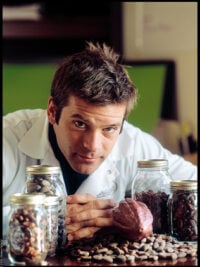
frederickschilling.jpg


Frederick: I come from a mixed background of music, religion, professional ski-bumming and a passion for food. I actually never liked chocolate as a child or a young adult. It wasn't until I was cooking at a higher end restaurant in Boulder Colorado that I experienced what a higher quality chocolate was. At the time we were using Valrhona and El Rey and I started to nibble on the bricks back in the pastry corner. It was the bittersweet that managed to maintain my attention and interest. When I started to look into chocolate further and learning of the rich history and lore of cacao, I was hooked. I have a deep appreciation for religion and culture and when I learned of the Aztec reverence for cacao, it really opened my mind to wanting to explore this bean much deeper. That was what got me going.


David: I know how you feel about getting hooked. Those innocent little nibbles can really lead to something much larger.

Why did you decide to go organic?

Frederick: From the beginning of my young adult life, I have been very passionate about sustainability and organics. I was already philosophically aligned with the organic movement before the inception of DAGOBA. So naturally, since I was exploring the idea of creating a food product for the market, it had to be organic.

Aside from chocolate bars, you also have a line of other products, all organic, including chocolate chips, cocoa nibs, hot chocolate mix, and chocolate-covered coffee beans. Where are Dagoba chocolates produced, and why did you choose to open your production facility there?

Our factory is located in Ashland Oregon. It's a small town in Southern Oregon, just over the California border, in the Rogue Valley. It's absolutely gorgeous here; and that's why we chose to have the factory here. The quality of life is pretty uncompromised. I'm able to ride my bike to work, go mountain biking right out my front door, skiing, hiking, kayaking, rafting... there are a plethora of outdoor activities to partake in around here. The town also has the nations largest Shakespeare Festival, so there is the element of theater wafting thru the streets. Interstate 5 goes right by the town so access for shipping product, while not as easy as being located in a major city, is pretty good.

We just purchased 3.5 acres of land in town and will be building a new factory this coming year with completion in the summer of 07'. It's going to have many 'green' aspects to the structure; solar panels up top and permaculture landscaping as a couple of examples. This factory will be open for tours, so make sure you stop by when you're driving thru!


David: Well, you still look pretty young to me. Must be all that chocolate.
After being in business after a few years, in reflection, what's been the most difficult part of making chocolate?

Frederick: We just turned 5 in June and it has been one interesting ride. I started the company in my kitchen, hand made the product for the first 1.5 years and have been pretty much making it up and learning as I go along. So while it's been extremely fun and interesting, the whole experience has a shadow of difficulty because it was founded with blind ambition.

Starting a company is just difficult. It takes a lot of time, hard work, patience, faith and a little ignorance too. The ignorance, while makes things a little difficult, also acts as the catalyst for pushing me. I don't know something, so I'm going to dig into it. That ignorance eventually turns to skill and knowledge. Then, with that knowledge and skill I start to create more things, usually burying myself in the process, digging up more things that I'm ignorant on, then learning more, then creating more, realizing how much I don't know, then learning, then creating more, realizing how much I don't know and so on. It's a great cycle and one that the creative mind needs in order to maintain itself. We need elements of difficulty to push us.

Yet, as the organic chocolate market starts to gain legs, sourcing enough high quality organic cacao may become very difficult; sooner than later. It's all about the source, right? As more organic chocolate companies start to spring up around the world, or as current companies come out with organic chocolate, a lot of them will be going after the good beans. It's already becoming tight. That's why I'm leaving for Central America in 2 days; to maintain and create new relationships with growers.

In 5 years, it's going to be very interesting indeed.


David: We leave in two days? I don't think I can get packed in time. I'll have to wait for the next trip.
When researching The Great Book of Chocolate, I met a lot of 'characters' in the chocolate world...and not all of them were particularly nice. Without naming names (my editor wouldn't let me, but you can...) can you tell us about any clashes you've had?
Why is the chocolate world so competitive?

Frederick: For the most part, everyone I've met in the industry is really nice. For the most part, everyone has always spoken to me with openness and really helped me figure this industry out. Yet, I've never been a threat to them. I was always considered as this little organic chocolate company - "Oh, how sweet, he's making organic chocolate". The chocolate makers/companies that I always spoke to were not making organic chocolate so they were willing to share their knowledge. YET, now that things are changing, DAGOBA is growing and more companies want to move into the organic chocolate market, lips are tightening a bit and vest are being buttoned.

As for being competitive, I don't think it's any more competitive than any other industry. Company secrets are company secrets. A lot of the hush-hush attitude that does permeate our industry probably has its roots from the Mars and Hershey dysfunctional relationship from years ago.

The thing is though, when you're talking about pure chocolate, there aren't any real secrets. Everyone knows how to make it. Everyone knows what kind of equipment the others use. Everyone knows where cacao comes from. Now, companies are even saying what farm the cacao comes from! So, transparency is actually becoming the "new thing", right?


David: There's a lot of talk lately about the 'corporate' organic movement, and we're seeing organics at chain-stores and supermarkets. On the other hand, there's also increased interest in buying local at farmer's markets, which are often organic. Obviously you can't use locally-grown cacao, but where does Dagoba fit in to all of this? And will we see Dagoba at Wal-Mart?

Frederick: A very good question.
This is a huge question David and one that I think of everyday, literally. I don't think there is a right or wrong answer, to be honest; it's an experiment in the making. Although, like you state, the best choice for food is to buy from the local organic farmer, or better yet, grow it yourself.

On the corporate organic movement; is it wrong to have organics at chain stores? Big box stores? Isn't this what we, the believers of true food, wanted? To get rid of the artificial food chain? Just because the stores that we now buy our food from are larger than most South Pacific islands, is it wrong that they are providing the people with organic food? This is what the people want. Now I personally don't shop at the large box stores, but ultimately, I believe this is a move in the right direction. Would I rather see an industrial farm being grown conventionally or organically? The industrial farming model isn't going away anytime soon, so in my opinion, it's a move in the right direction; to cut back on the amount of chemicals being applied to the soil. Perhaps in 10 years, the consumer will 'urge by purchase' the corporate growers to move back to a "biodiverse" farming model, which is more sustaining to the land. Ultimately it's up to the consumer to dictate what happens in the marketplace. In 10 years, if the big box consumer, after being educated on what organic means, wants food that comes from an even more sustaining farming model, the big boxes will respond as will the industrial farming operations.

Cacao grows in the tropics, so I'm forced to rely on fossil fuels to get our raw material to us; until I'm able to charter a fleet of large sail boats to transport my cacao to port and then move the beans via biodiesel fueled trucks to our new solar powered factory. As you know, DAGOBA is a company that makes every effort to be as "eco-minded" as possible. We use 100% alternative energy at the factory; use 100% recycled content paper for our wrappers and office paper, we compost our kitchen waste and many other small things. Are we perfect? Far from it. Yet, we're making the conscious decision to be aware of what we do and how we can improve upon it.


handmakingdagobachocolate.jpg


DAGOBA in Wal-Mart?
I actually just had this conversation on Thursday at our employee meeting. This very question was raised. My response; would it be a bad thing? If more people want organic chocolate, which is made from organic cacao, isn't planting more trees in the tropics a good thing? Would it be a good thing to go to Central and South America and convert deforested land to fields of cacao trees? I say yes. If we, DAGOBA, can have a positive impact on the tree situation in the tropics, I have no problem going into box stores. For me, it's not about preserving the ego of the brand perception. Some of our core consumers may be upset if we sell to Wal-Mart, but I would ask them these very questions. I think our core consumer, once they understood the potential good that could come out of selling more organic chocolate, would sympathize with such a decision.

As you know David, cacao is very different than other crops. The vast majority of cacao is grown on small family farms, where they also grow many other crops and fruit trees. Cacao, by default, is already being grown very sustainably in bio-diverse settings. If we can further this model, because of consumer demand, by replanting deforested areas then I can only say I'd be a hypocrite if we didn't do business with box stores.

We all need to be the Lorax in this day and age.


harvestingdagobabeans.jpg


David: Another chocolate-maker, not a Lorax, told me that most cacao beans aren't sprayed much since the locals can't afford it, but I've also heard otherwise.
What's the truth?

Frederick: Both are true.
As I just noted above, the vast majority of cacao is grown on small family farms and yes, most of them are too poor to afford chemicals. It's on the larger plantations that spraying will occur and most often it's the "premium" brands that will buy plantation grown cacao because it's often of better quality. I believe the government of Ghana will do aerial sprayings from time to time, as cacao is such as important export to that countries economy.

Methyl Bromide is the fumigant of choice for cacao, and this is where the pesticide gets applied. The cacao doesn't get sprayed on the farm level; it's at the ports where the cacao gets sprayed. When a container of cacao leaves a countries port, there's gonna be insects in that cacao, so they fumigate. When the container arrives into port, say in the US, and there is any sign of insects, they fumigate again. I've heard that cacao is actually one of the most heavily fumigated commodities in the world. I have a friend in the industry that used to work at a very large chocolate company and his job was to, every Thursday, fumigate the cacao warehouse with Methyl Bromide. He had to have a special handling license to carry out this task. I hear murmur in industry that methyl bromide may be getting phased out of use, which is a good thing, as it's nasty stuff.


David: I read somewhere that professionals don't use organic chocolate, since it doesn't taste as good as 'regular' chocolate. What are your thoughts on this and who's the biggest market for Dagoba chocolate, home cooks or professionals?

Frederick: To the professionals that say this, I would say, in a blind taste test of the San Francisco Chronicle, we beat Scharffenberger and Valrhona. We were awarded 'best dark chocolate' - the first time an organic chocolate ever won this award. Taste, is of course, subjective. I personally don't like a brand of French chocolate that people do back flips over for. To me, it tastes over roasted and the particle size is actually too small, therefore making it feel slimy on my palate. Other people go gaga over it. No right or wrong. I personally don't enjoy it.

There really is no difference between conventional and organic chocolate when it comes to quality. Taste is taste and conventional chocolates all taste differently. Organic chocolates all taste differently. I would be more than happy to sit down with the professionals that say that organic isn't as good as conventional and conduct a blind taste test and have them tell me which is organic and which is conventional.

Our biggest market is thru retailers. Our retail bars are what drive our business. We're a small company and we just can't compete on price with the big boys for food service business. We do sell our chocolate to a great many elite restaurants who brand us on the menu. But outside of that tiny niche, we don't sell much in the food service sector. Plus, for the retail bars, it allows me to create more and experiment with flavor infusions, which I really love doing.


David: And are there any pastry chefs that you know who are using your chocolate?

Frederick: Honestly, not off the top of my head. I don't pay attention to this, even though I probably should. I like what I do and often times get very tunnel visioned in my passion, meaning I don't pay attention to the "who's and the what's" as much as I probably should.


David: Lately, everyone's obsessed with percentages, which signify how much cacao is in the chocolate. Why do you think that is and do you think percentages are important?

Frederick: I think it started erupting when the health benefits of dark chocolate started to get announced by the media. This is when the public really started to pay attention to the cocoa content, as they were all looking for 70% or higher, regardless of what it tasted like.

I think percentages are important as they act as a kind of barometer for how dark chocolate is. It will rest on the flavor of the chocolate for me, but I'm much more apt to purchase a 65% or higher, so I personally appreciate knowing how much cacao is in the bar.

Yet, we must also remember that cacao percentage is defined as how much cacao is in there, not just cacao solids. So the percentage can include cocoa butter, which will dilute the flavor. So we can have a 85% dark bar that has an extra 20% cocoa butter added, making that 85% bar very mild; and probably pretty nasty too.


dagobabars.jpg


David: To be honest, Frederick, I never really liked milk chocolate until I tasted your Dagoba Milk Chocolate Chai Bar with candied ginger and spices, and a whole new world opened up to me. So I tried some of your others, including the Brasilia Bar with coconut and Brazil nuts, and Latté, scented with coffee beans and cinnamon, and now I'm hooked on milk chocolate, as well as dark! Who came up with all these exceptional flavor combinations? (And how can we become tasters?)

Frederick: I create the products, usually after a bottle of really good wine. The Chai is actually one of my favorites too. Some people say it's too strong on the spices, but it's the way I like my chai tea - spicy! I like a lot of cardamom, nutmeg, ginger, anise in my chai tea, so that's how I wanted to create this bar. I experimented with a dark chocolate chai bar, but the bitters of the dark bar really suppressed the spices.

Once the new factory is up and running with the tours, I'm sure we'll have the "tasting trial table", where people can try some of my new creations and write comments.

Ever had a milk bar with bacon bits and sun dried figs? It's so good.


David: Bacon and dried figs? Sounds like a nice breakfast! I can't wait for that one, Frederick. I noticed you've concocted cacao 'elixirs'. Who came up with these and what does one do with them?
And what the heck is 'horny goat weed'?

Frederick: What we did is use vegetable glycerin as the solvent base instead of alcohol, so there is an inherent sweetness to the elixirs. Then, the primary botanical in the elixir is cacao; which we extracted from organic Ecuadorian Arriba Nacional nibs. From there, we built on the botanicals for each formula. THEY ARE SOOOOOOO GOOD!!! The plain Cacao Elixir is like getting your chocolate craving without eating chocolate. There is no cocoa butter, so you're not eating the fat (nothing wrong with cocoa butter though!). The Antioxidant Elixir is made with copious amounts of berries, so it's really rich in flavor.

Horny goat weed? Exactly!


David: If someone's serving a chocolate dessert, what beverage do you think goes well with it?

Frederick: If it's got a cork in it, I like it.


David: I'm very excited when I learned that you've found a source for rare and special Ocumare cacao beans and you're going to start selling it soon. I've had a few Ocumare chocolates and they're exceptional. Why did you choose to pursue Ocumare, which is rare and frankly, rather costly?

Frederick: Ocumare is expensive and rare.
We were able to secure the majority of last springs harvest and the next harvest. It's exceptional cacao and the post harvest handling is top notch. I was really impressed with their facility. Ocumare is also certified organic, which many people don't know. As we grow as a company and my desire to continue to create world class chocolate matures, sourcing the best cacao has to be the primary focus. Without the best cacao, we can't create the best chocolate.

We'll also be bringing in some other very special cacao from Venezuela. I happened to be at the right place at the right time and secured some cacao from Puerto Ayacucho. A few times a year, Indians from the Cepai tribe come down from the headwaters of the Orinoco River with wild harvested cacao. It takes them about 15 days in their canoes to bring the cacao to Puerto Ayachucho. If the river is low, they have to go over land on donkeys, which takes about 30 days - one way! They only bring about 3,000lbs per trip, so the supply is extremely limited. The flavor is very unique and I'm really excited to be able to make chocolate from this cacao and offer it to people.


dagobabeans.jpg


David: I love your Xocolatl bar, a wickedly-dark bittersweet chocolate with chilies and cacao nibs, which is in my personal Top Ten Chocolate Bar category (actually, my top five.) People think adding chilies to chocolate is new and exciting, but it's been done for thousands of years. You're following a long-standing tradition. If that isn't your number #1 selling chocolate bar, can you tell us what is?

Frederick: Yes, it is actually our #1 selling bar. And yes, it's paying homage to the Aztecs beverage, Xocoatl. I never expected it to be our #1 selling bar, to be honest. I just wanted to show respect to what had come before me and for allowing me to make chocolate. I think it's great that it's our #1 bar, as it just shows that consumers are wanting to try unique things.


David: What's in the future for Frederick and Dagoba chocolate that readers can look out for?

Frederick: Oh boy, that's a big question and even bigger answer. People can always go to our website and sign up for our monthly e-newsletter. We report on everything that is happening in our universe and what new products are coming out.

In short, I'm really looking forward to coming out with some really unique single origin chocolates. I just secured some amazing Criollo-Trinitario cacao from the Philippines, so that should be out by the first of the year. A bar made from cacao of Bali. A single estate chocolate from Nicaragua. A bar made from cacao from the Napo of Ecuador. Right now, I'm all about digging down as far as I can go with source and bring these unique origins to the people; instead of blending it. I so love the ability to taste the terroir of cacao from each region, as it is so truly distinct.

It's a great journey and I'm having fun doing it. And thanks to our customers for giving me the opportunity to do what I do.

Thanks David!


David: Thanks for taking the time to chat, Frederick.
Have a great trip, and I'm looking forward to visiting your factory when it opens next year, and tasting your new chocolates...especially that Ocumare.


Let's say you're cooking dinner.
And you drop something behind the stove.


Like a bit of meat, for example.

Or a piece of broccoli.


But it's just out of reach.

(Of course.)


What would you do?

France, one of the last countries to ban smoking in restaurants, is ready to ban smoking, alledgedly on January 1st, 2007. Like most things here, it's not quite a 'done deal'...(in French, there's le conditionelle, a verb tense that gives politicians a bit of wiggle room, like shoulda-woulda-coulda).

Restaurant and café owners feel the ban will hurt business. But I'm wondering: Won't it help? People will tend not to linger, smoking 4-5 cigarettes après dinner, and clear the tables sooner. Will smokers really stop going out to dinner? That same arguement was brought up in California and New York, and hasn't proved to be true. And smoking will still be allowed in bars, nightclubs, and Tabacs.

Since there's a big election coming up next spring, the issue's rather touchy. No one seems to want to ruffle any feathers and alienate anyone, as Prime Minister Villepan learned when he snuffed out his chances of becoming the President of France when he imposed new employment laws for students, who reacted rather fiercely a few months back, forcing him to backtrack and lose much of his political clout. And French folks aren't necessarily fond of change; Ségolène Royale, a candidate for President, had to backtrack recently when she mistakenly said that French workers need to be flexible, and quickly changed, saying workers needed to be souple, or supple, instead.


Here's two articles (from the thread at eGullet):

From Le Figaro, in French, and at Expatica, in English.


Any guesses as to what's actually going to happen?


foodbloglogo.jpg


After returning from mon vacance, I timidly opened up my e-mailbox, and out spilled a few hundred messages. As I scanned each one, I found I'd been tagged by my pal Matt, who responded to Melissa's list for Five Things To Eat Before I Die. While the last thing I wanted to think about when I got back from vacation was dying (well, until we hit le traffic bouchon returning to Paris on the autoroute), here it goes...


The Salad Judy Rodgers Made For Me

When we were both working at Chez Panisse, one evening Judy Rodgers asked me if I'd like a salad. "Why yes," I responded, and a few minutes later she handed me the most memorable dish I'd ever eaten.

The salad was composed of a big pile of bitter, thick leaves of escarole. Tossed in with the salad was just-softened (and still slightly-warm) slices of tiny Yukon Gold potatoes, garlic chapons, slices of baguette that had been toasted and grilled, then rubbed with fresh garlic, with chunks of roasted rabbit loin. The whole salad was bathed in a mustardy vinaigrette, and it was all just the perfect confluence of ingredients, tastes, and textures.


The Corned Beef Sandwich From the Second Avenue Deli

Almost without warning, New York's Second Avenue Deli closed, taking with them perhaps the best corned beef sandwich on the planet. Okay, before you get all New York on me, yes, there are other delis in New York making excellent corned beef sandwiches (Katz's, Carnegie, etc...), but the Second Avenue Deli was my favorite spot.

A heaping mound of salty, coarsely-textured stack of sliced meat piled on soft slices of rye bread with the unmistakably scent of caraway seeds. Only a smear of spicy, dark mustard was necessary, before diving in. The seasoned waitresses were always happy to see me, like a long-lost family member, and were never failed to oblige me by bringing me an extra bowl of their crunchy half-sour pickles, which I'd polish off well before my sandwich ever hit the table.


Porcelana Chocolate from Amedei

If you've never tasted Amedei chocolate, it's probably because it's so rare they can't keep up with demand. I was lucky enough to spend a morning with Alessio Tessieri tasting the complete line of Amedei chocolate at his small roasting facility near Pisa, in Italy.

Slipping a tablet of Amedei's elusive Porcelana into my mouth and savoring the creamy, bittersweet chocolate as it melted lovingly into my complete being, was without a doubt, the pinnacle of my chocolate-tasting experience.


Château d'Yquem

Sauternes is a wine made from grapes that are left on the vine until they begin to rot (called 'the noble rot', in fact). Although there are several other fine Sauternes made in this region, Château d'Yquem is produced in the town of Sauternes, near Bordeaux, and is situated at exactly the perfect point where the fine mist from two converging rivers blankets the grapes, forming the basis for this noble rot. The half-dried grapes are hand-picked, and each musty, funky-looking cluster produces perhaps just a tiny sip of this precious, sweet nectar.

The first time I had Château d'Yquem, I was asked to create a dessert for a dinner party where a rare vintage from the 1930's would be presented (actually, all Château d'Yquem's are rare vintages, since they don't release a wine during years when the grapes are not excellent.) During dessert, the host of the party (Danny Kaye) handed me a glass of the deep amber-colored liquid, and as I drew the glass up to my face, the smell of caramel, apricots, toast, and fresh mangoes came tumbling out. By the time I tipped the first sip into my mouth, the sweet liquid totally overwhelmed me with it's fruity complexity. I've had subsequent glasses of Château d'Yquem and each one is unique and rare, but that first sip was unforgettable.


Glace Caramel at Berthillon

Living so close to Berthillon, I can practically go there everyday...and sometimes I do! (Except during most of the summer, when they're closed.) As I ponder which flavor to order while waiting my turn in the inevitable line, by the time it's my turn, I've changed my mind perhaps a zillion times.

I always walk away with the same thing: Caramel Ice Cream.

Imagine biting into a smooth, creamy mound of frosty caramel, with lots of buttery-sweetness but with a burnt, slighty-bitter edge, totally smooth, without being cloying. Paired with a scoop of chocolat amer, a chewy sorbet made from bitter chocolate, it's two scoops of heaven piled into a neat little cone.My tradition is to race over to the nearby Pont Marie, so I can enjoy my cornet overlooking the Seine and the city of Paris. If you're in my way, stand back as you're likely to be bowled over, so I can can make it to the bridge before my precious frozen boules des glaces melt away.

Later this month, Nicky and Oliver are hosting Sugar High Friday which you'll be able to catch at their fabulous blog delicious:days when they present the round-up on August 25th.

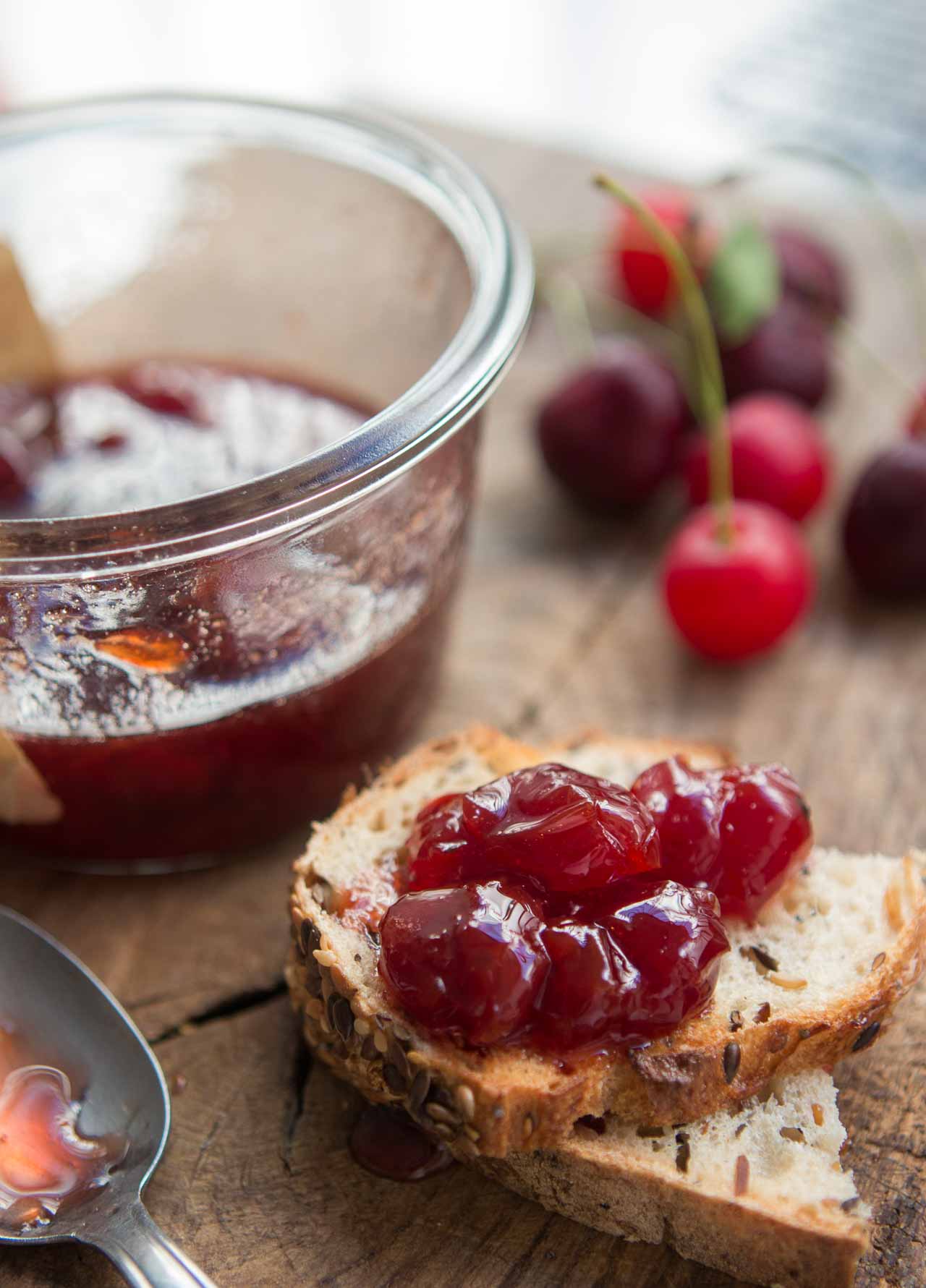
Their theme? Can You Can, a compendium of recipes for preserves, conserves, and jams and jellies from all over the world. Maybe I'm a Stupid Boy, but I assumed when they said 'can' they meant to use something that comes in a can. Can You Can (get it?) Being a literalist (and a smart-aleck), I decided to flip the top off a beer can and make Shallot, Beer, Prune, and Cocoa Nib Jam.


shallotjamfinished.jpg


What?
Beer in jam?

Well, why the heck not? I've been intrigued by the combination of beer and chocolate ever since tasting this fabulous gelatina from Italy. The flavor of the beer here is rather mild, and I used the classic 1664 French beer (the Budweiser of France...but it tastes better). But you can use whatever you'd like. Since you'll have to finish off the can, choose something you like.

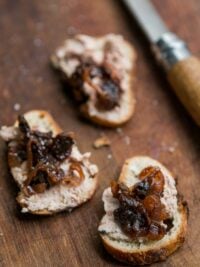
But rather than spread this jam on your morning toast (unless you like beer in the morning) I serve it alongside savory dishes like my Lamb Tagine that I made a few weeks ago, or smear a bit atop warm rounds of tangy goat cheese on grilled toasts for an appetizing appetizer.


Here's a few general tips on jam-making:


  • Hard & Fast
    Most conserves with fresh fruit benefit from being cooked quickly, over moderately-high heat. This allows the fruit to retain much of its character.

  • Don't Overcook
    There's nothing worse than overcooked jam. That's when the sugar caramelizes, and that flavor overwhelms whatever else is in the jam. There's not much you can do to save it at this point, so watch out.

  • Brighten Up
    Fruit jams often benefit from a squirt of lemon juice and a shot of kirsch added to brighten up flavors. Kirsch augments the taste of fruits and I add a few drops to just about every fruit dessert I make.

  • Don't Overreact
    Never use reactive cookware when making jams. Materials such as non-anondized aluminum and tin can react with the acids and leave a tinny aftertaste. To avoid burning and hotspots, use heavy-duty cookware with a thick bottom.

  • Don't Double Your Pleasure
    In general, don't double recipes. Better to make two small batches, since each will take less time to cook, preserving the appealing flavors of your ingredients.

  • Degrees of Faith
    If you aren't sure if your jam is cooked to the right temperature, check it with a candy thermometer. For this jam, it's easy to gauge its cooking, but fruit jams 'set' at about 220 degrees Fahrenheit (104 C). Never put a glass thermometer in something hot. It might break. Stick it in at the start of cooking.


halfshallots.jpg


Shallot, Cocoa Nib, Beer, and Prune Jam
About 1 1/2 cups


This goes great with pâté or as a sweet counterpoint to anything rich and meaty. In Paris, there's normally a gathering before dinner for drinks, such as a kir or a glass of Champagne. I've served this with slices of foie gras on toasted brioche, a perfect partnership.

I used the largest shallots I could find since I'm too lazy to peel those little ones. Feel free to substitute raisins for the prunes (I sometimes mix them), and if you'd like to use white wine or rosé instead of beer, allez-y.

1 pound (450g) shallots, peeled and sliced
2 tablespoon unflavored vegetable oil
big pinch of coarse salt
a few turns of freshly-cracked black pepper
1/2 cup (100g) beer
1/4 cup (50g) sugar
2 tablespoons honey
3 tablespoons cider or balsamic vinegar
8 prunes (3 oz/90g), pitted, and cut into tiny pieces
1 heaping tablespoon cocoa nibs (see Note)


In a medium-sized heavy-duty skillet or saucepan, heat the oil and sauté the shallots over moderate heat with a pinch of salt and pepper, stirring frequently, until they're soft and wilted, which should take about 10 minutes.

Add the beer, sugar, honey, vinegar, prune pieces, and cocoa nibs and continue cooking, stirring frequently, until the shallots begin to caramelize. While cooking, continue stirring them just enough to keep them from burning.


sauteedshallots.jpg


The jam is done when the shallots are nicely-caramelized, as shown.

Store the jam in the refrigerator, where it will keep for at least 2 months.

(Note: Organic Cocoa Nibs are also available from Dagoba.)


For his sweet event, the fine folks at delicious:days

There's a little bit of a war going on here in Paris on the rue des Rosiers, in the Marais. The Rue Des Rosiers is the Jewish street, sporting several good (and a few bad) bakeries, a few chic clothing stores, but a string of fafafel stands and restaurants. The most famous, L'As du Falafel, is always crowded, and teeming with locals, who come for their Heeb-Hop (Hebrew-Hop, as we call it), and tourists, who've read about L'As du Falafel in their guidebooks.

I always feel sorry for the other places on the street. There's often deserted, while the throngs of people line up at L'As in search of their falafel-fix. The only time they seem to generate any interest is when L'As du Falafel closes for the Sabbath, on Friday nights and Saturdays. But a few weeks ago I started noticing handwritten signs on the place across the street, Mi-Va-Mi, with slogans like "Taste and Compare", daring to take on the Ace o' Falafel, just across the street.

Today as I stop by to get my weekly falafel, making a beeline for L'As, I notice a swarm of missionaries agressively confronting passers-by with plates brimming with warm falafel, followed closely by someone with a guest-check book, pen-to-the-paper, ready to take their order. The scene was curious, since the French haven't quite grasped the concept of 'Free Samples' (or competition). When I asked a French friend why anyone rarely offers samples, I was told "Because it's not 'correct'. But there's a guy at the fromagerie on the Î'le St-Louis who's making a killing offering samples to passers-by, mostly tourists, who get one taste of great French cheese, and invariably come in and make a purchase.

Correct or not, that dude is rakin' it in.

So although there's no such thing as a free lunch, especially in Paris, there's lots of free falafels to be had this week as the street is abuzz with people bearing heaping bowls of freshly-fried falafels. I don't know how long it will last, and the offer doesn't extend to those who've already purchased. (I tried to get one of the falafel-pushers to augment my half-eaten sandwich, but being très Paris, there's little interest in the customer after the sale.)

And in an unlikely show of unity, as I was finishing up, I saw one of the fellows from L'As du Falafel pop one of his crisp falafels in the mouth of his main competitor, a woman who was offering falafels from Mi-Va-Mi. She stopped, took a taste, and nodded in agreement before going back to offering her falafels to all takers.


So perhaps there's something to be said for the absence of competition.


(Although I appreciate the presence of free samples.)


L'As du Falafel
34, rue des Rosiers
Tél: 01 48 87 63 60

Mi-Va-Mi
27, rue des Ecouffes
Tél: 01 42 71 53 72

Stupid Boy

33 comments - 08.11.2006

One of the hardest things about living in any foreign country is, of course, the language. Seriously, learning any language is really hard I'm sure, but anyone who can master French, who wasn't pushed from the womb and spent their lifetime in an all-French speaking environment, I take my chapeau off to you. For the rest of us, it's a challenge. Even the most mundane task, like writing a check, often requires a consultation with le dictionnaíre.


rareconditioned.jpg

English ain't so easy either. And perhaps, inadvertently, they're closer to the truth.


Last week, for example, I was looking for hand lotion (sans le dictionnaíre). As I combed the aisles at Monoprix, I finally found the moisturizer aisle, lined with lots of pretty pink and white bottles. So I picked a few up, reading the labels. After a careful reading and I finally found one that seems like what I was looking for, "Hmmm, that seems about right," I thought to myself. As I go, I notice I'm getting some strange looks from the women milling around me, but assume it's because they're not used to people reading the labels of moisturizers as if they were Camus. As I make my way to the caisse, the cashier, while standing in line, I re-read the label, picking up a line on the label noting the lotion I'm toting around was intended for cleansing, um, shall we say, 'intimate areas'. And presumably not for men.

(And even if I was, do you think I'd share that with you here?)

So it was no wonder that I got a few strange looks going back, trying to be non-chalant, and returning it to the shelf avoiding eye-contact with anyone in the process.

I've gotten in so much trouble mangling the language it's no longer funny (well, actually it is...) One of my most infamous stories, that I think I may have recounted here before, I was at my favorite épicerie and I wanted red currant, or groseille jam.
So in my picture-perfect French, I said, "Je voudrais le confiture de gros selles (which I pronounced as 'gross sells'), s'il vous plait." She looked at me, her eyes incredulous that she couldn't possibly believe her ears.
It was after a moment, I realized I meant groseilles (pronounced 'gro-zay').
I had asked for Big Turd Jam.


But even the French have trouble with their own language. I was at the Petit Palais museum recently with a gal pal (see video above), and came across a Nature Morte, which literally translates to 'Dead Nature', but actually means 'Still Life'. There was one Nature Morte 'aiguière', a still life of a peeled orange. So I asked the attendant what an 'aiguière was, and she was stumped. So she asked another attendant, who didn't know either. It's not even in my dictionary, which boasts 120,000 traductions. (Béa...help!)

About a year ago, I had just returned for leading a tour to Italy. My group visited Biella, a city famous for its mountaintop convent. One you've made the climb up to the majestic mountain, ensconced in the convent is a Madonna, made of black wood. She's known, of course, as The Black Madonna (not to be confused with the Jewish Madonna, in America.)

At a dinner party back in Paris, I was recounting how exciting it was to climb this mountain in Italy, to see the 'Verge noir'.
"It's amazing, so beautiful to see," I continued, "and people came from all over to see and worship the verge noir!"

Meanwhile, everyone's looking at me with a bit of shock, and panic. As I keep talking, I'm explaining the beauty and magnificence of le verge noir. "It's fantastic. Really a magnificent work of art", until a friend leans over and says that he thinks I mean the magnificent 'vierge noir', the black virgin.

Not the magnificent 'verge noir', the black penis.

Ahem!

So I took it with a grain of salt when a French friend started calling me "Stupid boy!, which I told him was somewhat impolite. Then I realized what he meant to say, perhaps, was "Silly boy." Or I hope he meant to say that.
Now to Anglophones, they are two very different things, but to a non-native English speaker, they're rather different in meaning. "Don't be stupid" is far different than "Don't be silly."

And, yes, sometimes even I am a stupid boy. For example, I know very little about some things, like Armagnac.
But the great thing about being a wonderful, giving, and caring person, is that occasionally you get rewarded for it and lavish gifts get bestowed upon thee.
Or me.


armagnac.jpg

The Best Armagnac in the World


After leading a Paris Chocolate Tour last spring, some of my guests bestowed upon me these lovely bottles of Armagnac. Of course, I was thrilled especially since the packaging revealed they were from Michel Chaudun's chocolate shop and one had a lovely box of his superb chocolates discreetly hidden inside. But I wasn't aware of how truly special those bottles were. When I wrote Kate about them, who lives in Gascony (the epicenterfor Armagnac), I could hear the gasp all the way to Paris, and she told me that I didn't just have "the best", but that I had "the best of the best".

Living in France, I like to try a new cheese, wine, or whatever I can get my hands on (except tripe, which I don't feel any great need to familiarize myself with), tasting new things while mulit-tasking and expanding my vocabulary. And although I thought my precious bottles of Armagnac might remain on my Too Good To Use shelf, they didn't for very long.

So I may be a 'Stupid Boy', but I do know about baking and chocolate. And so you're not a 'Stupid Boy' (or girl) you might want to know that Champagne Chocolate Truffles don't contain any Champagne, but are made with Cognac. I got into an online tiff on eGullet with someone who insisted I was wrong (and some of those eGullet folks get real nasty). She had seen a New York-based French chocolatier on television pour Champagne into his truffle mix. When I went to look at his recipe, sure enough, he did use true Champagne. He also called for a specific brand, and after some checking, I found out...surprise!...the Champagne company is one of his many sponsors.

But for the most part, Champagne in truffles means Cognac and derives from the old French term champaigne which means 'open-field', according to the Bureau National Interprofessional du Cognac.
(If that woman from eGullet is reading this, take it up with them, girlfriend...)

Both Armagnac and Cognac are distillations made from grapes, varieties which are generally not used for making ordinary table wine. Like Cognac, Armagnac is a region in France. It's closely associated with Gascony and it's cuisine (prunes and Armagnac, for example) and produced in the Pyrenees.

Cognac is farther north, on the Atlantic coast, near where oysters are farmed off the Ile de Ré. The salt from the region is famous as well. Armagnac is distilled once, while Cognac is distilled twice and I find when tasting the two, Armagnac feels more rugged to me, which is part of its appeal. Its flavors seems to be fuller and more complex while Cognac is more delicate and refined. It's been said that "Cognac is the girl you can bring home to meet your parents, while Armagnac is the one you keep hidden away."

So if I was making chocolate Champagne Truffles, theoretically I'd have to use fine Cognac. But if I had a choice of what to drink, I'm working my way through these bottles of Armagnac, which I've decided I'm not going to let sit on the self for too long.

What do you think I am...stupid?

pic4.jpg


Site Changes

You may have noticed I've been making several design changes to the site, and I've been adding entries about travel to Paris. Since I get so many request, I've adding my tips for those who are planning to visit the city, including hotel recommendations, transportation notes, and astuces to make your visit to Paris more fun from an insider's perspective. You may have noticed I've added a few other features to the site, including the Categories on the left-hand side of the screen so you can find things easier (or waste more time while you're at work). I've updated the Links page too, annotating the links and added lots more places, and listing many more sites of friends, for you to visit.

There may also be some goofy-looking posts in the near future, as I'm experimenting with a new blogging tool, Qumana, which formats words into HTML for me, since when you see évêché I need to type the symbolic equivalent of (B)(em)%eacute,vê,ch%eacute,(/em)(/B) on my mini-Mac laptop screen. So excuse any missteps and misplaced photos while I test out the new tool, and preserve my eyesight too.


Chocolate Tours in Paris and Normandy

We've just announced, on my Chocolate Tours page, news about my next Paris Chocolate Exploration with Mort Rosenblum, in May 6-12, 2007. This is a repeat of last year's sell-out Paris chocolate tour, where once again, our lucky guests will be warmly welcomed into the private workshops my favorite chocolatiers, including Jacques Genin and Jean-Charles Rochoux, and participate in a delicious private chocolate tasting at La Maison du Chocolat.

Since announcing the tour at the beginning of this month, almost half the spaces have been snapped up. So if you'd like to be a part of this incredibly fun chocolate adventure in Paris, you can read more about ithere and follow the link for booking and pricing information.

And yes, that's Mort on his boat, where we'll float on the Seine, sipping rosé, eating chocolate, and sampling delicious treats from the city's finest culinary shops, as we watch the rest of Paris drift by.

Speaking of chocolate, my classes with Susan Loomis at her home in Normandy, On Rue Tatin, are just about sold-out as well. These three days of hands-on cooking classes promise to be great fun, and if you've dreamed about cooking up delicious meals, and fabulous chocolate desserts in a magnificent French country kitchen, this is the trip for you. There are just two spaces left for this culinary adventure, and there's an option to spend an additional day with us in Paris visiting our favorite markets, fromageries, and of course, the prestigious chocolate shops on the Left Bank.

For guests coming to Paris interested in shorter half-day tours, I've updated the information about my popular Paris Chocolate Walks and Outdoor Market Tours, and now offer them in friendly small-group tours, making them more accessible to all. You can book online through Context Travel in Paris.


Book Update

My newest book is currently in production (yeah...I made my deadline!), which will be released in the spring of 2007. This month we're working on the photography and taking lots of photos of all the recipes. Everyone involved has been going full-steam ahead to make sure the book will be beautiful, in addition to being fun to read with hundreds of new recipes. There'll be almost fifty photographs, taken by one of the top food photographers in America, and I'm thrilled to be working with such a talented team of editors, designers, and stylists.
I'm planning a tour of several cities across the United States in conjunction with its release next spring and you can find out more on my Schedule page, which I'll update as the dates become available.


Flying The Friendly Skies?

Ok, so they're not so friendly anymore (Can someone please tell those idiots screaming into their cell phones at the airports to shut the hell up? What is wrong with people?)
In the September issue of Hemispheres magazine for United Airlines, you'll find my article: Three Perfect Days in Paris. But even if you're not planning to fly in September, the article will be posted on their web site, and archived there as well, for your future travel planning.

(My Schedule page lists the article as being in the October issue, but United bumped me up a month, although they didn't offer a bump-up on my next overseas flight.)


France via Flickr

If you're interested in seeing more of my foodie photos of France and Paris, visit my Flickr page. It's updated frequently since I'm addicted to my new toy.


Subscribing To The Site

You might have noticed the pretty green box up to the right (well, I think it's pretty...), where you can subscribe to the site and get updates from me. Normally, I send out about 4 updates a year, a friendly email with up-to-date news and information, but you need not worry about being innundated with emails. Enter your email to be the first to get the news directly from moi.

Your email address is not shared or sold so you won't get emails hawking videos of sex-crazed lesbian cheerleaders (unless you want) or men's herbal supplements guaranteed to 'put an eye out with that thing' (which don't work...or so I've heard.)


Feed Me!

No, this isn't a plea for money. For that, you'll have to wait 'til my next book comes out.
Do you know what an RSS Feed is? It allows you to find out instantly when your favorite sites and blogs, like mine, are updated. (Well, not all sites...Get on the stick, dude!)

You can learn more about RSS Feeders here. Google has come up with their own Google Reader, and there's several others out there, but if you're a Mac person, I strongly recommend NewsFire which is incredibly simple to download and use, and melds perfectly into our fabulous Mac desktop designs.

Then you can add this blog to your feed using the icons on the upper right, so you can do a Mac mind-meld with me!


Finally...

Thanks to all for reading the blog, and leaving such fantastic comments. Many of them give me a big grin, and others I find laugh-out-loud funny. Others I find informative, which I'm sure many of the other readers appreciate as well. I appreciate all your positive feedback and thoughtful comments that are left here on the site. Keep 'em coming!

In the future, I'll be posting about lots of things, including the world's best caramels (made with Breton salted butter), a lesson in harvesting salt, new recipes, and more Paris travel ideas and tips. And once the cooler weather of fall returns (it's pretty brisk now), more Paris chocolate finds and discoveries. Mais oui.

Stay tuned...

In spite of the appearance of these herbs, I assure you they're perfectly legit. No, I didn't open up my Pink Floyd double-album to remove any seeds. And no, I wasn't listening to The Moody Blues at full-volume on my headphones hoping my mom wouldn't smell anything funny (even though we rolled up a towel and pushed it against the bottom of the door.) And no, I no longer have my strobe light from many years ago when we'd be, um, getting-groovy down in my parents basement, laughing uncontrollably about something that any sane person would have found completely meaningless...as we did, the next day. But they sounded like good ideas at the time. Right?


So now that I'm a law-abiding adult, I get my rush cooking, and this is my stash. My friend Judy showed me how to make this easy herb mixture and now I make it every summer, making sure I'll have enough to last me through the next twelve months.

It's simply a mixture of fresh rosemary and sage, all chopped up with garlic and coarse salt. Since we're just about at the end of fresh garlic season, I made sure to snag a few of the tender, violet-colored bulbs at the market, bringing them up to my nose to ensure they're aromatic and pungent. Green garlic's also very easy to peel; the fleshy skin merely slips right off, so you'll have plenty of time to raid the pantry, on the rampage for anything sweet, just in case you get the munchies.

To make this herb mixture, take a very large bunch of fresh sage and pick the leaves off. Then take a large bunch of rosemary and strip off the oily leaves as well. A good proportion is about 2 to 3 parts sage leaves to 1 part rosemary. Then take about 8 small peeled garlic cloves and a heaping tablespoons of coarse salt (I use grey salt from Brittany) then chop it all up until the herbs are very fine, as shown. Discard any sticks or seeds.

Then spread the chopped mixture on a baking sheet and let it dry for about three days. (Hint: Don't keep it near an open window where their might be a breeze. It would be a total bummer if you wasted your stash.) Once dry, store your herb in a tighly-sealed in a jar. Dude.


pork.jpg


I use it as an instant rub over poultry, tuna filets, and meat; since I always have some on hand, it's simple to mix with some good olive oil and rub in in well before roasting.
Judy likes to toss a small fistful in a bowl of olive oil as a dipping sauce, too.
I tasted it once, and found it totally awesome. Although for some reason, we found it hysterically funny.

The first of the Reine Claude plums are at the market.


reineclaude2.jpg


These tiny, super-sweet little green plums are 18% sugar, one of the highest percentages of all fruits. The true French Reine Claude plums are grown in Moissac, near Toulouse, and are available for just a short time during August.

Get 'em while you can...

One of the first lessons I learned on my way to becoming une vrai Parisian was to never, ever be on time. I should backtrack and say: One should never to be on time when invited for dinner party. The hosts, who called with my first invitation to a soirée about a week after I arrived in Paris, said "Come at 8pm...But you know, in Paris, that means to come at 8:30pm."

Subsequently when I have guests for dinner, I expect them to be around 20 minutes late, although there's much debate on how late you're actually supposed to be. But if you're on time, or early, you might acidentially catch your hosts either in their little DIM skivvies.

Or less-appetizingly, stashing away the Picard boxes.

It's a tricky balance when you inviting folks for dinner, trying to make sure what dinner's gonna be hot and well-cooked without having to spend the last 30 minutes trapped in the kitchen while your guests drink up all the rosé. And it's now become fashionable to be even more late, as if to show that you have oh-just-so-much on your agenda, which has made being tardy something of a status symbol. But if your friends show up one hour late, and you've made something like Pork Roast, which can dry out in a minute, you're screwed. Then you'll only be thankful for them not arriving early and catching you in your petit slip français.


tagine.jpg


In Paris, with so many Arabic butchers around, it's easy to find cuts of meat that lend themselves to slow-braising and making North African stews like Tagines. Being a pastry chef since the beginning of time, I was always a little terrified of meat, never quite knowing how to handle it. But I bravely started going into the butcher shops, inspecting the enormous slabs of meat trying to look as if I knew something about them, then I'd make my pick. Conveying how to cut it for me is another story, but most of the time, chopping my hands through the air like Helen Keller doing karate seems to get the point across. My Arabic is terrible, so most of the time, I end up brining home a lamb shoulder, since it's inexpensive, not terribly fatty, and most importantly...easy to point to since they keep them right in front of the butcher cases.
(Ok, lamb shoulder's also hard to ruin.)

For some reason, leaner cuts of meat usually tastes better in restaurants than when I make them at home. I don't know why. But stewing cuts of meat, like lamb shoulder, I find I can make taste equally as good, or better, than anything I get when I go out. I've been making Tagines for the past few years with great success and once you start with a solid master recipe, like the one below, you can vary it for different kinds of meat or poulty, and you can make them as spicy or aromatic as you want by adjusting the spices. And since most benefit from long, leisurely braise in the oven, they're perfect when you're entertaining guests who arrive at various times, leaving you free to assist in the all-important task of making sure you guests have plenty of cool rosé in their glasses. But don't neglect yours either.


Lamb Tagine
About 6 servings


You can substitute chicken for the lamb. Cut it into 8 pieces and reduce the oven time to about 1 to 1½ hours. I also like to add a handful, say about 1/2 cup (75g) toasted, blanched almonds to the stew during the final 30 minutes of braising, or some green olives. Another option is to add prunes or dried California apricots, which add a sublime sweetness. I used to add strips of salty preserved lemons, but I'd always wake up in the middle of the night ravenously thirsty and have to chug a few liters of water, so now I don't anymore.


Often Tagines are served with big hunks of softly-baked bread sprinkled with anise seeds, I prepare cracked wheat or bulgur to serve underneat with a bit of chopped parsley added at the end. I've find it preferable to bread of couscous since it's a whole grain and the fabulously nutty and crunchy grains are really a delightful chew.
And so friends can customize their Tagine, I pass little dishes of plumped yellow raisins, homemade sweet shallot marmalade, and toasted chick peas (pois chiche brun) which I find in the Indian markets near La Chapelle, places I often spend hours poking around in.


1 lamb shoulder, cut into 6 pieces (have the butcher do it)
vegetable oil
1 medium onion, minced
1½ cups (375 ml) chicken stock (or water)
1 teaspoons dried ginger
1½ teaspoons coarse salt, plus more if necessary
1 teaspoons turmeric
2 teaspoons sweet paprika
2 cinnamon sticks
freshly ground black pepper
1 bunch cilantro (coriandre), rinsed and tied with a string
20 threads of saffron
juice of ½ lemon


Up to three days before you plan to make the Tagine, massage the lamb shoulder with the salt and let it sit in the refrigerator before you cook it.


To make the Tagine, in a heavy-duty Dutch oven, heat a few tablespoons of oil and sear the lamb pieces very well, turning them only after they're nicely dark, browned, and crusty (this helps add flavor to the Tagine.) As you cook them, don't crowd 'em in. If your Dutch oven isn't big enough to cook them all in a single layer at once, brown the lamb pieces in batches.


Preheat the oven to 350 degrees (175 C). Once the lamb is browned, add the onions and some of the stock, then scrape the bottom of the pan with a flat wooden spatula to release the flavorful browned bits. Add the remaining stock, then the spices, the bunch of cilantro, and the saffron.


Cover the pan and bake in the oven for 2 1/2 to 3 hours, turning the lamb over in the liquid a few times during the oven-braising. The liquid should just be steaming-hot and simmering gently. If it's boiling, turn down the heat (some Dutch ovens conduct heat differently.) When the meat starts to fall apart easily, that's when it's ready. It's hard to overcook lamb shoulder, so even an extra hour or so in the oven won't hurt it.


Remove the lid and let the Tagine remain in the oven for another 30 minutes, so the juices reduce, becoming rich and savory.


To serve, remove the cilantro and discard. Squeeze some lemon juice into the liquid and add more salt if you think it needs it. Serve mounds of cracked wheat underneath the Tagine, with lots of the juices poured over. At the table, make sure you have a tube of harissa handy, the fire-y Moroccan hot sauce, for those of us who like spicy food, as I do.


sorbet.jpg


For dessert, I recommend something fruity and refreshing, like a scoop of Sour Cherry Frozen Yogurt, from my book The Perfect Scoop.

I like it served with a fruity coulis made from red raspberries and cassis (black currants), mixed with sautéed cherries, made from the last cherries of the season, which I'm going to miss terribly.

Paris Sunset


If you're traveling to, and within France, many folks like to stay in touch with home, or want to be able to make and receive phone calls and get messages. So why not pick up a pay-as-you-go phone?

You purchase the phone (most start at 39€) then buy minutes in increments from 5€ to 100€, which are good anywhere from a few weeks to several months, although they do expire at a certain point.

The three principle phone companies in France that offer pay-as-you-go mobile service are:

-SFR

-Bouyges

-Orange

You'll need to show your passport when buying your phone and signing up for service. When you buy your phone, there are certain phones that are compatible with pay-as-you-go services, while others aren't, so you'll need to let them know what kind of service you want.

If you're French isn't very good, many of the young people that work in the France Telecom or Orange boutiques (the France Telecom mobile division) that are all over Paris are often interested in practicing their English (yes, really...) and if you get a good one, they can be really helpful. My success rate is about 50/50. And unless you like lines, avoid going first thing in the morning or during lunch hour(s). The other companies mentioned offer similar pay-as-you-go as well at the same price but Orange seems to have the most locations around France.

Once you buy the phone, you'll need to buy minutes. You can do this at any phone store and most Tabacs, as well as at some guichet automatiques, or ATM machines. With Orange, for example, you'll get a receipt with a 16-digit number which you enter into the phone (dial 224 first).

You get three tries, so don't mess up!
If you do, quelle dommage...you lose the minutes.


    Advantages

  • You get your own phone number (all mobile numbers in France begin with 06) that you can hang on to as long as you want. If your minutes expire and you don't recharge after a certain period of time, you lose your number and will get reassigned another the next time you visit.

  • You can receive incoming calls from anywhere in the world, free. (In France, you only pay for outgoing mobile phone calls.) You can make calls internationally at the same rate that Mobicarte calls cost, currently .55 centimes per minute.

  • All calls within France are included at the same price.

  • You can buy as much, or as little time, as you wish. If you're here for 2 weeks, you can just buy 45 minutes worth of calling time. If you need more, just stop in any Tabac of phone store and buy more in a few minutes.

  • Since none of the public phone booths take coins anymore, you don't need to make a special trip to the Tabac to buy a phone card to use one.

  • You can use the phone over and over, on every trip during your lifetime. In other countries, you can buy a SIM card to transfer the phone service to their system.

  • You can have the phone set in English, so the on-screen instructions are in easier to understand.


    Disadvantages

  • French cell phones can be notoriously quirky. I've had several different phones, and many times my phone doesn't ring if someone calls. More often, there's no notification that I have a new message, so I have to call and check my voicemail every so often.

  • For Americans who are used to very low-priced cell phone calling, the price here is 6 times more expensive, so you may not want have a long, leisurely phone conversation. But remember, you only pay if you initiated the call.

  • France uses 220V, so you'll need to recharge your phone in France, not in the United States. I recommend fully-charging it before you leave, so you can use it when you step off the plane on your next visit, if you need to.

  • The mobile phones are overly complicated. You have to scroll through a gazillion menus to get to what you want and press a lot more buttons too. And your phone number isn't displayed, so you need to write it down elsewhere. (When I asked why, I was told it was "For security." When I asked what kind of security that provided, they simply shrugged.)

  • The functions are not always explained with on-screen commands, so it can be frustrating to figure out how to do simple tasks like how to change your outgoing message or delete messages, which took me 2 years of asking at the different Orange boutiques to figure out...which no one seemed to know, oddly enough.


Updates:

Competition has come to the French mobile phone industry and Virgin Mobile, as well as others, are entering the fray. The prices are similar but worth checking out.

BIC and Orange France have introduced a simple cell phone that's sold pre-loaded with 60 minutes worth of talk time, for about €50. You'll get your own number immediately and the phone can be recharged.

My first experience with eating seaweed was when my fourth-grade teacher, Mrs. Barnett, brought in a big bag of gnarled dried Japanese seaweed, presumably to familiarize us with foods from other cultures. Few of us kids growing up in sheltered New England would touch the stuff, although I took a little taste, but didn't share her enthusiasm for the sea-scented tangle of salty greens.

So she ate the whole bag herself.

Later that day, Mrs. Barnett went home early, doubled-over, and clutching her stomach.


seaweed.jpg


As an adult, I've broadened my horizons, overcome any aversion, but most of the seaweed I consume comes surrounding tekka-make rolls, or other sushis as they're called in France. (They add the "s" to pluralize them, even though you don't pronounce it.)

My salt man, Monsieur Dion, who I used to get my fleur de sel and grey sea salt from (before he closed), appeared at my market on Sunday with a big barrel of Salicornes Fraîches, pickled in vinaigre de vin blanc with carrots, onions, and a few branches of thyme, which his brother made in Brittany. When I visited Brittany last summer, we visited Algoplus, where I tasted the locally-harvested salicornes, which had the curious taste of green beans. And in fact, the French call them haricots de mer, or green beans of the sea. In English, they're called 'glasswort'. According to Judy Rodgers in, The Zuni Cookbook (a book anyone interested in cooking should own) she includes a recipe for Pickled Glasswort and says the English used to call them "chicken claws".

While the haricots de mer were tasty, just a forkful was enough, although perhaps anything served with a dollop of crème fraîche, as they were served, certainly seems more appealing. And although I conceded that they were tasty, I resisted the tempation to buy a jar, assuming they'd end up in my 'Too Good To Use' shelf (which I feel will soon collapse.)


seaweedsandwiches.jpg


After considering their vinegary, cornichon-like taste, I mentioned to Monsieur Dion that they'd be good served alongside or atop something fatty and meaty, like pâte or a rich smear of rillettes, and before I could finish my sentence (which, as a rule, takes much longer for me in French than in English), he produced a platter bearing slices of crusty baguette spread with rillettes de porc, topped with a piece of salicorn. The next day, I used a few slices of toasted pain aux ceriales to make my own sandwich layered with juicy, vibrant-yellow slices of tomato, cured salmon with lots of fragrant dill, a thin layer of coarse-grained mustard, all finished with a squeeze of puckery lemon juice. I topped them off with a few 'sprigs' (I guess they're sprigs, although in French, there's probably a special word used exclusively for 'sprigs' of les salicornes.)

My sandwiches were terrific, and I spent the afternoon not clutching my stomach, but visiting the breathtaking Musée de l'Orangerie, then walking home along the Seine, without incident...and nary a rumble from below.


Algoplus
Zone du Bloscon
Roscoff, France
Tél: 02 98 61 14 14

David's Amazon Store

Subscribe

David Lebovitz

Monthly Archives

Archives By Date »

Browse by month: 2009

Browse by month: 2008

Browse by month: 2007

Browse by month: 2006

Browse by month: 2005

PPF2.png


David Lebovitz