Recently in Travel Tips category

Finding a Hotel In Paris

red hotel sign

Here’s a listing of a few notable hotels in Paris that you might want to investigate if you’re planning to come for a visit. I’ve been traveling to Paris for many years before moving here, and some of the hotels listed I’ve stayed in, while others have been recommended by guests and friends. There’s a pretty good selection, including one located on the top of the public hospital! Some are in the budget category, while a few are nicer if you’re looking for more comfort.

There’s been a spate of hip, hi-design hotels opening in neighborhoods outside of familiar areas and these hotels offer design-oriented rooms at reasonable prices. MamaShelter and Hi Matic are examples of them, and they are becoming more and more popular, especially with travelers looking for something more off-beat.

There’s a few caveats to remember, which I’ve listed below, since everyone has different standards and concerns when staying in a hotel. Only you know if you’ll be comfortable in a ‘budget’ hotel with few services, possible street noise, and standard bedding. Price makes a big difference and a hotel that’s less than 100€ per night is likely to offer few amenities, while one in the higher range is, of course, going to be a nicer place to stay. Prices listed are just to give readers an idea of how much the hotel was at the time when I created this list. They are subject to change so do check the hotel websites for the most up-to-date information.

Oops! Budget Hotel
50, avenue de Gobelins
Tel: 01 47 07 47 00
Fax: 01 43 31 17 74

Contemporary, hip hostel, with shared or private rooms, with baths, WiFi, A/C. and very economical prices.

MamaShelter
109, rue Bagnolet
Tel: 01 43 48 48 48
Fax: 01 43 48 49 49

Philippe Starck-designed budget hotel (rooms start at €79/night) in off-beat neighborhood. Quirky and interesting, but beware that dining in the hotel isn’t as affordable as the rooms.

Hôtel Saint Pierre
4, rue de l’Ecole de Médecine
Tel: 01 46 34 78 80
Fax: 01 40 51 05 17

Good budget option in the student-oriented Latin Quarter, free hi-speed internet in the rooms and television. Rates start at €63 per night. Just down the street from my favorite hot chocolate place in Paris, Pâtisserie Viennoisserie, where you can take breakfast too (closed weekends.)

Hôtel Bourgogne-Montana
3, rue de Bourgogne
Tel: 01 45 51 20 22
Fax: 01 45 56 11 98

In the relaxed seventh, very popular, good quality for the price. Good breakfast buffet and excellent staff.

Hôtel Amour
8, rue Navarin
Tel: 01 48 78 31 80

This hip hotel is well-priced, with rooms starting at about €100, especially considering its proximity to the rue des Martyrs. Rates are low, and the popular dining room is known for good fare, with the locals as well as guests. The artist-designed rooms are popular during fashion week, hence rates go up 20% when the fashionistas are in town.

Hôtel Hospitel
1, Place du Parvis Notre Dame
Tel: 01 44 32 01 00
Fax: 01 44 32 01 16

Located on the top floor of the historic Hôtel Dieu Hospital! It’s just next Nôtre Dame in the center of Paris. AC and WiFi.

Hi Matic
71, rue de Charonne
Tel: 01 43 67 56 56

Offers stylish “cabanes” with an ecological bent, designed by Matali Crasset. Rooms start at around €145/night.

Hôtel Bourg Tibourg
19, rue Bourg Tibourg
Tel: 01 42 78 47 39
Fax: 01 40 29 07 00

In a lively area, the Marais, but on a quiet street. Chic rooms designed by Jacques Garcia. Rooms that start at 190€. Wi-Fi (pronounced wee-fee, in French), interior garden, and air-conditioning.

Grand Hôtel Jeanne d’Arc
3, rue de Jarente
Tel 01 48 87 62 11
Fax 01 48 87 37 31

In the Marais, close to the Place des Vosges, this hotel is an outstanding value for its location (and it’s just a short stumble from (Vert d’Absinthe) Consequently, this hotel books quickly. No air-conditioning or fancy services. Doubles are around 79€.

Hôtel Castex
5, rue Castex
Tel: 01 42 72 31 52

Air-conditioning and free Wi-Fi. Well-located on a quiet side street near the Bastille.

Hôtel Chopin
46, Passage Jouffroy
Tel: 01 47 70 58 10
Fax: 01 42 47 00 70

In a passage near Montmarte. Inexpensive, lively area near the major department stores. Upper rooms have more light; request the forth floor.

Hôtel de la Place des Vosges
12, rue Birague
Tel: 01 42 72 60 46
Fax: 01 42 72 02 64

Rooms 100-140€ per night, with Wi-Fi No air-conditioning, but perfect location on small street leading into place des Vosges.

Hotel des Chevaliers
30, rue de Turenne
Tel: 01 42 72 73 47
Fax: 01 42 72 54 10

Great location a stone’s throw from the place des Vosges in the Marais. Air-conditioning, WiFi, and safes. Rooms begin at around €105/night.

Hotel Duo
11, rue du Temple
Tel: 01 42 72 72 22
Fax: 01 42 72 03 53

Very nice, modern hotel in the heart of the Marais, near lots of cafes and nightlife. Can be noisy during summer months if you leave windows open due to the neighborhood. Mid-priced.

Hôtel Britannique
20, avenue Victoria
Tel: 01 42 33 74 59
Fax: 01 42 33 82 65

Located near Chatelet. Clean and soundproofed rooms. The rooms are a tad on the small side but located overlooking a nice square in the center of Paris. Rooms start at 139€.


A few tips to keep in mind when researching hotels…


  • I never travel anywhere without my Tempur-Pedic Eye Mask. It’s simply the best travel product ever! Super-comfy, it blocks every bit of light so you can get a good night sleep in hotel rooms or airplanes.

  • You get what you pay for. Any hotel under 100€ per night is likely to be a bit flimsy, the décor a bit tired, and the rooms may not be a quiet as you’d like.

  • More and more hotels in Paris have free Wi-Fi. It does pay to ask when reserving if that is a concern.

  • In general, rooms on the inside are far quieter than rooms overlooking the street. Take note, especially if you plan to come in the summer. The downside is that inside rooms can face neighboring apartments, and often garbage cans rumble around in the early morning.

  • Don’t judge a hotel by the lobby. Many places have a gorgeous lobby, which can be deceiving. It’s cheaper to make the lobby look amazing rather than the rooms. Look at the room before you accept it.

  • The ‘star system’ can be misleading. Hotels pay taxes based on how many stars they have, so places are reluctant to accept four-stars. So don’t let stars be the sole judge. Two-stars or less generally means there are shared bathrooms, however.

  • Print out and bring your confirmation. I’ve had friends staying in lower-priced hotels in Paris who were told their room was booked and had to leave.

  • Does the hotel have an elevator? Although most do, some older ones may not, which is something to consider if you pack ‘American-style’ (which I am guilty of sometimes) and have a lot of heavy suitcases.

  • If you like your hotel, befriend the manager and go back. They’ll remember you and you’ll get better treatment each time. Bring them some chocolates on the last day or make little gesture of thanks if you ask them for special favors, such making restaurant reservations.

  • Most of the time, breakfast is extra; it may be expensive and can make your budget hotel not such a great deal. You can have a croissant and coffee at a local café for a couple of euros, although sometimes it’s nice to treat yourself the hotel breakfast once in a while. Many places charge up to 15€ per person (or more), so it may or may not be worth it to you.

  • Air-conditioning in France is not like American air-conditioning and can be weaker than you’re used to, which is something to consider in the summer. Normally the air-conditioning in the lower-priced hotels can be weaker.

  • If you’re staying for around a week, it can be more interesting to rent an apartment, and there’s lots of them out there. Some are professionally-run places with services and concierges. Others are privately-owned apartments that the owners either rent out habitually, or rent when they’re not there. Prices are similar to many of the hotels I’ve listed. The advantages are you can do your own cooking after you’ve explored the markets and wine shops and you can save on meals (although you have to do the dishes…) The downside is no one is there to help you, and if you rent a private apartment, often they’re smaller than what you may be used to.

  • Lastly, there’s a whole other world outside of the Left Bank. Many guests think they have to stay there, and are comfortable surrounded by lots of tourists and English-speakers. But other neighborhoods in Paris are great to explore and staying in one for a few days can give you a better sense of what Paris is about.

  • The French hotel chain Citadines rents ‘apartment-hotel’ suites with mini-kitchens. Although the décor is rather Ikea-like and lacking in Parisian charm, the rooms are clean and well-kept, but if you want housekeeping or extra towels, you’ll pay extra. You can get find deals if you stay in a neighborhood that’s not-quite centrally-located (but it’s so easy to get around with the métro, who cares.) Search their site, or other travel sites, to find deals, especially off-season.

Other Links and Resources

Secrets of Paris

Paris 35 (Hotels around Paris for 35€ per night)

Paris Trip Tips

Eurocheapo: Paris

Air BnB (Vacation Rentals)

Frugal Paris (NYT Frugal Traveler)

Renting an Apartment in Paris (My Tips)

Cheap & Chic Hotels in Paris (New York Times)-Annotated List

How to Survive Paris in the Summer

I’ve been wondering lately why I live here.

Winter is freezing cold. You can barely go stay outside for more than a few minutes without the icy blasts (which sound good now) sending you back indoors, to get under the covers, snuggly with a steaming cup of hot chocolate.

Then we have spring.
Which this year lasted 4 days.

Then summer comes, and Paris melts down. You can see it on every face of everyone in the city. From people waiting for the bus, straining to stand in a tiny sliver of shade, to the women fanning themselves furiously on the buses and métro, everyone here is hotter than heck. Yesterday I went to the movies just to get cool, but unfortunately the film (The Squid & The Whale) was a measly 1 hour long. Who makes a 1 hour movie? I was tempted to stay and see it again just to bask in the coolness of the cinema but it was hard to stay awake the first time around.
Anything to escape my rooftop apartment, just under a zinc roof, which yesterday was104 degrees F. A few friends of mine have similar rooftop apartments, and I decided that no one’s allowed to complain to us how hot they are, since we’re invariably 10 degrees hotter than they are. So there.

But this time of year, visitors start coming to Paris in droves. I don’t know why so many people choose to come to Paris in the summer, but everyone’s surprised when I tell them that many of the shops are closed and it’s really hot. And I’m leaving.
But come, they do.

So if you are planning to come to Paris in the next month or so, here are some tips to keep in mind:

roseparisheat.jpg

1. Drink rosé.

For some reason, Americans are reluctant to drink rosé, which is inexpensive and delightfully served icy-cold. Rosé in France, for the most part, is dry and very drinkable. And it goes down very well in the summer, speaking from recent experience. Order it by the carafe since there’s little difference between that and what comes in the more expensive bottles.

You’ll be drinking it so fast that it doesn’t really matter.

2. Never order anything they call ‘iced coffee’ or ‘iced tea’.

It’s invariably very, very sweet. If you order iced coffee, no matter what you’re thinking it’s going to be, stop before you do. No matter how tempting it sounds to you, just stop.

If you order something called ‘iced coffee’, you’ll be served a very small amount of dark liquid (very sweet) in a large glass, with a straw, and it will be really sweet. And expensive.

Iced tea is inevitably from a can. And flavored.

And very sweet as well.

(Disclaimer: Yes, that was me you saw on the Boulevard St. Michel at, gasp, Starbucks drinking a Frappucino. It was so hot, we had no choice. But I have a question: Is there any coffee in those things? You’d think if they’re gonna charge 4.50€, about $5.50, they would at least taste the slightest bit like coffee. Would it kill them to toss in an extra espresso without charging extra for it?)

3. There is no ice.

You may get a cube or two in your drink, but French people don’t use lots of ice and few places have those jumbo ice machines like in America. When I worked in restaurants in the US, the worst thing that could happen was when the ice machine broke. People freaked. I mean, they really freaked. It was like they couldn’t deal with drinking room-temperature water. And now, some places in America are charging extra if you don’t want ice. It’s like there’s this vast conspiracy to get you to use lots of ice or something in America. Perhaps someone’s putting something in the ice?

(Because whenever I request “No ice” in the US, the waiter gives me this funny look, and I can see him thinking, “Oh great. Why do I get all the ass#%$les in my section?”)

Speaking of drinking: You’ll notice that it’s customary not to fill wine or water glasses to-the-brim full. In France, glasses are generally filled half-full. And in some places or in homes you’re expected to use the same glass for both wine and water, so if you fill it too full with wine, you gotta finish all of it before you get any water.

And vice versa.

4. Don’t expect air-conditioning.

Or I should say, very little is air-conditioned, especially like the icy-cold turbo-blasts experienced in the US. Electricity is very expensive in France. That, coupled with a general dislike of cool breezes (or open windows…or any kind of ventilation in general) but it can get uncomfortably and unbearably hot and people will sit in restaurants and apartments with the windows firmly closed.

That includes the métro, which can be downright intolerable in the summer. Especially when it’s jammed full and your face is directly in some dudes hairy armpit who forgot to take his weekly shower. but you can’t move. Most of the buses aren’t air-conditioned (except I got on the #63 recently, and it was un peu de paradis), nor is the RER from the airport, which is downright miserable in the summer and you should avoid it. Spring for a cab or a shuttle.

5. Spring for some decent sandals.

Parisians do wear sandals and flip-flips (les thongs, except you don’t pronounce the ‘h’) but in general they wear rather sporty ones. If you want to wear rubber flip flops, stop at Pay-Less and get pair that doesn’t look skanky.

(And while you’re at it, make sure your feet look decent. Like mine do.)

5a: Don’t ever wear dark socks with sandals.
5b: Don’t ever wear dark knee socks with sandals.
5c: Don’t wear socks with sandals, period.

And remember, you can only wear two of the following at the same time: sandals, shorts, or a tank top. Never all three (if you do, then it’s obligatory to add a fanny pack and carry a Rick Steve’s guidebook.)

6. Spring for some nice shorts.

Parisians do wear shorts, in spite of what you hear, but do not wear them if you’re planning to go into sophisticated places or nice shops.

Do not wear your ultra-short shorts, or anything that looks like something Mariah Carey would wear…unless you’re trolling for les clients on the rue St. Denis.

(And men: If you’re planning on doing any shoe shopping during les soldes, please remember to wear undershorts. A friend of mine was a shoe salesperson and was always amazed how few men didn’t wear undies and whenever she looked up to ask about the fit, she was greeted with an eyeful.)

7. Take time to relax.

I’ve seen too many people coming to Paris who want to take in six museums in one day, rush from place to place with a rigid schedule, and generally make themselves and their friends crazy. You’ll notice that Parisians sit in cafés for lo-o-o-ong periods of time, thinking, reading, or doing absolutely nothing. It’s a skill I’ve finally mastered.

Just sit around and watch the world go by. Remember that citron pressée that you paid 6€ for? It’s for the privilege of doing just that. And it’s hot, so just relax. Or go to the movies. Paris is a great movie city. And most cinemas are air-conditioned.

8. Get out of the Left Bank.

While there’s lots of interesting things to do in Paris; fabulous chocolate shops, great bakeries, and shopping galore, there’s other neighborhoods in Paris worth exploring besides the Boulevard St. Germain-des-Pres.

Have you been to Belleville and Boulangerie 140 at Place Jourdain?

What about the Canal St. Martin for a stroll in the evening?

9. Parisians eat much later in the summer.

The sun doesn’t go down until around 11pm, so things happen later. No one will be eating dinner at 7 or 7:30pm, and many restaurants won’t even be open before that.
So plan accordingly.

If you want a seat outside (en terrasse, make sure to specify that when you reserve, as they’re the first to go. Otherwise, if you want a seat near the window, those go second and it’s best to show up earlier in the evening rather than later.

And if you’re staying in a hotel in a popular neighborhood, and need to keep the windows open, bring ear plugs to block out noisy Brits getting pissed or the Aussies and their birds drinking cans of 1664 under your window.

10. Prepare for les vacances.

Realize that lots of places close for a month, mostly in August but starting in mid-July. It’s said that Americans “live to work” and Europeans “work to live”, which is rather true, and they are outta here.

The upside is that you’ll have Paris much to yourselves and it’s very pleasant and uncrowded. But expect many, many places to be closed.
Any other tips?

Vert d’Absinthe: Absinthe in Paris

Paris is always full of little surprises, like any major city. It’s always fun to poke around and find something new and unusual. And there’s plenty of the unusual in a big city like Paris, as I often report. I think of Paris as a big village, full of colorful characters with lots of stories to tell and unusual offerings. And getting the know the people in your neighborhood, especially the vendors selling fine foods and drink, can be especially rewarding since often if you stay for a while and talk to them, there’s always something fascinating to learn.And, of course, taste!

absintheglass2.jpg
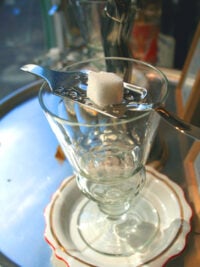
Getting ready to prepare a glass of absinthe, French-style, of course.

I’ve been meaning to take you to visit one on my favorite shops in Paris for quite a while: Vert d’Absinthe. This little shop is located in the Marais, but a bit removed from the busy tourist streets, just off the Place St. Catherine. Owner Luc-Santiago Rodriguez tells me his shop was the first boutique anywhere dedicated just for the purpose of selling absinthe, that wickedly suspicious elixir that’s recently been getting a lot of attention lately.

mrabsinthe.jpg
Luc-Santiago Rodriguez of Vert d’Absinthe in Paris.

Although the drink was originally produced as a cure-all medical tonic in 1792, Absinthe became a rather popular drink amongst Parisians in the late 1800′s, mainly with hedonists living in Montmarte who would sip it in cafés and clubs, like Le Moulin Rouge, before it was ultimately banned by the French government in 1915.

absinthedishes.jpg
Dishes with numbers were to let patrons know how much their glass of absinthe cost. Think of all the paper they saved!

Although experts are as unclear as a cloudy glass of absinthe on exactly why it was banned, the most colorful theory was that people went mad drinking absinthe due to the rotten wormwood used to make the drink. It was dubbed le f&eacute’e verte or ‘the green fairy’, since it was said to inspire hallucinations as well.

(Absinthe was banned in the US in 1912, and so far, it’s still technically illegal to import into the US.)

But nowadays, most people, including Luc-Santiago, agree that the powerful French wine industry at the time was upset that people, especially the artsy bohemians who lived in the north of Paris, were drinking cheap, hi-test absinthe (at 70% alcohol) instead of pricey wine (around 12% alcohol), in an attempt to get a better buzz for their buck. Since the French wine industry had suffered a severe set-back from the phylloxera infestation which killed most of the grapevines in France, the price of wine had gone up enormously. So it’s thought that the wine industry pressured the French government to put the kabosh on absinthe production.
And that was that.

absinthevarieties.jpg
It’s my one-stop shop for all things absinthe!

In 1988 absinthe made a comeback and the French government once again made it legal to sell and drink the anise-scented exilir, absinthe attaining a bit of a cult status in the process. With all the ceremony of pouring something previously forbidden in a fancy glass, pouring water over a sugar cube to make it cloudy (called louching), then slowly sipping it while staring into space in a deserted café…how could anyone not be entranced by the romance of absinthe?

If you come to France and want to try or purchase absinthe, be aware that not all drinks that look and sound like absinthe are indeed absinthe. You’ll come across ‘absente’ (missing the ‘h’), which has a bleary picture of Van Gogh on the packaging (it was said he went mad drinking absinthe and cut off his ear because of it, which to me is a rather iffy marketing move), but these impostors use a wormwood that’s different than the variety of wormwood (artemisia absinthium) used in true absinthe.

absintheherbs.jpg
The true herbs of absinthe.

The wormwood used to make true absinthe contains thujone, the most important compound in real absinthe.

Anyone interested in absinthe should make the trip to visit Luc-Santiago’s little shop Vert d’Absinthe, where 25 different kinds of absinthe are stocked. All are French except for one, which is made in Switzerland, and most of the French absinthe varieties are made near the Swiss border. Monsieur Rodriguez stocks all the proper paraphernalia for properly preparing and drinking a glass of absinthe, from vintage to contemporary; spoons, glasses, fontaines, and, of course, the bottles themselves.

And perhaps you’ll get a demonstration and a taste-test. Although drinking absinthe French-style means louching the drink by pouring water over a sugar cube through the special spoon before it clouds up the absinthe, the more flamboyant Czech-style method involves lighting the cube of sugar dramatically on fire, which I’ve yet to see him do.

Vert d’Absinthe
11 rue d’Ormesson
Paris
Tél: 01 42 71 69 73
Open daily, from 11am to 8pm (closed Monday)


Related Links

Absinthe Cake Recipe

Chubby Hubby: The Green Fairy

In Absinthia

The Wormwood Society

La Fée Verte


A few unusual places for absinthe in, or near, Paris:

-Hotel Royal Fromentin (11 rue Fromentin, Paris, tel. 01 42 81 02 33) serves absinthe at their historic bar, a former cabaret at the foot of Montmartre.

-Musée de l’Absinthe (44 rue Alphonse Calle, 95430 Auvers-sur-Oise, tel. 01 30 36 83 26, about fifteen minutes outside Paris) is open on the weekends and holidays and sports all sorts of memorabilia and paraphernalia from absinthe’s heyday. Take the train from the Gare du Nord.

-Cantada is a heavy metal bar, and one of the few bars in Paris to serve a wide selection of absinthe.

-La Fée Verte (108, rue de la Roquette), is a neighborhood café with absinthe on offer.


Procrastination: Ce n’existe pas

As any American knows, procrastination is a way of life. For example, I’m nearing the end of a big project, yet am having a hard time bucking down to finish it. I even got so desperate in my procrastination that I pulled out my oven and cleaned all behind it, the sides, and scrubbed off the baked-on sugar around the knobs. I’m looking for other projects to tackle next. I am a procrastinateur, if such a word exists. (And I’m not above making up words around here.)

When I was taking French classes shortly after I arrived a few years back, my teacher who was insane, (which is another story, including how he just freaked and starting punching-out the blackboard, but at least it wasn’t me…although I’m sure he was thinking it was) but spoke, like, nineteen languages. With complete fluency. I hate those people. But he had never heard of the world ‘procrastination’. So I pulled out the immense French dictionary at the school and sure enough, there it was, in French and English, spelled the same way.

But if you mention the word ‘procrastination’ to any French person, most likely they’ve never heard it before. I don’t know why. A friend here offered, “It’s because French people don’t procrastinate.” When I looked the word up today in my Robert Collins French Dictionnaire which sports 120,000 traductions, the word ‘procrastination’ only appears in the English-to-French translation, not in the Français-to-English translation.

Coincidence…or conspiracy?

anthelios.jpg

So here I am procrastinating.
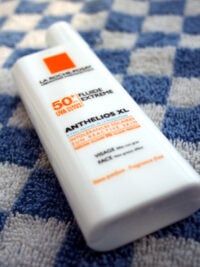
Speaking of things that are Too Good To Use, in France, you can get the most superb sunblock in the world. I was told about it by a friend who told me about this non-gloppy formula that she liked. So I went and bought some.

Then the plot thickened.
I was telling another friend about it, and she said,“Oh! That’s the stuff all my society friends from New York come over and hoard.”

Hmmm. Really? So I did some searching on the internet and found out that yes, Anthelios XL, or any suncress with Mexoryl® isn’t available in America, even though it’s considered the best, most effective sunscreen on the world. They refuse to give a reason, but FDA has banned the sale of it in the US.*

Paris has been hotter than heck lately. One blogger who shall remain nameless, Susan, pointed out that little weather icon I’ve added to the site said it wasn’t as hot as I was leading on.
So while she sits in her glamorous pool down on her farm, I offer indisputable proof…

thermometerparis.jpg

So now I have a sneaking suspicion that the weather icon I added is part of a large, right-wing conspiracy to make us believe that global warming isn’t happening and that yes, George W. Bush was a far better choice for president than Al Gore.

And never mind my photo of my chocolate thermometer.

Anyhow…I need to get back to work.
But I did try the sunscreen and it’s truly amazing. It’s thin, light, and didn’t leave my face feeling like a pruneaux after a day of walking around Paris during the heatwave. Since it’s not available in America (another right-wing conspiracy so all the sun-worshiping leftists get face cancer and can’t vote?), if you come to France, you can stock up (although check the legality with the authorities to make sure it’s okay) on La Roche-Posay Anthelios XL Fluide Extreme for the visage, the face.

Don’t procrastinate.

La Roche-Posay products are available in many Pharmacies and Parapharmacies in Paris.

*Update: La Roche-Posay sunscreen is now available in the United States legally.

The Rules: Bringing Food Home From France

“Can I bring it back?”

Answering many of the questions visitors have about what’s allowable to be brought back into the United States (legally), here’s an excellent article with some facts that tell you what foods can, and can’t, be brought back home from your trip abroad.

For more tips and news, Think Twice Before Stuffing Your Suitcase offers additional information.

Please note that rules are subject to change and revision and you can find further information at these US government websites:

-Transportation Security Administration

-Importing Food Products into the United States (FDA)

-Travelers Bringing Food Into the US for Personal Use (US Customs & Border Protection)

The Best Paris Guidebook

tuilleries

Paris is reported to be the most popular tourist destination in the world. Each year people come from all over the world for their vacations. I’m sure they spend months and months making arrangements, searching the internet looking for a charming, affordable hotel, scouring web site for decent airfares, and searching my blog for places to eat.

So after all that, what do most people depend on to get around this most fabulous of all cities? The free maps from Galleries Lafayette that the hotels give out. Not that there’s anything wrong with those maps.

Ok, yes there is.

guidebook.jpg

Let’s face it, Paris hasn’t changed much in the past 100 or so years or more, and it ain’t gonna be changing much in our lifetime either. So next time you come, on your very first day, stop by a Presse, or newstand, and buy one of these booklets. They cost about 5 to 7 euros, and are available in various sizes and formats. Few Parisians leave the house without this handy little booklet in their handbag or man-purse. It easily slips inside a coat pocket as well.

Mine lists all the outdoor markets in the city by day and location, addresses for all the attractions in Paris, the location of gas stations and taxi stands, where all the big department stores are, schools and universities (ok, you probably don’t need those), and a complete overview and map of the extensive métro system. And the last kicker: you can use it each and every time you come back to Paris. No need to buy a new one.

Related posts and links:

Paris Dining and Travel Guides

My Paris

Two Delicious Dining Guides to Paris

The Pastry Shops of Paris

French Menu Translation, Made Easy