May 2005 Archives

One of the fun things about living in Europe is that there are other people who've moved here (like me) who love their local culinary scene (like me.)

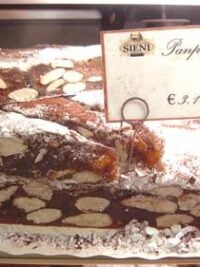
A few lucky guests each week follow along (or rather, try to keep up!) with Judy Witts Francini, aka Divina Cucina. A bundle of energy, each morning armed with an empty basket and a head full of menu ideas, she takes the Central Market in Florence by storm. A day begins with espresso at her favorite pastry shop, Antica Pasticceria Sieni (via San Antonio) where you sip espresso served with spicy wedges of panpepato, crisp brutti ma buoni (which means "ugly, but good"), and delicate cream-filled pastries.

panforteblog.jpg

Soon after, you're exploring the market with Judy. I tasted well-aged balsamic vinegar, found delicate tiny wild strawberries, and sampled aged sheep-milk Pecorino cheeses...which could make even the most devoted, cheese-loving Francophile pack their bags for Tuscany.

After thoughtfully selecting wines for lunch from her local expert at Casa del Vino (via dell'Ariento, 16/r), the sandwich maker fixed me a surprise snack for my train trip that evening. When I unwrapped my sandwich, I found Tuscan bread stuffed with anchovy and olive oil marinated tomatoes, arugola, and creamy burrata cheese from Apulia.

Then we walked back to Judy's apartment and participated in some hands-on cooking demonstrations.

Judy is a dynamo of knowledge, full of great culinary tips, such as...

1. Don't listen to music or watch tv while cooking, which distracts you from the food as it crackles, sizzles, and simmers.

2. Used good olive oil.
The best olive oils are pressed from hand-picked olives. Lesser-quality olive oils use olives that fall from the tree, which causes them to bruise and become prone to rancidity. That's why cheaper olive oils turn bad after a few months while better oils last much longer. And tastes better!

3. Always heat olive oil first in your saute pan before adding meat or vegetables.
This allows food to sear and cook quickly, which augments flavors. An exception is fresh garlic, which should be heated at the same time as the oil, since it's easy to burn.

4. Techniques are more important than recipes or details.
Even if you're not a master chef like Judy, use recipes as guidelines for cooking. While a recipe may indicate a cooking time of 20 minutes, you may find it takes more or less time in your kitchen. And you may like more salt. Or your lemons are larger, and sweeter. Learning techniques, rather than just following recipes, will make you cook like an Italian.

5. Almost all true balsamic vinegars are aged for at least 10 years. Anything less is not a real balsamic. The stuff you buy in shops labeled 'balsamic' with the consistency of water is not true balsamic and has added colorings and flavorings. Once you taste the real thing, you're eyes will roll back in your head and you will hallucinate.

I've been cooking professionally for over half of my life and I've tasted some mighty fine food, but one of the best things I've ever had, she made right in front of us: Herb Garlic Rub. It's something that anyone can make and tastes infinitely better than those stale mixtures one buys in a jar. Judy shucked a few large branches of fresh rosemary leaves. She added the leaves from an enormous bunch of fresh sage, a generous handful of salt, and 4-5 cloves of fresh garlic. Then she chopped and chopped and chopped until very fine, then left the mxiture on the cutting board until dry, which takes a day or two. Once dry, store the mixture in a jar. You can use the Herb Garlic Rub on any meat, fish, poultry, or vegetable. Add a bit to a bowl of good olive oil for dipping bread.

sandwichblog.jpg

Then in an amazing feat of culinary skill, replicating something that intrigued me at the market, Judy split a long loaf of Italian bread lengthwise. She generously poured some good olive oil over the insides (without measuring, folks...), dusted it with Herb Garlic Rub, then tucked a pork tenderloin inside. After wrapping the whole thing in foil, she baked it directly on the oven rack (in a 375 degree oven for about one hour.) As she unwrapped it, the overwhelming aroma of herbs and garlic permeated the air. None of us could be polite any longer, and we begin ripping off hunks of the herb-and-olive-oil infused bread and stuffing them in our mouths.

For dessert Judy whipped up Panna Cotta, one of Italy's most beloved desserts. Although Judy uses local Tuscan cream, you can substitute whole milk or buttermilk for some of the cream. We tossed tiny wild strawberries and plump raspberries in sugar to macerate, then piled some atop each Panna Cotta and drizzled it with an unrestrained pour of 30 year old syrupy-sweet balsamic vinegar.
Rare, and outrageously expensive, Judy kept advising, "Pour on more! Pour on more! That stuff tastes great!"

judyblog.jpg

Divina Cucina Panna Cotta
6 Servings

4 cups heavy cream (or substitute half-and-half, or use half buttermilk)
1/2 cup sugar
2 teaspoons vanilla extract
2 packages unflavored gelatin, such as Knox

Soften gelatin over 6 tablespoons cold water.

Heat cream over low heat with the sugar and stir until dissolved. Do not boil. Remove from heat.
Stir in gelatin until melted. Add the vanilla. Pour into glass serving goblets or bowls.

Chill for at least 2 hours. Once firm, top with sweetened berries and aged balsamic vinegar, or lots of shavings of chocolate.

The arrival of cherries means the dreariness of winter is definitely over, and I can finally look forward to a long, delicious summer of fresh apricots, raspberries, nectarines, peaches, and plums.
Once cherries became reasonable at the market (a little over a week ago, the Grand Epicerie had some for 50€ per kilo...about $30 per pound!) I'm using them as fast as I can pit 'em.

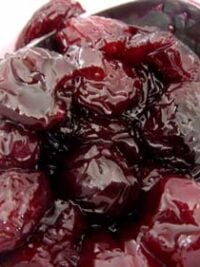
Although you might think it's funny to candy fresh something fresh, there are times perhaps your cherries aren't super-flavorful (like too early or too late in the season) and candying augments and intensifies flavor. And as a bonus, you'll end up with a lovely brilliant-red syrup which you can mix with Champagne for a fizzy and festive kir Royale. Once candied, these cherries will keep for a few weeks in the refrigerator. Spoon them over vanilla ice cream, stir them into yogurt, and toss them with nectarines or peaches for a summer cobbler.

candiedcherriesblog.jpg


Quick Candied Cherries

1 pound (450 gr) fresh cherries, rinsed
1 1/2 cups (375 ml) water
1 cup (200 gr) sugar
1 tablespoon fresh lemon juice

Remove the stems and pit the cherries (I use a handheld cherry pitter.)

In a large non-reactive saucepan (at least 4 quarts/liters) bring the cherries, water, sugar, and lemon juice to a boil.

Reduce the heat so the cherries are cooking at a low rolling boil. Cook for 25 minutes, stirring frequently during the last 10 minutes of cooking to make sure the cherries are cooking evenly and not sticking.

Once the syrup is mostly reduced and a brilliant ruby-color (with the the consistency of maple syrup), remove the pan from the heat and cool the cherries to room temperature.


Recommended Cherry Pitters

OXO Good Grips Cherry Pitter: Like all Oxo products, this one gets high marks from users.

Leifheit Cherry Pitter: All-metal cherry pitter, popular in Europe.

Leifheit Pro-Line Cherry Pitter: (I love that name!) This is a great contraption if you have a lot of cherries to pit. Keeps the cherries in a container, so it's less-messy to use than others.

One of the great places for lunch in Paris is Cuisine au Bar (8, Rue du Cherche-Midi), which has been touted as the French version of the sushi bar. The servers are welcoming and generous, and the tartines (open-faced sandwiches) are the most inventive and marvelous in all of Paris. A dedicated friend of mine lunches there every day.

I met Pim for lunch, of Chez Pim, and we both ordered the same thing: the chicken sandwich, a toasted slice of Poilâne levain bread (the bakery's just next door) moistened with homemade mayonnaise, slices of plump chicken, filets of anchovies and a scattering of capers, which kept rolling off. We both systematically added flecks of coarse sea salt, then consumed. Delicious. Pim, being far more polite than I am, ate her sandwich perfectly reasonably with a knife and fork. I wolfed my down, polishing it off in record time, licking my fingers afterwards.

After braving La Poste together afterwards, we parted, making plans for eating Thai food with other Paris bloggers in June. However after we parted, I noticed she made a beeline to Pierre Hermé's astonishing pastry shop on the Rue Bonaparte. So a few days later, I returned as well, and tasted one of the most stunning pastries of my life, his Arabesque macaron, which Pim had rhapsodized over earlier in the week.

macaroonblog.jpg

Normally a classicist, I prefer my macarons with chocolate, coffee, or pistachio. But this was an amazing creation. Delicate, crackly pistachio-dusted meringue cookies flavored with apricot. The filling was a melange of apricot cream and caramelized nut praline. Each season, M. Hermé introduces new flavors of macarons, some successful (olive oil-vanilla, rose-lychee, and caramel-beurre-salé) and some less so (his white truffle and catsup come to mind.) However Arabesque was perfection and I was sorry that I only bought one.
I will be going back tomorrow for another.

Having returned from my trip to Italy, narrowly escaping the hairy fangs of the too-vigilant EasyJet luggage police, I returned with a suitcase full of great Italian foods: chocolates from Amadei, and Domori, coffee (and more chocolate) from Slitti, jars of bittersweet chestnut honey, 12-year old syrupy Balsamic vinegar, luscious sun-dried tomatoes, and of course, bottles of fruity Tuscan olive oil.

Fresh Dried-Pasta
I've seen a lot of noodles in my time, but stopping in Pastificio Defilippis (via Lagrange, #39, in Torino) I had to take a moment to collect myself. Lining the walls were every kind of dried pasta imaginable, all made right there on the premises. Members of my group made a beeline for the pasta al cioccolato, but for some reason they ignored the coiled-up stewed eels available for antipasti.

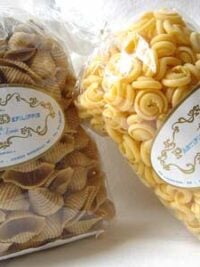
pastablog.jpg

Mesmerized, I found these two pastas irresistible. One I nicknamed 'bellybutton pasta', which I had to translate for the pasta maker by lifting up my shirt ("Boys Gone Wild: Torino!"), and the other is a whole-wheat pasta. If you haven't had whole-wheat pasta, it's great tossed with fresh or good-quality tinned tuna, pitted olives, sun-dried tomatoes, finely-shopped anchovies, fresh thyme leaves, topped with crumbled feta cheese.

Cocoa Beans
Is chocolate good for your health? There's no easy answer for that (although a simple yes would do.) Some research proves that the antioxidants in chocolate have health benefits. Yet a chocolate-maker that I know says most of the antioxidants disappear during processing.
What I tell people is that any health benefits in chocolate are likely found in the cacao beans. Either way, it's unlikely you'll get any health benefits from, um, say, Chocolate Cheesecake. Skip the 'cheesecake' part and just go for the chocolate.

kashayablog.jpg

These are cacao beans from Domori that I was blogging about earlier. They are the best beans I've tasted.

Lardo
(If you're kosher, or vegetarian, skip this section....)
I don't know what prompted me to try lardo in the first place. It's pork fat, thinly sliced, and served on warm toast with a flint of rosemary leaves. But it's one of those things that if you eat it once, you're hooked and you will never, ever get over the craving for. We don't get Food Network in Europe, but it seems every time I see it in America, Mario Batali is going on and on (and on) about lardo.
The name alone is a blatant indication that it's probably not good for you. But imagine grilled Tuscan bread moistened with just-pressed olive oil, draped over it are soft, rich and buttery slices of lardo. MMmmmmm....

Here's a photo so you can avoid a similar fate:

lardoblog.jpg

Formenton Garfagnana
I love polenta. And it's impossible to find in France. You have to make do with instant polenta which isn't bad, if you like baby food. At a lunch in a villa near Lucca, the chef gifted me a sack of artisan polenta, called formenton garfagnana. When I asked him what made it different from polenta, he began getting very excited, explaining it in detail, in rapid-fire Italian. I didn't have the heart to interrupt and let him know that I had know idea what he was talking about, so I kept nodding, avoiding the deer-in-the-headlights look. So if anyone can edify us all, post it in the comments section here. (Preferably in English!)

polentablog.jpg

Chestnut Honey
Years ago I innocently dipped my finger in a jar of Italian chestnut honey, anticipating sweet syrup. Instead I recoiled from the bitter taste which lingered way too long in my mouth. Now that I'm all grown up and so much more sophisticated, I begin each morning with a smear of velvety, savory chestnut honey on buttered toast. Yum! Is this stuff good. It can be expensive in the United States, but in Italy, it's common. Italians use so much of it that I even bought some from a street vendor in Pisa. I ended up lugging home in my carry-on enough jars of chestnut honey to last me for at least a year, I hope.

honeyblog.jpg

Two extraordinary vendors in the Central Market in Florence will mail order authentic Tuscan foods directly from their stands:

And if you live in the San Francisco Bay Area, you can visit the warehouse of Village Imports, which has open warehouse sales throughout the year.


So here I was, about to share with you tales of a market visit and meal I had in Florence, Italy, with my friend Judy, better known as Divina Cucina. We found fragrant, tiny wild strawberries, so she made a terrific Panna Cotta to serve with them, topped with a drizzle of aged, syrupy balsamic vinegar. Then while typing away (and procrastinating at the same time...does that count as multitasking?), I was reading other food blogs and noticed that Amy and Clotilde just posted Panna Cotta stories. Sigh! So I'll save that for another entry and if you absolutely have to make Panna Cotta right now, one of their recipes should hold you over until then.

Instead, I get to rant.
I wish I had a euro for each time someone said to me,
"What do you do all day in Paris? It must be so exciting!"

Well, let's look at how I spent yesterday morning, shall we?

I decided to have some friends over and make Braised Duck Legs in red wine. I decided the perfect accompaniment would be Cipolline Agro Dolce, another recipe from Judy. Before you say anything, I know, I know. You're supposed to, 1) visit the market first, 2) find what's in season, 3) then decide what to cook. Of course I know that. One of the many things I absorbed in my thirteen years at Chez Panisse. But I am the kind of guy that likes to head out shopping with a list. Otherwise, dinner would have been whatever was in my kitchen: radishes, olives, and Pocket Coffee. (see previous post)

(Judy's recipe calls for 1 1/2 pounds of peeled boiling onions, which you cook on the stovetop with a cup of so of white wine, enough to cover, a few tablespoons of sugar, vinegar, and olive oil, salt, and a chili pepper. You cook it all until the onions are glazed and caramelized. Delicious!)

Since there are no outdoor markets in Paris on Monday, I figured that I'd simply go to the supermarket and pick up boiling onions (Italians call them cipolline.) I first went to Monoprix, which seems to have everything...except what you went there to get in the first place. Sure enough, no small onions. I then went across the street to Ed, which is a discount supermarket and kind of grim and unsavory. The gate was down: "Closed For Inventory." Grrr.

I then walked over to Franprix, another supermarket. No onions. How can this be? One of the greatest food cities in the world, and no boiling onions? I decided to try Picard which specializes in frozen foods. People here rave about Picard (although I wonder, "Who the heck buys frozen baguettes when there are 1263 bakeries in Paris?"...and yes, I do know those kinds of things.) Picard has everything frozen; sacks of red currants, figs, and sour cherries, pigeons stuffed with foie gras and chocolate-glazed ice cream profiteroles. I scanned the freezers passing over frozen baby artichoke hearts, sliced leeks, minced sorrel, and fava beans.
But, of course, no onions.

After two hours of searching from supermarket to supermarket, I decided to call it quits. Heading home, I wanted to at least stop at Nicolas and get some wine, since I didn't want to go home dejected and empty-handed. As I approached, the door wouldn't budge.

"Open Monday, 4pm-8pm."

Defeat.
France 1: American 0.

Late yesterday afternoon, on my way to yoga, I stopped at Shopi, another supermarket and my last resort. Sure enough, there were little filets (mesh sacks) of boiling onions buried within the produce section.

The label read, "Produit d'Argentine".
It was a very long journey...for both of us.

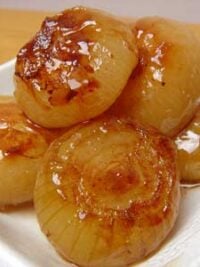
As you can imagine, I was very careful not to burn them.

onionblog.jpg

So, to answer your question...That's what I do all day.

Trim cube of chocolate

Gush out liquid espresso!

Clever caffeine cloak


pocketcoffees.jpg

Gianluca Franzoni is the master chocolatier at Domori. He's the person who is responsible for selecting the beans and roasting them to perfection. Cacao beans, like coffee, need to be roasted to bring out their flavor. Domori uses no vanilla in their chocolate, unlike other chocolate companies, since Gianluca believes that vanilla masks some of the flavors he coaxes out of the beans to make his chocolate. I immediately liked him because of his dedication to making truly fine chocolate....(and perhaps because his shirt would match the colors of my web site.) Aside from making great chocolate, the Italians really know how to dress.


DSC00871s.jpg


As you can imagine, Domori is a chocolate company that is rather revolutionary...and in a country that's no stranger to revolutions. If you've been to Italy, you know the Italians are lively, creative, wonderful people. And they're not afraid to do things a bit differently.

When Gianluca told me that Domori chocolates were so smooth that even the 100% bar of unsweetened chocolate, called Puro, was not the least bit bitter, (even without the sugar,) I frankly didn't believe him. But Puro was indeed great. It's made from 100% Sur Del Lago beans, which is used in some of the best chocolates I've tasted. For the hard-core chocolophiles, crunchy dark Ocumare cacao beans, known as Kashaya, are roasted whole and meant to be eaten just as they are. I mean, what kind of people pack up whole roasted cocoa beans and for hard-core chocolate-lovers to eat? The same people who brought us gelato, gianduiotti, and panna cotta.

As you can probably tell by now, I love Italians!

Domori is one of the few chocolate companies that actually owns their own plantations in Venezuela. Most of their beans are criollo hybrids, which is considered the best cacao available today. (The term 'cacao' refers to the beans used to make chocolate, and 'cocoa' usually refers to the powder made from the beans after they're roasted and pulverized.)

We tried a sample of all of their chocolates, guided by Gianluca....

DSC00847S.jpg

Esmereladas is their chocolate made from Ecuadorian cacao, that had a surprising tropical banana-like aroma and flavor. Rio Caribe, from their Venezuelan plantation, had an earthy, musky character while the Sambirano from the island of Madagascar (where a lot of vanilla is grown) had a raisin-sweet taste and a gorgeous red hue. Perhaps the most intriguing was the Puertofino, which was made from a rare, pure Ocumare cacao, which we all agreed had a delightful creamy taste, even though it was pure bittersweet chocolate with no dairy added.

If this is making you crave Domori chocolate, you can order their chocolate (as well as Tuscan chocolates from Slitti and Amadei) online at Chocosphere.

So onward in my pursuit of more great chocolate here in Tuscany.
Next I'll visit Slitti, which aside from blending their superb chocolates, they roast amazing coffee...which says a lot, since each time I sip an espresso in Italy, I fall into a deep trance-like state.
In the walled city of Lucca, where we're staying, I've had a chance to stock up on Amadei chocolate as well. Amedei specializes in very rare cacaos, such as Chuao and Porcelana and is another of the world's great chocolates.


DSC00812S.jpg


Eating in Tuscany includes focaccia flatbread permeated with olive oil and sprinkled generously with coarse salt, soup made with the Lucchese wholegrain known as farro, and I'm stockpiling delightfully bitter chestnut honey that I drizzle over toasted and buttered (salted butter, of course) levain bread. If you should ever visit Lucca, the best place to buy Tuscan foodstuffs is Antica Bodega at 31, via Santa Lucia. The wine, of course, is excellent, inexpensive, and generously poured in restaurants and enotecas.

Tomorrow I'm taking my group to a villa in the mountains for a wine and olive oil tasting before we return to Lucca to shop for local specialties at Antica Bodega, including sharp, sheeps-milk Pecorino cheese and well-aged, syrupy Balsamic vinegar, Parmesano-Reggiano and olive oil.

And of course, lots more chocolate.


Related Chocolate Links


Chocolatiers and Chocolate Makers

Theo Chocolate

Valrhona Chocolate

Chocolate FAQs

John-Charles Rochoux

Regis Chocolate

Patrick Roger

La Maison du Chocolat

Here I am in Torino, or Turin, if you're familiar with the shroud.
Being on the road means that I'm in unfamiliar hotels with less-than-ideal access. When I attempted to change the thermostat in my hotel room, the digital display read 'PARTY'. I don't know what the 'party' mode is, but when I pressed the switch again nothing exciting happened.

thermostat1.jpg

I'm leading a fabulous chocolate tour as I write. Torino is not on the tourist route. But it should be if you're into chocolate. Gianduja is the star chocolate attraction here, a blend of milk chocolate and hazelnuts ground until smooth then formed into a paste. Hazelnuts are a specialty of the Piedmonte region and during wartime, cocoa beans were scarce so someone had the great idea to blend them with chocolate, and gianduja was born. (If you've had Nutella, you know what a terrific alliance chocolate and hazelnuts can be.)

Gianduja1.jpg


Once the gianduja paste is made, it's formed into mounds that are molded into a flat peak, then wrapped in gold foil. I'm not much of a fan of milk chocolate, but when mixed with hazelnuts, it's dreamy and truly delicious. The best gianduja that I've had was at A. Giordano (Piazza Carol Felice, 69.)

The other chocolate treats of Torino are Bicerin and gelato. Bicerin is great, and something that deserves to be better known outside of Torino. It's a hot drink made with espresso, chocolate, and just enough whipped cream to make is smooth and creamy. It's a fabulous combination, and each afternoon residents of Torino line up at bars for a warm Bicerin.

The gelato here is thick, gooey, and delicious. Like nothing you've had in your life. Flavors include caffe, gianduja (my favorite, of course), pistacio, tangy yogurt, and torrone loaded with almonds and sweetened with honey. Here's my favorite gelato maker at the Caffe San Carlo (Piazza San Carlo, 156). He is perhaps my new favorite person in the world.
At least in Italy.

gelatoman1.jpg


Italians in Torino walks down the street eating gelato all hours of the day. Businessmen at lunchtime slurp cones while avoiding dripping on their Armani suits. Afternoons, swarms of teenagers with low-slung jeans send text-messages in between licks, and elderly women wander through the passages and window shop savoring gelato.

So I'm off tomorrow with my group for the mountains of Biella, where we'll dine at an Agriturismo, a farm that serves meals made from ingredients only grown on the land. Then onward to Genoa, where we'll stop along the way at Domori chocolate, one of the world's great chocolate manufacturers.

At a recent dinner party here in Paris, I asked a gentleman from New York City how he was enjoying his trip. He responded it was fine, but "I can't find anywhere to get a coffee in Paris."

There's been perhaps 3 times in my life where I've been speechless, much to the consternation of anyone within earshot. And this is the first time this century.

How can anyone say there's nowhere in Paris to drink coffee?
(I'll forgo any mention of how the same guest began hacking the beautiful artisan cheeses, carefully selected and arranged on a platter, into little bits after the host set it down. "That'll make things easier!" he proudly announced.)

I still have no idea what he was talking about.
Make what easier?


Anyhow...
Paris is a city filled with cafés.
In fact, the concept of the café was invented here in the 1600's at the Le Procope in the Latin Quarter, unfortunately a sad victim of a hideaous remodel about a decade ago. Cafés flourished when struggling artists and writers like Hemingway and Picasso (and more recently, Lebovitz) would escape their freezing-cold apartments for cozy heated cafes.
People come to sip coffee, read, argue, and have a smoke. There's a café on every corner, on every street, in every neighborhood. Because apartments are so small and Parisians are rather private, invitations to homes are rare. Instead people meet in cafés, and many consider them the living rooms of Parisians.

So I scoured the city in search of a café.
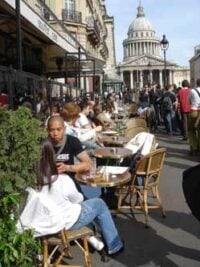
After 3 seconds I found one. Then another. And then another! Mon Dieu! These things are everywhere! Just in case you come to Paris and need to find one, this is what a café looks like:

cafe1.jpg

After giving it more thought (perhaps more than it deserved) I may have figured out what he was talking about. He wanted Starbucks. Ok, so that's coffee.

They said it couldn't happen here, but Starbucks has made it's way to Paris, opening several outlets over the past year. The appeal of Starbucks in America is pretty easy to understand: Starbucks gave Americans permission to sit down for 20 minutes, have a decent cup of coffee, read the Times, and use a bathroom (although unless you're rather acrobatic, not all at the same time). This concept has been embraced by Americans as neighborhood diners morphed into fast-food outlets in cities and towns, erasing local culture and communities. But do Europeans know what to do when confronted with a giant 20-ounce coffee in a paper cup, 'les brownies', and vente-mocha-soy-low-fat-chai lattés?

starbuckslist1.jpg


Here's the list of beverages explained for the French clientele. It's a bit hazy, since the people working in the shop were eyeing me suspiciously, (perhaps with even less comprehension than most French people eye me.)

When I travel to other places, I look forward to experiencing other cultures, and "doing as the locals do". Living in France has taught me that attempting to "fit in" means learning the language (the verbs are killing me), dressing up (I changed out of sweatpants to take my garbage out last sunday in case I ran into any neighbors), buying my cheese in one shop and my wine in another and my butter in another...and my vegetables in yet another. But in between it all, I take the time to enjoy a coffee in real cafés, one of the pleasures of living in Paris.

But just in case I run into anyone looking for a coffee, I finally found just the place to send them to...

AmericanCoffee1.jpg


Note: I'm off to Italy this week to lead a Chocolate Tour from Piemonte to Tuscany. I'll have lots of pictures and stories when I get back. I hope to post some entries from the road as well.

French Food Stamps

05.05.2005

The other day I was waiting on line at La Poste (emphasis on the word 'waiting'...), I happened to notice a new series of stamps on sale. Of course, I wanted to take a picture right then and there, but I figured everyone would think that was goofy, so I bought a set to show you:

stamps1.jpg

I love these. Stamp dedicated to cane sugar, Cantal cheese and 'la bouillabaisse'.

And people ask me why I live in France.

There is nothing simpler to make than a fresh fruit granita. For me, the only hard part is finding real estate in my freezer for the pan to stir it up in.


But springtime means strawberries.

And lots of 'em!

gariguettes2.jpg

Years ago, taste was hybridized out of commercial strawberries in favor of firmness for long-term storage, but many farmers are growing varieties of berries that have lots of flavor again. At the San Francisco Ferry Plaza Market, you can get delicious Swanton organic berries from the coastal town of Santa Cruz. In France, I find lovely and fragile Mara de Bois now debuting in markets. But no matter where you live or shop, in supermarkets or greengrocers, you can determine quality by taking a big sniff. Where you find fragrance, flavor is sure to follow. And I find tossing strawberries in a bit of sugar and letting them stand for a bit releases their juicy sweetness and the berries become a rosy-red color.

juicy-berries.jpg

Granita is basically a shaved ice. No ice cream machine is needed. All you need is a fork. The mixture is simply raked while freezing. Once frozen, spoon the icy crystals over vanilla ice cream, or piled into a glass by itself, perhaps with a complimentary fruit sorbet, or maybe a dollop of sweetened whipped cream.

Strawberry Granita
About 6 servings

1 pound strawberries, rinsed and hulled
3 tablespoons sugar
1/2 cup water
optional: 1 teaspoon fresh lemon juice

1. Slice the berries into pieces.
Toss the strawberries with the sugar and let stand for at least one hour at room temperature, or up to four hours. The strawberries will be very juicy and a lovely red color.
Place a non-reactive shallow metal or glass tray in the freezer (a long, rectangular lasagna pan works perfectly, but you can improvise.)
2. After one hour, puree the strawberries and their juices with the water in a blender. Taste, and add a squirt of fresh lemon juice if desired. At this point, if you want to strain out any seeds, go ahead. I leave them in. What the heck.
3. Pour the mixture into a shallow pan in the freezer. Check after 30 minutes. As the mixture begins to freeze, use a fork to scrape the frozen puree that froze around the edges into the center. Return to freezer.

granita2.jpg

4. Check the granita every 30 minutes, and scrape again as before, perhaps with a bit more vigor as the mixture hardens. It should take about 2 hours of freezing and scraping to finish completely.

One of my favorite actresses, and the first lady of American theater, Pamela Anderson, has a new progam called 'Stacked' on Fox television wednesday nights. Starring alongside Pam (who plays a bookstore clerk), and prominenly displayed behind her enormous talents, is Ripe For Dessert.

ripe.JPG


Check us out tonight!

Forget everything you've been told about salted butter.

Ok.
There, I hope that was easy.

(Now forget my last column.)

I've recently reconverted to salted butter.
Most recipe-writers like myself call for unsalted butter because it's easier to gauge how much salt will be used in the recipe and everyone seems to be on an exactitude kick when baking. Lighten up, home cooks. If people followed traffic rules with the same methodical precision they followed recipes we'd all be a lot safer.

paletsbreton.JPG


Kouign Amann took me a few years to learn to pronounce (although I tried to describe this to a French person) it's pronounced like "shwing" from Wayne's World, which lost something for better or worse in the translation. It's perhaps the best known dessert of this region. Driving through villages and cities, you'll find them piled high in the window of bakeries. Layers of flaky pastry cooked with obscene amounts of salted butter and sugar. When cooked right, the combination of melt-away pastry and salty caramel is unbelievable.

kouing.JPG

However since I wrote the last column on getting larger, I figured I'd better hold back on further descriptions of Kouign Amann and switch to gâteaux Bretons and palets Bretons. Both are basically buttery shortcakes with that lip-coating-just-near-the-ocean saltiness that cuts the richness of the butter.

Palets Bretons are small, cake-like confections (shown piled above) that have the consistency of rich cornbread with the exact blend of tender-toughness that Clint Eastwood is beginning to aspire to. Gâteaux Bretons are larger cakes made of rich better, poured into a cake mold, scraped with a fork, then baked until golden brown. When done right it's perhaps the most delicious thing in the universe. The picture that you see here means that a lot of people will get to experience that delicious-ness themselves.

bretoncake.jpg

My favorite place for palets Bretons is C. Ferchaux on the rue Général de Gaulle in Ploubazlanec (Bretons have a different language, and many of the names and places are full of "z's". You should have heard me trying to give directions.) I practically died walking in the bakery. The overwhelming smell of butter was greater than that of a butter farm I once visited. On the countertop was a big pot of rice pudding that the woman informed me gets cooked in the oven alongside the bread for 4 hours. I took a picture, but it would take a better food stylist than me to get rich pudding to look unctuous in a photo, so I skipped it in favor of the cakes.

Just about everyone coming to Paris asks me if I've read "Why French Women Don't Get Fat" by Mireille Guiliano.
No, I haven't read it, and I'm kind of sick of hearing about it, because many of the answers just seem all too obvious. Especially one of the reasons; it's because they smoke.

Is the alarming rise in American obesity aligned to the fact that about 20 or so years ago, people in America began to quit smoking? If you've been to Europe, you realize lots of people still smoke. (And I'm not sure any government wants too many to quit smoking, due to the huge taxes on cigarettes.)

But to say that there's something that the French women know that American women don't is rather silly. In America, people drive just about everywhere. Think when was the last time you walked to the store to buy groceries (and lugged them home?) And think about the staggering array of candies and fast-food available in 'drugstores' in America. And just how many calories are in that jumbo smoothie? (Answer: About 50% of your daily requirement.)

But for some reason, I wonder why Americans think there is some magic reason for the French being so slim? True in cities worldwide (and in American cities as well) many are preoccupied with appearances. But in America, the question remains why diet books are so popular, gyms are everywhere, and none of us are getting any slimmer. I loved the look on a friend's face here in Paris when I told her that people get up at 5am in America to work out at the gym.

So here are some observations why French women, and men, are (sometimes) in better shape than their American counterparts:

1. There is more of an emphasis on quality, not quantity. Unlike in American, in France, fast-foods and soda are very expensive while fresh foods and wine tend to be cheaper. It's expensive to eat healthy in America.

2. Meals are much lighter; there is often only one large meal per day. Many French people will have soup or a salad for a meal, unless dining in a restaurant.

3. People walk a lot. Even if you take the métro, there's plenty of stairs to contend with. For example, these are the stairs to my apartment. Imagine lugging 4 bottles of wine, 6 liters of Badoit water, and 10 kilos of flour up there!

steps.JPG

(Ok, those aren't really my front stairs...)

But just imagine how much more exercise you'd be getting if you walked to the gym (to use the treadmill) or walked to work (to sit behind a desk all day.) Still, it does add up.


4. Quantities are smaller. I've seen French people cutting up a single chicken wing with surgical precision, taking all the time in the world.
And consider a container of yogurt. French yogurt is about 4 ounces, half the size of their American counterparts. And for the most part, French people eat whole-milk yogurt 'nature', with no sugar added. Portions in America are huge.

5. There simply isn't the culture of 'always eating' in France. I recently read an article about fast-food restaurants inventing new things for Americans to eat while driving. Are we all that busy? Cookbook author Marion Cunningham once said to me, "Everyone's always telling me that they're so busy..but I'd like to know what's everyone so busy doing?"

6. And finally, people are not all the same size. Thankfully, most women don't resemble Paris Hilton (scary!) or Anna Nicole-Smith (scarier!) Still, even in France, there's more and more people that could perhaps walk a bit more, and consume a bit less.


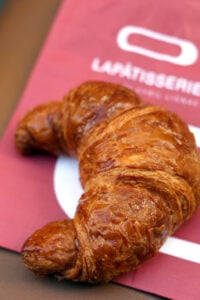
I'm often asked how I manage to stay in shape eating all the fabulous foods around me. Well, for the most part, when I indulge in a croissant, for example, I'll eat the best croissant I know of (the ones at Au Levain du Marais at 28, blvd Beaumarchais near the Bastille come to mind.) If I want chocolate, I don't bother with a big, rich chocolate dessert. I'll eat a few squares of the very best, most bittersweet chocolate I know of.

Ok, off for a walk to Berthillon for ice cream...


Purchase The Perfect Scoop from Amazon

bookcoversite.jpg

Purchase Ready for Dessert from Amazon

Twitter Updates

Loading Tweets...

Purchase The Great Book of Chocolate from Amazon

Recent Comments

  • David said: "adel: The fixed price menu is usually written on a..."
  • adel said: "I'm spending 7 nights in Paris and on my 2nd night..."
  • David said: "Hi Kitt: Since it's not my recipe, you should prob..."
  • David said: "Jule and Pavitra: I had the same concerns as well...."
  • jule said: "I second the question of Pavitra - doesn't all the..."

Subscribe

David's Amazon Store

Monthly Archives

Archives By Date »

Browse by month: 2010

Browse by month: 2009

Browse by month: 2008

Browse by month: 2007

Browse by month: 2006

Browse by month: 2005

David Lebovitz

Purchase Room for Dessert from Amazon

Purchase Ripe For Dessert from Amazon

Marthacircle.gif