June 2005 Archives

I've been meaning to cross Paris to make the trip to Vendermeersch for months. Actually, make that years. Really. For some reason, I never made it. Maybe it's because they're closed at the wrong time. Maybe it's the idea of taking the Métro to a firmly, fairly distant residential arrondisement of Paris. I don't know. But lots of Parisians have made the trip to Vandermeersch. According to Dorie Greenspan in her superb book Paris Sweets, the year Le Figaro newspaper declared their Galette des Rois (a marzipan-filled puff pastry dessert, created to celebrate Epiphany) as the best in Paris, they sold 1600 that weekend alone!

When I first walked in, I was assaulted by the "wall of Kouglofs". There were tons of them, in every size, in every price. (Although I don't understand why places price things like 3.86€ or 7.51€... I know they're sold by weight, but can't they just add or subtract a couple of centimes? Like pennies, who wants centimes?)

kueglhofsblog.jpg


Since it was just me (where is Pim when I need her?), I conservatively choose the smallest.


kugelhof1blog.jpg


Although I previously declared the Kouglof at Ladurée the Best of Show, this was surely the late-breaking winner. The Kouglof at Vandermeersch is bready but rich, not-too-sweet, made in a cake mold which is called, appropriately, a Kouglof. Stéphane Vandermeersch studs each Kouglof with plumped raisins, the cakes are baked, then soaked in a flavorful orange flower-scented syrup. Afterwards each gets a generous tumble in coarse sugar giving each a crunchy coating. Although I had meant to take the little sucker home, the liquid seeping through the thin waxed paper wrapping made me quickly, and deliciously, alter my plans. I stood in front of the bakery wolfing down my little treasure. It was incredibly moist and delicious. Sorry, it defies fancy superlatives. You'll just have to trust me.


tartsblog.jpg


Although equally famous is their Millefeuille, layers of buttery, crispy pastry sandwiched with vanilla-enriched cream, I had my eye on the Tarte Griotte; squares of Vandermeersch's famous puff pastry smeared with soft pistachio paste, topped with a haphazard mosaic of whole, vividly-green pistachios and tart sour cherries. Each was topped with a cherry on a stem so large that it would dwarf many a lesser-fruit.

And did I mention the compact loaf of grainy bread I discovered nestled in their wooden baking molds?


grainybreadblog.jpg


Vandermeersch
278, avenue Daumesnil, 12th
M: Porte Doree
tel: 01 43 47 21 66
Closed; Monday and Tuesday

Everyone over here is getting a chuckle over the Oprah vs. Hermès flap.
There seems be a lot of back-and-forth about what happened and who-said-what when Oprah wasn't allowed into Hermès to buy a watch for her pal Tina Turner (I had the same problem with her as well. Tina is so particular about which brand of watch she'll wear.)

The kinds folks at Hermès treated Oprah like they would treat anyone who tried to come into the shop --15 minutes after the store had closed.

In France, Closed means Closed. Just like the doors on the Métro. If you're not in the Métro and the doors are closing, they ain't holding 'em open for you. It's in or out. And if you're stuck between them...ouch! (Trust me, those doors are strong.)

Hermès didn't do anything unusual. Why should she get special treatment or an apology? Get over yourself, girlfriend. I had to when I got here. It ain't all about the customer. She needs to wait until opening hours for a $13,000 Birkin bag just like the rest of us have to.

But don't get me wrong, I feel the same way about Oprah that Tom feels about Katie. (Truly!...and I don't even have a movie to promote, but someday I may, so I'd better be nice now just in case.) She is so hip and 'right-on' about everything and gives away new cars and cool stuff (and now has fabulous abs on top of everything else, damn her, is there anything she doesn't have?) But has anyone called her to the mat for promoting junk-food in her magazine while preaching a weight-loss program and doling out "feel-good" lifestyle tips?

"Do not spend another summer fat! Get Oprah's weight loss secrets and favorite snacks. Beat your chocolate cravings! Get the plan for fab abs. Plus, your questions answered. Portion sizes? Low carb? Low fat? If you need to lose weight, this is the show for you!"
-from Oprah.com

Glancing through her magazine, (and no, I didn't buy it...someone left me a copy. Honest. Although I did enjoy the articles, "Are You Too PC?" and "This Month, It's You Time!"...which was helpful, since I was wondering when things were going to get around to being "My" time.)

But I was rather surprised to see who advertised within...

Honey Clusters breakfast cereal, Coke, Fanta and Sprite,
Hi-C, some icky-looking Honey Snack Bars, McDonald's Egg McMuffins, bottled salad dressing, Keebler Fruit Delights cookies, Quaker Oats Breakfast Squares, Teddy Grahams Cubs "Fun Packs", Kraft Cheese Nips "Sport Crisps", Taco Rice mix, Country Crock Microwavable mashed potatoes and macaroni and cheese, Jose Cuervo Margarita Minis, and Jell-O Sundae Toppers.

I can't figure out which of these promotes weight loss...
And can anyone tell me what the heck a 'sport crisp' is?


Maïs... Oui!


tortillasblog.jpg

Brie de Meaux

8 comments - 06.26.2005

In summertime, I follow Parisians who're making a mass exodus from the city. We scurry from the city, jamming crowded autoroutes and packing the train stations. The city offers few trees or shade, and the sunlight reflecting off the white buildings means little respite from the withering heat no matter how hard you look-and there's only so much icy-cold rosé that I can drink!

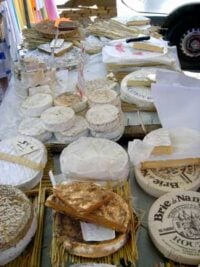
So I often make weekend trips to the village of Coulommiers, where there's a lively outdoor market selling the most famous cheese in the world: Brie.
Brie is not a town, but a region to the east about one hour away by car or train. The sunday market in Coulommiers is one of my favorites because no where else in the world will you find so many cheese vendors selling all kinds of Brie, many unavailable anywhere else.


brieatmarket.jpg


There are two true Brie cheeses. The classic is Brie de Meaux (Bree-du-Mohw), about 14-inches across, each disk weighing approximately 5 pounds. Brie de Melun (Brie-du-Meh-Lahn) is slightly smaller, a tad higher, and doesn't ripen all the way to make a creamy pâte, like Brie de Meaux. Often you'll cut open Brie de Melun and discover a drier layer of underripe cheese in the middle (at left). These cheeses have the most superb flavor in the late spring-to-early summer, when the cows feast on mustard blossoms, giving the cheese a musty, complex flavor and slight golden tinge.


2bries.jpg


Brie de Melun is aged longer than Brie de Meaux. It has a firmer texture and many aficionados prefer it because of it's stronger and more aggressive flavor. Both cheeses can be made with raw or pasteurized milk, although I prefer the raw versions, which are rarely available in the United States due to regulations in the US (where you're allowed to drive at high-speeds on freeways while talking on a cell phone and drinking a giant latté, but prohibited from eating cheese that has been prepared the same way for centuries.)

These two Brie cheeses are AOC (Appellation d'Origine Contrôlée) as of 1990, a product designation given by the French authorities, which states that these specific cheeses meet certain criterion for heating, coagulating, and salting the milk, the subsequent ripening, as well as being fabricated within the specific region. Most cheeses you'll find labeled Brie are not a true Brie unless the AOC label is affixed to the exterior. In the US, you'll only find it at a specialty cheese store...if you're lucky to find it at all. In France, a notable exception is Brie de Nangis, which is a young, milder Brie from the region but does not carry the AOC label, but it's good. The AOC designation has also been given to 34 cheeses as well as other products like the tasty green lentils from Puy, Haricot Tarbais (the dried beans used to make cassoulet), and the free-range Poulet de Bresse.

Although AOC is often a sign of quality, other products don't carry the appellation, since they may be made in a neighboring region, or a slightly larger size, or stirred a few more times than the regulations allow during production. So as with anything, let your nose and the taste be your guide. No matter where you live, always seek out a good cheese shop and ask the fromager for advice: they're a wealth of knowledge and should be proud of their cheeses and happy to help you.

Coulommiers is another excellent cheese from the region, and not AOC. It's a smaller round, about 6-inches in diameter, and not widely known outside of France. Coulommiers has the same barnyard-like smell that is delectably appetizing in Camembert and indicative of a truly ripe Brie, but is a bit more pungent.


brienoirstacked.jpg


Locals in Brie are perhaps the only ones who have developed an appreciation for Brie Noir. Normally Brie cheeses are ripened for between one and two months. Brie Noir is ripened much longer, often 8 to 10 months. It's such a regional specialty, and only appreciated by people of the region, that you're likely never to see it anywhere else.


brienoir2.jpg


As you can see, Brie Noir is dark, brown, and crumbly. It's covered with dusty powder and it tastes, well...horrid. After my first eaglerly-anticipated bite, I could not get the vile taste out of my mouth. It's bitter and acidic. A friend from Coulommiers suggested I dip it into my café au lait at breakfast, which I suspiciously tried, which actually moderated the flavor and made it more palatable. Who knew?


Brie Q & A's

But my supermarket cheese says Brie...isn't that Brie?

Real Brie is almost always Brie de Melun or Brie de Meaux. Most of the other cheeses labeled 'Brie' are not true Brie. They often won't ripen properly and taste worlds apart from real Brie.

Should you eat the rind?

The general rule for eating the rind of any cheese is that you may eat it as long as it won't interfere with the taste or experience of the cheese. For example, something with a lot of mold growth obviously wouldn't taste very good. A tough rind, like the rind of Parmesan, you wouldn't want to eat either.

How do I cut Brie?

Think of any round wheel of cheese like a pie or cake. You should slice a triangular wedge out, so that you have a nice portion of cheese.
When presented with a full cheese plate to serve yourself, never cut the 'nose' off the cheese, the pointy end: It's very bad manners!

Can I bring back raw milk cheese into the US?

That depends. Most of the time, I've found Customs Officers (oops...I mean 'Department of Homeland Security') officers will look the other way as long as you're bringing in cheese that's for personal consumption. Obviously if you have 60 wheels of Brie, you will likely get busted. Many fromageries in France will Cryo-vac (sous vide) cheese for transport to contain the fragrance, which I recommend. I once traveled with cheese in zip-top bags and by the end of the flight, the overhead bin totally reeked of cheese.
Luckily the other passengers were French...and for some reason, the US officials quickly waved me through customs.

10 Reasons The Amateur Gourmet Should Come to Paris...

1. They have no idea who Bobby Flay is.

2. The have no idea who Rachel Ray is.

3. They know who Tom Cruise and Katie Holmes are, but don't care.

4. Scientology is illegal.

5. Since they wouldn't let Oprah into Hermès, there's an unclaimed Birkin bag for Adam's mom.

6. They know who Oprah is, but don't care.

7. Yes, figs are really in season here.

8. "Brangelina" and "Bennifer" are not in the French vocabulary.

9. Richard Quest has been 'on assignment' for a suspiciously long time.

10. We need some New Yorkers here to show Parisians that you can't just walk right into people and expect not to get slugged.


Bonus Reason:

11. Carrie Bradshaw left.

Apricots


I'm in heaven with all the sensational fruits that explode at the markets every summer. Each shopping trip, I invariably lug back with way too much fruit. But everything looks so good I can't resist; rosy nectarines, blushing apricots, and crisp, dark cherries.

So to help you choose the best summer fruits, here's some shopping tips. Best bets are often at Farmer's Markets, where the growers take primo care of what they're selling and often they encourage sampling before you buy.


sour cherries

Cherries

The most popular sweet cherry varieties are deep-dark red and plump, with moist, perky stems. Bing cherries are reliably excellent. Although some varieties, like Queen Anne and Rainier, are light red and yellow-colored, they have a more delicate taste, which some people prefer. Cherries should be washed, then stored in the refrigerator. Unlike most other fruits, cherries are more appealing when served very cold and crisp.

Avoid cherries that are wrinkled, which means they were picked a while ago. Split apart cherries means they got wet while growing and will mold quickly.


Mara de Bois

Berries

When buying berries that are packed in plastic or cardboard containers, peek underneath: moisture on the bottom indicates the berries below are soggy or moldy.

Strawberries should be uniformly red with no green at the tips or at the stem. (Did you know the cluster of seeds concentrated at the tip is referred to as a 'cats nose'?)
Strawberries should have a sweet smell. Some berries have been hybridized to be red on the outside, but disappointingly underripe within, so color's not always an accurate indication. Avoid buying commercial strawberries after rainy weather: since they grow near the earth, they're often sprayed with a rather nasty chemical to prevent mold. Look for organic strawberries instead.

If you're not going to eat strawberries the same day, store them on a plate in the refrigerator, in a single-layer, so they don't mush each other down.

Raspberries, blueberries, and other bushberries should be plump and dry. Blackberries should be inky-black and a bit soft, never rock-hard. There's nothing worse than a sour blackberry.

Blueberries should be firm. Most have no fragrance. Did you know that each blueberry can contain up to 100 seeds? If you don't believe me, slice one open and count. I never wash any berries since they're too fragile-except blueberries and strawberries.

Can you freeze fresh berries or pitted cherries? Yes. Lay the fruits out in an even layer on a non-reactive baking sheet (or line one with parchment paper.) Freeze. Once frozen, store in zip-top freezer bags. Frozen berries and cherries can be used for sauces, or added frozen mixed with other fruits for pies, crisps, and cobblers.


melons

Melons

It's been said that finding a good melon is like falling in love. Sometimes you have to try a lot of them to find the right one.

Judy Rodgers in The Zuni Cafe Cookbook insists that the best melons are the ones with lots of netting and claims not to have picked a bad one since learning that. I always take a good sniff. The most amazing melons I've tasted were melons that I could smell before I could see them.

Choose a melon that's heavy and relatively firm, but not-rock hard (except for honeydew melons.) Any mold by the stem end or mushy spots are indications of it being over-the-hill.

A simple melon dessert can be made by pouring sweet wine, such as Muscat or Sauternes, over slices of melon and berries and chilling them well. Store melons in the refrigerator.


Peaches, Elderberries, and Nectarines

Nectarines and Peaches

The best peaches have a sweet, perfumed aroma if you sniff the stem end. Peaches need to be picked a day before ripening, then ripened off the tree. Or better yet, the same day. If they're too green, they were picked too soon and will never taste good. Ditto for nectarines. Find fruits that are mostly red and blushing.
If faced with a bin of underripe fruits, find one that's rather soft and smell it. If it smells good, chances are the rest will be too, once ripe.


bag of apricots

Apricots and Plums

Neither of these fruits boast much aroma, but they make up for it with lots of flavor. Apricots should have an appealing blush and no green. Red-tinged apricots means they've received lots of sunlight and will likely be good. Apricots are best when they're gushy-ripe. They should be very soft, like a water balloon. My favorite variety are the Royal and Blenheim apricots.

Most of the flavor in plums are in the skin, and they make the best jam, especially when mixed with raspberries. Santa Rosa and Elephant Heart plums are reliably good.

Baked apricots are a superb, easy dessert: simply halve ripe, but firm apricots, place face-down in a baking dish, pour in a wine glass of white wine (dry or sweet), and drizzle with a copious amount of honey (use more than you think, as apricots get quite tart when cooked.) You can add a split vanilla bean too. Bake until the apricots are tender and juicy.

Delicious with vanilla ice cream!


Fruit Recipes

Baked Nectarines and Cherries

Berry Cobbler

Candied Cherries

Cranberry Raisin Pie

Lemon Tart

Persimmon Bread

Polenta Crisp Topping

Quince tarte Tatin

Red Wine-Poached Rhubarb

Rosy Poached Quince

Tropical Fruit Soup

Vanilla-Poached Quince

Warm Compote of Summer Fruits

Ha! I fooled you.

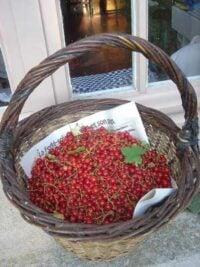
This time, this really is a 'no-recipe' (unlike my No-Recipe Cherry Jam) since unless you have your own bushes and pick them youself, you're not likely to have enough red currants to make jam.
So, no-recipe.


Last weekend out in the countryside lots of red currants were picked...


currentsblog.jpg


No make that lots of baskets of red currants!...


2basketsblog.jpg


Hours were spent stirring them diligently on the stove until the red currants were transformed into supple, translucent jelly...


jambllog.jpg


A few red currants were set aside to make a tart. Tangy, vibrant red currants, cooked with a soupçon of sugar, atop buttery pâte brisée...

Yum!


tartcblog.jpg


Later in the afternoon, we picked lots of perfumed rose petals to make jelly...


rosesblog.jpg


Très sexy...Non?


(The rose petals, not the cleavage!)

God forbid you don't buy fresh bread every day in France. And I love bread, so it's not unusual for me to come home carrying more than I should.
So the problem is, it's rather difficult to eat all that bread.


Bread


So what to do with all that lovely leftover bread?

I make Panzanella, a Tuscan salad designed to use up lots of leftover bread, which we ate this weekend during an outing in the countryside. Tuscans don't salt their bread, which goes back to a long-standing rift between them and the people from Pisa, who controlled the prices of salt many years ago..and they say I hold grudges!

(But if you've had unsalted bread, you perhaps can understand why they have so much leftover.)

You can use any firm-textured bread you have on hand. I prefer levain bread, which is dense and won't fall apart when tossed around. But you should use what you have leftover as long as it's not too airy. And in spite of what everyone tells you, it's not vital to use pricey heirloom tomatoes:marinating them in copious amounts of fresh herbs will infuse ordinary tomatoes with summertime flavor. And feel free to use lots of chopped fresh herbs as well. Oregano, Marjoram, thyme, and fresh mint are all wonderful mixed in.


panzanellablog.jpg


Panzanella

About six servings


Adapted from The Sweet Life in Paris by David Lebovitz


4 cups torn pieces of hearty, country-style bread (approximately 1-inch/3 cm pieces)
1 teaspoon Dijon mustard
1¼ teaspoon sea salt
lots of freshly ground pepper
2-3 cloves garlic, peeled and finely minced
3 tablespoons red wine vinegar
1 red onion, diced
3/4 cup best-quality olive oil
8 medium tomatoes (1½ pounds/750 grams)
1 large cucumber, peeled, halved, and seeds scraped away
3/4 cup pitted black olives, preferably kalamata
1 cup packed (80 grams) coarsely chopped mixed fresh basil, mint, and flat-leaf parsley
(Note: I never measure herbs, so feel free to use lots and lots. The more the better!)
½ pound (250 grams) feta cheese


Preheat the oven to 400 degrees. Spread the torn bread pieces on a baking sheet and toast until deep golden brown, about 15 minutes. Stir once or twice as they're toasting. Set aside to cool.


In a large bowl, whisk together the mustard, salt, pepper, garlic, and vinegar. Add the diced onion and let sit for at least 30 minutes. Stir in the olive oil. Remove the stems from the tomatoes and cut into 1-inch (3 cm) pieces. Cut the cucumber into ½-inch (1½ cm) pieces.


Add the tomatoes and cucumbers to the bowl with the dressing. Add the bread, olives and fresh herbs and toss well. Taste, and add additional salt, oil, and vinegar to your liking.
Crumble the feta over the top in large chunks and toss briefly.

Le Verre Volé

1 comments - 06.17.2005

If you plan on eating at Le Verre Volé (The Stolen Glass) be sure to call first and reserve a spot. It's located just next to the Canal St. Martin, a trendy quarter of Paris, and there's only seats for about 18 people or so. But unlike New York or San Francisco or Los Angeles, you could call that afternoon and likely get a spot. During dinner I told my dining companion that if this was in New York, there would be a line out the door...and around the corner.


Never An Empty Glass


I began the complex task of choosing from one of the wines from the shelves. Each has the price written across the neck of the bottle since Le Verre Volé doubles as a retail establishment. To drink it there, they add a modest 7€. I scanned the shelves and chose a red Mazel from the Ardeches (18€) that was very light and fruity. A bit 'fresh' when first opened—once it sat, it gained complexity. I was happy that it was the perfect choice for the warm evening and hearty food. During the evening, practically every three minutes, someone would roar up on their scooter, disembark, and rush in to buy a bottle of wine for dinner.

We shared a jellied terrine of oxtails (5€). The finely shredded meat was gently molded with some spring asparagus and peas, all barely held together with jellied beef stock that was light. It was served with pickled, vinegary capers on their stems and dressed salad greens.

All the main courses were meaty: blood sausage with roasted apples and potatoes, andouillettes de Troyes, and veal Marengo. Not being much of a fan of 'variety meats' (as they're politely called in America), I chose the caillettes ardechoise (10€), a patty of well-seasoned pork ground-up with tasty and still-chewy beet greens and spinach. It was roasted until searingly-crisp on the outside, and when I split it open, a moist cloud of steam erupted revealing fork-tender meat within.

One could also make up a meal composed of lots of the appetizers, like the roasted eggplant caviar, salt cod-stuffed peppers, or platters of various meats and cheeses.

The genial young men who run the place managed to keep the small crowd happy. One took orders and opened wine, while the other stood behind the tiny bar and dished up salads and roasted meats and sausages in the small ovens. Behind the bar is a glass door leading to an air-conditioned room, a jumble of boxes and bottles of wine.

I'll see you there.


Le Verre Volé
67, rue de Lancry
tel: 01 48 03 17 34
Métro: Jacques Bonsergent

Stand back. This is gonna get messy.

cherries


I'm going to teach you how to make something without a recipe.

Before you panic, remember that your grandmother made lots of things without recipes and without measuring everything down to the last 5/9ths of a teaspoon. Just breath. That's right, it will be okay.

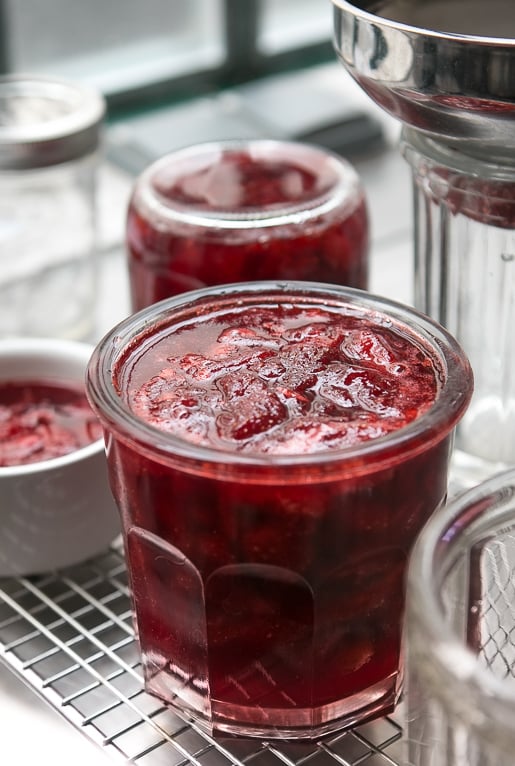
sour cherry jam

No-Recipe Cherry Jam


1. Buy as many cherries as you feel like pitting.

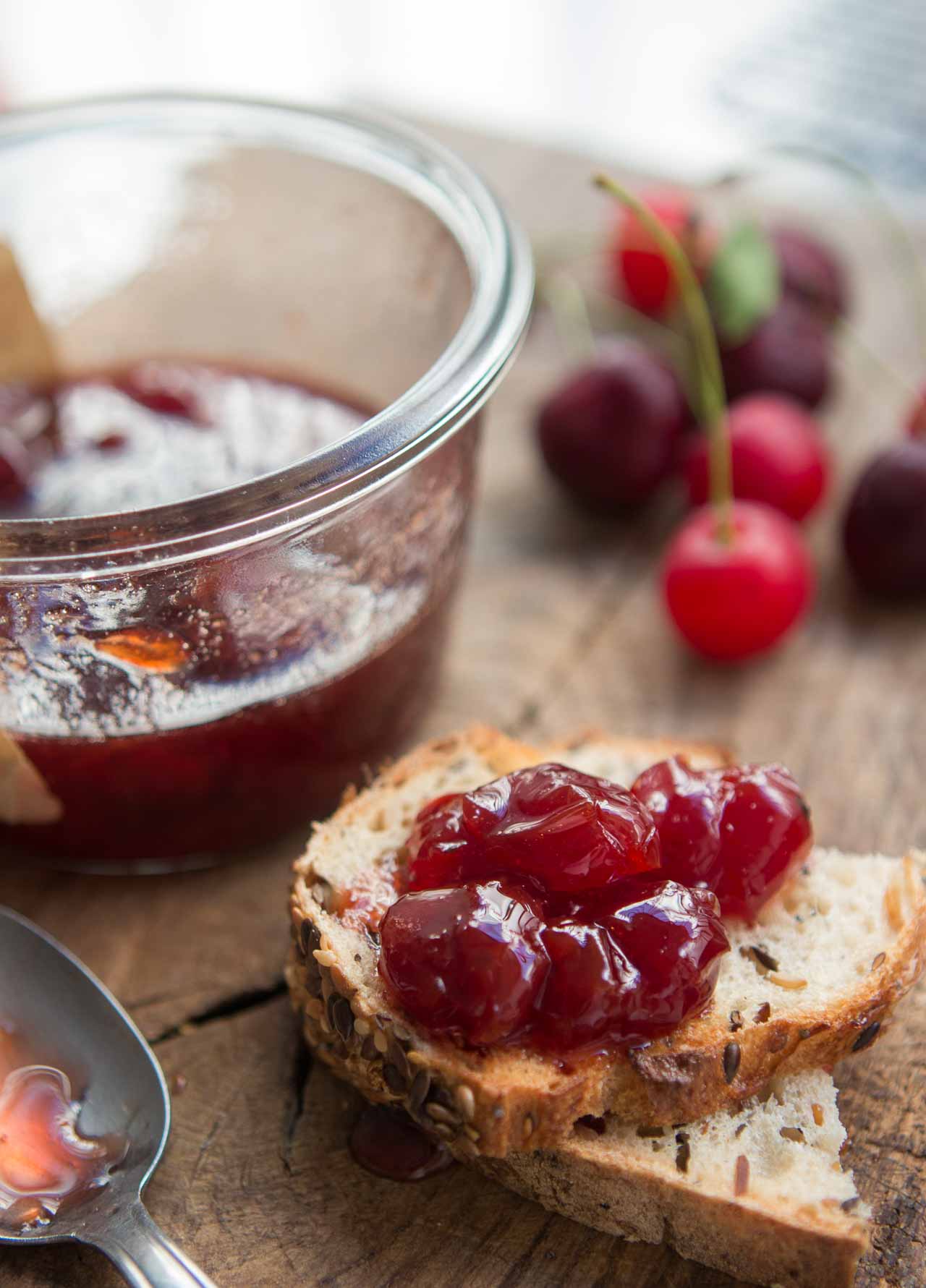
Usually I have the patience for about 3 pounds, but it's up to you. Figure one pound of cherries will make one good-sized jar of jam. Plump, dark Bing cherries work really well, although Burlats are good, and if you can find sour cherries, your jam will rock.


2. Wear something red. Or black. Rinse the cherries and remove the stems. Using the handy cherry pitter that I told you to buy a few weeks ago and pit the cherries. Make sure to remove all the pits since everyone is so litigious these days. Chop about ¾ of them into smaller pieces, but not too small. Leave some cherries whole so people can see later on how hard you worked pitting real cherries. If you leave too many whole ones, they'll tumble off your toast.


3. Cook the cherries in a large non-reactive stockpot. It should be pretty big since the juices bubble up. Add the zest and juice of one or two fresh lemons. Lemon juice adds pectin as well as acidity, and will help the jam gel later on.


4. Cook the cherries, stirring once in a while with a heatproof spatula, until they're wilted and completely soft, which may take about 20 minutes, depending on how much heat you give them. Aren't they beautiful, all juicy and red?


cherry jam


5. Once they're cooked, measure out how many cherries you have (including the juice.) Use 3/4 of the amount of sugar. For example if you have 4 cups of cooked cherry matter, add 3 cups of sugar. It may seem like a lot, but that amount of sugar is necessary to keep the jam from sprouting green whiskers after a few weeks in the refrigerator.


6. Stir the sugar and the cherries in the pot and cook over moderate-to-high heat. The best jam is cooked quickly. While it's cooking, put a small white plate in the freezer. Remain vigilant and stir the fruit often with a heatproof utensil. (Wouldn't it be a shame to burn it at this point?) Scrape the bottom of the pot as you stir as well.

And no matter how good they look, resist popping a warm cherry into your mouth. They are really hot, take it from me, and you will burn your mouth. Yes, take it from me.


7. Once the bubbles subside and the jam appears a bit thick and looks beginning to gel, (it will coat the spatula in a clear, thick-ish, jelly-like layer, but not too thick) turn off the heat and put a small amount of jam on the frozen plate and return to the freezer. After a few minutes, when you nudge it if it wrinkles, it's done.


wrinkle test


If not, cook it some more, turn off the heat, and test it again. If you overcook your jam, the sugar will caramelize and it won't taste good and there's nothing you can do. Better to undercook it, test it, then cook it some more.

Are you beginning to understand why all those gourmet jams are expensive?


Once it's done and gelled, add a bit of kirsch if you have it, clear cherry eau-de-vie which will highlight the flavor. Or add a few drops of almond extract, but not too much, or it will taste like a cheap Italian cake. Ladle the warm jam into clean jars and cover. Cool at room temperature, then put in the refrigerator, where it will keep for several months.


See, you did it!


Related Posts and Recipes:


Easy Jam Tart

Peach Leaf Wine

Quick Mincemeat Recipe

Red Wine-Poached Rhubarb

Seville Orange Marmalade

Shallot, Beer, Prune, and Cocoa Nib Jam

Strawberry Frozen Yogurt


USDA canning guidelines

The hottest table right now in Paris is not at some snooty Michelin 3-star restaurant. It's La Table Nutella, a temporary café to celebrate the 40th anniversary of Nutella, the world best-selling spread. Nutella, a paste made of hazelnuts and chocolate (and, um, a few other things) was invented in the Piedmonte region of Italy, famous for it's delicious hazelnuts.

Each morning a line forms before 7 am, waiting (and hoping) for entrance. I kinda gave up, not really wanting to wake up that early and standing on the street. And I hate crowds of people grabbing food. Plus I had heard stories of a new French revolution brewing since there wasn't nearly enough food to feed the hoards, and the staff was insanely stressed trying to control the crowd.

nutellacafeblog.jpg

It seems that the staff has figured out a solution to the problems plaguing the café by severly limited the amount of guests, which means the dreaded queue.
Then like magic, I got an email from Louisa that she scored a VIP table and we could cut in front of the queue, something the French are so adept at they even have their own word for it: resquillage.

Once seated, we ordered just about everything on the menu. All proceeds go to the group Rêves, so we didn't feel guilty.

eggblog.jpg

This is a dessert created by pastry chef Philippe Conticini for the café, who has written a companion cookbook with stunning recipes using Nutella. It's an eggshell filled with a rich, creamy chocolate custard that tasted remarkably like great chocolate pudding sans the skin. The baton, or cookie, that came with it was crunchy and the perfect accompaniment..

We split a giant brownie, and when I say giant, that thing was huge... Très Américain! Layers of sticky, dense brownie batter baked with a ganache-like paste of Nutella and toasted hazelnuts. I loved it, but others felt it was too rich.

brownieblog.jpg

So I ate theirs for them.

The Apple-Nutella Crumble was an unfriendly Franco-American alliance on par with Bush and Chirac (Apple Crumble has replaced the ubiquitous Apple Tart in France as the dessert-of-the-moment)...although I don't like apples and chocolate together, so I'm not the best judge. I did enjoy the fromage blanc with a dollop of Nutella but we all flipped for the little croissants which when split open, oozed out a serious amount of gooey Nutella inside.

When I cut it open, like the croissant itself, Louisa's enthusiasm spilled out, "Oh yeah, baby, bring it on!"

Seems I'm not the only one in love with Nutella.

ilovenutellablog.jpg


La Table Nutella
46, rue de Sévigné, 4th
Until June 22
Monday through Friday, 7am to 11:30am
Saturday 8am to 3pm
(Get there early; latecomers will most likely not get seated.)

I've dedicated a healthy portion of my life walking the streets and boulevards of Paris to find grainy bread here. I know I shouldn't complain. There's a boulangerie on every corner. You can get excellent baguettes or a nice loaf of pain au levain just about anywhere. But it's hard to find a loaf of bread with lots of seeds and stuff in it.
Maybe it's because the breads here, like Parisians, are so refined. I don't know.

Stübli makes dense, authentic German breads, but on my last visits the breads I lugged home were mushy and uninteresting, and no longer worth the schlep across Paris...even though it's a good excuse to make the voyage to Alléosse, the mind-blowing cheese shop on the rue Poncelet. There's a dinky, uninspired-looking joint on the rue Faubourg-Poissonière that makes sensational baguettes totally covered with golden sesame seeds that is wonderful toasted for breakfast. I crave this bread and make the voyage there often. But it's out of the way, and somewhat depressing, so no one goes there and I'm afraid they'll be closing soon.

Here are some of my favorite breads from various bakeries across Paris. Although I do love a traditional, crackly baguette paired with cheese, or toasted slices of hearty boule rustique slathered with homemade confiture for breakfast, these are the sturdy, hearty breads that I enjoy most here in Paris.

Norlanderblog.jpg

Norlander Bread
Christian Voiron
61, rue de la Glaçiere

I learned about this bread from Clotilde's explorations and it's a favorite. Tight and compact, Norlander bread is the heaviest bread I've found in Paris. And it's also small, making it the perfect bread for a little afternoon snack with some contraband peanut butter, which a friend smuggled out of an American army base in Switzerland.


Nordiqueblog.jpg

Pain Nordique
Le Grande Epicerie
22, rue de Sèvres

I've been told the Grand Epicerie makes over 80 different kinds of bread underground, beneath this enormous food emporium. This is a lighter, airy bread, yet full of lots of sunflower seeds and a good amount of oat flakes. It's excellent sliced-thin and toasted. But get there early: for some reason, by mid-afternoon they start feeding all the Pain Nordique loaves into the slicing machine and bagging them up.
Last time I was there, I was in the slowest line in the world, and as the lone saleswoman waited patiently on some madame that was bickering over the prices or freshness of a single roll or something. Meanwhile the other salesperson was tossing the brown loaves into a slicing machine as fast as he could. All I could do was stand there helplessly, hoping that my turn would come soon, before he could finish slicing all the loaves.
I ended up getting the last two. Whew!


Kayserblog.jpg

Pain aux Cereales
Eric Kayser
8, rue Monge

This is perhaps the best bread in the world.
I don't know how Eric Kayser does it, but each loaf comes out encrusted with golden sesame seeds. Slice it open, and you'll find a delicate but full-flavored bread studded with crunchy grains of millet, sesame and sunflower seeds, with a naturally sweet taste. I used to walk across Paris to his shop on the rue Monge for a loaf (actually, I always get two and freeze the other.) Now Kayser has opened bakeries across Paris and my local market at the Bastille has a vendor who sells the same bread, inexplicably, without identifying the baker or bakery of origin. Once I noticed an errant Kayser bag off to one side, which gave away their ruse.


tradiograinsblog.jpg

Tradigrains
Au Pain de Saint-Gilles
1 bis, rue Saint-Gilles

When the quality of the baguettes of my local boulanger, Au Levain du Marais, slid downhill after their month-long summer vacation a few years ago, I agonized over the loss for weeks and weeks. I was torn. In France, your live your life according to your local bakery. You know when the loaves go in and come out of the oven, when the baker is off, and how to get the baguette cooked just the way you like it (bien cuite, svp!) You adjust your life, since most bakeries are closed two days of the week, so you need to plan your schedule and meals around those two days. My supreme disappointment lasted for months until I discovered this grainy Tradigrain loaf at Au Pain de Saint-Gilles in the Marais, just a few blocks from chez David. Now this is proudly my baguette of choice. Do you see why?
Millet, poppy seeds and flax seeds ripple through the interior of each loaf. I can barely get out the door of the bakery without ripping off the end and devouring it (a French tradition, after any baguette purchase...I think of it as an immediate quality-control check.)

Cooking On Rue Tatin
with Susan Loomis and David Lebovitz

For this very special week, I'll be joining cookbook author Susan Loomis for a week of cooking and baking at her gorgeous and famous home on Rue Tatin (yes, she lives on Rue Tatin!) in the village of Louviers. Susan has written extensively about her life in Normandy and her latest book, Cooking At Home On Rue Tatin has quickly become one of my new favorite cookbooks.

During the week with Susan and me, we'll be cooking up a storm in her professional kitchen, creating menus and elaborate multi-course meals featuring local ingredients as well as learning cooking secrets and techniques as we go.
We'll be focusing on chocolate this week, and I'll conduct special seminars during your visit. We'll have a focused tasting and evaluation as well as learn how-to tempering chocolate, create wonderful chocolate confections, and baking classic French chocolate desserts.

We'll also visit an outdoor market in the medieval village of Le Neubourg that is simply amazing, as well as conduct private tastings of goat cheese and wine with local producers and specialists.

More information can be found by visiting On Rue Tatin.
This week is certain to sell-out as group size is limited; reserve your space now.

September 25-30, 2005

Second Chances

3 comments - 06.10.2005

For the past several years, I've avoided Mariage-Frères in the Marais. Last time I was there, a friend who had just arrived from the states had to go there immediately for tea. As the afternoon wore on, he began the usual jet-lag wilt (I can mimic the facial expressions, complete with nodding-back head, but I can't describe the feeling adequately at the moment.)
The best description that comes to mind--"Your body arrives one day...and your soul arrives a few days later."


DSC01289blog.jpg


As my friend faded into oblivion, I unsuccessfully tried to signal one of the linen-clad waiters for l'addition. At Mariages-Frères, the waiters have perfected and refined the art of avoiding the customers gaze. So we waited and waited and waited. That was my last visit.

But last week a non-jet-lagged friend asked to meet me her there for tea, and I thought why not give it another chance? Three years is a long time to hold a grudge against something that's a Paris institution.
Our rendez-vous was mid-afternoon, and the tea salon was calm and the servers were graceful and accommodating. I had a perfectly brewed pot of green Sencha tea along with a rather good wedge of tarte layered with fresh raspberries topped with a black tea chiboust.

tartblog.jpg

In the grand tradition of tea time, we imbibed in small cakes as well: a lovely, moist financier scented with green matcha tea and a madeline with a subtle bit of Earl Grey tea leaves.

teacakesblog.jpg


Mariages-Frères
30-35, rue du Bourg-Tibourg
Métro: St. Paul

Many people tell me this is one of their favorite recipes from my cookbook, Ready For Dessert. In addition to these fantastic Coconut and Chocolate Macaroons you'll find my infamous recipe for Fresh Ginger Cake which makes a fantastic summertime dessert served simply with sliced, juicy-sweet peaches or flavorful strawberries and raspberries.

macblog.jpg


I made a batch of macaroons for a Thai banquet last night here in Paris, where a happy alliance of French and American food bloggers (and food-lovers) got together for dinner. We chopped giant bunches of vivid-green herbs like cilantro, mint, and other greens with names that we learned have no English, or French translations. Jumbo prawns from Chinatown were quickly peeled and sautéed, and tiny branches of fresh green peppercorns were quickly skillet-cooked until tender.

Succulent beef was grilled and marinated in a spicy glaze then tossed with hot chilies, fresh cilantro leaves, and cooling slices of cucumbers. Things heated up as we simmered tea-smoked duck in red coconut curry sauce which was spooned over steamed rice fragant, with aromatic pandanus leaves. And I loved the shrimp stir-fried with vivid-green garlic shoots, which mellowed considerably once cooked quickly with the plump shrimp and Thai spices.


Coconut and Chocolate Macaroons

30 Cookies


From Ready for Dessert (Ten Speed)


4 large egg whites
1¼ cups sugar
¼ teaspoon salt
1 tablespoon honey
2½ cups unsweetened coconut (see note)
¼ cup flour
½ teaspoon vanilla extract
2 ounces bittersweet or semisweet chocolate, chopped


In a large skillet, mix together the egg whites, sugar, salt, honey, coconut and flour.


Heat over low-to-moderate heat on the stovetop, stirring constantly, scraping the bottom as you stir.


When the mixture just begins to scorch at the bottom, remove from heat and stir in the vanilla. Transfer to a bowl to cool to room temperature.

(At this point, the mixture can be chilled for up to one week, or frozen for up to two months.)


When ready to bake, line a baking sheet with parchment paper or silicone baking mat and preheat the oven to 350 degrees F.


Form the dough into 1 1/2-inch mounds with your fingers evenly spaced on the baking sheet. Bake for 18-20 minutes, until deep golden brown. Cool completely.


To dip the macaroons in chocolate, melt the chocolate in a clean, dry bowl set over a pan of simmering water (or in a microwave.) Line a baking sheet with plastic wrap. Dip the bottoms of each cookie in the chocolate and set the cookies on the baking sheet. Refrigerate 5-10 minutes, until the chocolate is set.


Note: Unsweetened coconut is available in most natural-food shops or you can purchase it online.


It goes under various names, such as coconut powder, medium shredded coconut, and coconut flakes. All will work well in this recipe.

If you live in the US and shop in supermarkets, usually there are just a few choices of yogurt, ranging from lots of mass-produced store brands to a few upscale organic selections. But visiting the yogurt aisle at the grocery store in France is always an exciting event for me.

The choices just go on and on and on and on and on and on and....

marketyogrtblog.jpg

There's plain yogurts made from cow, sheep, and goat milk.
There's reduced-fat.
There's soy yogurt (à la vache! in this land where cows are sacred...)
There's names like Fjord and Jockey.
There's off-beat flavors like fig, kiwi, prune, and wheat (yes, wheat.)

Small fromageries sell dainty glass jars filled with tangy, farm-fresh yogurt. Enormous hypermarches like Auchan boast multiple refrigerated aisles stocked with nothing but yogurt and fromage blanc, a cousin to yogurt (fromage blanc and fromage frais are soft, fresh cheeses, eaten with a spoon.)

When yogurt is sweetened, the labeled usually proclaims avec sucre de canne, with cane sugar, which is highly regarded here as a sweetener, in spite of the many sugar-beets harvested in France. In the US, high-fructose corn syrup is used, which is much cheaper than sugar but has an icky syrup-y aftertaste that I don't like. If you've ever compared a American Coke with a Coke from Mexico or Europe, you'll know what I'm talking about.

I've always been tantalized by le Petit Suisse since stories of French people descending on a San Francisco supplier during their
Open Warehouse
events which are legendary.

Le Petit Suisse is not yogurt, but a very rich little pot of fresh, sweet fromage frais. The first thing you notice is it's about half the size of the standard (4 oz) French yogurt (left, which is about half the size of a standard American yogurt (8 oz).

2yogurtsblog.jpg

Le Petit Suisse is made from skim milk, cream, and ferments lactiques. It was developed by a Swiss dairy worker, Monsieur Gervais, whose name is still emblazoned across the packaging. He's credited for developing it over 150 years ago in Normandy, a region justly famous for it's smooth, creamy, and unctuous cheeses like Camembert de Normandie, Epoisses and Pont L'Evêque.

Being France, naturally there are lots of rules involved if you want to enjoy it properly.

peelinggervaisblog.jpg

Overturn the little pot and squeeze it slightly to release the cylinder. Tip le petit Suisse on its side, then unroll it while peeling off the paper. Then you sprinkle a generous amount of turbinado sugar (called cassonade, or unrefined cane sugar) over the top, or serve it with a spoonful of jam. And dig in. It's tangy-sweet taste lends itself to being served with a fruit compote as well, although I prefer it as shown. And I like to savor it with a tiny spoon; its richness is best enjoyed in small doses.

finishedblog.jpg


By clicking here, Dannon will donate $1 to hunger relief in the US.

Just in case anyone thinks that learning French is difficult, my French workbook offers this simple explanation of how to easily construct a phrase.


French1.jpg

Comment Policy

06.04.2005

Comments are welcome and an important part of this blog. Readers are very welcome to leave comments about the blog posts. Questions will be answered in the comments at the discretion of the blog owner.

If no comment field appears at the end of a published post and comments, that means that the post is closed for comments. And if you have a question, it's likely been answered in the comments previously.


1. Please do not leave the name or URL to your website or blog in the body of your comment. There is a space for that where you enter your name and e-mail address, and it will automatically be linked to your website or blog.

The exception to that if you are linking to an entry on your blog or website that is relevant to the discussion. Examples include if you've attempted a similar recipe or you have a post on your website or blog that adds to the discussion. You are welcome to leave a link, but please format it in HTML, (tutorials here and here), which will make it easier for readers to visit your site.

2. Comments and URLs which link to commercial websites or blogs will immediately be deleted. The exception is if the link is part of the discussion, ie: If someone asks where they can find a certain tart pan, and another reader leaves a comment with a link to where it can be obtained.

3. Comments may be edited for grammar, spelling, or content.

4. Comments may be moderated and will not appear on the blog without the blog owners approval.

5. Comments may be deleted at any time, without notice.

6. Diverse points of view are welcome but please keep the conversation civil. The comments often become forums for discussion amongst readers, which is encouraged, but name-calling or baiting comments will be edited or deleted.

One-third of the readers of this blog live outside the United States and readers should be sensitive to cultural differences and values when leaving comments.


(This policy has been updated as of October 2009.)

Paris Pastry Shops

06.02.2005
Patrick Roger Chocolates patrick roger chocolate


Paris has some of the most amazing pastry and chocolate shops in the world!

I've written up many of them and you can browse through my archives to find out more about them: Paris Pastry Shops.

A recommended book for visitors is The Pâtisseries of Paris: A Paris Pastry Guide, which lists many favorites, along with addresses and specialties.


sweetlifeinparisbooks.jpg

A favorite quick-bite on the streets of Paris, at L'As du Fallafel.

falafelblog.jpg


L'As du Fallafel is one of the few places where Parisians chow down on the street. Beginning with a fork, dig into warm pita bread stuffed with marinated crunchy cabbage, silky eggplant, sesame hoummous, and boules of chick-pea paste, crisp-fried falafel. Spice it up with a dab of searingly-hot sauce piquante.

L'As du Fallafel: 34, rue de Rosiers, in the Marais. Open every day, except closed friday beginning at sundown, reopening for lunch sunday.

Subscribe

David's Amazon Store

Monthly Archives

Archives By Date »

Browse by month: 2009

Browse by month: 2008

Browse by month: 2007

Browse by month: 2006

Browse by month: 2005

David Lebovitz