August 2005 Archives

Do you know what today is?

It's Blog day 2005!


blogday2005_logo_3.jpg

As I learned from Pim, today food bloggers spanning the globe are to name 5 new food blogs that they like.
Here are a few of my favorites at the moment. I wanted to list more than 5, but I'm still psychologically-bruised by Mrs. Sheegan, my 3rd grade teacher, throwing up her hands and telling my parents, "David has a very hard time following directions. He'll ever amount to anything..."

Ha! I say to her.
Here I am...and where is she? I don't see her blog listed anywhere around here, do you?
I don't read .com after her name... do I?

Then I had second thoughts.
I realized that as a grown adult I just may need to learn to follow directions, (maybe that's been my problem all along...gulp, my editor will be thrilled with this new revelation)...so I winnowed down the list to just 5 new blogs that requests.
And I guess that means I I'll soon be on my way to amounting to something.

Since I have no idea who many of you are (if you don't post comments), here's a list of food blogs that I haven't mentioned in my postings that you should check out...Happy Blog Day!

The Food Whore

A very funny and scathing look at the world of catering. Anonymously penned...of course! As someone who's worked in the restaurant business for 25 years and has seen everything.
I'm hooked.

The Cooking Fire

William (or Bill?) writes about the cuisines and culinary traditions of Mexico. Think you know Mexican cooking? You'll learn something new here from each entry.
Pristine, informative photos accompany this well-written blog.

Chocolate Alchemy

This blog is focused on the how's and why's of making chocolate for people that want to tinker at it themselves. Lots of information and exploration. A terrific place to learn about chocolate.

In Praise of Sardines

Brett shares his wonder of all good things to eat wherever he goes. And he seems to go to all the places I want to go and eat!
Recently he blogged about my favorite food cities: Barcelona and San Sebastian, and is now back in San Francisco.

The Farm Girl Fare

Always dreamed of gettin' outta 'Frisco and moving to a midwestern farm?
Susan did, and she writes lovely tips about bread making, farm cooking, often accompanied by daily photos from her farm and gardens.


If you'd like to explore some other food blogs and web sites for other bakers and friends, many who I've written about before but didn't want to ignore, check out my links page.


Want To Start A Food Blog?

If you're wondering what it's like to write a food blog, or what's involved, check out what Adam writes.

He's just celebrated his 1000 posting which I believe merits a complimentary upgrade from 'amateur' status, don't you? Perhaps we can help him find a new title...(since somehow "The Mediocre Gourmet" doesn't have quite to same appeal.)

Adam has the youthful enthusiasm I had before I became the hardened, yet wiser, internationally-celebrated cookbook author that I've become.
That was before the media and damn paparazzi pursued me relentlessly, compelling me to seek refuge and my reclusive existence in my Paris rooftop pied-à-terre, prompting much speculation in the industry. The scandals of reputed multiple cosmetic surgeries, a failed romance with Jennifer Lopez (and that American Idol star, which I can't talk about due to our settlement agreement), the revealing slew of unauthorized biographies that cast doubt on my personal life, and that nasty, and unfortunately public, falling out with Justin and Cammy at that club after that award scandal.

All have forced me to live an unassuming and vaguely anonymous life, food blogging in Paris.

Zut!

08.30.2005

A recent article in Le Nouvel Observateur noted a steady price increase for some of the basic staples of life in France:


article.jpg


Is there anything more fabulous than something created through the wonder and miracle of caramelization?


kouignamanndone!.jpg


Is there no means and ends that one won't go to to experience that sigh with relief when one triumphantly pulls this perfectly-caramelized melange of butter, sugar, and salt out of their oven?
I think not.

Those wacky butter-lovin' Bretons invented this unique gâteau for delivering the maximum dose of caramel: an all-encompassing dessert, which does double-duty at tea time. And I've been obsessed with figuring out how to make a perfect Kouign Amann, one of my favorite caramelized things in the world.

And here are my results.

I searched long-and-wide for Kouign Amann recipes, which are rare...either they're really sketchy, assuming that no one will actually dare to make it, or they didn't work at all and I was left with a wet, buttery mess.

This week, I pulled disk-after-caramelized-disk out of my oven in a obsessive attempt to master this dessert that I love so much. This was also much to the delight of friends and neighbors, who never thought they could get enough Kouign Amann. After all my tinkering, by now they have.

I also learned why it was so hard to find a good Kouign Amann, it's a bit of a challenge. So if you'd like to make a Kouign Amann, here's a few tips I learned that will help you out before you get going...

Fresh little cornichons ready for pickling, at the market:


cornichons.jpg


(And no, this photo has nothing to do with someone's Speedo comment...)

Kig ha Farz

1 comments - 08.27.2005

When you think of 'take-out', France perhaps isn't the first culture that comes to mind.

The concept to me seems so American; pick up the phone or walk to the corner, grab something to eat, bring it home and eat it in front of the television.
Nice and quick...and no dishes!

In spite of what you might think, France has plenty of take-out food shops, called traiteurs. These specialty shops are loaded with tempting things to eat: roasted and smoked meats, a few carefully-selected cheeses, vegetable salads, poached and cured fish, and of course, terrines and pâtes.


fievre.jpg

A Terrine de Lièvre made from wild hare, which graze freely in Brittany...
...until the little critters are hunted down and made into terrines!


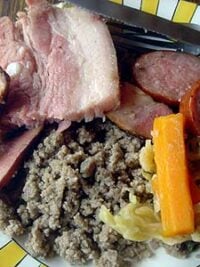
Although I don't usually visit the traiteur, since I like to cook for myself and friends, i was in serious pursuit of Kig ha Farz, a Breton curiosity that's made by making a gargantuan 'dumpling' of buckwheat flour, eggs, butter, and milk or cream, stirring them together and simmering the whole thing in a special linen sack (and yes, I bought one in Brittany to make this in the future.)

After the giant dumpling is cooked, the bag is rolled and rolled until the dumpling's been broken up into tiny, couscous-like pieces. It's heaped onto a plate and served with smoked bacon or lard, as they call it in France. Although I've seen recipes that call for vegetables served alongside, no one seemed to be requesting any...and there didn't seem to be any on offer.


kikafarz.jpg


After hearing about Kig ha Farz for years, I was very curious and eager to try it. Acting on a tip from a friend's Breton mother, I found one of the few remaining places in the world that still makes Kig ha Farz...and they make it only on Wednesdays.

Sure enough, when I arrived, there was a huge mob barely forming a line...and the frantic, but cheerful saleswomen were spooning Kig ha Farz into take-out barquettes as fast as they could (and most couldn't resist picking and eating little morsels as they scooped. I can't say I blame them...I'd do the same, if no one was watching. Take that to those of you who think I'm too uptight about food sanitation!)

Sporting a seriously-treacherous butcher's knife, only then would the crowd part just long enough for them to hack off a slab of smoked bacon, wrap it in butcher-paper, and send you on your way. Once I was lucky to escape (alive), I went back to the house and wolfed down a plate of Kig ha Farz...then immediately had seconds, giving little to the thought that in just a few hours I'd have to don a swimsuit to return to the beach.
And the little French swimsuits leave no room for imagination, or expansion, caused by too much Kig ha Farz and lard.


lardbreton.jpg


Surely the most well-known take-away treats in Brittany are crêpes, which are impossible to avoid no matter where you go. I woke extra-early one morning to scour a local Vide-Grenier (similar to a flea market, but more like a large, free-form garage sale.) There I scored a stack sumptuous, unused vintage French linen sheets (for about the price of one French linen pillowcase in the US) from a rather nasty woman...an encounter which would make a visit to the oral surgeon seem pleasurable.


crepemakers.jpg


Thankfully there were dilligent crêpemakers there, swirling the eggy batter over the hot griddle, dotting them with salty butter and a dusting of crunchy sugar, passing off the warm, folded crêpes to hungry and beat-upon shoppers....aka: moi!.

Later in the day, it was back to the traiteur and to make a picnic for the beach.
It was a perfectly clear day, blue sky, delicious food and red wine...gentle waves lapping as I fell asleep in the warm sand...where I dreamed of many future nights, dozing away in my cozy bed between luxurious, hard-won linen sheets...with a big, round tummy...full of Kig ha Farz!


winebeach.jpg


Tonnard-Léost
Traiteur-Charcuterie Fine-Boucher
1, rue Général-Leclerc
Plouescat
Tel: 02 98 69 61 78


Recipe for Kig ha farz

Of all the regions in France, one of the most peculiar is Brittany. The cuisine is hearty, earthy, and dynamic...like the terrain...


rocksbrittany.jpg


The coastline is a virtual lunar landscape of jutting rock formations, with pristine beaches tucked in between. Consequently, Upper Brittany is somewhat remote and not a popular tourist destination. Most of my days began at a almost-deserted beach with a dip in a frigid, but clear water, and finished at a lively crêperie, picking through a mound of moules frites, aromatic mussels simmered with white wine and local shallots, served with a overly-generous pile of frites that I thought I'd never be able to finish (but of course, I always did...mustn't be rude!)

Ah, summer vacation in Brittany.
There's not much to do here except swim in the chilly water, and eat seafood, red onions (more about them in a later post), and...salted butter.

Oh, did I mention Breton butter before?
Unlike the rest of France, the Bretons don't eat much cheese...in fact, there's no cheese that I can think of is produced there and I didn't see one fromagerie in 10 days. But they make up for it by consuming lots of butter, which they're justifiably famous for.
When you compliment a local pastry shop or restaurant on their cuisine, they will invariably respond proudly, "C'est la buerre de Bretagne!"


farbreton2.jpg


There's also not as much wine wine consumed either, since the locals drink plenty of sparkling, lightly-alcoholic apple cider. A fizzy bottle is popped open before each meal and served in a traditional bolées, similar to a squat, wide coffee cup with a handle.

But back the butter; it'sthe best I've ever tasted.
Breton butter is notable since it's almost always flecked with large, coarse grains of salt that crunch when you bite into them. I spread some on my toast each morning before drizzling it with bitter chestnut honey. Much of the salt used is harvested on ponds and marshes in the Guérande, where the famed fleur de sel is harvested as well.
And unlike the rest of the country, Bretons often butter their bread, which is never done elsewhere in France except with oysters, which are customarily served with buttered rye bread, pain de seigle. (So next time you're in Paris and that waiter gives you a funny sneer when you ask for butter, tell him you're from Brittany.)


prunecrepes.jpg


Naturally much of this butter makes it's way into buckwheat crêpes, or galettes de ble noir (when made with buckwheat flour, or ble noir, they're normally called galettes rather than crêpes,
In fact, you can buy crêpes at most of the local pastry shops, and if you're lucky, they're still warm.

One night I picked up a stack and for simple dessert, I heated a bottle of hard apple cider in a skillet, added a handful of dark, moist unrefined cassonade sugar, a modest knob of Breton salted butter and some delicious prunes from Gascony. Once the cider was sweet and syrupy, I added some folded crêpes, a pour of Calvados, and voila!


Perhaps the most famous dessert of the region is the Far Breton. Far is the Breton word for 'custard', and the Far Breton is remarkably similar to a custard tart sans the crust. Like everything, there are good versions, and not-so-good versions (like pretzels on the streets of Manhattan). You'll find Far Breton everywhere in Brittany; in supermarkets, outdoor markets, restaurants, and pastry shops. Like flan in Paris (which is a wedge of custard tart, and not the inverted caramel custard that many of us are used to,) a slab of Far Breton with prunes is often a mid-afternoons snack, or le goûter for hungry folks.

Although I find most of them rather dense and heavy, I knew that if I tried as many as possible like Goldilock's, I would certainaly find the version that was "just right". And sure enough, the best was from a pastry shop in Lesnevin called Labbé, a few steps off the main square.


farbreton.jpg


(If you're looking for a recipe, you might want to try the one by Dorie Greenspan that appeared in Bon Appétit recently.)

Another extraordinary treat is the Kouign Amann, which is pronounced many different ways, depending on your accent. I learned to say it by rhyming Kouign with the word schwing!, from Wayne's World...which I've tried to explain with a sharp thrust of my hips to French people but it doesn't seem to translate very well, and people were looking at me funny, so I gave up.


kouingaman.jpg


A friend who visited Brittany once wrote me and said, "A stick of butter would seem light in comparison!.." when describing his first encounter withKouign Amann. And indeed, the word amann is the Breton word for butter.

I had to try one from several bakeries, since it's once of my favorite desserts: layers of flaky pastry baked with plenty of salted butter and sugar, until it's all dark, crisp, and caramelized. Sometimes they'll sell it by the slab at outdoor markets, and they slice off a hunk for you and sell it by the kilo.
I don't think I've ever met a Kouign Amann I didn't like.
What's not to like?

After I posted about Kouign Amann before, I decided that in a few weeks I would try to make one or two, and I'll post my results here when I get it just right.

But the best thing I ate all week was...


frasiseplougastel.jpg


Ok, I know what you're thinking.
Here I was surrounded by fabulous buttery creations, but then I discovered strawberries from Plougastel.

Oh My God!
These were the best strawberries I've ever had. Although usually I judge fruit based on it's aroma before I buy (and these had little smell), these looked so ruby-red and glistening, that I just had to try them. Each one was sweet-sweet-sweet!
Each was juicy with flavor, like a soft piece of sugary-sweet strawberry candy and deep red all the way through. I've never had strawberries like that before, although I've seen them in the markets in Paris, they never looked so appealing as they did at that village fruit market in Brittany.

I've been thinking about this for quite a while, and figured I'd ask "Is it just me?...What would you do?"

Let's say you've been invited to someone's house for dinner. Yum.

You arrive and they're preparing the food. There's piles of fresh produce and meat on the counter, ready to be whipped up into something magical and tasty. Vibrant tomatoes, leafy greens, juicy meat ready to be roasted....hmmmm.
Can you practically taste it?

As you sip your glass of red wine, you watch and chat with your host as they prepare dinner.
They wash the raw chicken or pork under running water in the kitchen sink. Afterwards a quick wipe their hands (uh oh, you begin to think...no soap!...not to mention they're going to use that kitchen towel again and again and again...).
Then they fill the sink with water to wash the lettuce...without cleaning it out!

Ick!

Or what if they're making a salad, and take the knife they've just used to cut up the uncooked pork sausage?
Without wiping the knife, they begin slicing the cucumbers and tomatoes for the salad, tossing it all together, then triumphantly setting it down on the table.
I mean, Hello?

Since you're a extremely polite and gracious guest, like I am, (and believe me, no one's allergic to lettuce or cucumbers...so forget that one.)
I mean, it's not like you can just eat around the salmonella, can you?

...what do you do?

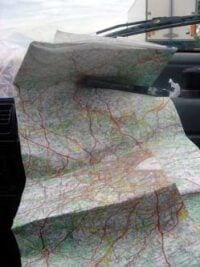
The French predilection of blowing things out of proportion is nowhere more evident than in the highly detailed, extraordinary Michelin maps, which cover every nook, cranny, crevice and petit village in France. And like many things French, once you figure out how to work within the 'system', in this case an unwieldingly large map that's impossible to unfurl in the car, it works better than anything else it the world.
(Unless you're trying to renew your French visa. Then you realize there's absolutely no system to work within...)


map.jpg


But even the most astute scholar of la langue française would have trouble giving concise verbal directions to his French driver navigating the villages of Brittany. Most have the disturbing habit of names that have been roughly translated from an ancient, almost-forgotten language.
Try reeling off these names while giving directions...

....Ploudaniel, Plougastel, Plougerneau, Plouneour-Trez, Plougasnou, and Ploubezre, Ploubazenec, Ploumillau...


aut_con_bib.gif


....even Bibendum couldn't do it!

Still, for me, driving gives me the opportunity to visit my favorite food hot-spots in France. And in case you think all the food in France is 'gourmet', it ain't.
(So please don't ask me anymore about that silliness Why French Women Don't Get Fat, since it will soon become obvious to you that 'French Women Don't Do Any Driving On les Autoroutes'.)

So before I write beautiful, poetic essays accompanied by lavish photos of rich, buttery, golden desserts from Brittany, I thought I'd share my absolute favorite food destinations in France with you: Le Auto Boutique.

And the best of the worst is found at the Auto Boutique, inviting, ultra-modern structures that line the autoroutes of France, where you can refuel your car, and refuel yourself.

vendingwaiting.jpg


Each Auto Boutique is like a mini-village. Some sell fleur de sel and foie gras (imagine finding those at your local 7-11!), other times I've seen local saucisson and regional wines amongst the offerings.
Although the majority of drivers stop for a cigarette and café, there's plenty of other options beside vending machine café express and soupe de legumes.

vendingmachine.jpg


But I first fell in love with les Auto Boutiques when I spotted this:


ouefdur.jpg


The ouef dur mayonnaise.

It's one of the classic bistro entrées. Here it's been reduced to its most simple, most minimalist elements: just an egg, just a packet of mayonnaise.
It reminds me of something that you might be served at El Bulli, but here you can have it for the astonishingly low-price of only 1.80€.
Remember you saw it here first.

And of course, you'll be able to choose something from the staggering display of Les sandwiches.


sandwiches.jpg


Once again, don't let the fancy packaging fool you. Oh-la-la!...Le jambon fromage? That's ham & cheese, pal.
But every once in a while, you'll find something exotic, something wild and Provençal, like a Tapenade sandwich...


tapenadesandwiches.jpg


Ok, that plastic-wrapped triangle is about as authentic and 'wild and Provençal' as a Peter Mayle novel-ette about some dreary English bloke who leads a dreary life of corporate drudgery in London but receives a mysterious inheritance of a house in Provence so he moves to Provence, learns to make wine, befriends his charming neighbor and has hilarious adventures borrowing his tractor, and watches sunsets daily with a glass of rosé and a game of boules...and of course, further hi-jinks ensue when he finds a local, rosy-cheeked contractor to...blah blah blah....

Before you toss your nose up in the air, for the more sophisticated amongst yourselves, you'll find les tartes, including the people-pleasin' Quiche Lorraine.


quichestarts.jpg


So it's 5am, and I'm fueled up on café express (the French say, "It's not the coffee you take after dinner that keeps you awake, it's the one you have at 5 o'clock"...and I have to admit, they're right.)

Onward through Brittany....

Back to Paris, after 10 days in the summer sun (and occasional drizzle) of Brittany.

I've had enough butter to last me quite a while, in buttery buckwheat crêpes, buttery caramelized Kouign Amann, butter-rich Far Breton, and Kik ha farz...drizzled with butter.

In the next few days, between exercising, I'll be adding photos and stories about all the treats...


sucettes.jpg

Driving home with caramel sucettes made with salted Breton butter...of course!
peches-plat.jpg

These are pêche plat, or 'flat peaches'...for obvious reasons!
They're white-fleshed little peaches with tiny pits and are grown in the US as well, where they're often called Donut® or Saturn peaches.
Last week in Paris I saw flat nectarines. Is this a trend?
What's next...flat watermelons? Flat blueberries?


plumsblog1.jpg

These are the best fruit in the world: Reine Claude plums.
Don't let the dull green skin fool you; these are the sweetest fruits to be found. There's similar green plums in France, but le vrai Reine Claude plums are only grown in Moissac, a town close to Toulouse. I eat them by the bagful, like candy, during their brief but productive in season.


hazelnutsblog.jpg

Fresh hazelnuts, still on their pods. I pick them right off the trees and crack them open. Last year I did a dinner with San Francisco chef Traci des Jardins, who shaved slices the soft, almost-crisp nuts over a delicous Celery Root Soup, which made our guests swoon. No wonder she beat the shorts off that Italian chef from New York.


chevreblog.jpg

At the market in the Norman village of Louviers, I found these lovely rounds of chèvre. I bought three...but left them behind in someone's refrigerator so I never got to taste them!


breadbreadbread.jpg

Loaves of country bread at the market.


chickensgelatineblog.jpg

Are these the French version of Peeps™?


susansbirthday.jpg

My main reason for heading to Normandy this weekend was to celebrate Susan's birthday and we invited some of her best friends. We spent the evening grilling corn on the cob and travers du porc (pork ribs) that I bought at Tang Frères in Paris' Chinatown.
We finished the evening with a sky-high Devils Food Cake that I made along with Homemade Malted Milk Ice cream. Très americain...but our French friends lapped it up it as fast as us Americans!
The ornate Gothic church directly across from her home provided a dramatic backdrop as the summer sun went down.

1. You buy clothing, not based on style or fashion, but because the texture and color of the fabric will make new and interesting backgrounds for your food shots.

2. You choose routes through town based on what's to eat or photograph along the way in lieu of the most direct path.

3. You find the only friends that'll talk to you are other food bloggers...since you don't have anything to talk about but your food blog.

4. Before heading out to dinner, you make sure you have your camera instead of remembering your wallet or purse.

5. You find yourself having amazing relationships with people in far-away places like Jakarta, Tasmania, and Scotland, ignoring your friends who live right in the same neighborhood.

6. You make dinner reservations not according to who has the best food, but which dining room has the best natural lighting.

7. At the market, the vendors see you coming and instinctively begin re-arranging their produce in anticipation of your arrival.

8. When foodies talk about Mario, Rachel, Florence, and Alton, you have no idea who they're talking about.
But you know instantly who Adam, Heidi, Pim, and The Food Whore are.

9. You've always been told that normal people should keep "those kinds of thoughts" to themselves.
But you ignore it, and hit POST ENTRY anyways.

10. Dinner isn't ready until it's gone through Photoshop™.


So who's ready for vacation?

I am!

I'm off to Normandy and Brittany.

Be back soon...

A favorite late summer treat in France is the Pêche de Vigne, or 'peach of the grapevine'.
These fuzzy heirloom peaches have a dull, very fuzzy dusky exterior that gives little clue to the dazzling flesh within.

But slice one open, and...wow!

peachesdevignes2.jpg

The rare Pêche de Vigne appears only for a short time; just during the fleeting, final weeks in August. Their taste is a curious cross between a ripe and juicy white peach and a succulent raspberry. They're best peeled and simply eaten just as they are, with their pale pink juices running every which way. For dessert, macerate slices in sweetened red wine and served very cold along with a good amount of the delicious liquid.

It's been said the hardest thing about fresh shelling beans is finding them. If that's true where you live, you're missing something very special and one of the great treats of summer. You may have seen them at your market, but passed them by since you didn't know what to do with them. And for some, cooking beans bring up images of beanpots simmering for hours, which can turn your summertime kitchen into a sauna.


bean salad


But fear not!

Fresh shelling beans take just a few minutes to cook, and taste worlds away from those dusty dried beans in that crumpled brown sack that you got years ago at the health food store thinking at the time that they'd be fun to cook, but once you got them home, they lost their appeal and are withering away in your cupboard along with that rusting tin of ancient curry powder you used a teaspoon of a few years ago to make that recipe from one of the hottest chefs from the 1999 issue of Food and Wine from that chef with the wind-swept, and perfectly up-jelled haircut, named Grant who converted an abandoned loft into Charleston's super-hot new restaurant (it's now closed) with industrial fixtures his model/girlfriend found at the flea market and arty waiters (who seem to spend as much time at the gym as they do in their art studios) in jeans and tight black Banana Republic t-shirts and one waiter had kind of a cool tattoo, as seen in the close up shot of his arm while delivering a plate of grilled curried monkfish.


vertical bean plate


(Also in the back of that same cupboard is the bottle of dark corn syrup that you bought to make pecan pie and a few months later you found teeming with ants along the rim where the bottle didn't close tightly and you washed it in under boiling water, scattering ants around your sink, but made you fearful of re-opening the bottle and getting the rim and neck all sticky again and having ants scramble all over your fingers. You've think you've gotten them all, then you discover one three minutes later scrambling up your arm.)

I rest my case. It's better to buy fresh.


tomato plate


Fresh shelling beans are wonderful in summer soups, but I prefer them as unadulterated as possible. They're a snap to cook too. In France, there's even a shelling bean, les haricots de Paimpol, which have their own AOC status, which I used to make this simple summer salad. (If you want to see how reverential the French can be about their beans, be sure to click on the link.)


Fresh Shelling Bean Salad


To make a gorgeous summer salad with shelling beans, simply tear open the pods of the beans and pluck out the beans. A pound of beans will give you enough for about 4 people.

Bring a pot of lightly salted water to a boil and drop the beans in. Let them simmer for about 20 minutes. Taste one (careful, they're hot!). I like my just slightly firm, but not too crunchy. Most fresh shelling beans cook in 20 to 30 minutes. But cook them to your liking.

While they're cooking, make a simple vinaigrette using olive oil, your favorite vinegar, and if you have it, you won't be disappointed if you add a little pour of nutty walnut, argan, or hazelnut oil.

When the beans are done, drain them.
Toss the beans in the vinaigrette while they're warm, allowing them to absorb the lovely flavor of the vinaigrette better. If you want, add some chopped herbs, like basil and thyme, some freshly-ground black pepper and minced shallots (which are one of the great secrets of French cooking. Professional chefs use lots of shallots too. How come you don't use them?)
Let cool to room temperature. You can allow the beans to marinate for a few hours, which will improve their flavor.

Quarter some tomatoes, coarsely chop some fresh mint and flat-leaf parsley, and toss them with the beans. Taste for salt and seasonings.

Did someone mention tossing in some fresh, sweet kernels of corn?
Did I hear something about adding big chunks of crumbled feta cheese?
Isn't there anyone out there fighting for coarsely chopped green or black olives?

Yes, yes, and yes!

I eat bowlsful of this salad on it's own all summer long. It's great just as it is, or as an accompaniment to roasted chicken or pork loin, or grilled fish. And it's perfect for do-ahead entertaining.

Shelling beans: try 'em today!

I was talking to my agent in the US the other day (which sounds far more pretentious than it really it....usually our 'talking' is me listening while he tells me what I should and shouldn't be doing with my life.)
Obviously I have a need for stern, authoritarian figures.

I was telling him that I would be going on vacation for a few weeks.


"A vacation?" he bellowed,"...a vacation from what?"


A recent article in the New York Times compared the quality-of-life between Americans and the French, specifically taking on the issue of the copious amounts of vacations most Europeans have (although everyone likes to pick specifically on the French)...


"...Perhaps even more important, however, the members of that French family are compensated for their lower income with much more time together. Fully employed French workers average about seven weeks of paid vacation a year. In America, that figure is less than four.

So which society has made the better choice?"

-Paul Krugman, The New York Times


Much of the editorial talked about 'living smaller' and 'buying less', which allows Europeans to work less and relax more. As politicians in the US preach "Family Values" (can anyone explain what that is?), in France they put that into practice by spending the month of August with their families on vacation (although the idea of spending a month with my family sounds more like, er, le prison than vacation!)

When I moved to Paris, all year long, I was surprised to find that everything was closed on Sunday: departments stores, supermarkets, and yes, even le Office Max. Soon, however, I appreciated Sundays more and more. There was nothing to do but relax and enjoy a nice supper or a stroll to the park. It's something that always surprises visitors to Paris who come expecting to be able to "do something" on Sunday. I usually suggest a stroll up the Canal St. Martin or perhaps sitting by the Seine watching the boats go by, but more visitors need to find something that's "Open For Business".


So this weekend, the car was packed up with all the ingredients for a perfect getaway in the countryside!


wine.jpg


There's really not much to do in the country.
No internet access (help!) and nowhere to go but outdoors. So most of the weekend was spent cooking, picking fruit, playing Scrabble in French, and taking leisurely walks through wheatfields and lush forests. And catching up on badly-neglected sleep.
Oh yes, and there were a few highly-competitive Pastis-fueled games of pétanque.


apple.jpg

The first glowing apples of the season. They'll be ready soon for making les Tarte aux pomes and for le Crumble.


sureau.jpg

Delicate bunches of sureau, or elderberries, clinging onto the trees. The tiny purple berries are used to make sparkling jams and the blossoms are deep-fried into fritters.


sorbet.jpg

One night I made a sorbet from rosy-skinned nectarines which I bought at a local market. I had made a well-seasoned Tagine of Chicken, Saffron, and Almonds and afterwards, this was our dessert. It was refreshing and pure, then (never content), I poured some fruity red wine over it, which elevated it to something even better!
Everyone loved the anise-scented biscotti alongside since the flavors reminded them of their beloved Pastis.


plums-.jpg

One day we all took a walk through the forest and came across bushes of these violet orbs clustered on branches. I'm almost sure they were wild plums, which make amazing jam, but I was too scared to try one and see so I left them for the next lucky (and more knowledgeable...or braver...or stuipider) forager.
But aren't they beautiful...


tarte.jpg

Late-in-the-season juicy apricots found their way into an Apricot and Marzipan Tart, the perfect ending to a summer dinner of local cheeses, a big green salad, and lovely, crackly baguettes from the local boulangerie in Betons-Bazoches. I adore apricots, which are one of the few fruits that's even more wonderful cooked than fresh; cooking highlights their tangy nature. When baked between layers of aromatic almond marzipan, I can't imagine a better summertime dessert.

What's up with all the soft, pale baguettes appearing in Paris?

A few years back, when I moved to the Bastille, my local boulangerie made the best baguettes I've ever had. Each baguette was a revelation. If I was lucky to get there at just the right time, I would be handed a still-warm, slender flute of bread. I'd rip off the end as soon as I got out the door, and began devouring the loaf, leaving a tell-tale scattering of crumbs back to my apartment.


boul,nageries.jpg

Au Levain du Marais, 28 boulvard Beaumarchais

Enter any boulangerie, and you'll pass on you way in Parisians exiting with freshly-baked baguettes. Once outside, they'll instinctively rip off a bit of the end, le quignon, as it's called.
It's an instant, on-the-spot quality-control check.

(And just in case any of you xenophobes think that English is a simple language to learn, why do we call the end of the bread, the quignon, the 'heel'...like the bottom of a shoe?
We also say, "We spend time" but also, "We spend money"?
And we "Take Xanax", yet we also "Take a taxi"...do they both have the same effect? I don't think so...)

Maybe I need to head to the le pharmacie for le Xanax, since my deep depression started after my bakery closed for their last annual August vacation..

When they re-opened a month later, something changed.


palebread2.jpg

A Scandalously Wrong Baguette I Recently Purchased (with high-hopes) From Another Boulangerie

Instead of baking richly-dark, slim loaves with a crackly deep golden-brown crust and a meltingly soft, supple and chewy interior, their baguettes which were once so tempting, were now a pale imitation of their former self.
And I mean p-a-l-e!

Each subsequent baguette was soft and doughy. I began asking the saleswoman for "Bien cuite, s'il vous plaît" making her rifle through the basket of upright baguettes to search for a crunchy, well-baked baguette. But now that I've been living in Paris for a number of years and speak impeccable French, I hear Parisians utter the sinister phrase that's bringing down the reputation of French baguettes: "Pas bien cuite, s'il vous plaît."
At many of the boulangeries of Paris, I'm noticing a trend of baking under-cooked baguettes.
Doesn't anyone want a delicious, crispy baguette anymore?

Years ago the quality of baguettes had declined to the point that the government stepped in (don't you wish the US government would spend a little time worrying about improving our food supply?)
Rules were passed that demanded that a proper baguette was made with only three ingredients: flour, yeast, and salt. Each baguette had to weigh 250 grams (about 10 ounces) and cost the same. Go into just about every boulangerie in France nowadays and a standard baguette costs 80 centimes.

This was a good effort to raise the standards of baguettes, although some boulangeries scoot around les regles by sprinkling a few pavots (poppy seeds) or grains des sesame on top, enabling them to get away with charging a few more centimes. There's also thebaguette traditionelle or la baguette ancienne (country baguette) which are often hand-crafted and made with a bit of sourdough or levain, which enables them to last longer than a standard baguette. They taste better too, in my opinion.

If living alone (or if you're one of the last fans of the soon-to-be-forgotten Atkins diet...), you can buy half of a baguette for 40 centimes.
Can you imagine anyone in the US even bothering to walk the few steps to a cash register just for a 40 cent sale?
I am so sure....not!

Or you can do as I learned here in France, and wrap any leftover baguette in a torchon (kitchen towel), which will keep your fresh bread just until the next morning when it can be toasted then slathered with butter and spread with fruit confiture then dipped in your bowl of café au lait for your petit dejeuner.


cafeaulaitblog.jpg

My Daily, First-Thing-In-The-Morning, Must-Have, Café au Lait...Yes! In a Bowl!

And speaking of coffee, there's been a lot of talk on food blogs debating the merits (or demerits) of French coffee, but no one's talking about the common error that most visitors to France make when ordering coffee: a café au lait is not the same things as a café crème. The café au lait is served in a bowl, only at home, for breakfast. (Yes, those decorative bowls they sell are actually used for coffee.) That's why the café waiter will sometimes raise an eyebrow if you request a café au lait.

A café crème is a café express served in a large cup and saucer (similar to a cappuccino), with warm, softly-steamed milk. Europeans never rarely coffee with milk after a meal. It's too rich. A café noisette is a small coffee with a noisette (hazelnut) of warm milk dabbed on the top, if you prefer a touch of milk with your coffee.

So anyways...I'd given up hope for finding the perfect baguette until I had lunch today at a wonderful, small, unknown restaurant (after spending the morning tangling with the frustrating, unending maze of French bureaucracy at the all-powerful, Prefecture de Police... arrgghh....if I had any hair left, I'd have ripped it out!...but don't get me started...whew!....ok, calme...)

We entered from an unassuming side street in the Marais. I ordered a wonderful Braised Pintade (guinea fowl) which came in a smooth, rich, and slightly smoky sauce of red wine, glossy from just a soupç of butter swirled in at the last moment. It was served with a gratin of potatoes and cabbage scented with smoky lardoons of bacon and a carafe of outstanding wine from the Juraçon.

After bringing the food, the proprietor plunked down a linen-lined basket of the most excellent slices of still-warm baguette that I've had in Paris. Each piece had a thick, crunchy, dark-brown crust that shattered reluctantly when pulled apart. The interior was a soft, creamy white with generous holes. I asked for the name of the boulangerie, telling him the baguette was the best I've had in years..."C'est magnifique!"

The owner smiled in agreement.


Restaurant Le Felteu
15, rue Pecquay, 4th
Tel: 01 42 72 14 51
Mètro: Rambuteau

Tang Frères

11 comments - 08.04.2005

Spiky, very aromatic durians at Tang Frères, the giant Chinese supermarket of Paris.

durians.jpg

Tang Frères
48, avenue d'Ivry, 13th
Tel: 01 45 70 80 00
Mètro: Porte d'Ivry

Many people want to know;"How do you temper chocolate and why do you do it?"


rockyroad2.jpg

Homemade Rocky Road, from The Great Book of Chocolate, Enrobed in Tempered Chocolate


The short answer is that chemically, chocolate is composed of lots of different little crystals (six to be exact) but the desirable ones are called beta crystals. The development and formation of these beta crystals are what makes well-tempered chocolate.

If the cocoa butter rises to the surface, some people commonly think their chocolate's gotten moldy and toss it out. If you've done that, you've tossed out perfectly good, but unattractive, chocolate.


untempered.jpg


As you can see, there is a dull white sheen on the surface of this piece of chocolate.

So that's what happens to chocolate that's not properly tempered: the cocoa fat rises to the surface and "blooms", making it unappealing and unattractive. When you buy chocolate, like a candy bar, the chocolate's been tempered and it should be nice and shiny and snap when you break it. If you leave your candy bar in a warm car and later open it up, often it'll become white and gray. The heat caused your chocolate to lose it's temper. When you buy chocolate for baking, it should arrive well-tempered. But once you chop it up and melt it, the beta crystals change, the chocolate loses its temper, and you'll need to re-temper it again if you plan to use it as a coating. If you're going to cook with it, just use it in your recipe, as indicated.

Pages and volumes of technical research have been written about tempering chocolate, but here are the main reasons for all you home cooks out there:


  • To avoid fat (and sugar) bloom, characterized by unappealing white streaks or blotches on the surface.
  • To raise the melting temperature of finished chocolate so it doesn't melt on contact with your fingers.
  • To preserve the keeping quality of chocolate by stratifying the fat.
  • To cool chocolate quickly. Tempered chocolate cools fast, within 5 minutes.
  • To give chocolate a glossy, shiny appearance, and a crisp, clean snap when you break it.


As I've said, you don't need to temper chocolate is you're going to bake a chocolate cake or make chocolate ice cream. The only time you need to temper chocolate is when you need an attractive, shiny coating for candies that will sit at room temperature. You can get around tempering by dipping chocolates in melted, untempered chocolate and storing them in the refrigerator. Just remove them from the refrigerator a few minutes prior to serving them. The coolness of the refrigerator will stratify the cocoa fat and it's won't bloom.


Theo Chocolates


There's many different methods for tempering chocolate.
Some are really complicated, and some are really messy, especially for home cooks.

Many professional pastry chefs and chocolatiers can instinctively tell when chocolate is perfectly tempered by looking at it or touching a smidge it to their lip. However a few years ago I was doing a demonstration tempering a brand-new chocolate and it just didn't temper. I kept stirring and stirring, but I could visually tell those stubborn crystals wouldn't cooperate. So now I rely on a thermometer, which is foolproof.

After I studied chocolate-making and learning from the masters at Callebaut in Belgium and at L'école du Grand Chocolat Valrhona in France, I developed a simple 3-step method that's a snap for home cooks. All you need is an accurate chocolate thermometer, although a good digital thermometer will work. I bought one of those laser-thermometers just for fun, but there's a too-large margin-of-error and it only measures surface temperature, so mine's been retired to my kitchen cabinet.

Tempering Chocolate


1. The first step is melting the chocolate in a clean, dry bowl set over simmering water, to about 115° F.


2. The second step it to let it cool to the low 80°s F. I drop a good-sized chunk of solid (and tempered) chocolate in, which provides insurance by 'seeding' the melted chocolate with good beta crystals. While cooling, stir frequently. Motion equals good crystallization, aka, tempering.


3. The last step is the most important.

It's bringing the chocolate up to the perfect temperature, where it's chock-full of those great beta crystals. This occurs in most dark chocolates between 88° and 91° F. (Check with manufacturer if unsure about your particular chocolate.)


4. Remove what's left of the chunk of 'seed' chocolate, and your chocolate is dip-worthy: you can dip all the chocolates you want and all will be perfectly tempered. Don't let it get above 91° F or you'll have to begin the process all over again. If it drops below the temperatures, rewarm it gently to bring it back up.


For more chocolate tips, recipes, and information, check out The Great Book of Chocolate


GTCH.jpg


Related Posts and Links

Chocolate FAQs

Chocolate Thermometers

Agave-Sweetened Chocolate Ice Cream (Recipe)

Chocolate-Covered Caramelized Matzoh Crunch (Recipe)

Chocolate-Covered Salted Peanut Caramel Cups(Recipe)

The Easiest Chocolate Ice Cream Ever! (Recipe)


Well, I've learned a couple of intriguing things lately.

One is something I've known for a while: when I get obsessed with something, it's all I can think about for days and days.
And all I've been thinking about is popcorn in it's most recent incarnation chez David, as golden, buttery, sweet and crispy Caramel Corn.
I've learned so much about America's favorite snack (it is, isn't it?) but after making 7 enormous batches of Caramel Corn, my main tip is: don't make popcorn dressed in only a bath towel.

It gets swelteringly hot here in Paris in my petit kitchen, and it's too darn uncomfortable if I wear too much. The second thing I've learned is that a hastily-wrapped towel around your waist can easily slip off while making popcorn, and it's impossible to stop and 're-adjust' everything properly...especially when there's projectile edibles exploding out of searing-hot oil.

So let's just say the combination of a flimsy towel, unintentional nudity, and scorching-hot corn kernels does not make a happy baker.

Trust me. I've learned.


So, ahem, moving on...here's a few things I've learned about popcorn recently in my quest for the ultimate, perfect Caramel Corn...

popcornredux.jpg

(...and no...that's not popcorn shrimp!)

Success in the popcorn arena depends on many things. Much of it depends on the freshness of whatever brand and whichever popping technique that you use. Another factor may be how securely you knot your towel around your waist when you pop the popcorn, although can't provide empirical evidence.
I think the popcorn that I found was not super-fresh (my first clue should have been the depiction of the late World Trade Center on the package.) When popped, it yielded relatively little popcorn. Success in popcorn-making can depend on the hybridized variety of popcorn used as well as the moistness of the popcorn kernels and how they've been stored (which is why you shouldn't buy popcorn from open-bins...or with packaging featuring expired landmarks.)

In general, the rule is that ¼ cup of popcorn kernels should yield about 8 cups of cooked popcorn.

A reader emailed me to tell me she likes Orville Redenbacher's popcorn. Good luck. Try explaining who Orville Redenbacker is to a Parisian, missy! (I'd have a better chance finding Paul Newman, I imagine...)
Since I don't have a microwave oven, I couldn't try that, but I know le micro-onde makes excellent popcorn because there's no direct source of heat and the packaging is air-tight. My only problem with microwave popcorn is the panoply of ingredients added to "preserve freshness" and the text-heavy list of faux flavorings.

My expat-pal Judy passed on various recipes for me to try. The most intriguing recommended baking the Caramel Corn for up to 45 minutes after it's glazed. So I re-tried my recipe, spreading the Caramel Corn on two non-stick baking sheets and cooking it at 300° F for 30 minutes, stirring it midpoint through baking.

Les résultats?
The 'baked' popcorn was a bit crisper and the glaze was a bit thinner. However since the Caramel Corn got stirred, it lost the lustrous glossy sheen of my last successful batch. Still it was glorious, and was the perfect dessert last night after we celebrated a friend's birthday at the cavernous Sinorama Chinese restaurant (135, avenue de Choisy) in the thirteen arrondissement. It was the perfect accompaniment to the quivering Mango Pudding served with fresh fruits which was devoured by all.
Who knew that a classic American treat after a Chinese banquet served in France to a diverse group of friends from France, America, Switzerland, and Germany, would be so well-received?
The entire batch was gobbled up quickly.

And so goes another one of my petits attempts at international diplomacy here in Paris, albeit via something sweet. (Hey, it works every time...)

So...after 7 tries, I've used up all my popcorn and while all my dental fillings are still intact, I'm quitting while I'm ahead.


UPDATE: You can find my recipe for Caramel Corn here.

Purchase The Perfect Scoop from Amazon

bookcoversite.jpg

Purchase Ready for Dessert from Amazon

Twitter Updates

Loading Tweets...

Purchase The Great Book of Chocolate from Amazon

Recent Comments

  • David said: "adel: The fixed price menu is usually written on a..."
  • adel said: "I'm spending 7 nights in Paris and on my 2nd night..."
  • David said: "Hi Kitt: Since it's not my recipe, you should prob..."
  • David said: "Jule and Pavitra: I had the same concerns as well...."
  • jule said: "I second the question of Pavitra - doesn't all the..."

Subscribe

David's Amazon Store

Monthly Archives

Archives By Date »

Browse by month: 2010

Browse by month: 2009

Browse by month: 2008

Browse by month: 2007

Browse by month: 2006

Browse by month: 2005

David Lebovitz

Purchase Room for Dessert from Amazon

Purchase Ripe For Dessert from Amazon

Marthacircle.gif