When I told a friend that I was going to Italy to learn hot to make coffee, she responded, "You just dump the coffee into a filter and pour water over it. What else do you need to do?"
Well, since you asked, plenty.
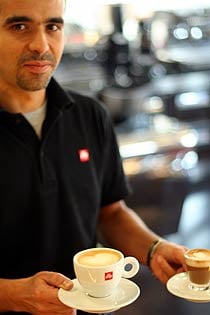
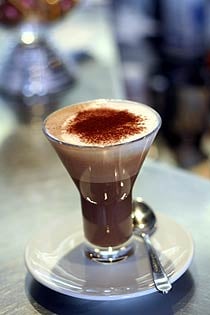
Illy barista Michele Pauletic shows off his skill, and one of my first efforts to match his
First of all, there's an important distinction between 'brewing coffee' and 'extracting espresso'.
Brewed coffee is steeping ground beans in hot water, which any fool like me can do, whereas making espresso involves a couple of crucial steps and the deft use of a high-pressured machine combined with several specific techniques. It's not easy to make the perfect espresso, but anyone can make a pretty decent one, even using an inexpensive home machine.
And how do you know what a good espresso is?
It's a very tiny cup of deep-brown liquid, just a couple of sips, not bitter-tasting, but rich, complex and lingering, which endures on your tastebuds for 10-15 minutes afterwards—one singular, perfectly-extracted shot of true Italian espresso.
I was really anxious to visit Illy, since I've been having trouble getting just the right little shot to taste good at home. Mine was either too watery, or bitter and virtually undrinkable, even though I was using a very powerful espresso maker. But I was also curious why the espresso in Italy tastes so much better than it does anywhere else, even in the humblest caffè. So when Illy invited me to come to their roasting plant and Università del Caffè in Trieste, I cleared my calendar and jumped on a plane.
So what did I learn at Illy?
I learned that anyone, even me, can pull a great cup of espresso at home.
Here's the 1, 2 and 3's of it...
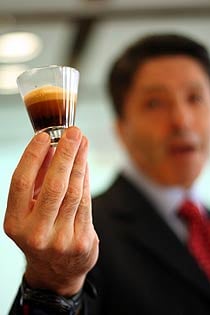
Moreno Faina shows off a perfect crema while a barista keeps the Illy staff fueled all day long
1. Start with good coffee.
This seems like a no-brainer. But I have a friend who said his vinaigrettes never tasted as good as he'd like them to. When I pointed out that you can't make a good salad dressing with crappy olive oil from Trader Joe's, neither can you make a good cup of espresso unless you start with good coffee beans correctly roasted and packed.
The best coffee is made from Arabica beans and at Illy, we tasted two espressos side-by-side; one made with pure Arabica beans and the other with a 50-50 blend of Robusta and Arabica (which I should point out was not an Illy product!)
The difference was astounding: The coffee brewed with Robusta was vile and smelled horrid, while the Arabica was intensely-flavored, yet smooth and full. Because Italy never colonized coffee-growing countries, they weren't economically tied to specific coffee-growing countries so historically, they were able to cull the best beans from around the world. Other countries, like France, colonized places like Cameroon, which are known for inferior Robusta beans and tend to use them, which is reflected in the poor-quality of coffee generally served around Paris.
Don't believe packaging that says '100% Arabica'—it seems meaningless.
And because this is an equal-opportunity, cross-cultural blog, we'll get to American coffee later...
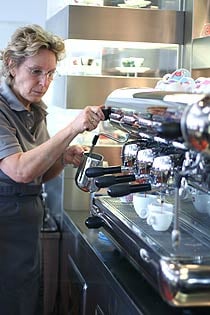
Ready to enjoy a chilled coffee drink while two cups of espresso trickle out
The trend towards single-origin products is rather misleading as well, since the best brands of coffee, like chocolate and some wines, combines various qualities of different beans (or grapes) to compliment each other to achieve the right flavor profile. The scientist at Illy advised that ideally, one must blend at least 4-5 difference beans to get a good flavor. Illy uses 9 different beans but constantly adjusts the roast and blend to adapt to various characteristics of the beans, depending on the seasons and environmental conditions.
In the lab, I watched them pick thought who looked like perfectly-good green beans, one-by-one. But when they handed me a bean called a 'stinker' and asked me to take a sniff, one whiff was all I needed to know why that's the international moniker for the rank bean they plucked out. It was moldy and cheesy, and they told me that just one bean like that could ruin an entire can of coffee.
As a baker, it would be similar to using a rancid nut in a batch of cookies. And if you've ever bit into a rank nut, you know what I mean. When I was starting out as a pastry cook, the chef made me eat one, and for twenty years afterwards, I made sure no one got one in their dessert, believe you me.
But even if you can start with the best green coffee beans, you can ruin them by improper roasting, and you can forget getting a good cup of coffee from them. Many people complain Starbucks and Peet's coffee tastes burnt, which is perhaps roasted that far to mask the flavor of inferior beans. The scientist at Illy, Marino Petracco, kept looking in my direction when talking about "That Starbucks coffee from California," but I didn't want to interrupt and tell him Starbucks was from Seattle.
(Jeez, why do people like to blame California for a host of ills?)
But next time I visit, I'm bringing him a bag of Peet's burnt coffee; which'll give him something from California to complain about.
Unlike what many people think, coffee beans roasted for espresso should not be ultra dark-roasted, which would obliterate any of the subtle flavors that emerge when roasting. Coffee beans destined for espresso should ideally be medium-roasted. Coffee beans can be roasted in as little as 90 seconds, or up to 40 minutes—too long degrades aroma and too little makes the beans bitter. And once roasted, in spite of what you might have been told, coffee should be stored at room temperature in a dark, airtight container. Humidity, light, and oxygen are the biggest enemies of coffee, so the damp refrigerator is not an ideal place to keep your coffee. The freezer's alright, but if you let the coffee sit out for any length of time, condensation will form which can ruin the beans.
A previous reader queried if the Illy coffee he bought in the US was as fresh as what's available in Italy, so I asked the Illy team who responded by taking me on a tour of the packing facility. They showed me how their coffee is 'pressurized', not just vacuum-packed. Each tin, which they fabricate themselves, is welded together and in a nearby machine, I almost had an regrettable accident when I heard a very, very loud explosion, which turned out to be a test run. Every so often a tin is removed from the welder and pressurized before it loudly explodes, to test the seal. (Note to self: If you've been drinking a lot of diuretic caffeinated beverages, use the men's room before taking a tour of a coffee packing facility, since you never know what deafening surprises await. Especially if you're only traveling with one pair of trousers.)
The difference between 'pressurized' over 'vacuum-packed' coffee is a dose of nitrogen gas gets added just before the container is sealed, which they say actually augments good aromas over time in the coffee, but which can augment bad flavors as well...which they told me is why no one else does it. They claim their coffee stays fresh for up to three years that way.
Be sure to check back here in 2010, and I'll post the results of that test.
2. Understanding Espresso.
Perhaps the biggest surprise to me, which shouldn't have been a surprise when you think about it, is that espresso is an emulsion; a liquid composed of stratified oils. Think salad dressing that separates as it sits, which has lost its emulsion. But a good shake brings it back. Chocolate, mayonnaise, gravy, and butter are other examples of emulsions.
Emulsions are lurking everywhere!
Since a coffee bean is roughly 12% oil, a hot (but not too hot), high-pressured water system can extract a nicely-emulsified cup of espresso in 20-25 seconds. Too short, and it's watery and insipid. Too long, and it's thick but bitter. So timing is important.
Anywhere outside of Italy, I watch the barista make an espresso before placing my order. When in doubt, I order a macchiato, or espresso 'marked' with a dab of steamed milk, which neutralizes the acidity of a poorly-extracted cup. A common mistake is to add more water, creating a caffè Americano actually increases the sensation of bitterness on your tongue and isn't recommended, unless you add milk.
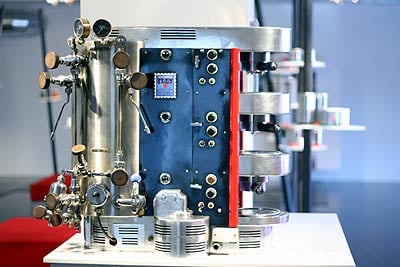
One of the world's first espresso machines
Although the espresso-maker was invented by the French, Francesco Illy refined it in 1935, adding compressed pressure to the process, which shortened the extraction time and reduced the bitterness in the finished espresso. (Gaggia invented the spring-lever machine in 1947 and Faema introduced a pump to push the water through in 1961.)
There are a lot of various machines available to make espresso, but it's difficult to find a home machine that will do it as well as the professional models. And they had them all lined up at Illy's Università del Caffè for me to take through their paces.
The inexpensive machines don't have the high-pressure pumps needed to make a perfect espresso, but I was able to pull a very good cup in the smaller machines, including their Francis!Francis! X1 machine. The Illy barista, Michele Pauletic (who kept me fueled by so much espresso all weekend, I think I slept a total of 2½ hours) had me try that machine and I extracted an excellent espresso, similar in strength and quality to the huge powerhouse models they had lined up. These machines are inexpensive in Italy, although the prices do creep up when exported to the states. But due to voltage differences, the ones sold in the US are modified.
If anyone's interested in buying a second-home in Trieste, I'm happy to stay there when you're not in town. And teach you how to make espresso. Get in touch.
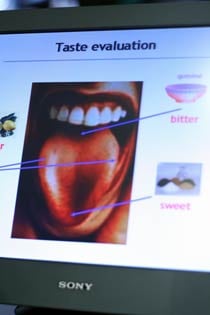
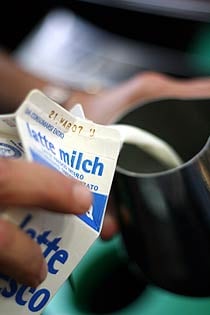
Learning how coffee tastes and steamed milk techniques
Because we all taste things differently depending on our physiology, and where things hit our tongues, most of us tend to crave sweet, fatty things, since their high-caloric value means nourishment. Whereas bitter usually send a danger signal to our brains, since many toxic substances are indeed tart and sour, explained Signore Pettracco, the scientist.
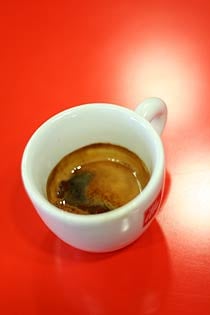
So a good espresso isn't bitter (or burnt-tasting) and should be a thin syrup, 25 ml (about 2 tablespoons) and should have a layer of crema on top, a bit of foam which barista Michele told me was marked with what he called a "tiger's stripes", because of the wavy lines and mottled marks in the foam. Jeffrey Steingarten, in his obsessive-essay on espresso-making, says a good crema is notable if it'll support a spoonful of sugar atop for 2 seconds before disappearing under the surface.
3. Extracting of the Perfect Cup
It's generally recognized that there are three major factors you need to combine in order to make a good espresso: good beans, good water, and good grinding. (Thanks Alan for the exceptionally-thorough link about water...I think!)
As mentioned, you can't make good coffee from bad beans, but the same goes with water. If it's too rich in calcium, magnesium, or other minerals, not only will it inhibit the pressure of the pipes in your machine after a while, but will affect the taste too. All you folks out there chugging bottled water should apply the same criterion to the water you use in your coffee.
Getting the grind right is just as important and unless you have a very powerful burr grinder, you're better off having your coffee professionally-ground for espresso since it's impossible to get it ground fine enough in an inexpensive coffee mill (the kind with the small, whizzing blade.) If it's too fine the water can't get through, but if it's too coarse, the water will flow through too quickly. So it needs to be just right.
Being a horrible snob, I thought the pods of espresso, pre-measured coffee packed in little pouches, were a lousy idea until I tried one at Illy, and I'm thinking of making the switch permanently. I'd had bad experiences with Lavazza pods, where the coffee was too-loosely packed and the water flowed through like manna.
And I normally buy pre-ground espresso and had mixed results. But I popped one of those Illy pods in my machine and I knew when a very thin stream of dark, inky liquid trickled out, I got it right. The Illy pods are indeed more expensive, but it's still less-expensive and better-tasting, than the espresso that I get in most cafés around town.
Speaking of packing, it vital to tamp the coffee in the filter holder correctly.
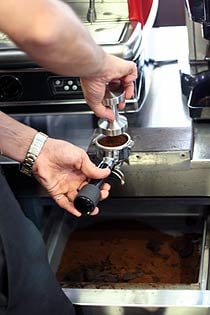
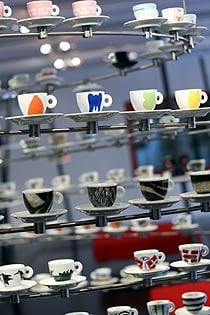
Correct tamping is very important, and my favorite Illy espresso cups, designed by Jeff Koons (I think they were glued-down, but I was afraid to check.)
To make perfect espresso, use no more than 7 gr of coffee and one should tamp using 9-15 kg of pressure, which you can check using that long-neglected bathroom scale. (You should wash it first to get rid of any stinky-feet smell, which they didn't mention at Illy, but I think it's a good idea all the same.)
The ground coffee in the filter holder should be level and smooth with no gaps anywhere. A deft turn of the tamper should be used to polish it off after packing before extracting. It's impossible to get the right amount of pressure using the plastic disk on the coffee grinder ("...like your Starbucks in California", I can still hear ringing in my ears...), so I learned to press straight down, holding the filter holder off to the side of the countertop, not directly on it. I wanted to pocket the extremely heavy-duty tamper they had me use, but didn't want to get busted on the way out. (Which would not be good for international relations.)
Curiously, they're not available in France, but I do plan to pick one up when I'm in the states in June since it really did the trick.
And they look pretty cool.
A perfect espresso should take 20-25 seconds to extract, although in a less-powerful home machine, it may take 18 seconds. When I tried the Francis!Francis! machine at Illy, as it passed the 18 second mark, everyone watching started panicking, rushing over telling me to "Stop! Stop!"; since the pressure is less than the bigger models the extraction time is slightly less.
Still, it tasted pretty darned good to me.
Espresso should also be made fast. Once the machine is heated up and ready to go, remove the filter holder, add the coffee, tamp it down, polish it off, and let 'er rip.
One thing that really surprised me is that the espresso make in a double-filter holder is always better than that made in a single-filter, due to its sloping sides. Because a double-filter is intended to hold more coffee, the straight sides produce a more even extraction. That's why if you go to a good espresso bar, they'll often make two espressos and toss one out when they make yours. Or they'll wait for the next customer to order one before making yours.
Which if you're in Italy, will probably be a few seconds later. You may need to wait a bit longer if you're in one of those coffee places "like you have in California..."
In the next installment, I'll take you in the employee coffee bar at Illy, including the barista, who I've dubbed The Most Popular (and perhaps busiest) Woman in Trieste, and a look at some wacky packaging from the past, frothing milk, and the fine art of coffee-tasting...and spitting.
Well David,
I have a Krups bistro double coffee maker for filtered and espresso! I use Illy and still make lousy watery versions of what should be fabulous coffee; give us home bodies some advice. No matter how much I try I can't make a decent espresso! By the way, I like some of the French demitasse in Paris though I notice everyone there is into espresso!
David,
This is the definitive post on making espresso. Thank you! So interesting. (Gorgeous photos too.) No wonder my espresso never tasted as good as what I got in Italy.
Good post and some of the language sounds like an Italian speaking English. So, Italy rubbed off a bit, eh?
I really prefer a lungo, never milk.
Macchiato actually means spotted or stained, which describes very well what happens either direction, because some sickos do like hot milk macchiato di caffé.
My little after dinner trick is to put a liqueur into a warmed cup and make the espresso on top of it. Frangelico is tasty. I don't need dessert after that.
Oh, the California thing. In Italy most people see the US as NY, Miami and California. They have no need of much else, other than the few with relatives in Chicago, which is, of course, almost in California.
There, I said it. It has nothing to do with the taste--which I acknowledge is superior to café américain--and everything to do with the size. I like to nurse a cup of coffee over several minutes, and I like it to stay warm the whole time. Espresso fails on both counts. It's often cold by the time it gets to my table, and if you let it sit for more than a minute, it certainly will be cold. But I drink it anyway. What else are you going to do, be caught red-handed in a Parisian Starbucks? I think not.
Posted by Brian at March 21, 2007 11:41 AM
Well, even though those Italians have squashed my California spirit into a tiny spec stuck to the bottom of their finely-polished loafers, I'm totally into this post! It made me realize that I used to own an espresso machine. Where'd it go? I feel an Amazon.com trip a commin' on! Whooo hooo!
I wish I could buy Illy's "pressurized for three years of fresh fall-out shelter storage" argument. But empirically, I've found no evidence to support this claim. The difference between making a shot with an unopened can of Illy exported to the U.S. and locally-roasted fresh beans is, without fail, a night and day comparison -- in terms of freshness and the richness of the crema on the espresso it produces. I commend Illy for their amazing quality controls and standards, but unfortunately they cannot seem to stop time and overcome space no matter how much nitrogen they inject.
The "Starbucks in California" references are pretty amusing. My guess is they discriminate between Washington and California the way Americans don't discriminate between, say, Kazakhstan and Uzbekistan. But if they're really being clever about it, they would know that Starbucks got their start by consulting visits with Alfred Peet in California. Alfred being the founder of, of course, Peet's Coffee & Tea.
HAHAHA!! I only today figured out that Illy is your way of writing Italy. I'm a little slow sometimes.
Posted by Bob at March 21, 2007 2:51 PM
Addendum - And there are days like today when I should just stay in bed. Illy does not mean Italy! Sorry about that.
Posted by Bob at March 21, 2007 3:02 PM
great post! i love espresso and used to have a pavoni (one of those beautiful machines with a lever) and always used illy... nowadays i make my coffee in a jura impressa, less attractive, but the coffee is decent and ready at the push of a button. my favourite coffee is a musetti at the moment.
people always think espresso is bad for you because it's strong, but in fact, it's better for you as with filter, the water stays in contact with the beans for longer and picks up more toxins on the way, that's what i've heard anyway. can you confirm that?
I love a well-made espresso, but I have to admit that my husband got me this plastic device:
http://aerobie.com/Products/aeropress_story.htm
...and it seriously makes the greatest espresso. It's my secret to making coffee at work now without having to use the industrial-grade coffee machine and equally industrial grade coffee.
I was feeling kind of embarrassed about my love for this thing until I saw that Jeffrey Steingarten likes it too.
The most amazing espresso experience I ever had was in Koh Lanta, Thailand. I was walking along the beach when I saw this random coffee bar parked right on the beach. Out of curiosity, I ordered an espresso. While waiting for it, I noticed that the beans used are this brand called Doi Chaang which hails from Northern Thailand, with roasting done in the US.
The man who made the espresso took so much care with the work that it was all rather touching for me when the cup finally arrived. The espresso was surprisingly good. Definitely better than those served at the run-with-your-coffee chains. Till that day, I had no idea that Thailand's coffee beans actually had some standard and never did I expect to find on a beach in Koh Lanta.
Posted by Kate at March 22, 2007 12:38 AM
Very informative post! Did they say anything about Expresso having LESS caffeine than regular coffee as someone told me recently...
Also they mentioned that the bottom inside of the cup should be rounded so you can fully taste the "fruits" of the bean..Hmmm
It's funny that you mention the difference between pure Arabica and espresso made with a Robusta blend. I've got a coffee-roaster friend and he's always complaining about how the Italians still add a little Robusta (apparently it helps the crema at the expense of flavor). But it's nice to know that at least Illy leaves it out.
Posted by Alex at March 22, 2007 6:25 AM
"Because Italy never colonized coffee-growing countries"
What about Ethiopia, Eritrea, Somalia and Libya? I think they produce coffee.
http://en.wikipedia.org/wiki/Italian_empire
Posted by Jeff at March 22, 2007 8:53 AM
KT: Another reader recommended that device, although I haven't used it.
...and Trig and Kevin: I did set up a page of links to the Aeropress as well as other espresso-makers and coffee accessories here that I like and one's that coffee-loving readers pointed out to me.
Someone I know who roasts his own beans swears by the Gaggia, which costs less than $200US, although there's also a DeLonghi that's half of that.
Johanna: Toxins? Good God, woman.
What do they put in their coffee in England?
Elise & Matt: Thanks and glad you liked the photos. Coming from you both, that's quite a compliment.
Jeff: *sigh* I wish someone could explain why the coffee is Italy is so much better than it is here. A reader pointed out one reason in a previous post and he has a very informative coffee blog that's full of great info that I'm going to delve into myself.
Carol: Espresso does have less-caffeine that coffee brewed in other ways. In the previous post, I gave an appoximation.
Kate: That beach in Thailand would be pretty good right about now...and the coffee sounds like a very good benefit. But there are some cultures that really take coffee seriously and spend the time to produce a terrific cup. Sounds like paradise....
Excellent post!
We exclusively use Illy coffee at home with our Francis!Francis! X5, to great effect. Maybe not *quite* as excellent as the brew in Italy, but a hell of a lot cheaper than airfare.
We got the machine by subscribing to Illy a Casa, which nets us not only regular home delivery of the good stuff for less than retail, but a substantial discount on the machine itself.
If you are in the US and seriously into espresso, this is the way to go: Illy a Casa home delivery.
Interestingly, last I went into A. G. Ferrari as we were out of coffee, and asked whether they carried Illy. The manager's response was that they don't, because Illy's American blend is different than their Italian blend, and they (Ferrari) aspire only to sell the most authentic Italian goods they can. Illy evidently will not export the Italian blend, period. Still, having never tasted them side-by-side (and clearly never will), I don't notice enough of a difference to care. The American blend works just fine for me.
I like my little moka pot. I know technically it isn't really espresso, but it comes pretty close without all the expense.
I buy Blue Bottle coffee (yes, from here in CA!), grind it myself, and brew up a mighty fine cup. Somehow I don't think pre-packaged, even Illy, would be as good.
Posted by Diane at March 23, 2007 2:30 AM
Diane: I use a Bialetti pot at home for my morning coffee. It makes good coffee, but not a tight, syrupy espresso. That Aerolatte contraption other poster mentioned sounds intriguing and would be interested in seeing how it worked.
Brian: In the morning, I still like a big steaming bowl of Cafe au lait too...although now that I'm a Euro-dude, it's espresso the rest of the day for me.
Monika: You can cut-and-past blog entries into Word then print them out. Or just bookmark the page to come back and visit me! : D
Sean: Yes, a friend in the US told me about that coffee club and it's a good deal, especially since that machine does a great job of making espresso (and it looks pretty cool too!)
Didn't know that there was a different blend for the US, though. Will ask Illy next time I get in touch with them about that. I know companies like Lavazza and Segafreddo make different roasts and blends for their French market.
I always stock up on coffee (and pasta di farro) when in Italy, courtesy of my strict adherence to the second-(Empty) suitcase I always bring along.
Coffee... wooo what a loaded subject. And here I am going to confess that I love my Magimix and those little capsules. How embarrassing and ecologically incorrect. Well at least I only ride in a car once or twice a month. And PS: if someone wants to take me to Italy...oh well, sigh, it is hell getting old and ugly.
Sean: PS: I sent your inquiry to the Illy folks in New York, if there's a difference between what's in America vs in Italy, and their response was, "...that's not valid at all."
So perhaps we'll have to have a taste-off in June!
I use a Gaggia Carezza with Lavazza inBlue, which comes ground. I already blew $200 on the Gaggia, so I couldn't see spending another $200 on a burr grinder. I've had great success so far, for almost a year now. I was able to get the inBlue around the corner at a market for $5 a can (cheaper than the Illy, at $12 a can). I've tried beans from Peets and Starbucks, but I could never get them to grind it the right way, and the shots were always very bitter.
I have the same espresso machine you have, David, and I had a lot of trouble until I upgraded the grinder I had (it was an inexpensive burr grinder) to a Rancilio Rocky grinder, bought through Illy. Thanks for a great post.
I think that the climate of Eritrea and Somalia (hot and arid lowlands) is hardly ideal for coffee growing; for what concerns the former, see:here.
Lybia is definitely too arid, and none of the three countries is listed among coffee producers, cfr.: see this list.
Of course Ethiopia does produce commercial coffee now, but probably not that much at the time of World War 2nd, during the short period of Italian military occupation.
Posted by Leandro do Brasil at March 26, 2007 5:34 PM
I also enjoy a cafe au lait at home every morning...with 'old fashioned' tools! And when I am in the mood for espresso and cappuccino...I use my Bialetti and I must say I prefer 'Kimbo' espresso over Illy....(I know I'll be hung for that)
Your post, unfortunately, contains many mistakes. Illy is not the best espresso coffee maker by far, although their marketing tries to make you believe it. There are at least a dozen Italian coffee manufacturers within the real premium quality segment, a class above Illy. Illy is good but definitely not worth its price: you can have much better espresso for the same amount of money.
Illy has a tradition of only using 100% arabica but his does not mean, by far, that robusta has no place in a premium coffee. All premium brands have carefully selected mixtures with usually up to 30-40% robusta (good quality robusta, of course, the selection they made you taste was obviously of bad quality on purpose to mislead you) and either those or their 100% arabica blends might give you a much tastier espresso than Illy's.
You laugh about their geographical mistakes regarding the USA, however, you simply accept their assertions about France and Italy and their colonialization and its ifluence on their coffee quality which is just as plain wrong and laughable as mixing Washington and California.
About the time to pull a perfect shot of espresso as well as the quality of the equipment you were presented as state-of-the-art, you better check out www.coffeegeek.com. There, you will find real factual information, not marketing stuff of one of the manufacturers.
Posted by coffee_geek at March 29, 2007 12:00 PM
Hi Coffee_Geek: Thanks for your message. Since I'm not an expert on coffee, I was passing on what I had learned, as mentioned. As always, I expect and hope that readers will do their own research and find what they prefer to drink. My goal was to learn the secrets of good espresso since I have a large, heavy-duty machine and haven't been able to pull a great shot out of it. Illy's University of Coffee seemed like a good place to start. Now I'm on a quest and am interested in learning more.
(I will say cally, that the Illy Espressamente store here in Paris is one of the few places where the espresso is always excellent. It's a rampant rumor the French use robusta beans. And while I can't confirm that for a fact, I do know that the coffee you get in 99.9% of the cafés here is vile.)
Your site is a terrific source of information and I am hosting a guest post by someone who knows a lot more than me about coffee shortly. Stay tuned...
It's not my site, I'm just a regular visitor there but thanks, anyway, in their name... :-)))
All premium brands like Molinari, Vergano, Musetti, Bonomi, Hausbrandt, Lucaffé and the others do use robusta. It helps the crema as one of the posters said but certainly not at the expense of taste. The body and the aftertaste of the coffee is usually richer that way. But, it's also a question of personal preference. All these brands do offer 100% arabica as well, so it's your choice.
Learning is always good. If you have the proper equipment (the grinder is even more important than the espresso machine), try to experiment all right but don't limit yourself to Illy. Try these premium brands as well and you'll find out which one you will like most. I'm almost sure it won't be Illy...