I was going to write a post, and call it, The Rabbit of Seville. If you're old enough to remember, there was a Bugs Bunny cartoon that was a spoof of The Barber of Seville*, and that's what it was called.

In French, there's a phrase, Poser le lapin (or Poser de lapin), which means "to pose like a rabbit", but really means "to be stood up" (not that I would know anything about that...) So I thought it would be clever and a good spoof to title this post for Seville Orange Marmalade with something along those lines. But then I got really busy and couldn't find a way to spin it into a good story, and thought maybe half of you out there might not know what The Barber of Seville was anyways and you'd think I was loony tune myself.
As mentioned, I've been quite busy. Too busy, in fact, to look up whether it's Poser le or Poser de. And since Seville orange season is short and fleeting, I wanted to get this post up sooner rather than later.
And what was I doing, you might ask?
Well, just today I went to the market to buy food, I prepared some hot chocolate kits, I had a falafel at L'As du Falafel (I always seem to get a craving for a felafel on Saturdays, when they're invariably closed so I went today to prepare for the long, falafel-free weekend), I went to two different bakeries to buy two different kinds of breads that I like, I visited a pastry shop to learn how they make macarons, and I went to a sex shop.
(You'll probably notice I've spelled 'felafel' a few different ways. Since the restaurant did too, on their menus and napkins, I'll let you figure out which spelling you prefer.)
The visit to the bakery I'll save for a future post, with plenty of pictures, but a gal-pal called last week asking if I knew where to find a certain thingy that one person wears on their thingy which causes the other person's thingy to feel better during les liaisons amouroux. (How's that for keeping my site's PG-13 rating?) Unlike breads and pastries, that's unfortunately not one of my areas of specialty in Paris, so I placed a call to a friend that knows about that stuff, and off we went to the boutique**. Let's just say after our visit there, where the excitable French saleperson described every little detail about their wares, I have lots of new words in my French vocabulary (although they're not words one might use in everyday conversation.) If I did, which I'd most likely do by accident, I'm sure I'd get in a lot more trouble around here than I already do.
So, anyhow.
Where was I?
Oh yes, even I get busy.
But this time of year brings Seville oranges to the markets in Paris. For the past few years, I kept complaining they were hard to find since it's perhaps my favorite of all jams and jellies to make and eat. But this year they were everywhere. (See? It pays to complain. Either that, or a whole lot of French produce suppliers read my blog.) And I found myself busy making four batches of marmalade, which was a whole lot easier since I came up with a brand-new, revolutionary technique which I couldn't wait to share. (Which is why I never had the time to figure out how to tie this jam-making, being stood up, or Bugs Bunny.)
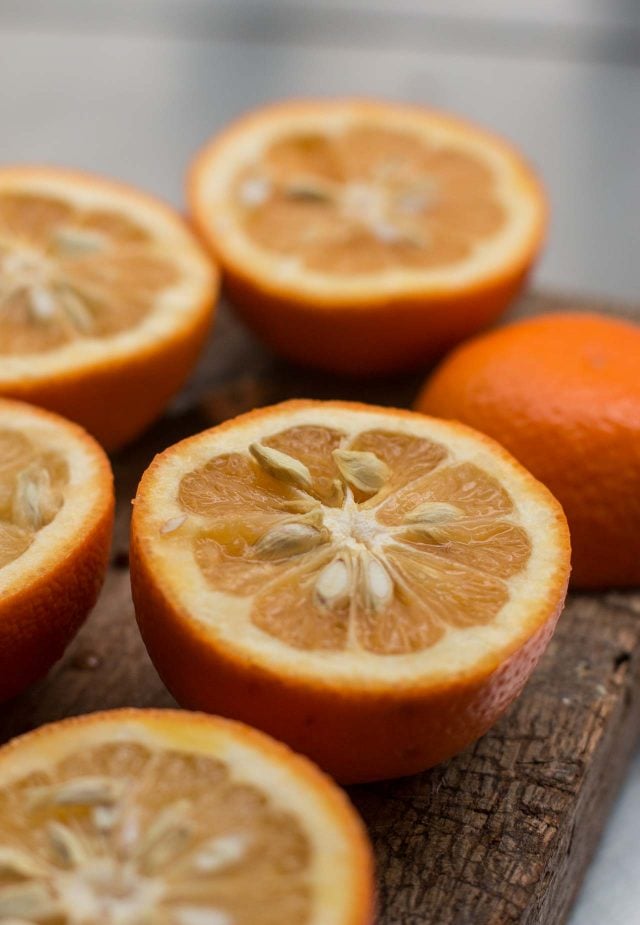
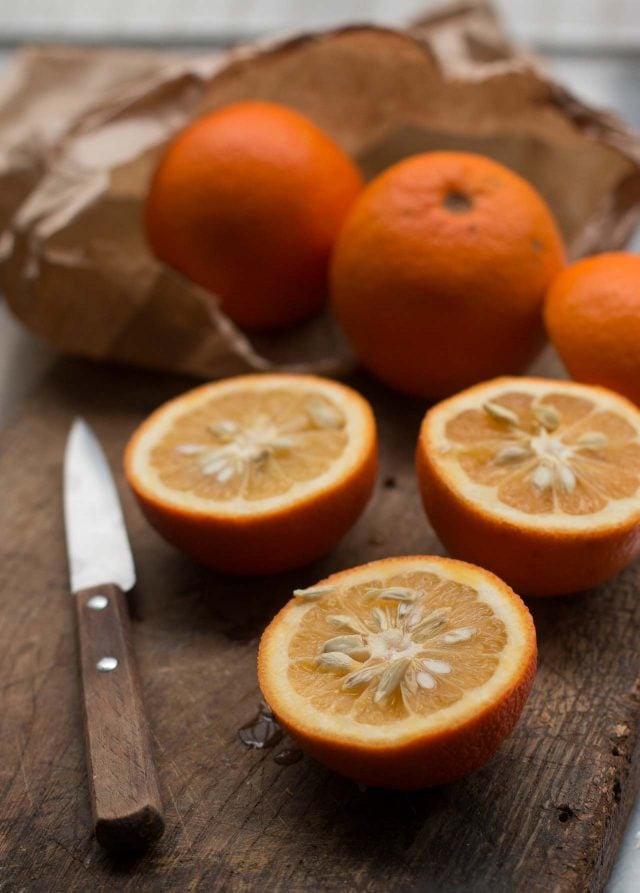
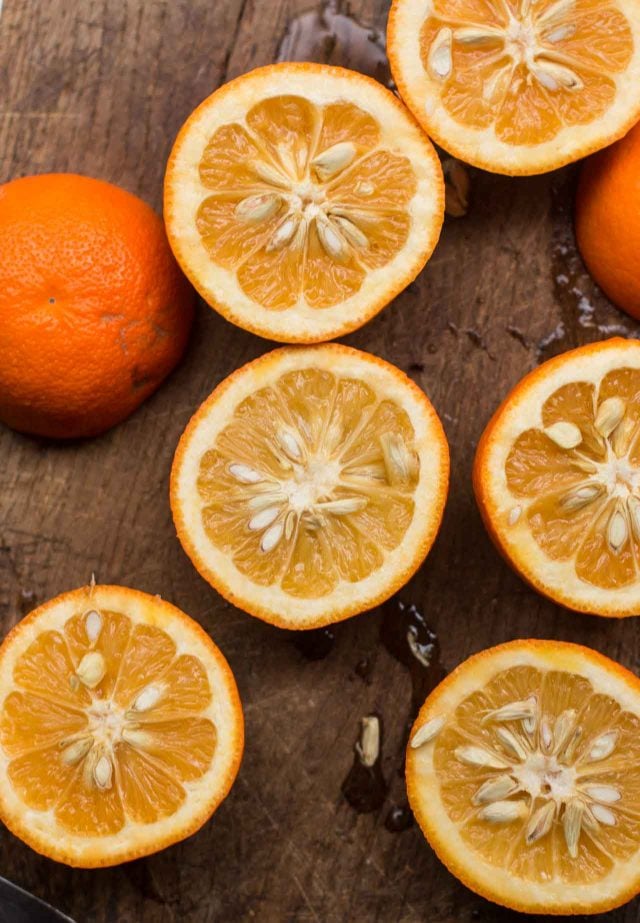
Since Seville oranges are rife with seeds, which makes slicing them difficult since you have to keep moving the seeds around with your slippery fingers, while trying to cut the oranges, then finding more, and fishing around deeper inside to extract more, plucking them out, etc...Each Seville orange has perhaps twenty to thirty inside.

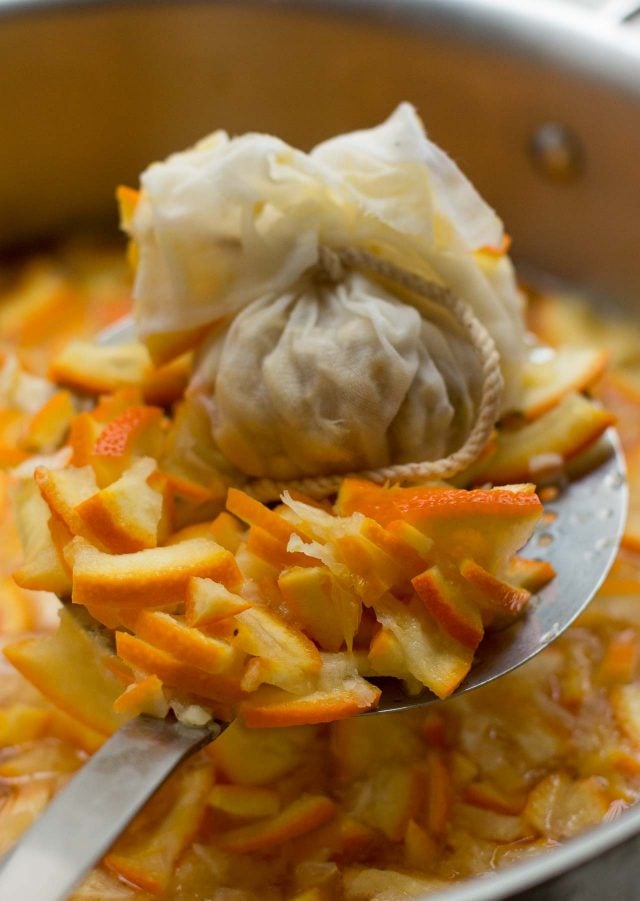
So I thought, what if I was to squeeze the juice and seeds out first, strain them, then pour the juice back in? The seeds are precious commodities in jam-making, and get saved and used since they're so high in pectin. They're wrapped in a sack and cooked with the marmalade giving the marmalade gets a suave, jellied texture. And this simple method makes the whole process much easier.
By the way, I read an account recently that Seville orange marmalade was created because of an error. Apparently an Englishwoman in 1700, the wife of a grocer, was stuck with some sour oranges that were bought cheaply from a boat that was carrying them from Seville. Since there was a storm, they wanted to get rid of their stock or oranges quickly, so the grocer bought them. But they were inedibly sour so his wife decided to try making jam from then, and viola!...Seville Orange Marmalade was invented. Too bad she didn't have a food blog. But then again, they didn't have Bugs Bunny or shops that sell 'adult novelties' in those days, so she had much more time on her hands for jam-making.

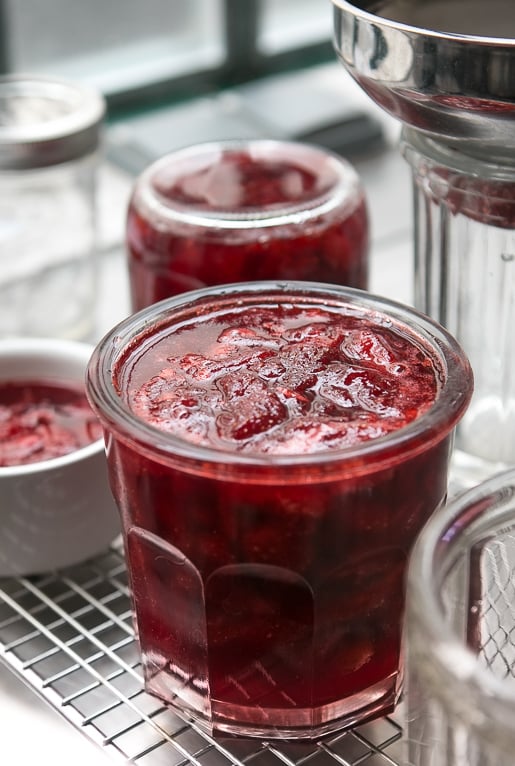
Seville Orange Marmalade
Two quarts
Adapted from Room For Dessert (HarperCollins)
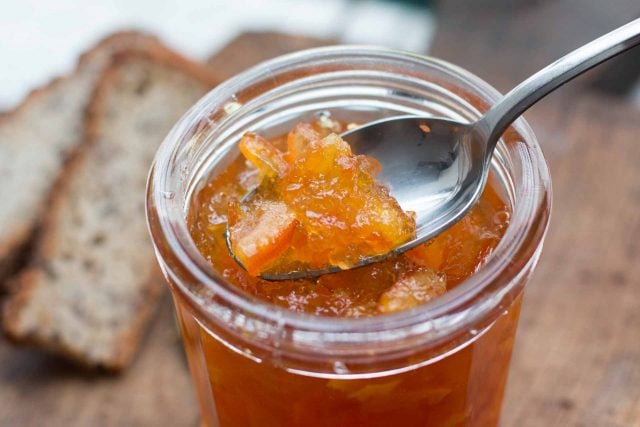
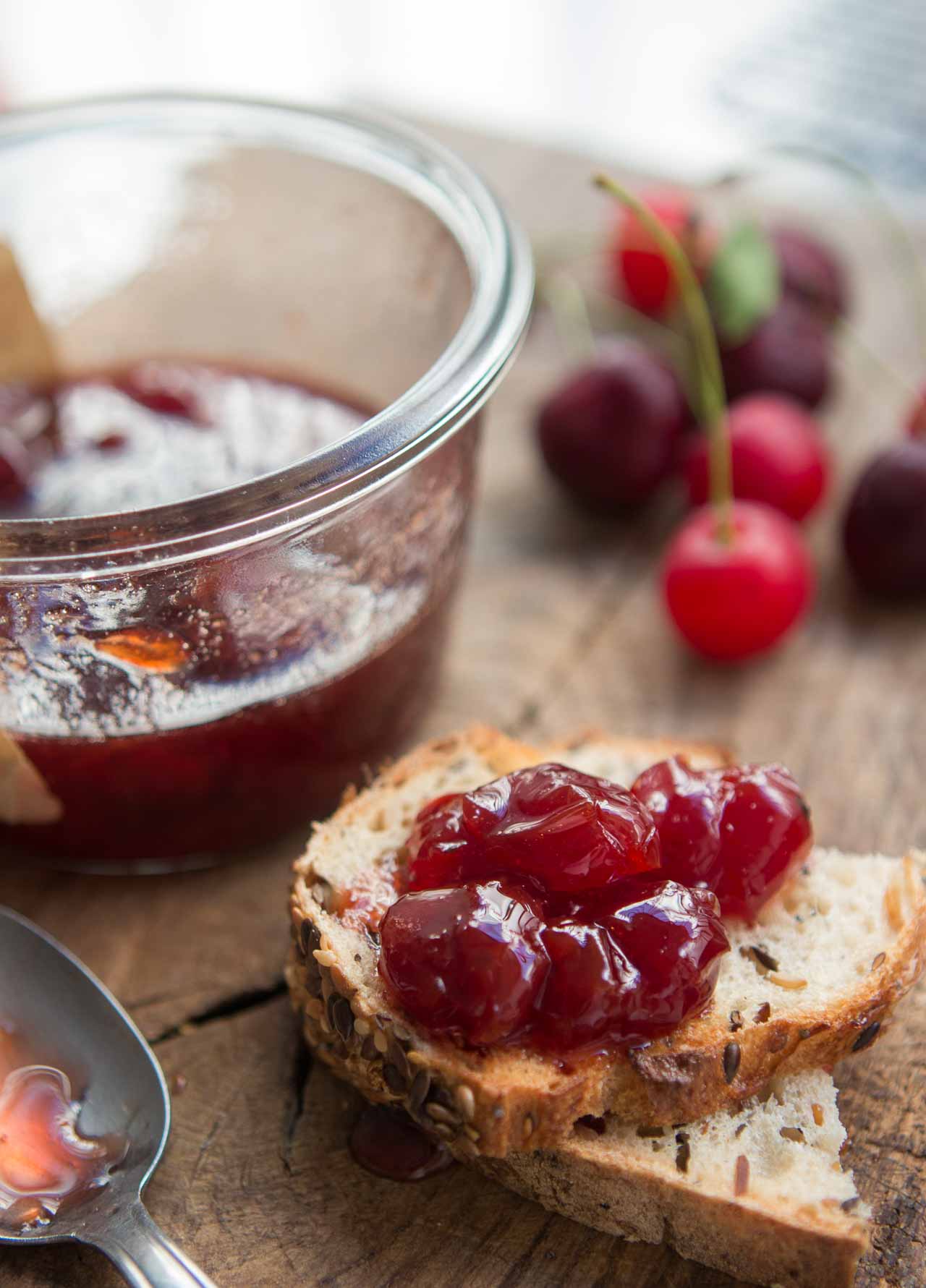
The friend who I went shopping with for 'adult novelties' was telling me that she had trouble jam-making. If you're new to the process, using a candy thermometer makes it rather foolproof, although it's not necessary. Because of all the pectin, Seville orange marmalade tends to gel very quickly, then sets into a lovely quivering spread that's irresistible piled up on toasted and buttered whole-grain bread. It's my favorite winter breakfast treat and I make as much of this marmalade as I can during the sour orange season to stock up for the rest of the year. But I did give away a few jars, including one to my elderly neighbor, who gave me three bisous!
(Two is normale in Paris...)
6 Seville oranges***
1 navel orange
10 cups (2.5 liters) water
8 cups (1.6 kg) sugar
pinch of salt
1 tablespoon Scotch (optional)
1. Wash oranges and wipe them dry. Cut each Seville orange in half, crosswise around the equator. Set a non-reactive mesh strainer over a bowl and squeeze the orange halves to remove the seeds, assisting with your fingers to remove any stubborn ones tucked deep within.
2. Tie the seeds up in cheesecloth or muslin very securely.
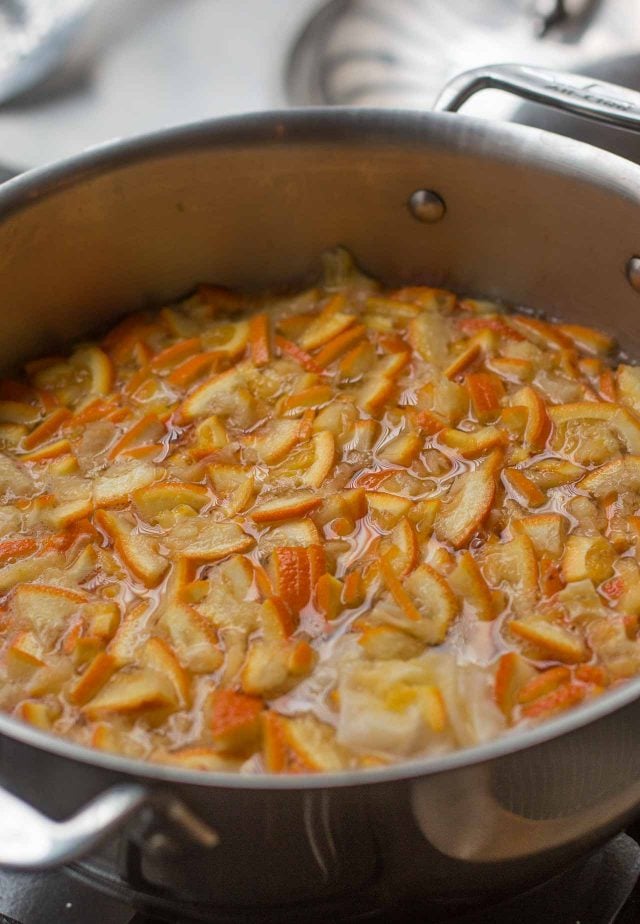
3. Cut each rind into 3 pieces and use a sharp chef's knife to cut the rinds into slices as thin as possible. Each piece shouldn't be too large (no more than a centimeter, or 1/3-inch in length.) Cut the navel orange into similar-sized pieces.
4. In a large (10-12 quart/liter) stockpot, add the water, orange slices, seed pouch, and salt, as well as the juice from the Seville oranges.
5. Stir the sugar into the mixture and set the stockpot over high heat. Bring to a boil, then reduce heat to a gentle boil. Stir occasionally while cooking to make sure it does not burn on the bottom.
6. Continue cooking until it has reached the jelling point, about 220 degrees, if using a candy thermometer. To test the marmalade, turn off the heat and put a small amount on a plate that has been chilled in the freezer and briefly return it to the freezer. Check it in a few minutes; it should be slighty jelled and will wrinkle just a bit when you slide your finger through it. If not, continue to cook until it is.
7. Remove from heat, discard the seed pouch, then stir in the Scotch (if using), and ladle the mixture into clean jars****. Sometimes I bury a piece of vanilla bean in each jar. (Which is a great way to recycle previously-used or dried-out vanilla beans.)

I don't process my jams, since I store them in the refrigerator. But if you wish to preserve them by canning, you can read more about the process here.
*I live on the same street where the author of The Barber of Seville lived in Paris. So I guess there's another connection there I could've explored for this post.
**The boutique is called dollhouse at 24, rue du Roi de Sicile, in the Marais. I was thinking they had something called 'posing straps' and I could wind that somehow into a post about Poser de lapin, or Poser le lapin. But the idea of a rabbit in a thong was a little weird. Even for me.
***Sour or Seville oranges are called in French oranges amers and are available mid-winter in many other countries around the world as well. I've never attempted the recipe with regular oranges but if you want to try using them, let me know how it turns out.
****If anyone know where to get a wide-mouthed canning funnel in Paris, let me know as well. The BHV has every kind of funnel known. Every size, material, and shape. Funnels for decanting wine, for bottling vinegar, and for straining soups.
Except, of course, funnels for canning.
Even in the canning aisle.


David, I'd suggest getting your wide funnel from Weck Online. Rather a peculiar name but they stock canning stuff. www.weckonline.com. If you don't like the plastic ones Lakeland stocks a non-stick one, which is what I use and I like it a lot. www.lakeland.co.uk
The up side of not perfecting the jam making process is that friends can take pity and share their wares.... On toast with coffee....Yum!!!
I'm a HUGE marmalade lover. Really. This looks delicious.
And might I add that your photography is beautiful! WOW!
(not that it wasn't before, you know, I'm just saying you really are getting the most out of that camera, i can tell! ok I'll shut up now)
This post was really clever and funny -- it makes me think it would be brilliant if you had a cooking show. Anyone who can juggle marmalade, Bugs Bunny and
shopping for certain kinds of, ahem, toys in one post AND make it work seems ready for show business.
Thanks for the vote of confidence, Nan. The only problem Nan that I don't think I could do it all in '30 Minutes or Less'.
My mother, who lives in England, has the same problem finding wide-mouth funnels. On her trips to the States, she always picks up a few to give to her friends in England, who all have gardens and who all can jams and chutneys from the produce of said gardens--but can't find canning funnels for love or money.
My local supermarket here in the American hinterlands does not reliably stock cilantro or bulghur, the fish counter is a sad mockery of all the fish-cooking advice I've ever gotten, and the "gourmet" cheese display would make the good readers here weep--but it DOES have wide-mouth canning funnels! David, can I send you one?
Alternatively, perhaps if you sent a non-French-speaking volunteer back to the sex toy shop, with instructions to ask for a canning funnel using only hand gestures, he or she would come back with a suitable doo-dad that could be adapted for your purposes? It's been a while since I've been to such places (small town, kids, no time, I know, excuses, excuses...), but it seems like there ought to be possibilities for creative improvisation...
It is in fact poser un lapin :-)
Bugs Bunny? Thong-wearing rabbits? Sex toys? You should be a guest contributor on my site.
I really advice you to cook your marmelade in 2 time with 12 hours rest between the 2 cooking. It helps to extract all flavors from oranges.
Very very funy post by the way ;-)
true, it's "poser un lapin" i confirm ;-)
marmalade, didn't love it until I moved to Japan.
Ahah, funny to see that you so cutely tried to see whether it was poser le or poser de, when in fact, as said by other readers, it is "poser un lapin". And very nice marmalade indeed, with great photos, as Matt mentioned! Right on!
Got my funnel today at E. Dehillerin where they had to unearth it from some box stowed in the deep, dark recesses of Le Halles.
Funny, in this city of fine cuisine, it's easier to find 'adult novelties' than it is to find a funnel!
Why do the funny, witty ones who can oh, so successfully mix making this wonderful marmalade and talk about naughty sex shops in one breathe always prefer the professor! Why:) I love your blog more and more with every entry.
I recently had a marmalade assembly line in my kitchen. This time I attempted some blood orange marmalade. As I was waiting for the crucial moment to gel my phone rang and I made the mistake of answering it. While I was distracted by my mother and therefore was not stirring constantly, my marmalade scorched. Ack! I was so upset. I had no more blood oranges and had spent all that time preparing. Off the heat I stirred it a bit contemplating that I was going to have to throw it out, but I just couldn't. Then after I had stirred all the little burnt bits in to the mixture I tasted it and you know it didn't taste really burnt or bad, just sort of a deeper, flavour. I thought it just needed to be brightened up a bit. So a large glug of Grand Marnier went into it, cooked it again for a few minutes and it was done. I renamed it Caramelized Blood Orange with Grand Marnier Marmalade. The perfect gourmet name to tag onto a total mistake rectified. I was so proud of my save and thought you and your readers would appreciate.
I brought back some killer marmalade, most made with seville oranges, from a trip to Ireland last year [my fave was a Whiskey Marm. from Avoca] and having had some success with jam making had hoped to try my hand at marmalade. Unfortunately, I haven't been able to find sevilles in my 'hood--San Francisco. Since you used to live [and cook] out here, do you know if that variety is available in these parts? I'm thinking it might just be a European thing and I'm SOL, but if you have any leads you'd care to share, I'd be most grateful.
Can, you use the same recipe for kumquats? My tree is bursting full and I'd like to harvest them before the birds, squirrels and 6 year old get to them.
Hi David: I enjoy your blog so much and thanks for sharing your sejour en France. Here is another funny expression you might add to your rabbit vocabulary. "Un chaud lapin" Next time you're at a dinner party just bring that up and I can guarantee either odd stares or histerical laughter. You might even find "un chaud lapin" au sex shoppe. Salut, Sandra
Jinxie: Try Monterey Market in Berkeley. That's where I always got mine. (Elise at Simply Recipes is going to post her recipe using locally-grown Seville oranges, from Sacramento, shortly.)
Betty: I would imagine you could substitute kumquats, which will be a lot of slicing & seeding! Don't know the exact quantities you should use but let us know how it turns out.
Sandra: Ok...but will I get slapped if I do?
I think you might...
"Chaud lapin" means a highly sexed person of the male gender. Don't say it at a dinner party unless you know what it means (and whom it refers to).
Bises,
Pti
Oh, you're good. You're really good. Anyone who could get me this excited about making orange marmalade has to have something up his sleeve. Was it the inspiring talk about seville oranges? The nostalgic reminiscing about cartoons?..... Or rather, could it be the subtle subliminals that you've ployed on your unsuspecting audience? Toys.... hot rabbits ... David! You might very well be losing your PG rating!
FYI it's poser UN lapin. Thanks for your great blog!
Seville orange marmalade is also my favourite, particularly on toasted rye bread. Rose Grey and Ruth Roger's recipe for it (marmallata di arance siviglia), from 'River Cafe Cookbook Green', is a real winner. You boil the oranges whole, like Claudia Roden's orange cake - the whole house smells fabulous. Also... my mum makes great kumquat marmalade using her microwave, the colour is beautiful, it keeps well and is easy once you get past the chopping and de-seeding - I was really a bit surprised, although I shouldn't be, she is an excellent cook!
Looks great, I made some blood organge marmalade this weekend which turned out beautiful. However, after putting the jam in the jar, all the skin bits floated to the top.Any tips on how to get a nice homogenous distribution? Thank you!
Eva: Never had orange bits float to the top, since usually my marmalade is solid pieces of oranges from top to bottom. (Also, didn't your marmalade made with blood oranges turn brown? That often happens, so I don't use them.)
Try stirring the marmalade as it cools. Assuming that it's going to gel, they should be suspended once it cools.
David, May I introduce you to my personal favorite chauds lapins! we met over dim sum in NY and some how it all connects to sour oranges and play things.
Click here
An apocryphal marmalade story - but I love it!
When Mary Queen of Scots was in exile in Spain, she was suffering from a persistent sore throat. A Spanish physician prescribed a mixture of ground-up Seville oranges and honey. It worked well - and even better; it tasted great. She was so thrilled with the results, that she had large quantities cooked up and packed into large stoneware jars, which were marked "MA" for "Maria", "R" for "Regina", "Malada" for "Ill". These were shipped back to England when she returned. Courtiers got to taste this concoction, and of course anything that the Queen endorsed became a great favourite! Sadly, the "Marmalade" provided no throat protection against a sharp axe.
Another story...
Scottish wool was highly prized by textile makers in Spain. Ballast was required for the return sailings of the cargo ships. Since the raw wool was bulky, and took up more space than the desired trade items from Spain, they looked around for something worthless to balance the weight and bulk of the wool. Most city streets in Spain are lined with orange trees, valued for dense shade and the scent and beauty of their blossoms and fruit. When the ripe fruit falls to the ground, it costs money to shovel them for disposal.They provided the perfect ballast material! Faced with tons of this bitter, inedible fruit arriving at their ports, the thrifty and ingenious Scots found a use for it by making it into marmalade.
My own experience...
Living in Italy, where "Merangole" trees are used for decorative and shade purposes, I noticed that tourists would pick an orange, take one bite, and dash it to the ground in disgust. To me, they looked for all the world like Seville Oranges - and why not! My Italian neighbours were at first astounded, and then delighted, when I picked their oranges, made marmalade, and presented them with jars of it. It did not spark a marmalade industry in Nettuno, but the neighbours are still making and enjoying it, long after I returned to Canada. My other contribution to Italian cucina was Lemon Meringue Pie. Nice to know that I am long remembered for my "bite" and "sweetness"!
Hey, if you still can't find the funnel after searching at the reccomended places, let me know and I'll pop one in the mail for you.
Marmalade is wonderful stuff for winter jamming in the kitchen. Having coaxed the produce manager at my local supermarket here in New Jersey into obtaining some I've been having a grand time playing variations on a theme. Seville orange marmalade with Beam Black Label, with apricots (dried, marinated before incorporation in the marmalade,) with cranberries, etc.
Sweet oranges make up into a sweet marmalade, one I find too bland and without the tang that Seville oranges have to offer. If that's all you can find, try using sweet oranges in combination with lemon to mimic that luscious sharp sweetness of Sevilles.
The name, Marmalade, comes, or so I understand, from the Portuguese for quince, marmelo. They were used for a stiff, sweet concoction (no connection to your Paris toy shop) similar to today's quince cheese. It would be served after dinner, as a digestif.
Enjoy your confiture. Yummy stuff.
Judy: Thanks for the tips on mix-ins for the Seville Orange Marmalade. The cranberries sound especially good.
I must correct you, though, when you say 'your Paris toy shop'. I was going with a friend for something for her, not me...(yes...really!)
Not that there's anything wrong with that, though...
I get my jollies from jammin'!
New to the marmalade home production business.
Finished batch one last evening. It has not set and I am
perplexed. The jars are not yet sealed; a rescue operation possible?
Elizabeth: You can cook it further until it gels, using the chilled-plate test method that I recommend, or a thermometer. The seeds are rife with pectin so if it hasn't set, perhaps it needs a bit of a nudge.