July 2007 archives

Tuesdays With Dorie

First I came up with the title for this post, since I thought it would be a fun jeu de mots. But then I realized I had to figure out what the heck I was going write about. So I put on my long-neglected thinking cap, scrolled through the email addresses of my last few remaining friends, and scanned my agenda, desperately searching for inspiration.
Then it hit me.

And then I thought, “Hey, what don’t I give Dorie Greenspan a call?”

Dorie Greenspan

Thankfully Madame Greenspan agreed to go along on this ruse with me so I could get this post up and running. But there was also the promise of something buttery and sweet, rubber-clad fish boys, just-roasted coffee, prowling through my favorite Arab épicerie with floor-to-ceiling dried fruits and nuts, and finishing it up with verrines at a trendy restaurant. How could she refuse?

And refuse she did not.
So off we went.

Our first stop last Tuesday was blé sucré, en route to the Marche d’Aligre.

Continue Reading Tuesdays With Dorie…

How To Make Ice Cream Without a Machine

People have been making ice cream far longer than the invention of electricity so there’s no reason you can’t make ice cream and sorbets at home without a machine.

The advantage to using an electric or hand-cranked machine is that the final result will be smoother and creamier. Freezing anything from liquid-to-solid means you’re creating hard ice crystals, so if you’re making it by hand, as your ice cream or sorbet mixture freezes, you want to break up those ice crystals as much as possible so your final results are as smooth and creamy as possible.

Vanilla Ice Cream

Machines are relatively inexpensive nowadays with models costing less than $50, and yes, I’ve seen the ball, but if I started tossing one of those around the streets here in Paris, I’d probably get even more strange looks than I normally get. (Plus you’ll need to lug some rock salt home as well.)

But not everyone has the space or the budget for a machine, so here’s how you can do your own ice cream at home without a churner. I recommend starting with an ice cream recipe that is custard-based for the smoothest texture possible. You can use my Vanilla Ice Cream or another favorite, or even this Strawberry Frozen Yogurt recipe using Greek-style or drained yogurt. The richer the recipe, the creamier and smoother the results are going to be.

Ice cream made this way is best eaten soon after it’s made—which shouldn’t be a problem.

Cooking Custard

Continue Reading How To Make Ice Cream Without a Machine…

Continental Linkin’

Required reading from Mort Rosenblum: A New France, Sixth Republic—or Sarkostan?

Let’s all wish Chef Grant Achatz well, and a speedy and successful recovery.

Don’t tell me anyone actually likes the pigeons in Paris?

No danger of a chocolate meltdown where you live?
Stock up for your fix at Chocosphere in the US, and Seventy Percent, in the UK.

…and where you’ll find others like you.

…and where you’ll find others like me.

Opening this was really an Oh My God! moment.

No, the customer isn’t always right…and I agree.

The new, hot and very steamy Neapolitan in my life.

Wish I knew this in June: How to travel the world with ten pounds, or less.

Some new & inspired scoops.
(Warning: Yet another bad picture of me. What is up with that? I’m going to start asking for pre-publication approval. Honestly….)

Remember métro hands?
Well, get ready for Vélib’ hands.

Did you miss the last batch of Madame Prigent’s outstanding French honey? La Campanella has them in stock again.
(Tip: Try the dark, rich miel de bourdain, made from black alder. Boy, is that good…)

And Americans ask me if I’m afraid of French dentists?

Wanted: French Lesson

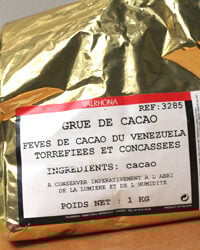
grue de cacao

In my never-ending quest to improve my French, I had some friends over for dinner last night and was asking them what the word ‘grue‘ meant.

After consulting le dictionnaire français (aka: mon ma bible), the only definition we came across was that a grue was a ‘crane’—as in the long-limbed bird.

Curiously, it’s sometimes used a slang for a ‘working woman’, if you know what I mean. Or one who is ‘facile‘.

So how does any of that relate to ground up cocoa beans?

I’m Not Complaining. But…

Each spring, as the temperature starts to gently climb in Paris day-by-day, most normal people spend their time figuring out how to maximize their time outdoors basking in the gloriously warm Parisian air.

Around here, though, spring means only one thing: Eat all the chocolate I’ve got on hand because my apartment turns into the world’s largest bain marie, a sizzling oven capable of melting the thickest, darkest, and densest of chocolate bars from ’round the globe.

Chocolate Bars A-Plenty!

When I travel and come across an interesting tablet of chocolate, I always pick it up and take it home, hopeful that I’ll invite some friends over for a tasting. And my stash grows and grows throughout the year. But come April or May when I’m finally able to fling my wood-shuttered windows wide open and let the fresh air in, the bittersweet backlog gets to be too much and I realize that I need to eat all my chocolate now—and as quickly as possible.

So I spent the last couple of months, pre-Speedo season mind you, wolfing down lots and lots of unusual and curious chocolate bars.

Continue Reading I’m Not Complaining. But……

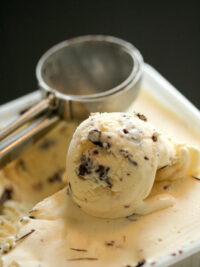
How Long Does Ice Cream Last?

A reader recently wrote to ask, “How long does ice cream last in the freezer?”

Oddly, I never gave it much thought since it doesn’t seem to linger too long around here. So I looked around and found the answer at the FDA website: 2-4 months.

The most common problem when ice creams and other frozen desserts spend too long in the freezer is the texture changes and if not covered properly (ideally with plastic wrap on the surface, then covered with a lid), they can get icy and pick up other flavors from the freezer.

If they do get icy, most sorbets and sherbets can be melted down and re-churned, as can Philadelphia-style ice creams made without eggs. But I find custard-based ice creams don’t re-freeze as successfully, so don’t let those sit around too long.

Related Posts and Recipes


Making Ice Cream Without a Machine

The Easiest Chocolate Ice Cream Recipe…Ever

Chocolate FAQs

Buying an Ice Cream Maker

Salted Caramel Ice Cream Recipe

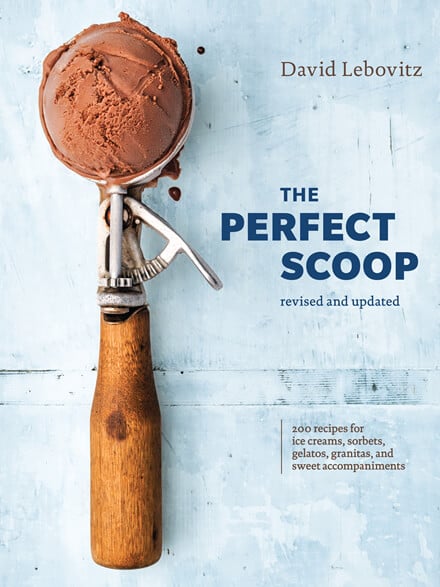
The Perfect Scoop: Now in Softcover!

Ice Cream Making FAQs

Recipes for Using Leftover Egg Whites


Writing Your Own Cookbook

Many folks dream of turning their recipes into a cookbook and I hope to answer some of the questions you might have about the process in a concise manner. Below are some pointers that might help you out but there’s lots of other great tips out there and I encourage you to read as much as you can. (I’ve provided some great links at the end.)

books4.jpg

I offer some advice, but more important, interspersed are lots of questions for you to ask yourself. There’s no right or wrong answers, just points to refine as you pursue your goal.

Here’s ten tips to help you get started:

1. Start With A Great Idea

Come up with an idea. A while you’re at it, make it a good one.

Perhaps you have a bevy of good recipes. Or you want to be famous and have a show on television. Maybe you want to be rich. All are reasons to write a book. But the best is because you want to share your great food and terrific stories with readers. If you look at your favorite cookbooks, each one has at least one recipe that’s amazing, that you make over and over again. If not, the author’s voice rings through and you like thumbing through it for the writing or the photographs. In either case, there’s something about it that excites you.

As Regina Schrambling wrote about Julia Child “…everyone wants to be her, but no one would dream of putting in 10 years of obsessive work on a cookbook.” Yes indeed, Julia spent ten years writing Mastering the Art of French Cooking. Are you willing to spend ten years laboring over a manuscript? That’s probably not likely and shouldn’t take that long, but you should believe in your idea enough to obsess over it night and day during the time you’re writing it, and be willing to spend a big chunk of your life devoted to it.

2. Find Your Niche

Saying you’re doing ‘seasonal and regional foods’ isn’t enough anymore. Everyone does that—or says they do…what makes yours any better?

Continue Reading Writing Your Own Cookbook…

French Tuna

Every time I’m at G. Detou buying chocolate or whatever, I look at the tins of tuna lined up near the window. I’ve never picked any of them up, but I like looking at the pretty designs and graphic, stylized lettering. When I was there last week, I thought, “Why not try them out?”

So I bought these two.

Tuna

Since then, they’ve been sitting on my coffee table where I look at them and pick them up from time to time to admire the packaging and the smooth, cool rounded metal tins. Then I put them back down. One is flavored with coconut, lime and red chili pepper and the other has prunes and spices.

Prunes? With tuna?

While I like prunes a lot…and what’s not to like about tuna?… the idea of them intersecting, mixed up in a can, sounds less-than-appealing. Maybe they’re delicious and I’ve been missing out on a great flavor combination all my life. Who knows? And the one with coconut (which also has raisins listed in the ingredients), frankly, scares me. But the tin sure is pretty and has been brightening my day ever since I brought it home. Doesn’t it make you happy just to look at it?

All I know is that I’m afraid to open them for fear of what’s inside. But I’m trying to keep an open mind.

Now if I could only work up the courage to open them…

G.Detou
58, Rue Tiquetonne (2nd)
Tél: 01 42 36 54 67