Recently in Europe Category

red onions on burger


For those of you who don't live here, you're probably scratching your heads as who in their right minds would want a hamburger in Paris. If you're a visitor, you probably don't come to Paris in search of a burger (unless you've got kids in tow). But Parisians, as well as the rest of us, often get the craving for a nice, juicy patty on a big, fluffy bun, and I'm happy to help in our quest to find the best of the lot.

Here's a list of the places that were suggested by helpful readers in the comments of my post on the burgers at Hippopotamus. I was pretty bowled over with the choices out there and look forward to trying some, or all, of them out.

Please note that I haven't been to most of these places (yet), and I can't personally vouch for them.

Hence I'm trusting you guys on these...so they'd better be good! : )

My favorite travel tip that I rarely advertise is to tell people I'm leaving a day prior to my actual departure.


pasta with pistou


And tell them I'm coming back a day after I actually return. That way, I avoid all those last-minute crises as well as returning home and being slammed by a few weeks of backed-up panicky messages on my machine.


côte d'azur beach


I think everyone's figured it out by now and after getting in late last night, today is my day to put out the fires that erupted while I was gone, so to speak. But first, while it's all fresh, here's some of the high points of my trip to Nice and the Côte d'Azur:


zucchini blossoms


"Sun-drenched" is a cliché that's often applied to the food of the region, and at the cours Saleya market in Vieux Nice, as well as others, you can see that it applies decidely well.

socca sign in vence


"The great thing about socca," Rosa Jackson told me, as we ripped into our second double order of the giant chickpea crêpe between us, "is that even if you're not hungry, you can still eat it."

A few days later, while standing on the square in Vence, waiting while a young man poured chickpea batter onto a very hot oiled griddle, a timid young American woman asked him for a crêpe. He explained, in fractured English, that he only made socca, and she started to walk away.

Nice

25 comments - 06.14.2008

socca, pizza, pissaladiere, wine


If there's anything nicer than taking a break and heading to the south of France, I can't imagine what it could be right now. My first day in Nice, we ran from socca stand to socca stand, tasting as many as we could. Fortified, we hit the wonderful market in the old part of town to select our fixings for a lovely dinner.


socca


The way of life down here, and the cooking, are a world away from Paris. Generous bunches of basil find their way into pistou, which we pounded in the mortar and pestle until almost smooth.

bread


Alain Ducasse recently took over la direction of Le Jules Verne, the high-end restaurant in the Eiffel Tower that had lost its reputation and luster as a fine dining destination during the past several years. I hadn't ever eaten there, since its reputation had preceded it. But this week, I finally got my chance to dine there.


foie gras


We waited patiently for the private elevator of the Tour Eiffel to lift us up to mid-tower, over four hundred feet in the air, above Paris.

We're mid-week into our Paris Chocolate Tour here and we're having a great time. Everyone's enjoying the unusually fine weather, and of course, the chocolate.

I wanted to post a few shots and notes in my spare seven minutes—it's 5:34am so forgive any typos or missed links. I'll catch 'em later...in my free time ; )


Jean-Charles RochouxPassionfruit sorbet

Cheerful, and the amazingly-talented, Jean-Charles Rochoux shows us a chocolate replica of his arm in his laboratory. He made it for a Halloween display at a Parisian department store. The scoop of passionfruit sorbet is from Le Bac à Glaces, an ice cream shop just a few blocks away, where we stopped to cool down.


rochouxchocolateparis

At M. Rochoux's swanky boutique, his assistant Murielle, packs up a box of chocolate. Check out the sexy glove. Oh la la! I may need even more sorbet to cool down...

If you do stop in, be sure to get a tablet of his chocolate from Peru. This is one of my favorite chocolates in his shop, along with the tablets of caramelized hazelnuts from Piedmont enrobed in chocolate as well as his latest; a bar of chocolate with a unctuous layer of creamy caramel oozing out.


salade parisienne

A light French salad: la salade parisienne. Yes, there is some lettuce tucked under that mountain of ham, but I was more focused on the yummy house-made fries at Le Nemrod that I dove on as soon as they landed. Unfortunately, being the consummate host, I did share a few with my table mates. But not before grabbing all the crispiest specimens. Since my salad was so light, my guests knew I needed the extra nourishment to make it through the afternoon.

Did I mention how light it was? Just checking...


rose

Of course, it's not lunch in Paris without un peu de rosé. I had a little pitcher, which was just enough to carry me through the afternoon. Well, at least until dinner.


saladnemrod

If the above salad looked too light for you, the salad with soft-cooked egg melting over a huge mound of crispy bacon and studly croutons, may be more suitable to carry someone through a week of tasting chocolates. They also make a letter-perfect croque monsieur (and madame), if you're in the neighborhood.


When a British travel writer asked if I'd like to meet for brunch last week, he also asked if I could suggest a reasonable place for the article he was doing. So I put on my thinking cap, kicked off my slippers, tossed my funky pajamas in the laundry bin, showered and...get this...shaved!...and actually took a break from my project and got a few breaths of fresh air.

Imagine that!
(This is getting to be a habit around here...)

eggcrepe.jpg

Le Brunch is indeed available at some places in Paris, but je deteste being around people first thing in the morning—and I'm not so fond of Le Brunch either. So we compromised on the more civilized hour of 1pm. Not much is open in Paris on Sunday, which our President is fixing to change, so I suggested Breizh Café a tidy corner spot specializing in galettes de blé noir, commonly known as buckwheat crêpes.

This sparsely-finished restaurant is in the heart of 'bobo' (bourgeois bohemians) land, so there's no shortage of strollers or hipsters hanging out in this part of the Marais on Sunday. Once you get by all the posers skulking on the sidewalks peering in gallery windows, cigarettes perched in the corners of their mouth and the obligatory Sunday am dark glasses...(who unlike me, couldn't bother to shave)...it's a relief to find an inexpensive place to eat where the food is anything but trendy.


Breizh Cafe


Because owner Bertrand Larcher is a true Breton, the Breizh Café focuses on the quality of the products and lets them shine, rather than trying to mess with the originals: there's no red pepper dust on the corner of the plate or twirls of squiggly sauces that have no business being there.

Meribel

44 comments - 01.01.2008
Les Alps

For the holidays this year, I decided to take up a friends offer to visit their family in Méribel, a village way high up in the French alps. As you can see, it's a spectacular place. And I'm not just talking 'gorgeous sunsets' or 'charmingly quaint' spectacular. I mean, Méribel was mind-blowingly, insanely hallucinante.

Seriously, I wasn't prepared for the awesome beauty of it all. Although I haven't strapped on a pair of skis in over thirty years, there I stood, at the top of the mountain on my first day on skis in decades, ready to slide down.

treesbluesky-.jpgham-.jpg

Let me tell you—skiing isn't one of those things that you get more comfortable with as you get older. *sigh* Especially when you're with a group of skiers that include some crazy teenagers who, at the top of a particularly steep run, simply point their skis in the straight-down position, and shove off with their poles and a banchee-like "On y va, Daveeeeeeeeeeeeeeeeed!"

mountainslopes-.jpg

And off they'd go...

Here's a few tips for those traveling to Paris, or around France, who are avoiding gluten.

France may present more of a challenge than other countries, which was confirmed when I tried to find some tips online for gluten-free dining in France and turned up almost nothing

So here are a few helpful hints that will help you navigate French restaurants and dining, how to deal with waiters, and where you can find gluten-free products in Paris.


  • Familiarize yourself with some of the natural foods shops in France.

    Well-known ones include Naturalia, La Vie Claire and Biocoop.

    Many carry gluten-free products and grains. Natural food stores here are some of my favorite places to shop anyways since they carry many regional, organic, and unusual products which are hard-to-find elsewhere in France. Biocoop is perhaps the most varied, although Naturalia has more shops.


  • Vegetarian restaurants may offer good options and be more receptive to special dietary needs.

    You can find a list here, or do a Google search. It's a good idea to call to make sure they're open before heading over since they come-and-go in Paris.

  • Lisbon

    18 comments - 06.01.2007

    If anyone of you has been planning to go to Portugal, I'd say "Don't walk...run!" to get there. Except that's perhaps only possible if you live in Spain. And in which case, you'd probably take the train. Since I live in Paris, I took an airplane from Charles de Gaulle Airport and every time I head out there, I panic days before since it's undoubtedly the worst airport in the world. Broken elevators, directional signs that lead to nowhere, and a dearth of bathrooms, especially for United patrons: There's no rest rooms once you pass security, so you need to exit the waiting area if you need to go, then re-pass through the security line.
    What knucklehead designed that?

    Anyhow, enough from Monsieur Grouchy-pants.
    This is about a vacation, for heck's sake.

    But we took EasyJet, which leaves from de Gaulle's nifty Terminal 3, which is clean, modern and a snap to navigate. (Whose roof hasn't collapsed yet...) And they're even kind enough to let you take knives and long, sharp objects on the plane. When we unpacked in Lisbon, we realized we'd carried a 7-inch razor-sharp box cutter on the plane with us, which came in handy for slicing some of the delicious charcutaria we sampled. Merci!


    tram.jpgchickenandfries.jpg

    Since I'm leaving soon for my book tour in the states, here's some various and sundry impressions and images from my trip. Apologies to any Portuguese folks for mangling their language. And thanks to the readers who offered ideas for places to go and things to eat. I would agree that Lisbon is a terrific place to spend a few days, but if you go, it's worth either renting a car or taking the train to explore some of the beaches and small towns outside of the city.

    And if you don't learn any other word in Portuguese, the most important word in the language is churrasquiera....or 'barbeque'.


    tiles.jpgnatas.jpg

    What I love most about Lisbon is that there's still plenty of relics from the decades of the recent past, namely bits and pieces of art nouveau and art deco everywhere. And the tilework, which you can find all around the city is marvelous, constantly surprising and very colorful.

    Equally marvelous, and edible to boot, are natas; small custard-based tartlets meant to be consumed en masse. Believe me, if I could've fit all three into my mouth at once I would have. No one is shy in Lisbon: you simply belly-up to the counter and order a plateful.


    versailles.jpgpinkpastries.jpg

    Although they vary in quality from place to place in Lisbon, some of the best natas and other pastries are at Pastelaria Versailles.

    I'm heading to Lisbon soon.
    Anyone got any must-do tips or casual restaurant suggestions?

    If so, please leave 'em in the comments....


    Saúde!

    Trieste is located in the upper corner of Italy, located just at the border of Slovenia. It's a compact port city and in addition to Slovenian influences, you might be surprised to come across a shop carrying beer steins, since there are residual Hungarian and Austrian influences in the melange as well. But unlike other Italian cities, you'll find people drinking big glasses of beer, and dining on sauerkraut and dumplings...and I mean, big, hearty ones...not just gnocchi, although you'll find those too. Which I certainly did.

    Along with perhaps a little gelato here and there...


    Gelato

    My daily dose of heavenly gelato from Zampolli


    Since my time was limited, I wasn't able to explore the areas far out of town, which I've been told were where the best food was to be found. The restaurants in the city were a bit uninspiring, although the bars filled up in the early evenings and were great places to have a Gingerino or my favorite aperitivo; an oversized wine glass (God bless the Italians...) with a shot of bitter orange aperitif, chilled prosecco, and a chunk of blood orange served with a handful of ice. I couldn't catch the name, but it sure tasted good with all the food the Italians pile up at the bars nightly to snack on. The first time I saw an enormous spread of food on a bar a few years back in Italy, free for the taking, I expressed my surprise to an Italian friend, who replied, "Well, it's so much nicer to have a little something to eat with your drink...don't you think?"

    Why yes, since you asked.

    Although I know it's not a trend that's going to cross the border into France. But it's a national custom I'm happy to partake of when in Italy.

    After all, I don't want to be rude. Do I?

    The hardest part about sampling so much good food, and enjoying things like, say, fancy Italian cars and easy-access to American booty, is that once you get a taste of the good life, it's almost impossible to go back.

    I challenge anyone who's flecked a bit of fleur de sel across their food can go back to ordinary table salt. I took one taste of the cloud-like, billowy chocolate-enrobed marshmallows from Pierre Marcolini and now I can't seem to get enough. And once you've taken a foot file to your sorry feet, you'll be taking your shoes off all day long to admire your polished pieds.


    specialbottle.jpg

    A special bottle used to evaluate 'Aceto Balsamico Tradizionale'

    My first experience with real, true balsamic vinegar goes back to the time I worked with Paul Bertolli at Chez Panisse. Every so often he'd ask me for the key to the liquor cabinet (which, for some reason, I was entrusted with) and he'd pull out his little dark bottle of brown, viscous syrup. A breathless hush would fall over the kitchen, and he would tenderly drip a few precious drops onto the dinner plates with great reverence. Although that liquor cabinet got pilfered on perhaps one too many occasions, mostly involving after-work fresh fruit dacquiris for the staff (I was definitely not the person to entrust with the key), I never did touch that little bottle.
    It scared me.

    So when planning my visit to the Emilia-Romania region, I decided I would be so close to Modena, it would be a shame not to visit and see what all the fuss was about. I sent a message to the Consorzio Produttori Aceto Balsamico Tradizionale di Modena who was happy to provide me with a glimpse of the process of making traditional balsamic vinegar.


    giovanna.jpg

    Giovanna uses a glass tube to demonstrate the varying thickness of her vinegars


    I could not have been luckier to spend the morning with Giovanna Cati-Barbieri and her husband Giorgio, who may be the tallest man in Italy. Giovanna took me up to their cellar where rows of barrels are lined up, where her vinegars are aged and stored. In fact, tucked away in the attics of many residents of this city are similar wooden barrels, some hundreds of years old, where families privately make their own batches of vinegar, as they've been doing for generations.

    Traditional balsamic vinegar is not to be confused with industrial balsamic vinegar, the acidic brown water that costs 2 bucks at the supermarket. It's like comparing Ye Olde Log Cabin to pure, deep-dark maple syrup: there's simply is no comparison. Giovanna, like others in town, follows traditional methods to make her balsamic vinegars, a process that's strictly regulated and has both DOC (Denominazione di Origin Controllata) and DOP (Denominazione d'Origine Protetta) designations which ensure the 80 member consortium of local producers follow specific quality-assured guidelines.


    balsamicratings.jpg

    Rating the vinegar


    You need to have a lot of patience to make true balsamico and many of Giovanna's barrels are stamped with her daughter's name in hopes she'll carry on the tradition. Although you can find balsamic that's younger, only balsamic vinegars that are aged 12 or 25 years get certification. And as those of us getting into our advanced years, there's certainly a good argument for the gifts that age has bestowed upon us. But more importantly, aside from the certifications and designations, these balsamic vinegars are without a doubt one of the best-tasting things you're ever liable to put in your mouth.


    cherryvinegar.jpg

    Gorgeous bottles of balsamic aged in cherrywood


    The process of making balsamic begins in October of each year with just-picked Lambrusco and Trebbiano grapes. If the grapes sit for any period of time, they'll begin to ferment, so they're cooked right away, but to a temperature no higher than 194 degrees (90 C), which is enough to release their juices but not to cook away any of the flavor. This year, 2006, was exceptionally good for the grapes, since the heatwave concentrated the natural sugars in the grapes. So perhaps Mr. Bush is right, and we shouldn't be afraid of global warming, and embrace it.

    (But what do I know? He's the President and I'm just the Bad-Boy of Baking...)

    Once the grape must has been cooked, the juice is cooled, filtered, then stored in barrels, which are never filled more than 3/4's full. Giovanna uses many different types of wood, mostly castagno but also ginepro (juniper) and ciliegia (cherry), to make special reserve vinegars, since the wood imparts a fine flavor to the balsamico. As the vinegar ages and evaporates over the years, the vinegar gets transferred from the large 'mother' barrel to smaller ones, gradually and systematically, over a period of several years. If you're lucky, some day you'll get a chance to taste vinegar that's over 100 years old. It's a rare treat.


    judybottle.jpg

    Judy Francini, the Divina Cucina, shows off a bottle of 100-year old vinegar in Florence


    As Giovanna explained, "Balsamico is a life philosophy" since the techniques get handed down by word-of-mouth, and it takes more than just reading a recipe to know how to make the vinegars; when they must be decanted, how to monitor the evaporation, and evaluationing the vinegar at various times throughout the aging process. Giovanna also explained that the barrels are used like a dowry, handed down to daughters from generation-to-generation. She's hoping her daughter will want to carry on the tradition as well. I hope so too.

    Afterwards, Giovanna led me through a tasting of her vinegars, starting with a 12-year old bottle designated by a white cap, which was grape-y, tart, and pungent-sweet. It would be perfect to drizzle over carpaccio or shards of aged Parmesan cheese. Her 25-year old with a gold cap, was far fruitier, stickier, and with less acidity and more beguiling complexity. Then she brought out the big guns: a tray of very special bottles, including her 25-year old reserve balsamic aged in cherry wood, which I immediately envisioned dripping over a vanilla-flavored panna cotta, then I tasted another 25-year old balsamic vinegar aged in juniper wood barrels, which she said should only be served over something "very important", like venison or red meat.


    meatbalsamic.jpg

    So good drizzled over sliceds of rare beef at Ristorante Vinicio


    After several delectable spoonfuls, I was starting to swoon, wondering why I had lived so long without making aceto balsamico an essential item in my pantry? Well, I'm sure it had something to do with the cost; a small bottle will set one back about $25. But since you're just using just a few drops at a time (don't you dare mix it into salad dressing), maybe ½ teaspoon, it's merely a few cents per serving. So I tucked several bottles, packed very well, in my suitcase which thankfully made it back to my Parisian pad in one piece.

    In spite of the price, a stingy few drops are all you need to make a very big impact. And never mind the photo...I asked them to keep pouring, feigning trouble with my camera, so they'd keep the precious liquid flowing. (Call me, or any politician, a liar and a glutton.) But I do recommend for newbies to try a bottle that's at least 12-years old, as there's a substantial difference between a thin, rather uninteresting 10-year old balsamic vinegar and a luscious, velvety 12- or 25-year old. The consortium of balsamic producers use a special bottle, designed by racecar designer Giugiaro, to designate the provenance of their vinegars. Incidentally, it's the same creative team that designs cars for a well-known, very famous Italian factory nearby, too.


    vbicvinegar.jpg

    Freshly-churned vanilla gelato is the perfect foil for the tart-sweet taste of balsamico


    The sad news is that now I've developed a taste of the good life, especially for true aceto balsamico, and have been tipping it over everything around here, from venison to vanilla ice cream. (Ok, I don't really know how to cook venison, but I couldn't think of anything else that began with the letter 'v'...and I wanted to feel "very important" too.) But balsamico is also good with fresh figs, soft young goat cheese, shards of pecorino or Parmesan cheese, dark chocolate, gnocchi, and tortellini filled with sweet butternut squash.


    Acetaia di Giorgio
    Via Cabassi, 67
    Tel: 059/333015

    Visits can be arrange by telephone or through their web site and Giovanna speaks English.
    Reasonably-priced, secure international shipping is available as well.


    maserati.jpg

    If you haven't spent all your euros on vinegar, stop here on your way out of Modena


    Modena

    To learn more about balsamic vinegar in Modena, visit the web site for the Consorzio Produttori di Aceto Balsamico Tradizionale di Modena.

    Modena is a easy train ride from Florence, and the trip takes about 20 minutes making it a perfect day excursion. To visit the balsamic producers, call in advance and you'll need to rent a car or take a taxi. The New York Times recently wrote an excellent article about the region as well.

    Another, larger producer of traditional balsamic vinegar is Acetaia Bompana. Visits can be arranged in English or French as well.

    Be sure to visit the Mercato Coperto Albinelli. This wrought iron-covered daily market is a must-see and is one of the best in the world. Open until 2pm.


    Hotel
    Hotel Centrale
    Via Rismondo, 55
    Tel: 059/218808

    Modest lodging, smack-dab in the center of town, on a quiet street.


    Restaurants

    Ristorante Vinicio
    Via Emilia
    Tel: 059/280313

    Gran Caffè
    Piazza XX Settembre, 34
    Simple, contemporary foods. Great lunch spot for pasta and salads, with wine bar for early evening drinks. Next to market.

    Trattoria da Omer
    Via Torre, 33
    Tel: 059/218050
    Pastas and simple trattoria fare.

    Ristorante da Danilo
    Via Coltellini, 31
    Tel: 059/225498
    Regional cuisine, including bollito misto, boiled meat dinners, dished up almost tableside. The ravioli di zucca, plump squash ravioli, are excellent.

    Hosteria Giusti
    Vicolo Squallore, 46
    Tel: 059/222533
    Tiny salumeria with a few tables hidden in the back.

    After spending years learning the language, I'm pretty comfortable with menus in French and I'm rarely in for any unpleasant surprises when waiters bring me food anymore. But on my trip to Italy, I was completely baffled when handed an Italian menu, scarcely knowing stinco from souris d'agneau. Stinco I Iearned the hard way: a Fred Flintstone-sized hunk of roasted veal knuckle was plunked down in front of me, after a hearty pasta course, and there was no chance of leaving until I finished it off. All of it. And you might want to be careful ordering souris d'agneau in France, since a 'souris' is a mouse, which doesn't sound as appetizing as lamb shank, which is actually what you'd be ordering.
    Well, hopefully...just don't forget the 'd'agneau' part.


    parisdiningguide.jpg


    So I carried along Andy Herbach and Michael Dillon's Eating and Drinking in Italy on my trip. Although I need little help deciding what to drink, many times I was stumped when presented with a menu. Luckily I had slipped this slender guide into my pocket, which is one of the most appealing features of these guides, so one could discretely refer to them without looking like a total rube.


    italydiningguide.jpg


    These guides are inexepensive too, and the Paris menu translator has everything from pibales (small eels...ew) to pithiviers (puff pastry filled with ground almonds and cream...yum).

    It's rather difficult to find a good, comprehensive, and compact menu translator, so most people resort to tearing pages out of their guidebooks, which are rather broad-based don't get into the nitty-gritty of the difference between congre (big eel) and colin (hake). Then they end up facing a heaping platter of something they'd prefer not to encounter either on sea or shore. Another bonus is both books also have loads of information about European dining customs, like never filling a wine glass more than halfway full in Paris, as well as restaurant suggestions and the Italian guide has brief descriptions of the regions of Italy, and what to order when you're there.

    Both are highly recommended, so much so that I plan to take their Berlin Made Easy guide with me on my trip this winter, so I end up with gegrillt jakobsmuscheln instead of gekockten aal.

    Roman Gorgy

    13 comments - 10.26.2006

    During my recent trip to Italy, I joined an Italian friend of mine at a trattoria for a late night supper. As we hungrily ate our overfilled plates of pasta Carbonara and Cacio e Pepe, a local specialty made with pecorino cheese and lots of spicy, freshly-ground black pepper, mingled with lots of Italian voices were plenty of Americans, making sure they were heard above the din.

    But Americans aren't just famous for speaking loudly.

    "Americans are the best!" my friend said,"You just get them drunk and you can have sex with them. Everyone knows that."

    Who knew?
    I certainly didn't. That was one reputation that I didn't know we Americans had to live up to (or live down.) So I suppose I've been a failure to my people, or maybe I just need to drink more and get with the program. But with all the young men with plucked, over-arched eyebrows and waxed chests I saw, coupled with the overdose of cologne, lots of extraneous zippers and buckles on clothing, phony Versace belts (though the knock-offs seem more restrained than the real ones), and a staggering amount of hair gel that would be more than sufficient for anyone except Chewbacca, I think it might take more than a few glasses of wine to get anyone to put out for one of those giovani uomini on the prowl in Rome.

    So if you're American and you plan on visiting Rome, depending on the purpose of your vacation, you might want to watch your alcohol consumption, play it safe, and stick to gelato.
    Or espresso.

    Or chocolate.


    romechocolateII.jpg


    Chocolate in Rome, you ask?
    Although one doesn't normally associate Rome with chocolate, since chocolate normally finds its way into creamy-smooth gelalot due to the warm temperatures, but friend of mine, a native of Rome who didn't offer advice of the carnal nature, gave me directions to a chocolate shop that she swore, "Rivals anything in Paris." Hmmm. Thems fightin' words. (Sorry to non-native English speakers who are scratching their heads over that poor grammar...blame it on the south.)
    So we wandered the streets of Rome, searching for the shop, until we came upon a small piazza where Confetteria Moriondo & Gariglio was tucked away in the corner.

    Entering the velvet-lined shop, I smelled something delightful in the air, and saw in the small, well-lit backroom, a group of women sitting around chatting and peeling freshly-roasted chestnuts. Being naturally curious, some say a pain-in-the-butt, I wandered back there to take a look. Within minutes a large Italian fellow came lumbering towards me, thankfully without plucked eyebrows or Versace knock-offs (I didn't check out the chest hair 'situation'), he seemed to have no ulterior motives and offered to speak with me about his chocolates.


    romachocolate.jpg


    Attilio Procietti explained how Rome is a tough place for him to make chocolates, since anything chocolate dipped need to stand up to the heat of summer. To combat melting, he uses a harder chocolate with less cocoa butter than normal, which resist melting. In addition, he avoids soft or creamy centers high in milk fat, and indeed perhaps the best of his chocolates that I sampled were simply little dark chocolate squares embedded with crackly cocoa nibs. His shop, Moriondo & Gariglio is the oldest chocolate boutique in Rome, started in 1850 as the chocolatier to the House of Savoy, whose recipes have been handed down for generations and generations. Attilio also gave me tastes of his molded fruit gels, similar to the French pâte de fruit, and I was impressed by the bright orange apricot-flavored ones. I was quickly becoming high on sugar, finding myself swooning, as defenseless to the charms of Rome as a wide-eyed American college-aged backpacker lugging a copy of Let's Go on his first trip to Europe, falling prey to Roman lotharios right and left.


    chestnuts.jpg


    But maintaining my professionalism (and not wanting to give my blog readers the wrong impression about me...that's for my other, top-secret blog...) I was most curious about the candied chestnuts made from the castagni the women in the back were peeling, which are called Marrons Glacés, an Italian specialty that have because a favorite holiday treat in France as well as Italy during the holiday season. Most marrons glacés end up tasting like dry, starchy lumps of sugar, but these were moist and delicate, each one a perfect bite of woodsy, earthy chestnut preserved in a slightly-sweet sugar syrup.

    I feel deeply in love with these marrons glacés, but I doubt anyone would use these candied chestnuts as objects of seduction, although maybe I should. With my brush-cut hair, which requires a bare minimum of gel, and the triumphant return of chest hair, I'm probably not the best candidate for launching an Italian-style romantic entrapment.

    But I would imagine it beats all that waxing and plucking anyways, don't you think?


    Confetteria Moriondo & Gariglio
    Via del Piè di Marmo, 21-22
    Tel: 06.69.90.856


    (This post is part of Chocolate In Context's Food Destinations #3: Favorite Chocolate Shops world-wide round-up.)


    Other favorite addresses in Rome:

    Tazza d'Oro
    Via degli Orfani, 84
    My favorite espresso stop in Rome. Elbow up to the always-busy counter and be sure to try the Espresso Granita in the summer.

    L'Albero del Cacao
    Via Capo le Case, 21
    Tiny, friendly chocolate shop with good selection of Italian chocolates from my friends at Domori, Amedei, and Slitti.

    San Crispino
    Via della Panetteri, 42 (near Trevi fountain)
    Some of my favorite gelati in the world. Try the meringue-based flavors for a special treat.

    Giolitti
    Via degli Uffici di Vicario, 40
    Near the Pantheon, the classic Rome gelato. A must!

    Pizzarium
    Via della Meloria, 43
    Great stand-up pizza place a short hike from the Vatican (stop at food emporium Castroni on the Via Cola di Rienzo en route). The pizza topped with potatoes is the most popular, and with good reason.

    Volpetti
    (near Testaccio market)
    Via Marmorata, 47
    Amazing food store with everything Italian, including every conceivable salumi and cheese imaginable. Cafeteria-style restaurant just around the corner is great for lunch after visiting the market.

    Biscottificio Innocenti
    Via della Lucce, 21a
    Really fun cookie shop, but how does one choose? Try brutti ma buoni, aka: ugly but good. If she's there, don't let the gruff older woman scare you away. As she barely waddled around herself, she complained about how fat Americans are.
    I guess she was too big to see very far her behind, herself!


    For further places and addresses, you can read my post from Rome last year. Johanna also posted a good list of places in Rome at The Passionate Cook.

    "It's not your fault!" she laughed.

    I had just walked in the door of my hotel, clutching my stomach in a bit of a panic, unable to fit in another morsel of food, no matter how small or appealing. Halfway through my 10 day eating trip through Italy, I felt like a plump, overstuffed ricotta-filled cannoli, bursting at both ends. I told the woman at the front desk at my hotel that I could not eat one more bite of anything, or I would surely die.


    bolognagelato3.jpg


    "It's not your fault." she told me, "The food in Bologna is too good!"

    And indeed, she was right. We'd eaten very well, from simple trattorias, slurping up Tagliatelle al Ragú and Tortellini with Ricotta and Zucchini Blossoms floating in brodo, to filling up on pizza bianco, stuffed with everything from roasted potatoes and fragrant rosemary to gooey, stringy Italian cheese and thin-sliced prosciutto. Although I could easily point a finger at the restaurants for the gustory overload, I did have a role in the matter, since between all these meals, I consumed a rather indecent amount of gelato.
    So I'll share the blame, mezzo-mezzo.


    gelatomachine5.jpg

    Fresh-churned Gelato di Cioccolato


    Eating gelato in Italy is a national pastime. Like Americans who tote oversized paper cups of coffee wherever they go, Italians walk around lapping up cones of gelato instead. You never hear anyone complain about their weight, calories, or anything like that. They just love their gelato and its enjoyment is an integral part of life in Italy. And as they say, "When in Rome..."
    (A theme which began a few days earlier, when we actually were in Rome. But it's not so pretty to say, "When in Bologna, do as the Bolognese do." Is it?)

    But one thing that is pretty incredible is the gelato that's churned up in Bologna.


    gelatomaker.jpg

    Gianni Figliomeni of Il Gelatauro


    Just a short walk from the center of Bologna, is where you'll find Il Gelatauro, where Gianni Figliomeni makes what many consider the best gelato in Italy. Although I think the cookies deserve an award as well, and just looking at the picture makes me wish I hadn't been so polite when they offered me a bag to take back with me.
    Stupid Boy! What was I thinking?


    bolognacookies1.jpg

    Krumiri cookies and Mondorletti al Cioccolatto Fondente


    Above are the chewy, excellent cookies that I had from Il Gelatauro. The krumiri are vibrant-green cookies made simply of pistachio paste and honey mixed together and baked. But what pistachio paste that is! Unlike ordinary, dull-flavored pistachios, Bronte pistachios from Sicily are brilliant-green, and not-so-delicate, filled with intense pistachio flavor. You simply can't make cookies like these without them, nor can you make Pistachio gelato without them as well, so don't even bother. The other cookies, Mondorletti al Cioccolatto Fondente, are made by mixing ground nuts with rare manna syrup (when Gianni can find it), then dipped in sublime Amedei Chuao chocolate from their plantation in South America.


    gelatocase.jpg

    Most gelato has less fat than regular ice cream, but it's denser since less air is whipped in while churning, generally just 20-25%.


    But what I came here for was the gelato, which not only didn't disappoint, but after eating gelato non-stop the previous week in Rome, I wasn't prepared for how special these gelatos are. Il Gelatauro uses mostly organic ingredients, so when you order a cone of Creme (and they have gluten-free cones), you can taste the fatty, golden-yellow egg yolks used to enrich the gelato base. And although it would take a rather big Italian dude with lots of muscles and a crowbar to pry me away from my beloved Cioccolato gelato, the Yogurt gelato had the fresh tang of yogurt combined with the slippery, lickable texture of gelato. It was the best, freshest-tasting Yogurt gelato I've ever had.


    bolognagelato4.jpg

    Once the gelato is scraped from the machine, chunks of cake crumbs are scattered over and soaked with liquor, then mixed in.


    Other flavors included Principe di Calabria, scented with bergamot and Calabrian jasmine flowers, rich Mascarpone, Zucca e Cannela, made with squash and cinnamon, and Semi di Finocchio, a gelato flecked with sugared, candied fennel seeds, which were originally given to pregnant women to increase milk production. Since I'm neither pregnant, nor lactating, I'll have to take their word for it.

    But it's not just esoteric or the unusual that tempt, delight, or whatever they say in Italian (Hey, lay off—I'm having enough trouble with French...let's not toss Italian into the mix.) His Chocolate-Brownie gelato was an amazingly right-on recreation of an all-American idea, although that should come as no surpise since his wife is American artist Angela Lorenz,whose artwork is shown on the walls of the gelateria. Perhaps she also had a hand with the creation of the Baked Apple and Cinnamon gelato and Caki, or the creamy, autumnal Persimmon gelato with a soft orange hue as well. If so, I suggest they revoke her American passport so she has to stay in Italy.

    As they walked me through the gelateria and the spotless laboratory I learned much about his gelato-making techniques. Many gelaterias make just one base, then add flavors to build them up. But at Il Gelatauro, each base is made separately and to certain specifications, then frozen at the start of each day. All Gianni's gelatos are made with fresh, organic cream and milk, unrefined cane sugar, and a touch of the highest-quality powdered milk to increase the milky-smooth flavor and mouth-feel without increasing the fat. He confided in me that many of the thick gelatos we taste at other places have added vegetable fat to make them thicker and smoother. But there's nothing like that done here, and as I watched and tasted a spoonful of each and every flavor they had to offer (how could I resist?), I finally made my way back to my hotel.

    To do—what else?

    Make plans for dinner!


    Il Gelatauro
    San Vitale, 98/b
    Tel: 051 230049


    (More food photos of my trip to Italy are here.)


    Other Gelato in Bologna

    bolognagranita2.jpg


    Stefino
    Via Galliera, 49/B
    Tel: 051 246736

    Sicilian-style granite, or shaved ice. I can't imagine anything better in the summer (or even in the winter) than espresso and chocolate granita piled into a cup.

    la Sorbetteria
    Via Castiglione, 44
    Tel: 051 233257

    Rich, thick gelato in flavors such as ricotta with caramelized figs, dulce de leche, and chocolate-studded straciatelle.
    Make sure to visit their chocolate shop, il Coccolato at Via Castiglione, 44/B, just down the street too.


    Restaurants in Bologna

    Trattoria Tony
    Via A. Righi, 1/B
    Tel: 051 232852

    Simple basic Bolognese fare. Great pasta, tortellini en brodo, and bollito misto. Friendly service, but the food requires a grappa chaser afterwards if you plan to sleep that night. Seriously.

    Trattoria Anna Maria
    Via Belle Arti, 17/A

    Angela from Il Gelatauro was so rapturous about the barely-there, super-thin strands of tagliatelli that I knew if I didn't go, I'd regret it for the rest of my life. I followed my Tagliatelli Ragu´ with roasted, fork-tender Guinea Fowl. Be sure to reserve.

    Enoteca Italiana
    Via Marsala, 2/b
    Tel: 051 235989

    Lovely, lively wine bar with an amazing selection of Italian delicacies for sale as well, including well-stocked shelves of Domori, Slitti, and Amedei chocolates.

    A.F. Tamburini
    Via Capriarie, 1
    Tel: 051 234726

    Glorious shop featuring all sorts of cheeses and salumi. Casual cafeteria if you wish to sample their fare on the premises.


    Hotels in Bologna

    Two reasonably-priced hotels in the center of town, just a 10 minute walk from the train station, and just minutes from all the gelaterias listed above!

    Hotel Paradise
    Vicolo Cattani, 7
    Tel. 051 23179

    Hotel Metropolitan
    Via dell'Orso, 6
    Tel: 051 229393

    Once upon a time, I worked in a restaurant that was well-known for using ingredients of exceptional quality. The most magnificent fruits and vegetables would come barrelling through our kitchen door every day, from plump, rare black raspberries to teeny-tiny wild strawberries, fraises des bois.

    While I can't really guess the psychology behind it, we would often treat these marvels like precious jewels, reserving them for the perfect moment.

    Or we'd just forget about them, then throw them away.

    Unfortunately, because they were so fragile, they'd often last no longer than a day or so, and we'd arrive the next morning to find they hadn't been used the previous evening and had to be tossed. While I don't want to apologize or make excuses for this inexcusable behavior, restaurants are odd places full of strange people acting unusual...and no, it's not just the customers. There's mis-communications, too much going on all at once, and frankly, things don't always happen like they should. And don't tell me that you haven't let something accidentially spoil in under your eagle-eye either.

    Because I'm not buying it.


    slittigianduja.jpg


    So one day, one of the other cooks started to dub things as they came through the door, "Too good to use."
    He used the phrase to refer to things that were so special, that we just couldn't bear to use them. And soon, the rest of us picked up the phrase too, and when something beautiful would arrive, it became the joke to label it as being something that was "too good to use."

    So, last year when I led an Italian Chocolate Tour through Tuscany and Torino, we stopped at Slitti in the tiny town of Monsummano Terme. Although Slitti started out in 1969 as a coffee-roasting company, Andrea Slitti (the son of the founder) started applying his roasting expertise to chocolate-making and now Slitti is regarded as one of the top chocolate-makers in the world. After our visit, on the way out, Palmira Slitti (Andrea's wife who runs the shop) pressed a jar of their Crema da spalmare al Cioccolato Fondente ricca di nocciole into my already loaded-up bag of chocolates with a cheerful ciao bella.


    slitti2.jpg


    When I got home, I put the jar on my kitchen shelf so I could admire it, and it sat there day-after-day. Each day I would gaze up, all glassy-eyed, imagining the chocolate-y goodness through the glass of the jar, and I could practically taste the tiny bits of roasted Piedmontese hazelnuts, embedded in a rich, dark chocolate paste that were speckled throughout.

    One day I decided it was no longer "too good to use" and abruptly pulled the jar down from its perch, opened it up, and with knife poised, got ready to spread.

    Ugh!
    Instead of dipping into the tasty spread, I peered inside first and saw that the entire surface was covered with green, dusty mold. Ick! So at 6:30am, I had the unenviable task of cleaning moldy chocolate. Not a pretty thing to wake up to. I managed to get all visible signs of mold off, then I poured in a shot of Jack Daniels (which around here is definitely not too-good-to-use) and swished it around to kill any microscopic traces of green hairiness.

    Thankfully I didn't toss it, and the hazelnut-chocolate paste was the best I've ever tasted. Unlike commercial hazelnut and chocolate spreads, this crema da spalmare from Slitti was made from the best, just-blended chocolate imaginable, studded with the world-famous Piedmontese hazelnuts from Langhe. And I've been enjoying it for the past few weeks, the warm weather in Paris makes it the perfect spreadable (ie: heap-able) consistency for my morning toast.

    So maybe you have something in your cabinet, something you picked up on a trip that you're holding on to. Or do you have a bottle of wine you've been saving for a special occasion? Or is there something else that's so special that you can't bear to open it?

    Do you have something that's "too good to use"?


    Slitti
    Cioccolato e Caffè
    Via Francesca Sud, 1268
    Monsummano Terme
    Italy
    Tel: 0572.640240

    (Slitti chocolate bars are available in the United States through Chocosphere, which is listed on my chocolate links page.
    I don't know about the availability of Slitti's Crema da spalmare al Cioccolato Fondente ricca di nocciole in America, but I don't feel to bad for you if you can't get it, since I haven't been able to find a source for it here in Paris, France...and we share a common border!)

    "Can I bring it back?"

    Answering many of the questions visitors have about what's allowable to be brought back into the United States (legally), here's an excellent article from Janet Fletcher in the San Francisco Chronicle with the facts that tell you what foods can, and can't, be brought back home from your trip abroad.

    For more tips and news, Think Twice Before Stuffing Your Suitcase, which offers additional information.

    Good reading before your next trip!

    Disneyland is often called 'The Happiest Place on Earth'.
    I don't know about that.

    For me, Neal's Yard Dairy is that place.


    nealsyardexterior.jpg


    I'd been anxious (well, more than anxious, practically hysterical) to visit them in London ever since I first tasted their cheeses, which are imported by my gal-pals Peggy Smith and Sue Conley at Cowgirl Creamery in the San Francisco bay area.

    Neal's Yard Dairy has been making cheese since 1979. The founder, Randolph Hodgson stated the cheesemaking operation in London's Covent Garden. On their web site, he states "We didn't know what we were doing and so we gave the customers a taste of everything and asked them what they thought."


    stilton.jpg


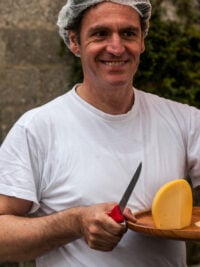
    And indeed, I was a bit startled when I inquired about a cheese and the affable salesperson (who wear knee-high white rubber boots and other cheesemaking garb) grabbed a knife, plucked off a nice slab, and handed it to me. When I wasn't sure (yes, really), he repeated the process with several of the other cheddars (someone once asked why in France they don't give tastes freely, and a French friend replied, with a bit of derision, and perhaps sadness, "That wouldn't be 'correct'."

    (Incongruously, the fellow who helped me at Neal's Yard was French. Maybe he should come back and start a new trend?)

    When I entered Neal's Yard in Covent Garden, there were huge rounds of cheddar piled way, way up high.


    cheddarwheels.jpg


    And Neal's Yard cheddars are the best in the world.
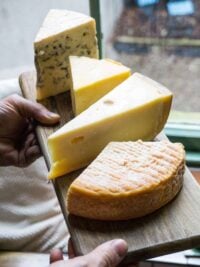
    The exteriors are covered with dark, dusky rind, but when cut open, the interior is revealed. The cheeses are a sunny, golden yellow, often with little streaks of blue mold running through. Dry and crumbly, they left an indelible sharpness when eaten.

    My favorite was the Westcombe Cheddar which was well-aged and had a sweet-sharpness that I knew would be fabulous. And it was.

    I think I tasted every cheese in the shop, at their suggestion, and I waddled out with lots of wedges of English cheese to bring home and savor. The best blue, I think, was Harbourne Blue, a rather crumbly sort of cheese, yet soft and tangy. I purchased a stack (well, actually about 7 stacks) of oatcakes which are the perfect vehicle for the blue cheese.


    bleucheeseoatcake.jpg


    I also loved the slightly dry Gorwydd Caerphilly. Even though I could barely wrap my tounge around the name, the cheese went down quite well. Both cheese, including the Harbourne Blue, I've been enjoying with a salad every day since I got home.


    bleuwsalad.jpg


    On Saturday at Borough Market, across the Thames, locals line up outside Neal's Yard for freshly-grilled cheese sandwiches made with Montgomery's Cheddar, finely diced red onions, and heated on a griddle between pain Poîlane. The other option (which I passed on...how can I pass up a perfect grilled cheese sandwich?) was raclette. Ok, it was an easy decision: My fingers were so frozen that I didn't think I could wield a fork properly and was afraid that most of it would end up on the ground. The sandwich was the prudent option. I would hate to waste a single, delicious morsel.


    gooeycheese.jpg


    Raclette is often made over an open fire. The ritual is a big, sexy affair. A huge slab of cheese is heated until super-hot and bubbling, then the hot, gooey stuff is shaved over a plate of sliced potatoes and gherkins (or cornichons, but it's a relief to me typing in English and not having to code everything in HTML, so I'm using gherkins today.)


    raclette(usethis).jpg


    I also brought back several blocks of Montgomery Farmhouse Butter, which boasts a whopping 85% butterfat (I think. I was in a butterfat-induced haze by that point.) I thought it would be tasty when spread over a warm, toasted crumpet, and sure enough, I was right. I ran out of crumpets at home before I ran out of butter and will have to make a batch to finish off the buttery block. I guess I wasn't spreading on enough butter?


    buttercrumpet.jpg


    If you're interested in learning more about Neal's Yard, I urge you to visit their website, which is full of excellent information and lots of terrific photos of the cheesemaking operations.

    In the United States, Neal's Yard cheeses are available at Cowgirl Creamery and Central Market stores. If your local cheeseshop carries any of their cheeses, don't hesitate to bring a slab or two home.

    You won't be disappointed. Just make sure to pick up plenty of oatcakes, and perhaps some crumpets, as well.


    cutcheddar.jpg


    Neal's Yard Dairy
    17 Shorts Gardens, Covent Garden
    and
    6 Park Street, Borough Market
    London

    With the Eurostar, London is just a 2 ½ hour train from the Paris gare du Nord. Why wouldn't you go for a weekend?
    I guess I could think of a million reasons why I haven't been to London but none are very compelling. When an email from some friends who live in Hawaii announced they were coming for the weekend (which involved several flight across mutliple time zones), I couldn't come up with an excuse not to go and meet them.

    People (myself included) often wonder why Europeans don't travel more outside of their country (in fact, just a slim minority of Americans have passports) when Italy, Spain, and London are just a hop, skip, and a jump across the frontière.

    So I found myself speeding Chunnel-ward for the weekend. In winter, London is bone-chilling cold. Truly. I was surprised it was so much colder than Paris. An icy-blast of wind ripped through whatever layers of clothing I was bundled up in. Another surprise was the cost of most things. A trip on the Tube was a startling 3 pounds (about $5). And although England is a nation of beer drinkers, most pubs only had French or Belgian beers.

    Except for one woman I had a tangle with at Monmouth Coffee (who shall remain faceless and nameless, and their famous coffee sucks...even though the nice woman there gave me my coffee for free because the other woman was so nasty), the Brits were chipper, friendly, and witty. At the astounding Borough Market, the cheery vendors braving the cold were happy to chat and offer tastes. I had a cream scone, stocked up on cheese (more in a future post), and my first gooey Treacle Tart from &Clark's, Sally Clark's bakery that was so sweet my teeth hurt.
    Of course, I loved it.

    And my dinner at Fergus Henderson's restaurant St. John was great fun, a wonderful place. Instead of heaping on the pretense like so many other well-known restaurants, the room is block-white with pegs on the wall, like meat hooks, for hanging your coat. They're the sole decoration in the sparse room which I believe was formerly a butcher shop as well.

    We started with a big platter of rock-hard bones brimming with warm marrow, accompanied by warm grilled sourdough bread, coarse grey salt, and a garlicky parsley salad. Another salad was Shaved, Dried Venison Liver with Radishes, Capers, Soft-Cooked Egg, sauced with a warm mustardy dressing and that was followed by my main course of roasted Pintade, Guinea Fowl, with Braised Cabbage and Salt-Roasted Potatoes. Dessert was a Warm Treacle Cake for 2 that was big enough for 8 and tasted like an upsidedown cake without the fruit. It was served with a large pitcher of warm creme anglaise. We also had a decent, but unexceptional Date Cake with Spiced Ice Cream and Hot Caramel Sauce. A scoop of just-churned Chocolate Ice Cream with an unusual red dessert wine (whose name escapes me) was a nice finish to the meal, and it was all quite lovely.

    Here's some of the other things I found to eat in London:


    bacon.jpg

    The Brits sure like their bacon, at Borough Market.


    kendalmint.jpg

    I didn't know what this was since the box doesn't have much information. When I asked, I was told, "It's a big block of sugar, covered with chocolate."
    Sounds good to me! And indeed it was. In fact, it was so delicous, I bought a few more to take home. As you can see, it's like a big peppermint pattie. I'm going to crumble one into my next batch of brownies, if there's any left.


    bunnies.jpg

    Is it almost Easter?


    luis.jpg

    This is Luis, who spends all day at Borough market slicing ham as thin as possible. He offered me a taste of the two he was working on that day and if you've never had real Spanish ham, it's really incredible and puts all other hams out of business. The best is made from pigs which feed on wild acorns so the ham takes on a deliciously nutty flavor because of that. Food blogger Joanne, who I met up with, along with Jeanne, bought several slices for her lucky dinner guests that evening.


    brownietower.jpg

    I don't know how they got the brownies to stack so tall, but they didn't believe me when I requested the extra-large one, located near the bottom. My friend bought one, but neglected to share it with me so I'll never know if they're as good as the young bakers said they were. Still, that's quite a tower.


    bunghole.jpg

    Sam, please explain your people.


    fishandchips.jpg

    Apparently a good plate of Fish and Chips is rarely found in London. You need to travel to the smaller villages, I've heard. However in London we got a list of a few good spots, including North Sea Fish Restaurant (7-8 Leigh Street). Our taxi driver knew the address well, so we assumed that was a good sign. And we were right. It was great. A huge piece of cod and fries, accompanied by malt vinegar and homemade tartar sauce, enlivened with horseradish and capers.


    beefdripping.jpg

    That's an awful lot of beef fat, don't you think?


    spotteddickchocolate.jpg

    At the chic Harvey Nichol's store near Hyde Park, I scanned the chocolate aisle looking for new taste treats.

    I passed on this one.

    Having returned from my trip to Italy, narrowly escaping the hairy fangs of the too-vigilant EasyJet luggage police, I returned with a suitcase full of great Italian foods: chocolates from Amadei, and Domori, coffee (and more chocolate) from Slitti, jars of bittersweet chestnut honey, 12-year old syrupy Balsamic vinegar, luscious sun-dried tomatoes, and of course, bottles of fruity Tuscan olive oil.

    Fresh Dried-Pasta
    I've seen a lot of noodles in my time, but stopping in Pastificio Defilippis (via Lagrange, #39, in Torino) I had to take a moment to collect myself. Lining the walls were every kind of dried pasta imaginable, all made right there on the premises. Members of my group made a beeline for the pasta al cioccolato, but for some reason they ignored the coiled-up stewed eels available for antipasti.

    pastablog.jpg

    Mesmerized, I found these two pastas irresistible. One I nicknamed 'bellybutton pasta', which I had to translate for the pasta maker by lifting up my shirt ("Boys Gone Wild: Torino!"), and the other is a whole-wheat pasta. If you haven't had whole-wheat pasta, it's great tossed with fresh or good-quality tinned tuna, pitted olives, sun-dried tomatoes, finely-shopped anchovies, fresh thyme leaves, topped with crumbled feta cheese.

    Cocoa Beans
    Is chocolate good for your health? There's no easy answer for that (although a simple yes would do.) Some research proves that the antioxidants in chocolate have health benefits. Yet a chocolate-maker that I know says most of the antioxidants disappear during processing.
    What I tell people is that any health benefits in chocolate are likely found in the cacao beans. Either way, it's unlikely you'll get any health benefits from, um, say, Chocolate Cheesecake. Skip the 'cheesecake' part and just go for the chocolate.

    kashayablog.jpg

    These are cacao beans from Domori that I was blogging about earlier. They are the best beans I've tasted.

    Lardo
    (If you're kosher, or vegetarian, skip this section....)
    I don't know what prompted me to try lardo in the first place. It's pork fat, thinly sliced, and served on warm toast with a flint of rosemary leaves. But it's one of those things that if you eat it once, you're hooked and you will never, ever get over the craving for. We don't get Food Network in Europe, but it seems every time I see it in America, Mario Batali is going on and on (and on) about lardo.
    The name alone is a blatant indication that it's probably not good for you. But imagine grilled Tuscan bread moistened with just-pressed olive oil, draped over it are soft, rich and buttery slices of lardo. MMmmmmm....

    Here's a photo so you can avoid a similar fate:

    lardoblog.jpg

    Formenton Garfagnana
    I love polenta. And it's impossible to find in France. You have to make do with instant polenta which isn't bad, if you like baby food. At a lunch in a villa near Lucca, the chef gifted me a sack of artisan polenta, called formenton garfagnana. When I asked him what made it different from polenta, he began getting very excited, explaining it in detail, in rapid-fire Italian. I didn't have the heart to interrupt and let him know that I had know idea what he was talking about, so I kept nodding, avoiding the deer-in-the-headlights look. So if anyone can edify us all, post it in the comments section here. (Preferably in English!)

    polentablog.jpg

    Chestnut Honey
    Years ago I innocently dipped my finger in a jar of Italian chestnut honey, anticipating sweet syrup. Instead I recoiled from the bitter taste which lingered way too long in my mouth. Now that I'm all grown up and so much more sophisticated, I begin each morning with a smear of velvety, savory chestnut honey on buttered toast. Yum! Is this stuff good. It can be expensive in the United States, but in Italy, it's common. Italians use so much of it that I even bought some from a street vendor in Pisa. I ended up lugging home in my carry-on enough jars of chestnut honey to last me for at least a year, I hope.

    honeyblog.jpg

    Two extraordinary vendors in the Central Market in Florence will mail order authentic Tuscan foods directly from their stands:

    And if you live in the San Francisco Bay Area, you can visit the warehouse of Village Imports, which has open warehouse sales throughout the year.

    Here I am in Torino, or Turin, if you're familiar with the shroud.
    Being on the road means that I'm in unfamiliar hotels with less-than-ideal access. When I attempted to change the thermostat in my hotel room, the digital display read 'PARTY'. I don't know what the 'party' mode is, but when I pressed the switch again nothing exciting happened.

    thermostat1.jpg

    I'm leading a fabulous chocolate tour as I write. Torino is not on the tourist route. But it should be if you're into chocolate. Gianduja is the star chocolate attraction here, a blend of milk chocolate and hazelnuts ground until smooth then formed into a paste. Hazelnuts are a specialty of the Piedmonte region and during wartime, cocoa beans were scarce so someone had the great idea to blend them with chocolate, and gianduja was born. (If you've had Nutella, you know what a terrific alliance chocolate and hazelnuts can be.)

    Gianduja1.jpg


    Once the gianduja paste is made, it's formed into mounds that are molded into a flat peak, then wrapped in gold foil. I'm not much of a fan of milk chocolate, but when mixed with hazelnuts, it's dreamy and truly delicious. The best gianduja that I've had was at A. Giordano (Piazza Carol Felice, 69.)

    The other chocolate treats of Torino are Bicerin and gelato. Bicerin is great, and something that deserves to be better known outside of Torino. It's a hot drink made with espresso, chocolate, and just enough whipped cream to make is smooth and creamy. It's a fabulous combination, and each afternoon residents of Torino line up at bars for a warm Bicerin.

    The gelato here is thick, gooey, and delicious. Like nothing you've had in your life. Flavors include caffe, gianduja (my favorite, of course), pistacio, tangy yogurt, and torrone loaded with almonds and sweetened with honey. Here's my favorite gelato maker at the Caffe San Carlo (Piazza San Carlo, 156). He is perhaps my new favorite person in the world.
    At least in Italy.

    gelatoman1.jpg


    Italians in Torino walks down the street eating gelato all hours of the day. Businessmen at lunchtime slurp cones while avoiding dripping on their Armani suits. Afternoons, swarms of teenagers with low-slung jeans send text-messages in between licks, and elderly women wander through the passages and window shop savoring gelato.

    So I'm off tomorrow with my group for the mountains of Biella, where we'll dine at an Agriturismo, a farm that serves meals made from ingredients only grown on the land. Then onward to Genoa, where we'll stop along the way at Domori chocolate, one of the world's great chocolate manufacturers.

    Purchase The Perfect Scoop from Amazon

    David Lebovitz

    Purchase The Great Book of Chocolate from Amazon

    Monthly Archives

    Archives By Date »

    Browse by month: 2008

    Browse by month: 2007

    Browse by month: 2006

    Browse by month: 2005

    Purchase Room for Dessert from Amazon

    Purchase Ripe For Dessert from Amazon

    David's Amazon Store

    Subscribe