Results tagged butter from David Lebovitz

Brittany’s Butter Bonanza

Of all the regions in France, one of the most peculiar is Brittany. The cuisine is hearty, earthy, and dynamic…like the terrain…

rocksbrittany.jpg

The coastline is a virtual lunar landscape of jutting rock formations, with pristine beaches tucked in between. Consequently, upper Brittany is somewhat remote and not a popular tourist destination. Most of my days began at a almost-deserted beach with a dip in a frigid, clear water, and finished at a lively crêperie, picking through a mound of moules frites, steaming-hot mussels simmered with white wine and local shallots, served with a overly-generous pile of frites that I thought I’d never be able to finish. (But of course, I always did…mustn’t be rude.)

Ah, summer vacation in Brittany. There’s not much to do here except swim in the chilly water, and eat seafood, red onions (more about them in a later post), and…the delicious salted butter.

Unlike the rest of France, the Bretons don’t eat much cheese…in fact, there’s no local cheeses that I can think of that are produced there and I didn’t see one fromagerie in ten days. But they make up for it by offering up lots of butter, which they’re justifiably famous for. When you compliment a local pastry shop or restaurant on their cuisine, they will invariably respond proudly, “C’est la buerre de Bretagne!

farbreton2.jpg

There’s also not so much wine wine consumed either, since the locals drink plenty of sparkling, lightly-alcoholic apple cider. A fizzy bottle is popped open before each meal and served in a traditional bolées, similar to a squat coffee cup with a handle.

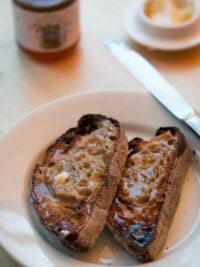
But back the butter—it’s the best I’ve ever tasted. Breton butter is notable since it’s almost always flecked with large, coarse grains of salt that crunch when you bite into them. I spread some on my toast each morning before drizzling it with bitter chestnut honey. Much of the salt used is harvested on ponds and marshes in the Guérande, where the famed fleur de sel is harvested as well. And unlike the rest of the country, Bretons often butter their bread, which is never done elsewhere in France except with oysters, which are customarily served with buttered rye bread, pain de seigle. (So next time you’re in Paris and that waiter gives you a disapproving sneer when you ask for butter, tell him you’re from Brittany.)

prunecrepes.jpg

Naturally much of this butter makes its way into buckwheat crêpes, or galettes de blé noir (when made with buckwheat flour, or blé noir, they’re normally called galettes rather than crêpes. You can buy crêpes at most of the local pastry shops, and if you’re lucky, they’re still warm.

One night I picked up a stack and for simple dessert, I heated a bottle of hard apple cider in a skillet, added a handful of unrefined cassonade sugar, a modest knob of Breton salted butter and some delicious prunes from Gascony. Once the cider was sweet and syrupy, I added some folded crêpes, a pour of Calvados, and voila!

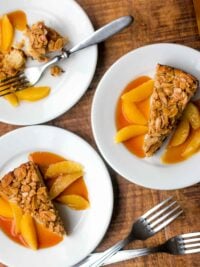
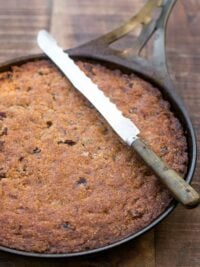
Perhaps the most famous dessert of the region is the Far Breton. Far is the Breton word for ‘custard’, and the Far Breton is remarkably similar to a custard tart sans the crust. Like everything, there are good versions, and not-so-good versions (like pretzels on the streets of Manhattan). You’ll find Far Breton everywhere in Brittany; in supermarkets, outdoor markets, restaurants, and pastry shops. Like flan in Paris (which is a wedge of custard tart, and not the inverted caramel custard that many of us are used to,) a slab of Far Breton with prunes is often a mid-afternoons snack, or le goûter for hungry folks.

Although I find most of them rather dense and heavy, I knew that if I tried as many as possible like Goldilock’s, I would certainaly find the version that was “just right”. And sure enough, the best was from a pastry shop in Lesnevin called Labbé, a few steps off the main square.

farbreton.jpg

(If you’re looking for a recipe, you might want to try the one by Dorie Greenspan that appeared in Bon Appétit recently.)


Another extraordinary treat is the Kouign amann, which is pronounced (and spelled) a few different ways, depending on your accent. I learned to say it by rhyming Kouign with the word schwing!, from Wayne’s World…which I’ve tried to explain with a sharp thrust of my hips to French people but it doesn’t seem to translate very well, and people were looking at me funny, so I gave up.

kouingaman.jpg

A friend who visited Brittany once wrote me and said, “A stick of butter would seem light in comparison!..” when describing his first encounter withKouign amann. And indeed, the word amann is the Breton word for butter.

I had to try one from several bakeries, since it’s one of my favorite desserts: layers of flaky pastry baked with plenty of salted butter and sugar, until it’s all dark, crisp, and caramelized? Bring it on. Sometimes they’ll sell it by the slab at outdoor markets, and they slice off a hunk for you and sell it by the kilo. But the best thing I ate all week was…

frasiseplougastel.jpg

Ok, I know what you’re thinking. Here I was surrounded by fabulous buttery creations, but then I discovered strawberries from Plougastel. But honestly, these were the best strawberries I’ve ever had. Although usually I judge fruit based on it’s aroma before I buy (and these had little smell), these looked so ruby-red and glistening, that I just had to try them. Each one was sweet-sweet-sweet! Each was juicy with flavor, like a soft piece of sweet strawberry candy and deep red all the way through. I’ve never had strawberries like that before, although I’ve seen them in the markets in Paris, they never looked so appealing as they did at that village fruit market in Brittany.


Related Links and Posts

Alledgedly the Birthplace of Kouign Amann

Le Bateau en chocolat (Georges Larnicol launches a chocolate boat, video)

Kouign Amann Recipe

A Great Kouign Amann in Paris

Kig ha farz

Larnicol: Kouign Amann in Paris

Caramel Corn Recipe

Caramel Corn

I tried various recipes of for caramel corn, some came out too dark, some not dark enough. So I worked and worked, until I settled on this one.

Caramel Corn

Adapted from Epicurious

  • 2 tablespoons vegetable oil
  • 1/3 - 1/2 cup popcorn kernels
  • 1 stick (½ cup) unsalted butter
  • 1½ cups packed light brown sugar
  • ½ cup light corn syrup
  • ½ teaspoon coarse salt
  • ½ teaspoon baking soda
  • ½ teaspoon vanilla extract
  • 1 cup salted peanuts, or use any toasted nuts, such as almonds, pecans, or cashews.

Special equipment: a candy thermometer

Heat oil with 3 kernels in a 3-quart heavy saucepan, covered, over moderate heat until 1 or 2 kernels pop. Remove lid and quickly add remaining kernels, then cook, covered, shaking pan frequently, until kernels stop popping (or until your shoulder gives out), about 3 minutes. Remove from heat and uncover.

I ended up with 6 cups of popped popcorn.

(Premium American-brands of popcorn will yield more than mine did, about 8 cups of popcorn. If so, you may need to prepare 2 baking sheets in the next step.)

Line bottom of a large shallow baking pan with foil and lightly oil foil, or use a non-stick baking sheet.

Melt butter in a 6-quart heavy pot or Dutch oven over moderate heat. Add brown sugar and corn syrup, and salt and bring to a boil over moderate heat, stirring, then boil, without stirring, until syrup registers 300 degrees F on thermometer, 8 to 10 minutes. Remove pot from heat.

Using a wooden spoon or a heatproof spatula, stir vanilla and baking soda into the syrup, then quickly stir in peanuts and popcorn to coat. Immediately spread mixture over baking pan as thinly and evenly as possible.

Let cool completely, then break into bits.

Click here for more cookie and candy Recipes.

Fromagerie François Olivier

When people ask me the rather silly question, “Why do you live in France?”, I simply direct them to the nearest fromagerie. Yes, there’s great food to be found everywhere: Spain has great ham and crisp, almondy turrone, Italian olive oil and gelato in Italy are the best anywhere. And when in New York who can resist the chewy bialys and bagels? But there is nothing comparable to the cheeses of France…

cheeseblogsusans.jpg

In the small city of Rouen, in Normandy, is one of the few remaining affineurs in France. As you may know, once milk is formed into molds, it needs to be properly ripened to become cheese. The ripening can be for just a few hours or can last up to several years for a hard grating cheese such as Parmegiano-Reggiano. There’s just handful of affineurs left in France, who ripen cheese in caves just below their shops. The last time I visited François Olivier with my friend Susan Loomis, he welcomed us into the caves. This time, he told us that as of a few months ago, European Union regulations forbid visitors. Perhaps that’s one of the reasons the French voted against the constitution.

francoisblog.jpg

Of course, I was immediately attracted to the butter that François salts himself. While I was there, a steady stream of customers came in for a large block of it.

butterblog.jpg

But I also came for the camembert, since François carries one of the few artisianally-made camemberts left in Normandy. Although camembert is the unofficial symbol of France (there was a giant wheel of camembert balloon ‘float’ to lead off the parades at the commencements of the Tour de France recently) but there are few remaining true camemberts left. Like Brie de Meaux, true camembert is actually called Camembert de Normandie and will be labeled au lait cru (raw milk) so if you come to France, be sure to choose a cheese labeled as such, not simply ‘camembert’.

gooeycheeseblog.jpg

The French are a famously stubborn lot and are refusing to compromise the integrity of their cheeses (as well as a few other things…) But why not? They make the best cheeses in the world. And Normandy is arguably the most famous cheesemaking region here in France. At François’ fromagerie, you’ll find the elusive Maroilles, a hulking square of cheese aged for 100 days and weighing in at a hefty one-pound, with a powerful, pungent fragrance that cheese-expert Steve Jenkins describes as “…about as subtle as a bolt of lightening–get out a clothespin.” One whiff, and I agreed.

More subtle was the soft, dewy-white wheels of Delicor. When sliced open, the pleasantly chewy rind gives way to a soft, milky cheese that is sweet and slippery on the tongue. This is the one cheese that François makes entirely himself and is justly proud of it. Another famous cheese of the region is represented here, Neufchâtel (not to be confused with the low-fat cream cheese in the United States) which is often heart-shaped since the women cheesemakers would often make them for their sweethearts. You’ll find Graval, a mound of bulging Neufchâtel, enriched with extra cream with a velvety yellow mold on the exterior. The nutty, complex vieux Comté, aged for 2 years, was the best I’ve had. And I’ve had a lot of Comté.

Properly made raw milk cheeses have been consumed for centuries and he noted that raw milk that’s less than 1½ hour old is full of natural antibodies. He compared cheeses made with cooked milk to wine made with cooked grapes.

When reflecting on the new changes in cheese making because of EU regulations and strict US importation laws, François sadly noted that in most of the world, quality means hygienic, whereas here, quality means good taste.

Fromagerie François Olivier
40, rue de l’Hôpital
Rouen
tel: 02 35 71 10 40


French Cheese Archives