At Giolitti, where I got my daily cono of chocolate gelato in Rome…

Giolitti
via Uffici del Vicaro, 40
Rome
tel: 06 6991243
At Giolitti, where I got my daily cono of chocolate gelato in Rome…

Homemade Rocky Road, from The Great Book of Chocolate, Enrobed in Tempered Chocolate
How do you temper chocolate, and why do you do it? The short answer is that chemically, chocolate is composed of lots of different little crystals (six to be exact) but the desirable ones are called beta crystals. The development and formation of these beta crystals are what makes well-tempered chocolate.
If the cocoa butter rises to the surface, some people commonly think their chocolate has gotten moldy and toss it out. If you’ve done that, you’ve tossed out perfectly good, but unattractive, chocolate.

As you can see, there is a dull white sheen on the surface of this piece of chocolate. And that’s what happens to chocolate that’s not properly tempered: the cocoa fat rises to the surface and “blooms”, making it unappealing and unattractive. When you buy chocolate, like a candy bar or chocolate in bulk, the chocolate has been tempered and it should be nice and shiny and snap when you break it. Yet if you leave your candy bar in a warm car and later open it up, often it’ll become white and gray. The heat caused your chocolate to lose it’s temper. When you buy chocolate for baking, it should arrive well-tempered. (If buying pistoles in bulk, they may be dull from becoming scratched during transport, which is not to be confused with untempered.) But once you chop it up and melt it, the beta crystals change, the chocolate loses its temper, and you’ll need to re-temper it again if you plan to use it as a coating.
Pages and volumes of technical research have been written about tempering chocolate, but here are the main reasons for all you home cooks out there:
As I’ve said, you don’t need to temper chocolate if you’re going to bake a chocolate cake or make chocolate ice cream. The only time you need to temper chocolate is when you need an attractive, shiny coating for candies that will sit at room temperature. You can get around tempering by dipping chocolates in melted, untempered chocolate and storing them in the refrigerator. Just remove them from the refrigerator a few minutes prior to serving them. The coolness of the refrigerator will stratify the cocoa fat and it won’t bloom.
There are many different methods for tempering chocolate. Some are a bit complicated, and some are really messy, especially for home cooks. I rely on a thermometer, which is foolproof. It’s best to use a dark chocolate that is no higher than 70% in cocoa solids. Higher percentage chocolates (and some artisan bean-to-bar chocolates) can be quite acidic, and may behave differently.
I developed a simple 3-step method that’s a snap for home cooks. All you need is an accurate chocolate thermometer, although a good digital thermometer will work.
Tempering Chocolate
1. The first step is to melt the dark chocolate in a clean, dry bowl set over simmering water, to about 115º-120º F (46º-49ºC.)
2. Remove from heat and let it cool to the low 80ºs F (27ºC.) Drop a good-sized chunk of solid (and tempered) chocolate in, which provides insurance by ‘seeding’ the melted chocolate with good beta crystals. While cooling, stir frequently. Motion equals good crystallization, aka, tempering.
3. The last step is the most important: It’s bringing the chocolate up to the perfect temperature, where it’s chock-full of those great beta crystals. This occurs in most dark chocolates between 88° and 91° F (31º-32ºC.)
(Milk chocolate tempers at 86º-88ºF, 30º-31ºC. Please note that chocolates can vary, so check with manufacturer if unsure about your particular chocolate.)
4. Remove what’s left of the chunk of ‘seed’ chocolate, and your chocolate is dip-worthy: you can dip all the chocolates you want and all will be perfectly tempered. Don’t let it get above 91° F (32ºC) or you’ll have to begin the process all over again. If it drops below the temperatures, rewarm it gently to bring it back up.
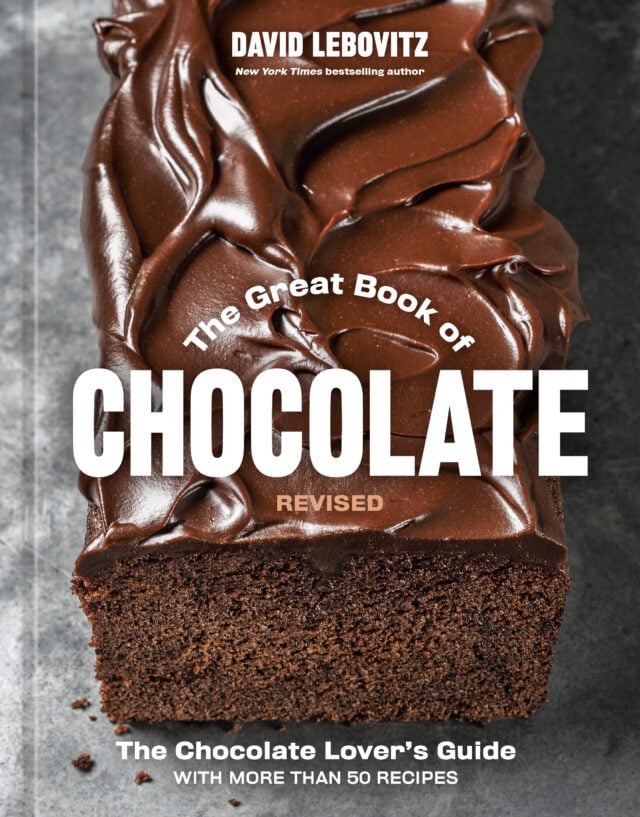
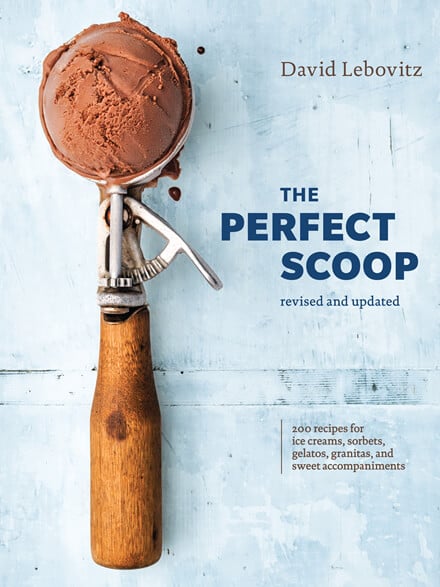
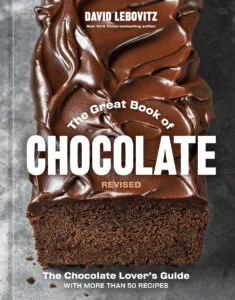
For more chocolate tips, recipes, and information, check out The Great Book of Chocolate
Related Posts and Links
Agave-Sweetened Chocolate Ice Cream (Recipe)
Chocolate-Covered Caramelized Matzoh Crunch (Recipe)
Chocolate-Covered Salted Peanut Caramel Cups(Recipe)
Ladurée makes what I consider the best macarons anywhere. And apparently so do many others: the four shops of Ladurée in Paris sell 12,000 macarons each day, over four million per year.

Many Americans raise an eyebrow when confronted with their first French macaron, since macaroons in the US are normally chewy, egg white-based cookies heaped with shredded coconut. But both the French macaron and the American macaroon are based on the crisp Italian meringue cookies made of whipped egg whites, sugar, and ground almonds or bitter apricot kernels, called amaretti. However Ladurée gives credit to Pierre Desfontaines, a distant cousin of founder Louis Ernest Ladurée, who they claim first joined two disks of crisp macarons together with buttercream and ganache fillings in mini-sandwiches to create the now-classic Ladurée
Aside from taking credit for providing Paris with their now-legendary macarons and other sweet treats, the wife of Monsieur Ladurée decided soon after the original bakery opened in 1862 that she would open a the first salon de thé in Paris, where a woman could sit unescorted and not be considered ‘loose’. (My French dictionary doesn’t have a definition for ‘loose woman’…but if you come to Paris and want to see zaftig dames offering their services, take a stroll down the rue Blondel.)
Recently, the macaron wars have been raging in Paris, as pâtissieres try to outdo each other by introducing wild and over-the-top flavors and outrageous packaging. Ladurée has of course entered the fray but with dignity and class, avoiding some of the silliness I’ve seen.
Recently Ladurée macaron flavors include jet-black reglisse (licorice), herbaceous anis vert (anise), and the au courant flavor-combination-of-the-moment in Paris, citron vert-basilic (lime-basil).
But to me, the there’s nothing better than the Ladurée classics: chocolat amer (bittersweet chocolate), dark café, and my absolute favorite, caramel-beurre-salé, a duo of almond-rich macaron cookies oozing smooth caramel…enriched with salted butter.
Ladurée
16, rue Royale
Tel: 01 42 60 21 79
Mètro: Madeleine or Concorde
Related Links and Recipes
10 Insanely Delicious Things You Shouldn’t Miss in Paris
I Love Macarons (Amazon)
Since I wrote the book on chocolate I realize that I should be blogging more about chocolate, but all the answers to many of your chocolate questions can easily be found in The Great Book of Chocolate. This book is the ultimate guidebook to the world of chocolate and a wealth of information with delicious recipes. If you’re like me and can never have enough chocolate, this is the book for you.
Want to know the difference between bittersweet and semisweet chocolate? What’s the difference between Venezuelan and Ecuadorian cocoa beans? Which country produces the best chocolate? Which chocolatiers worldwide produce the most interesting and scrumptious chocolates? All the answers, and everything else you’ve ever wanted to know about chocolate, can be found in The Great Book of Chocolate.
One of the most common misconceptions about appreciating chocolate is that you should base your opinion on the percentage of cacao in the bar. The was reinforced this week when a close friend came to visit, and brought me a tablet of the fantastic chocolate from Cacao Sampaka in Barcelona, which I profiled for Saveur magazine last year in their 100 Best issue. Like everyone that I bring into chocolate shops, he was raving because the chocolate tablet that he graciously brought me (albeit half-eaten) was 71%! (…insert his enthusiasm here.) Like lots of people, everyone seems to expound upon the theory that the higher the better. (…insert everyone’s question here… “But what about anti-oxidants?…)

I like my friend very much and he may be reading this and if he is, I want him to continue to bring me care packages from Target and Trader Joe’s on his return visits so I don’t want to make him feel cuplable (well, maybe a little.) But I feel compelled to get folks to understand that the exact percentage of cacao in the bar is truly unimportant to the taste or even the bitterness. I’ve had chocolate bars that are 99% cacao that were palatable and other bars that were 80% cacao that were bitter and inedible (and I like very bitter chocolate.) I’ve had 90% bars that were amazingly good and smooth, while others were 60% and were crumbly and mushy.
So quit throwing your nose up in the air and saying, “I only eat chocolate that’s at least 75%.” To me, the numbers are, um, interesting, but not what I look for when evaluating chocolate, since by muddy chocolate-colored logic, that argument means that the 75% chocolate is inherently better than a 70% chocolate. It’s amazing with this analytical mind that I didn’t make my mother proud and become the lawyer (or better yet, the doctor) that she always wanted in the family.
Look what I have. Two Italian chocolates from Baratti & Milano in Torino:

One is 65% and the other is 80%. Does that mean the 60% is the worse of the two and should be avoided at all costs? You’ll also notice one is made from beans from Ghana and other from beans from Grenada. Quick: which one is better?
It means little to judge a chocolate based simply on a number (or origin, but that’s information that can be found in the book.)
Why?
The percentage doesn’t take into account…
The variety of beans,
or…
The quality of the beans,
or…
The careful roasting of the beans,
or…
The blending of the beans by the chocolate-maker,
or…
The sweetness of the beans themselves,
or…
The acidity of the beans themselves.
I think part of the reason many of us Americans are hung up on high numbers (which is why we never adopted the metric system) because It sounds so much better to say, “Oh my gosh! It was 105 degrees today!” rather than, “Mon dieu, it was an unbelievable 40 degrees today!”
John Scharffenberger of ScharffenBerger chocolate says to pretend you’re Helen Keller when tasting chocolate; Don’t read the label and don’t listen to what others tell you. Taste the chocolate and judge for yourself. If you like it, it’s good chocolate!
Forget Catherine Deneuve and Carole Bouquet.
The most photographed and revered woman in Paris is Denise Acabo. With her braided pig-tails, necktie, and crisply-pleated kilt, Denise is the sweetest woman in Paris.
Her shop, A l’Etoile d’Or, has an ethereal selection of artisan confections and chocolates from France and whenever I go, I invariably find something new to try, something tasty, something that is so amazing, that I’m compelled to go back for more. What’s a guy to do?

I give myself at least one hour to shop. Minimum. Words fly out of her mouth in rapid-fire French. She’ll often use the tu word, instead of the formal vous, which suggests immediately comradery.
Don’t understand a word of French?
That’s ok, Just nod. She’ll keep going.
Continue Reading A l’Etoile d’Or: The Best Candy Shop in Paris…
Many people tell me this is one of their favorite recipes from my cookbook, Ready For Dessert. In addition to these fantastic Coconut and Chocolate Macaroons you’ll find my infamous recipe for Fresh Ginger Cake which makes a fantastic summertime dessert served simply with sliced, juicy-sweet peaches or flavorful strawberries and raspberries.

I made a batch of macaroons for a Thai banquet last night here in Paris, where a happy alliance of French and American food bloggers (and food-lovers) got together for dinner. We chopped giant bunches of vivid-green herbs like cilantro, mint, and other greens with names that we learned have no English, or French translations. Jumbo prawns from Chinatown were quickly peeled and sautéed, and tiny branches of fresh green peppercorns were quickly skillet-cooked until tender.
Succulent beef was grilled and marinated in a spicy glaze then tossed with hot chilies, fresh cilantro leaves, and cooling slices of cucumbers. Things heated up as we simmered tea-smoked duck in red coconut curry sauce which was spooned over steamed rice fragrant, with aromatic pandanus leaves. And I loved the shrimp stir-fried with vivid-green garlic shoots, which mellowed considerably once cooked quickly with the plump shrimp and Thai spices.
Coconut and Chocolate Macaroons
30 Cookies
From Ready for Dessert (Ten Speed)
- 4 large egg whites
- 1¼ cups sugar
- ¼ teaspoon salt
- 1 tablespoon honey
- 2½ cups unsweetened coconut (see note)
- ¼ cup flour
- ½ teaspoon vanilla extract
- 2 ounces bittersweet or semisweet chocolate, chopped
In a large skillet, mix together the egg whites, sugar, salt, honey, coconut and flour.
Heat over low-to-moderate heat on the stovetop, stirring constantly, scraping the bottom as you stir.
When the mixture just begins to scorch at the bottom, remove from heat and stir in the vanilla. Transfer to a bowl to cool to room temperature.
(At this point, the mixture can be chilled for up to one week, or frozen for up to two months.)
When ready to bake, line a baking sheet with parchment paper or silicone baking mat and preheat the oven to 350 degrees F.
Form the dough into 1 1/2-inch mounds with your fingers evenly spaced on the baking sheet. Bake for 18-20 minutes, until deep golden brown. Cool completely.
To dip the macaroons in chocolate, melt the chocolate in a clean, dry bowl set over a pan of simmering water (or in a microwave.) Line a baking sheet with plastic wrap. Dip the bottoms of each cookie in the chocolate and set the cookies on the baking sheet. Refrigerate 5-10 minutes, until the chocolate is set.
Note: Unsweetened coconut is available in most natural-food shops or you can purchase it online.
It goes under various names, such as coconut powder, medium shredded coconut, and coconut flakes. All will work well in this recipe.
Paris has some of the most amazing pastry and chocolate shops in the world!
I’ve written up many of them and you can browse through my archives to find out more about them: Paris Pastry Shops.
A recommended book for visitors is The Pâtisseries of Paris: A Paris Pastry Guide, which lists many favorites, along with addresses and specialties.
One of the great places for lunch in Paris is Cuisine au Bar (8, rue du Cherche-Midi), which has been touted as the French version of the sushi bar. The servers are welcoming and generous, and the tartines (open-faced sandwiches) are the most inventive and marvelous in all of Paris. A dedicated friend of mine lunches there every day.
I met Pim for lunch, and we both ordered the same thing: the chicken sandwich, a toasted slice of Poilâne levain bread (the bakery’s just next door) moistened with homemade mayonnaise, slices of plump chicken, filets of anchovies and a scattering of capers, which kept rolling off. We both systematically added flecks of coarse sea salt, then consumed. Delicious. Pim, being far more polite than I am, ate her sandwich perfectly reasonably with a knife and fork. I wolfed my down, polishing it off in record time, licking my fingers afterward.
After braving La Poste together afterward, we parted, making plans for eating Thai food with other Paris bloggers in June. However after we parted, I noticed she made a beeline to the astonishing pastry shop of Pierre Hermé on the Rue Bonaparte. So a few days later, I returned as well, and tasted one of the most stunning pastries of my life, his Arabesque macaron, which Pim had rhapsodized over earlier in the week.

Normally a classicist, I prefer my macarons with chocolate, coffee, or pistachio. But this was an amazing creation. Delicate, crackly pistachio-dusted meringue cookies flavored with apricot. The filling was a melange of apricot cream and caramelized nut praline. Each season, M. Hermé introduces new flavors of macarons, some successful (olive oil-vanilla, rose-lychee, and caramel-beurre-salé) and some less so (his white truffle and ketcup come to mind.) However Arabesque was perfection and I was sorry that I only bought one.
I will be going back tomorrow for another.
72, rue Bonaparte (6th)
184, rue de Vaugirard (15th)
4, rue Cambon (1st)-macarons & chocolates only
58, avenue Paul Doumer (16th)-macarons and chocolates only
Related Links
Pierre Hermé’s Ketchup Macaron Recipe
Recent Comments