Results tagged Marais from David Lebovitz

Breizh Cáfe: Buckwheat crêpes in Paris

When a British travel writer asked if I’d like to meet for brunch last week, he also asked if I could suggest a reasonable place for the article he was doing. So I put on my thinking cap, kicked off my slippers, tossed my funky pajamas in the laundry bin, showered and…get this…shaved!…and actually took a break from my project and got a few breaths of fresh air.

Imagine that! (This is getting to be a habit around here…)

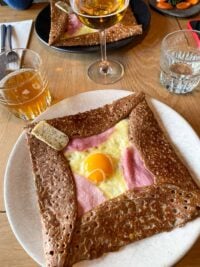
eggcrepe.jpg

Le Brunch is indeed available at some places in Paris, but je deteste being around people first thing in the morning—and I’m not so fond of Le Brunch either. So we compromised on the more civilized hour of 1pm. Not much is open in Paris on Sunday, which our President is fixing to change, so I suggested Breizh Café a tidy corner spot specializing in galettes de blé noir, commonly known as buckwheat crêpes.

There’s no shortage of strollers or hipsters hanging out in this part of the Marais on Sunday. Once you get by all the folks peering in gallery windows, cigarettes perched in the corners of their mouth and the obligatory Sunday am dark glasses, it’s a relief to find an inexpensive place to eat where the food is anything but trendy.

Breizh Cafe

Because owner Bertrand Larcher is a true Breton, the Breizh Café focuses on the quality of the products and lets them shine, rather than trying to mess with the originals: there’s no red pepper dust on the corner of the plate or twirls of squiggly sauces that have no business being there.

Continue Reading Breizh Cáfe: Buckwheat crêpes in Paris…

Marshmallows in Paris: Pain de Sucre

I’ve been trying to convince my French friends that yes…marshmallows do go atop sweet potatoes.

But only once a year. And only on Thanksgiving.

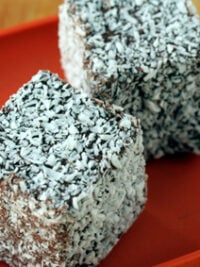
2marshmallows.jpg

Maybe more than Americans, French people do like marshmallows. A lot. You see them in many bakeries and pastry shops, often in long strands, on display either in lengths or tied into knots, in apothecary jars. It’s a tradition that goes back, before the advent of gelatin, when marshmallows were made with mallow extract which was (and still may be) considered good for your respiratory system.

Nowadays the French eat lots of marshmallows, not necessarily on sweet potatoes, but as a candy or le snack. And my local pharmacy still carries them…although I don’t think they’re covered by my health insurance.

Continue Reading Marshmallows in Paris: Pain de Sucre…

Café des Musées

Cafe des Musees

Located a few blocks north of the historic place des Vosges, steps away from the hubbub of tourists clogging the sidewalks, is Café des Musées, a terrific restaurant in Paris.

Chef François Chenel makes his own pâtés and smokes his own organic salmon, which arrives with a spoonful of crème fraîche, chives, and toasted levain bread. Both are also available to take home, including pre-cooked lobes of foie gras, even if you’re not dining here.

Café des Musées

We split an order of grouse. One of the great things about France is that in the winter, restaurants will feature game like partridge, wild pigeon, and other specialties that are hard to find elsewhere. The grouse was dark and meaty-red, just as ordered. Alongside were triangles of braised celery root, a pile of dressed watercress and quetsches, Italian prune plums, cooked until jam-like. Although as unctuous and sweet as I would have liked, a shot of port in the deglazing would’ve sealed the deal.

Other menu options are a pretty well-crusted entrecôte steak, served with real French fries, which are unfortunately rare nowadays in Paris. Cochon noir de Bigorre (which looks like a licorice pig) is always great here, a neatly-classic steak tartare, and for those looking for a vegetarian option, a cocotte of seasonal vegetables comes in a casserole, bathed in olive oil. (A friend who ordered this pronounced it “boring”, so perhaps that’s not the best choice.)

For dessert, we shared a raspberry Dacquoise; a slightly-crisp almond meringue which had a nice cake-like chew. It was served with excellent, dark cherry-red raspberries which were so sweet they were syrupy.

For those on a budget, at both lunch and dinner, on offer is a prix-fixe option. One recent fixed-price menu was vichyssoise and foie de veau, veal liver, with dessert for just 19€. Another time it was a poached egg in red wine with a lamb shank following up for the main course, with dessert being rhubarb crisp.

The service is a bit scattered, but that to me is the charm of eating in a neighborhood-type restaurant where people just go for good food but are welcome to linger. It’s the kind of place where the tables are pushed close together so you’re rubbing shoulders with your neighbors and perhaps sharing a basket of good bread. That’s one of the pleasures of dining in lesser-known Parisian restaurants and cafés.

My friends and I shared a bottle—ok, two bottles—of fruity gamay from the Touraine which went very nicely with everything from the charcuterie to the game and through the dessert. And afterward as well.

Café des Musées
49, rue de Turenne (3rd)
Tél: 01 42 72 96 17


Related Posts and Links

Eating & Drinking Guide for Paris

Two French Dining Guides

Marling Menu-Master for France

10 Insanely Delicious Things You Shouldn’t Miss in Paris

Gluten-Free Eating & Dining in Paris

Paris Favorites: Eating, Drinking and Shopping

Tips for Vegetarian Dining in Paris

Sunday Dining in Paris


Not Very Appetizing

There something about this restaurant…

VD Restaurant

…that makes me rather nervous about eating there.


Who Is Josephine Vannier?

A blog is an online diary where you can write about what you see and what you eat. It’s a marvelous thing that you can use to share your culinary experiences for everyone to read.

The flip side of having a blog is that others can, and do, read it.

A while back I wrote something about a chocolate shop in the Marais that I once walked by with a friend, a very talented chocolatier from Brussels. He looked in the window and didn’t find the presentation all that enticing. So I wrote a few words about the place here on the site, a comment he made in passing, that wasn’t necessarily glowing nor was it desultory. (Either way, I’m off the hook. He said it, not me.) But it was enough to invoke an email from someone at the company about a year later. But it wasn’t signed by Joséphine Vannier.
Maybe it was a pseudonym for Her Divine Greatness! herself.

Chocolates from Josephine Vannier

I can’t find the message, but it went along the lines of, “David: Let us assure you that our chocolates are very fine and we invite you to come and try them.”

Or something to that effect. There was definitely an emphasis on the words ‘us’ or something about coming in for a ‘meeting’ that I recall rather distinctly

Seizing the opportunity, I responded, saying I’d love to come in and get shown around, hopefully by the elusive Joséphine herself, and to be properly introduced to her chocolates with her expert help.
Alas, a response was not forthcoming: I never heard back.

Continue Reading Who Is Josephine Vannier?…

Free Falafel!

There’s a little bit of a war going on here in Paris on the rue des Rosiers, in the Marais. The Rue Des Rosiers is the Jewish street, sporting several good (and a few bad) bakeries, a few chic clothing stores, but a string of fafafel stands and restaurants. The most famous, L’As du Falafel, is always crowded, and teeming with locals, who come for their Heeb-Hop (Hebrew-Hop, as we call it), and tourists, who’ve read about L’As du Falafel in their guidebooks.

I always feel sorry for the other places on the street. There’s often deserted, while the throngs of people line up at L’As in search of their falafel-fix. The only time they seem to generate any interest is when L’As du Falafel closes for the Sabbath, on Friday nights and Saturdays. But a few weeks ago I started noticing handwritten signs on the place across the street, Mi-Va-Mi, with slogans like “Taste and Compare”, daring to take on the Ace o’ Falafel, just across the street.

Today as I stop by to get my weekly falafel, making a beeline for L’As, I notice a swarm of missionaries agressively confronting passers-by with plates brimming with warm falafel, followed closely by someone with a guest-check book, pen-to-the-paper, ready to take their order. The scene was curious, since the French haven’t quite grasped the concept of ‘Free Samples’ (or competition). When I asked a French friend why anyone rarely offers samples, I was told “Because it’s not ‘correct’. But there’s a guy at the fromagerie on the Î’le St-Louis who’s making a killing offering samples to passers-by, mostly tourists, who get one taste of great French cheese, and invariably come in and make a purchase.

Correct or not, that dude is rakin’ it in.

So although there’s no such thing as a free lunch, especially in Paris, there’s lots of free falafels to be had this week as the street is abuzz with people bearing heaping bowls of freshly-fried falafels. I don’t know how long it will last, and the offer doesn’t extend to those who’ve already purchased. (I tried to get one of the falafel-pushers to augment my half-eaten sandwich, but being très Paris, there’s little interest in the customer after the sale.)

And in an unlikely show of unity, as I was finishing up, I saw one of the fellows from L’As du Falafel pop one of his crisp falafels in the mouth of his main competitor, a woman who was offering falafels from Mi-Va-Mi. She stopped, took a taste, and nodded in agreement before going back to offering her falafels to all takers.

So perhaps there’s something to be said for the absence of competition.

(Although I appreciate the presence of free samples.)

L’As du Falafel
34, rue des Rosiers
Tél: 01 48 87 63 60

Mi-Va-Mi
27, rue des Ecouffes
Tél: 01 42 71 53 72

Absinthe Cake Recipe

When I told Luc-Santiago from Vert d’Absinthe here in Paris that I didn’t like anise very much (or, stupid me, how long have I lived in Paris? I should have said, “I don’t appreciate anise very much.”), I wished I had my camera cocked-and-ready, as the look on his face was priceless. While I appreciate the culture and mystique of Absinthe and its cousin pastis, I’m not a fan of anise-based drinks.

cake3.jpg

But luckily I am a fan of anise-baked anything, and do like that flavor when baked in cakes and cookies, such as biscotti and the like. I had a suspicion that a buttery cake with a healthy shot of Absinthe in the batter, then more Absinthe added as a crunchy glaze would be a success…and it was! Happily, the flavor of anise goes amazingly well with chocolate too, so feel free to pair this with a favorite Chocolate Ice Cream or a dark, slick chocolate sauce.

But it’s also lovely with a compote made of fresh or dried apricots, or a Nectarine and Cherry Compote. During the winter, I plan to make a colorful fruit salad of navel and blood oranges with a few rounds of tangy kumquats to serve alongside, since I’m suspicious of that green bottle on my shelf, with an alcohol content of 72%, may fall and explode. (Now that would have made a good opening for an episode of Six Feet Under.) But mostly I enjoy serving this Absinthe Cake all on its own and if you make it, I’m sure it won’t fail to get your guests full attention no matter how you serve it.

If you don’t have a convenient source for finely-ground pistachio meal, you can use almond meal (sometimes called almond flour). I’ve tested this cake with stone-ground cornmeal too, which provided a nice crunch, but Parisian friends found it a tad unusual since they’re not really used to desserts, or anything else, with cornmeal.

And I didn’t have any candied angelica on hand (like, who does?), but next time I make this cake, I’m definitely going to add a handful of finely-chopped angelica to the batter. I think tiny flecks of green flitting around in this cake would be rather festive and certainly in the spirit of le fée verte, aka; The Green Fairy, oui?

If you live in a country where you don’t have the freedom to get Absinthe, move. Aside from that, write a letter to your highest-ranking elected official whose job it is to protect the good of society from such ills, you can substitute an anise-scented apertif, such as Pernod, pastis, or ouzo, although they don’t have that sublime, sneaky herbaceous flavor and aroma found in true Absinthe. The other downside is that you won’t see any green fairies floating around your kitchen…which may, or may not, be a good thing…depending on which highest-ranking elected official you last voted for, I suppose.

Oops, and before I step down down from my high-horse, I do recommend that you use Rumford baking powder, or a similar brand, that doesn’t contain any aluminum. Most natural-food stores and Trader Joe’s carry aluminum-free baking powder and you’ll notice a major difference in your baking once you go aluminum-free. You’ll never miss that tinny aftertaste you get when using other brands.

glazedabsinthecake.jpg
Don’t be put off by the sugary-looking glaze. As the cake cools, the glazes melds beautifully with the cake, which won raves from all who tried it.

Absinthe Cake

One 9-inch rectangular cake

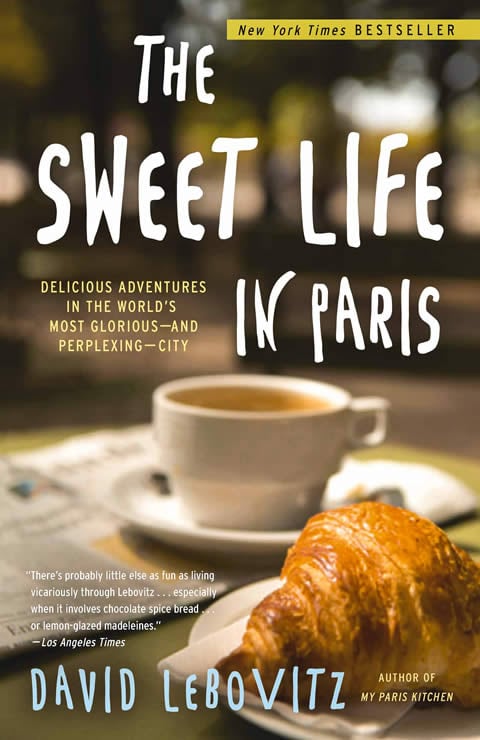
From The Sweet Life in Paris (Broadway Books)

For the cake:

  • 1 1/4 teaspoon anise seeds
  • 1 1/4 cup (175g) cake flour
  • 1/2 cup plus 2 tablespoons (65 gr) pistachio or almond meal or (1/2 cup (70g) stoneground yellow cornmeal)
  • 2 teaspoons baking powder (preferably Rumford)
  • 1/4 teaspoon salt
  • 8 tablespoons (105 g) unsalted butter, at room temperature
  • 1 cup (200g) granulated sugar
  • 2 large eggs, at room temperature
  • 1/4 cup (60 ml) whole milk
  • 1/4 cup (60 ml) Absinthe
  • 1 orange, preferably unsprayed

For the Absinthe glaze:

1/4 cup (25 g) granulated sugar
1/4 cup (60 ml) Absinthe

1. Preheat the oven to 350 degrees (175 C). Butter a 9-inch loaf pan, then line the bottom with parchment paper.

2. In a mortar and pestle or spice mill, grind the anise seeds until relatively fine. Whisk together the cake flour, cornmeal, baking powder, salt, and anise seeds. Set aside.

3. In the bowl of a standing electric mixer, or by hand, beat the butter and sugar until light and fluffy. Add the eggs one at a time, until they’re completely incorporated.

4. Mix together the milk and Absinthe with a few swipes of grated orange zest.

5. Stir half of the dry ingredients into the beaten butter, then the milk and Absinthe mixture.

6. By hand, stir in the other half of the dry ingredients until just smooth (do not overmix). Smooth the batter into the prepared loaf pan and bake for about 40 minutes, or until a toothpick inserted into the center comes out clean.

7. Remove the cake from the oven and let cool 30 minutes.

8. To glaze the cake with Absinthe, use a toothpick and poke 50 holes in the cake. In a small bowl, gently stir together the 1/4 cup (25 g) sugar, and 1/4 cup (60 ml) of Absinthe until just mixed. (You can add a bit of orange zest here if you’d like too.)
Be sure not to let the sugar dissolve too much!

9. Remove the cake from the loaf pan, peel off the parchment paper, and set the cake on a cooling rack over a baking sheet.

10. Spoon some of the Absinthe glaze over the top and sides of the cake, allowing it to soak the top and spill down the sides a bit. Continue until all the glaze is used up.

(Note: The photo at the top was this cake, but baked in an individual-sized cake mold.)


Related Links

Absinthe Ice Cream

The Sweet Life in Paris

Vert d’Absinthe: Absinthe in Paris

Paris is always full of little surprises, like any major city. It’s always fun to poke around and find something new and unusual. And there’s plenty of the unusual in a big city like Paris, as I often report. I think of Paris as a big village, full of colorful characters with lots of stories to tell and unusual offerings. And getting the know the people in your neighborhood, especially the vendors selling fine foods and drink, can be especially rewarding since often if you stay for a while and talk to them, there’s always something fascinating to learn.And, of course, taste!

absintheglass2.jpg
Getting ready to prepare a glass of absinthe, French-style, of course.

I’ve been meaning to take you to visit one on my favorite shops in Paris for quite a while: Vert d’Absinthe. This little shop is located in the Marais, but a bit removed from the busy tourist streets, just off the Place St. Catherine. Owner Luc-Santiago Rodriguez tells me his shop was the first boutique anywhere dedicated just for the purpose of selling absinthe, that wickedly suspicious elixir that’s recently been getting a lot of attention lately.

mrabsinthe.jpg
Luc-Santiago Rodriguez of Vert d’Absinthe in Paris.

Although the drink was originally produced as a cure-all medical tonic in 1792, Absinthe became a rather popular drink amongst Parisians in the late 1800′s, mainly with hedonists living in Montmarte who would sip it in cafés and clubs, like Le Moulin Rouge, before it was ultimately banned by the French government in 1915.

absinthedishes.jpg
Dishes with numbers were to let patrons know how much their glass of absinthe cost. Think of all the paper they saved!

Although experts are as unclear as a cloudy glass of absinthe on exactly why it was banned, the most colorful theory was that people went mad drinking absinthe due to the rotten wormwood used to make the drink. It was dubbed le f&eacute’e verte or ‘the green fairy’, since it was said to inspire hallucinations as well.

(Absinthe was banned in the US in 1912, and so far, it’s still technically illegal to import into the US.)

But nowadays, most people, including Luc-Santiago, agree that the powerful French wine industry at the time was upset that people, especially the artsy bohemians who lived in the north of Paris, were drinking cheap, hi-test absinthe (at 70% alcohol) instead of pricey wine (around 12% alcohol), in an attempt to get a better buzz for their buck. Since the French wine industry had suffered a severe set-back from the phylloxera infestation which killed most of the grapevines in France, the price of wine had gone up enormously. So it’s thought that the wine industry pressured the French government to put the kabosh on absinthe production.
And that was that.

absinthevarieties.jpg
It’s my one-stop shop for all things absinthe!

In 1988 absinthe made a comeback and the French government once again made it legal to sell and drink the anise-scented exilir, absinthe attaining a bit of a cult status in the process. With all the ceremony of pouring something previously forbidden in a fancy glass, pouring water over a sugar cube to make it cloudy (called louching), then slowly sipping it while staring into space in a deserted café…how could anyone not be entranced by the romance of absinthe?

If you come to France and want to try or purchase absinthe, be aware that not all drinks that look and sound like absinthe are indeed absinthe. You’ll come across ‘absente’ (missing the ‘h’), which has a bleary picture of Van Gogh on the packaging (it was said he went mad drinking absinthe and cut off his ear because of it, which to me is a rather iffy marketing move), but these impostors use a wormwood that’s different than the variety of wormwood (artemisia absinthium) used in true absinthe.

absintheherbs.jpg
The true herbs of absinthe.

The wormwood used to make true absinthe contains thujone, the most important compound in real absinthe.

Anyone interested in absinthe should make the trip to visit Luc-Santiago’s little shop Vert d’Absinthe, where 25 different kinds of absinthe are stocked. All are French except for one, which is made in Switzerland, and most of the French absinthe varieties are made near the Swiss border. Monsieur Rodriguez stocks all the proper paraphernalia for properly preparing and drinking a glass of absinthe, from vintage to contemporary; spoons, glasses, fontaines, and, of course, the bottles themselves.

And perhaps you’ll get a demonstration and a taste-test. Although drinking absinthe French-style means louching the drink by pouring water over a sugar cube through the special spoon before it clouds up the absinthe, the more flamboyant Czech-style method involves lighting the cube of sugar dramatically on fire, which I’ve yet to see him do.

Vert d’Absinthe
11 rue d’Ormesson
Paris
Tél: 01 42 71 69 73
Open daily, from 11am to 8pm (closed Monday)


Related Links

Absinthe Cake Recipe

Chubby Hubby: The Green Fairy

In Absinthia

The Wormwood Society

La Fée Verte


A few unusual places for absinthe in, or near, Paris:

-Hotel Royal Fromentin (11 rue Fromentin, Paris, tel. 01 42 81 02 33) serves absinthe at their historic bar, a former cabaret at the foot of Montmartre.

-Musée de l’Absinthe (44 rue Alphonse Calle, 95430 Auvers-sur-Oise, tel. 01 30 36 83 26, about fifteen minutes outside Paris) is open on the weekends and holidays and sports all sorts of memorabilia and paraphernalia from absinthe’s heyday. Take the train from the Gare du Nord.

-Cantada is a heavy metal bar, and one of the few bars in Paris to serve a wide selection of absinthe.

-La Fée Verte (108, rue de la Roquette), is a neighborhood café with absinthe on offer.