November 2011 archives

Lamingtons

Lamingtons

When I was in Australia, a couple of interesting things happened while I scooting around Sydney. One was that I went on the hunt for Lamingtons, and a number of people offered to send me recipes, but didn’t. And two, I got quite a few messages from people asking if I was coming to Melbourne. Then a food festival there rolled around and even though I woke up at all hours, checking my messages night and day, an invite to that city never landed in my Inbox.

Lamingtons

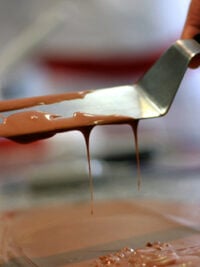
But instead of being tough and bitter, I decided to dive into something tender and sweet, and was compelled to whip up my own recipe for Lamingtons. (And it’s hard to remain mad at anyone in Australia because, truly, everyone was exceptionally nice to me during my visit to Sydney.) I did call upon one of those nice folks, the master of the Lamington, Matt Rothman, when deciding whether to go with a cocoa powder icing or one made with chocolate. And he responded that he makes either, depending on whether he wanted the glaze to soak in to the cake a little (cocoa powder) or for it to be more of a thicker icing (chocolate).

Continue Reading Lamingtons…

Merguez Corn Dogs

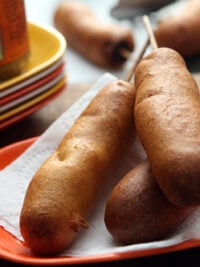
Corn dogs

When I moved to Paris, one of the kind people who took me under their wing (as in, the kind that takes you out to Ikea), said to me – “You’re not a real Parisian until you’ve had a merguez sandwich stuffed with frites inside, at 3am.”

Continue Reading Merguez Corn Dogs…

My Favorite Kitchen Tip, Ever

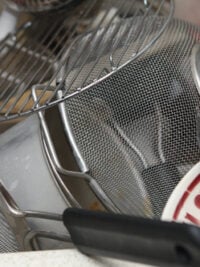
dirty dishes

This isn’t the most photogenic of posts, but one of the dirty secrets of writing cookbooks is the dishes. And this season, as the cavalcade of cooking tips comes tumbling forth in anticipation of all the holidays – and the cooking and baking that go along with them – this is the best tip I’ve ever been given.

Most of you probably know how many dishes to takes just to bake a simple cake: a stack bowls, a mixer and the whip, a gaggle of spatulas, and for my fellow Americans, a bunch of measuring cups and spoons. Now imagine if you made that same cake three times in a row, making a few other sets of dishes dirty. Then did it again.

In spite of that fact that I have a real dishwasher, I spend a few hours each and every day washing dishes. It’s funny because when friends call and ask me if I’m free for dinner, sometimes I have to decline because I have to work, and they don’t seem to understand that part of my “work” is washing and/or putting away dishes and pots and pans. It’s a cycle that’s part of my life and when I left the restaurant business, being able to hand off a bustub full of dirty dishes to someone else was something I missed a lot. (If you ask anyone who is the most important person in a restaurant kitchen, even more than the chef, it’s the dishwasher.)

Continue Reading My Favorite Kitchen Tip, Ever…

What is half-and-half?

half-and-half

Readers who are unfamiliar with the product, when they find it listed as an ingredient in a recipe, often ask: What is half-and-half?

Half-and-half is a product that is composed of one-half cream and one-half whole milk. In the United States, the fat percentages of those products are 30 to 36%, and 3.25%, respectively. Store-bought half-and-half can be anywhere in the range of 10.5% to 18% butterfat. (Fat-free and lowfat half-and-half items are available, but I don’t use them.) Half-and-half was likely conceived as something to be added to coffee, and was meant to be an item of convenience. It’s a common item in grocery stores in the United States, sold in pints and quarts alongside the milk, cream, and other fresh dairy products.

I use half-and-half in recipes where I want some richness, but not the same richness if full-fat cream was used. In some instances, I’ll offer an option to use either cream or half-and-half, to satisfy those looking for richness versus those looking to be a little more prudent. Like most recipes, always use what is indicated in the list of ingredients.

You can make half-and-half by mixing both whole milk and whipping cream or heavy cream, in equal proportions.


Related Posts and Links

Recipes to Use Up Leftover Egg Whites

Definitions of Fluid Milk & Milk Products (IDFA)

Ingredients for American Baking in Paris

Baking Ingredients and Substitutions

French Sugars

Non-Dairy Milks and Creams (The Cook’s Thesaurus)

Tips on How to Make Ice Cream

Chocolate FAQs

Cocoa Powder FAQs

Mustard Glasses

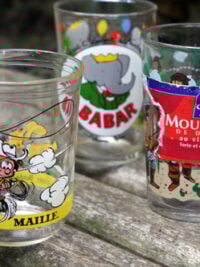
mustard glasses

It’s been a while since I’ve visited the jelly aisle of an American supermarket. But one thing I have etched in my memory from my childhood are the glasses with cartoon characters on them. Whatever marketing genius came up with the idea deserves more recognition than I can give here, but as a kid, we had to finish all our milk and “see Fred Flintstone” (whose visage was embossed in the bottom), before we could get on to dessert. And imagine where my career would be right now if I didn’t comply?

As long as I can remember, drinking glasses were a give-away item in the states, from being packed in cardboard boxes with powdered laundry detergent to give-aways at the local gas station. And that tradition has crossed the Atlantic when a few years back 6-packs of blue-banded Orangina glasses were offered as a token with a fill-up on l’autoroute.

Continue Reading Mustard Glasses…

Moist Chocolate-Beet Cake

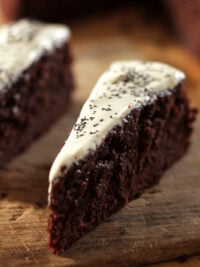
chocolate-beet cake

It’s interesting reading some of the talk regarding if the internet is ready to replace cookbooks. Sure, there are people furiously clicking around wherever they can for a chocolate cake recipe. And there are hundreds of thousands of chocolate cake recipes that you can find using a search engine. But to me, that’s not enough. When I want to spend my precious time and funds making something to eat, I don’t want to merely find a recipe. There’s nothing compelling about a downloadable list of ingredients. It just leaves me cold. I want the author or writer to tell me about the recipe, what inspired them to create it, or how it came about.

beets

I want to know why someone chose that recipe, what twists they gave it, what made the cake or casserole they were making so special to them that they wanted to share it. Was it an unusual ingredient? Did they like the description they read of it elsewhere? Were they inquisitive about how a root vegetable from their garden could make its way into a chocolate cake?

Continue Reading Moist Chocolate-Beet Cake…

How to tell if baking powder is still good

baking powder test

Baking powder does not last forever. Because it’s sensitive to moisture and humidity, it generally has a shelf life of between six months to one year. Baking powder should be kept in a cool, dry place, such as inside a cabinet, and should be discarded when it is no longer active. (Its cousin, baking soda*, has an indefinite shelf life, although some manufacturers recommend changing it every three years.)

baking powder

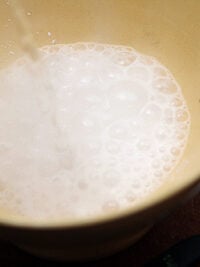
To test if baking powder is still active, spoon 1/2 teaspoon in a bowl and pour 1/4 cup (60 ml) of boiling water over it. Right away it should bubble up violently. If it does, it’s still good. If it doesn’t, discard it and open a new tin.

Continue Reading How to tell if baking powder is still good…

O Chateau Wine Bar and Tastings in Paris

Ô-Chateau Wine Bar in Paris

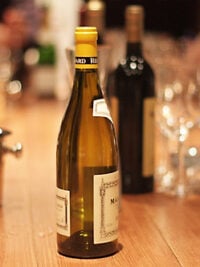
Sometimes I go back into the archives and pull up a post to refresh it. Perhaps the hours have changed, they’ve moved, or something else prompted me to tweak the entry. But a lot has happened since I first wrote about Ô Chateau wine tasting programs. First off, since I wrote about them, they’ve moved – twice.

Ô-Chateau Wine Bar in Paris Ô-Chateau Wine Bar in Paris

Continue Reading O Chateau Wine Bar and Tastings in Paris…