David Lebovitz
circle  Home My Books Bio Chocolate Tours My Paris Schedule Recipes Links
corner Circle     corner
 
Search My Blog:


The Perfect Scoop


Tours
Click Here For Exciting Information About Upcoming Chocolate and Culinary Tours


Visit the Travel Blogs Ad Network and the Food Blog Ad Network to advertise here.


Categories...


Add me to your RSS:


Room For Dessert


Read My FAQs


Ripe For Dessert


Visit David's Flickr Page
www.flickr.com
This is a Flickr badge showing public photos from daveleb. Make your own badge here.


Archives
June 2008
May 2008
April 2008
March 2008
February 2008
January 2008
December 2007
November 2007
October 2007
September 2007
August 2007
July 2007
June 2007
May 2007
April 2007
March 2007
February 2007
January 2007
December 2006
November 2006
October 2006
September 2006
August 2006
July 2006
June 2006
May 2006
April 2006
March 2006
February 2006
January 2006
December 2005
November 2005
October 2005
September 2005
August 2005
July 2005
June 2005
May 2005
April 2005


Best Chef's Food Blog 2006
"Best Chef's Food Blog 2006"


The Independent
"The best food blog in the world"


The Wall Street Journal
"Blog Watch 2006"


About
"Top Ten Food Blogs" by About.com


WellFed.com Best City Food Blog
"Best City Food Blog 2005"


David Lebovitz Archives: Candy & Sweets

Patric Chocolate
line

May 4, 2008 | Comments (23)

New chocolate-makers are springing up across America, in the most unlikeliest of places. Like Missouri.

Who'd a thunk it?


Patric Chocolate


Using good 'ol American ingenuity, a little over a year ago, Alan McClure started grinding up beans and molding them into lithe bars of very dark, and very sleek, bittersweet chocolate.

His company, Patric chocolate, makes bars that are "micro-produced," and he's got two in his line-up, both using cacao from Madagascar.

When I asked Alan what attracted him to the cacao from that region, he said "Since the bars are made from cacao that come from one single estate, and since the family there has owned it for quite some time, they really have been able to exert an extremely high level of control on the quality and consistency of the fermentation and drying, which is actually quite rare in the cacao world."

Alan proclaims that this isn't pure "criollo" chocolate, a much-touted term for a varietal that almost all chocolate experts say no longer exists in its pure form. (Some chocolate-makers are claiming to the contrary.) Right now, the all the beans for Patric's bars are from a plantation in the Sambirano Valley.

Continue reading "Patric Chocolate" »

Permalink


Taza Chocolate
line

March 23, 2008 | Comments (31)

tazahotchocolate2


I've been a little lax in my duties around here reporting on chocolate. In my defense, I've been sidetracked by bacon, seaweed, and kimchi. But man cannot live by chocolate alone.

Even in Paris.

Speaking of chocolate, when I was doing research for my chocolate book, it was challenging to find people to talk about what they do. I met with one representative from a big chocolate company who said he would only talk to me, and let me visit, if I only wrote about their company in the book. (Uh...sure!)

When I was writing my ice cream book, I called a gelato chain here in Paris, asking if I could come in and see how they make their ice cream to include them in the book. After much hemming and hawing, I never heard back.

It's always after the book comes out, you become a popular fellow. I seem to be always behind the curve on these things.

Continue reading "Taza Chocolate" »

Permalink


REGIS Chocolatier
line

February 27, 2007 | Comments (12)

Living in a foreign country, as an outsider, you tend to notice lots of contradictions. If you try to learn the native language, like I am, you'll notice there's all sorts of curiosities specifically designed to trip your up. When people ask me what I do all day, they don't realize that just to do something as basic as write a check, I often have to pull out the dictionary. (Although I've seen French people consult theirs almost as frequently.)

But English ain't no walk in le parc either...we've got where, we're, wear, ware...that all sound exactly the same but mean pretty different things.


carameling-nuts.jpg

Caramelizing Nuts for Praline at REGIS


One of the things you learn when speaking a new language is that there are lots of rules...and seemingly just as many exceptions. Sometimes they're things not taught in classes but you just need to learn by osmosis.

For example, Paris is generally pronounced Par-EE, without saying the final 'S'.

But if you say the name Régis, you say Rey-GeeSS you certainly do pronounce the final 'S'.

Similarly, if you mention the 16th arrondissement, most Parisians who don't live there (or is that 'their'?) will sneer and say, "Oh, they are all snobs over there" or "I don't like those people there, they're not very nice."

So imagine me being pleasantly surprised when I went to visit REGIS chocolatier in the heart of enemy territory.

Continue reading "REGIS Chocolatier" »

Permalink


Chocolatier Le Furet Tanrade
line

January 21, 2007 | Comments (10)

One of my favorite things to do in Paris is just wander around, often in neighborhoods that aren't really known for anything special. There's always something interesting to find; shops specializing in vintage hairbrushes and combs, a locksmith for doors installed only during the reign of Napolean III, or the recently-departed Reptiles World (sic), which was one of my favorite places to pass the time while waiting for a train at the nearby Gare du Nord.

And of course, I'm usually on the lookout for food, and am especially keen when I come across a shop specializing in candymaking or chocolate. If I get lucky, I discover some little treasure, often in the most unlikeliest of places.


chocolates1.jpg


Le Furet Tanrade was opened in 1728, and it's still one of the sweetest little chocolate shops I've found in Paris.

Sure, their chocolates aren't nearly as sleek or refined as their Left Bank counterparts, but I appreciated their handmade charm all the same. Especially the petits dark squares filled with a crisp morsel of mint fondant cloaked in brusque, dark chocolate. And the chocolates filled with caramel and feuilleté were certainly as delicious as those found in swankier boutiques.

One chocolate that picqued my curiosity was flavored with chanvre, a word I wasn't familiar with. Although I've been previously familiar with the green leaf embedded atop the chocolate in my younger days, she offered a sample since she was having difficulty explaining exactly what was inside. (The French word for what I thought it was is a four-letter word in English...madame might not have appreciated my translation.)

But then, in that little shop, I learned my Word-For-The-Day: the ganache was infused with hemp.

(For the record, I'd advise against overseas shipping.)

But should you find yourself near the Gare du Nord or Gare d'Est, and need to pass a bit of time (or want try to get a bit of a buzz)...or if you just want to take a journey to a less-visited quartier of Paris, Le Furet Tanrade certainly makes a tasty stopping point.


Le Furet Tanrade
63, rue de Chabrol (10th)
Tél: 01 47 70 48 34
Métro: Poissonière


Permalink


John-Charles Rochoux, Parisian Chocolatier
line

January 8, 2007 | Comments (19)

One of the hardest things about writing about food is coming up with that killer opening sentence. It should start with something that grabs your attention right away, tickles your curiosity, then encourages the reader (which would be you) to follow the writer (which, or course, would be me) deeper into the story. Thankfully when writing about chocolate, I can include pictures to help me get going, so most of the work is already done.


chocolatebunny.jpg

A Handcarved Rabbit Made of Pure White chocolate.


The other difficult thing when writing about chocolate is that there's only so many superlatives you can use to describe it, and words like: dark, unctuous, bittersweet, delicious, seductive, etc...don't really seem to pinpoint that feeling that you get when you walk into a pristine chocolate shop and are completely overwhelmed by the heady experience, inhaling that sweet, unmistakable scent of chocolate that permeates the air and overtakes you. There's that quiet moment, when you step into a special place full of chocolate, where you briefly forget all that's going on outside.


orangettes.jpg

Slender Orangettes; strips of candied orange peel flecked with crunchy nougat, dipped in dark chocolate.


I'm fortunate to live a city where there's an unusually large amount of very good chocolate shops, and all-too-often one needs a refuge from the fast-pace of the streets and sprawling avenues. Here in Paris, I have my favorites, and one of them is John-Charles Rochoux. His petit shop is located just off the bustling rue de Rennes. It's not just a refuge from one of Paris' busy boulevards, but a step back to another era. In his shop, chocolate is both an edible obsession and an object of sculptural craftmanship, and you'll find many intricate, precious little chocolate sculptures, as well as a rather serious selection of bonbons from one of Paris' top chocolatiers.


mrochouxalligator.jpg

Paris Chocolatier Jean-Charles Rochoux


Although there's several chocolate shops across the city that are terrific, at Jean-Charles Rochoux you'll find lots of little wonders here to keep you enchanted, including the amazing chocolate sculptures that M. Rochoux creates in his small, pristine workshop just beneath the tidy boutique. This kind of craftsmanship is rarely found anymore, even in a chocolate-obsessed city like Paris.

I was fortunate enough to take some time from my busy schedule to pose for Monsieur Rochoux, so he could create one of the most iconic pieces in the shop: Le torse.

Continue reading "John-Charles Rochoux, Parisian Chocolatier" »

Permalink


A Date For International Understanding
line

December 6, 2006 | Comments (11)

Although most of the comments and messages I get are friendly and kind, a few do slip through that are less-than-complimentary. A majority of them illuminate the errors of my ways by pointing out the faults in my cross-cultural observations. So I was delighted when I found Socio-Site Scan v1.01, some brand-new software which allows me to simply input all my blog entries, and tells me what percentage of my posts are which are complimentary to one culture, and what percentage isn't.

So what did I find?

Roughly 67.8% are complimentary to the French, while only 65.3% of what I write was pro-American.
But a whopping 47% were anti-French, followed closely by 45.2% of swipes at my compatriots in the states.


dates.jpg


Since this is the beginning of the holiday season, one full of global good cheer (real or imagined), I decided that since our politicians have been messing it up a bit too long, at least 6 years too long (oops...gonna have to give the site a second run-through), I decided that today I'm calling a holiday truce.

Since there's no time like the present, I'm happy to start right now promoting international understanding by sharing these divinely delicious dates from Iran, which are perhaps the best dates I've ever had. (Insert your own joke here.) They certainly rival the Medjool dates from California, which are excellent as well, although they're far pricier. Hmm, perhaps I might suggest America trade dates for oil? It certainly would be a tasty trade-off that might make everyone a little less combative.

Continue reading "A Date For International Understanding" »

Permalink


Pierre Marcolini's Chocolate-Covered Marshmallows
line

September 30, 2006 | Comments (16)

The hardest of all foods to photograph, I've learned, are chocolate-covered marshmallows.


marshmallowsmarcolini.jpg


The bright, fluffy, vanilla-flecked cubes of sweet, airy marshmallow in contrast to the thin, intensely-flavored coating of bittersweet chocolate certainly presents a challenge.

I futzed around a bit, trying to figure out how to show the lofty-white cubes in juxtaposition to the coating of pure, dark chocolate. They're such diverse colors and textures that I tried several variations and lighting situations, until I decided that they'd looked best with a piece broked off.

So I took a bite out of one.

Then I took another bite.

And then, I stopped shooting...

...and ate the whole pack.

Sorry.


Pierre Marcolini
89 Rue de Seine
Paris
Tél: 01 44 07 39 07


Permalink


My Hero, Henri Le Roux
line

September 12, 2006 | Comments (26)

While I know that many of you reading this blog are desperately searching for information on Tucker Carlson, so call me a lousy blogger as I beg your indulgence while I introduce you to someone who I consider if far more interesting and important (and judging from the comments, better-liked): Henri Le Roux.

If you don't know who Henri Le Roux is, it's time that you did.


cbstartiner.jpg

Le Caramelier; Salted-Butter Caramel Spread


There's a lot of very talented chocolatiers and pastry chefs in France. Some are quite famous, and some just go to work everyday and do their jobs well. A few have rather large egos, others are more humble, preferring the lights of the kitchen to the ones in the television studio. (I was at a recent event with another food blogger who correctly noted that all the famous chefs mostly talk about is one thing: Themselves.) But if you mention the name 'Henri Le Roux' to any chocolatier or confiseur in France, they stand silent for a moment. Then nod agreeably. He is perhaps the most respected and admired pastry chef and candymaker I know.


cbscaramels.jpg

The famous C.B.S. caramels in assorted flavors, including lime, black tea, orange-ginger and, of course, chocolate


I first met Monsieur Le Roux when I went to the Salon du Chocolat in Paris with my Thierry Lallet, who has an excellent (and highly-recommended) chocolate shop in Bordeaux, Saunion, one of the best in France.


cutcaramels1.jpg

Freshly-made C.B.S. caramels studded with hazelnuts, almonds, and walnuts


Before that day, I thought that caramels were caramels, and until that point, I'd tasted so many things in my life that there was little left that would deeply impress me. M. Le Roux is a very kind man, who basically changed the way pastry chefs, glaciers, and bakers everywhere think about caramel: he created caramel-buerre-salé (caramel-salt-butter), which he simply calls C.B.S.
And they are truly divine.


caramelmachine.jpg

The 55-year old candywrapping machine barely keeps up with the demand for M. Le Roux's caramels


Henri Le Roux, whose Breton father was a pastry chef (and lived in New York for 5 years, cooking at the Waldorf-Astoria Hotel) started making caramels in the seaside town of Quiberon in 1976, located at the tip of a dramatic peninsula in the south of Brittany, where the best butter in the world is found (the first chapter in his book, is called "Le Rideau de Beurre", or "The Curtain of Butter". He decided to open there, selling cakes, candies, and ice creams. But like warm, buttery caramel, word of his candies spread and he stopped making cakes and tartes to concentrate all his energy on candymaking. Just 3 years later, in 1908, M. Le Roux won the award for the best candy in France, Le Meilleur Bonbon de France at the Salon International de la Confiserie in Paris.


florentines.jpg

Salted-Caramel Buckwheat Florentines just-slathered in bittersweet chocolate


M. Le Roux was kind enough to let me explore his workshop with him when I paid a visit during my August vacation in Brittany. As he raced from room to room, he flipped open bins of almonds from Provence or hazelnuts from Turkey to give me a sample, later showing me how he grinds his own fresh nut pastes in his broyeuse with massive granite rollers which keep cool, while metal rollers would heat the nuts too much, losing some of the flavor. And a rarity in the pastry field nowadays, M. Le Roux uses true bitter almonds in his almond paste, which he sources from the Mediterranean. Almond extract is made from bitter almonds, even in America, but they're hardly used anymore since they're difficult to find (and those pesky toxicity issues.) But in the land sans lawsuits, M. Le Roux makes that effort and blends a few into his freshly-pressed almond paste which tastes like none other I've tasted in France.


boxoflerouxchocolate.jpg

Exceptional chocolates from Henri Le Roux, which were too good not to eat right away


I like to ask chocolatiers which chocolate they use.
Most are secretive, but M. Le Roux led me into a cool room packed floor to ceiling with boxes of various chocolates he gets from all over France and Belgium. He tore into them, breaking off chunks for me to taste and explaining how he uses some of each, blending them as he wishes to get the desired tastes he's after. Valrhona and
Barry-Callebaut are used, but he also sources chocolate from François Pralus, an artisan chocolate-maker located in Roanne, just outside of Lyon, who specializes in single-origin chocolates, as well.


mrandmrsleroux.jpg

Henri and Lorraine Le Roux in their boutique, in Quiberon


I wanted to describe each and every chocolate in the box, but decided that that would constitute cruel and unusual punishment. (Actually, I ate them all and didn't feel like writing down what tasted as I was eating as I went. As mentioned, I'm a lousy blogger.) But I remember Harem, a filling of green tea and fresh mint, Sarrasine, infused with blé noir (buckwheat), and Yannick, blended dark cane sugar, salted butter and ground crêpes dentelle, hyper-thin, crackly lace cookies ground to a crunchy paste.

Oh yes, there's C.B.S. too, nutty salted-butter caramel enrobed in dark chocolate as well, which was my favorite.


cbsbook.jpg

Le Roux
18, rue de Pont Maria
56170 Quiberon, France

(Will ship internationally.)


Henri Le Roux's caramels and chocolates are available in Paris at:

A l'Etoile d'Or
30, rue Fontaine
Tél: 01 48 74 59 55
M: Blanche

M. Le Roux will also be at the Salon du Chocolat in Paris which takes place October 28-November 1st, 2006.

Permalink


A Visit to Parisian Chocolatier Jean-Charles Rochoux
line

July 7, 2006 | Comments (14)

This was an easy post!

If you'd like to know what it's like to visit Jean-Charles Rochoux with me, one of my favorite chocolatiers in Paris, go visit Too Many Chefs for Meg's write-up of our visit.


(Note to Meg and Taina: Could you have found a worse picture of me?
...Oh la vâche!*
)


Jean-Charles Rochoux
16 rue d'Assas
Paris
Tél: 01 42 84 29 45


* Holy Cow!

Permalink


Belt-Tightening
line

June 21, 2006 | Comments (20)

Summer is here in Paris. It arrived without warning last week and was brutal. It was hot, and it hit around 31°(about 88°) and so humid, I faced a real-meltdown of chocolate. And just about everything else around here, including me, suffered the same fate. Just when no one couldn't bear it anymore, it stopped. Then we had rain and cool weather. It's so other-worldly (hey...am I back in San Francisco?), but summer arriving means a lot less clothes, and since I'm now European, it's obligatory that they're much, much tighter. Damn Europeans and their fine-tailoring. So that means it's time to pay for the last 8 months of eating too many pastries, tasting too many chocolates, snacking on too many macarons, and drinking perhaps a bit too much vin rouge. I don't know if I can hold my stomach in consecutively for the next three months, but I'm going to try. I've unpacked my shorts for summer and they definitely are un peu serré.


jacquescaramelswillis.jpg


Speaking of tightening ye olde belt, last week I got to spend the morning at my favorite place in Paris, getting rid of a few excess US dollars I had lying around. My favorite place isn't the Eiffel Tower nor the Louvre (they don't take dollars), nor was it the Museé d'Orsay or the Jardin du Luxembourg. Yes, I got to go to the American Embassy, my favorite place in Paris! I like hanging out there, since everyone there understands me, unconditionally, and without judgment. There's no raised eyebrows or startled expressions, like last week when I recently ordered 'Big Turd Jam' (confiture des grosse selles), when I meant red currant (confiture des groseilles). Luckily they were out of the first one.

But the American Embassy is great: I can argue back with impunity and get huffy with them. Hey, why not? I'm on equal turf, and I'm an American and my English is just as good as theirs.
And I can argue with anyone all I want and make perfectly-formed sentances with correctly-placed pronouns and not worry if this verb is masculine to I need to match the adjective to the gender as well, or decide if I need to decide which of the gazillion French verbs I need to conjugate correctly, unlike I have to do at the Préfécture.
What are they going to do if I screw it up my English at the US Embassy? Kick me out? Or in?

So there I was, on the rue St. Florentin, where I waited, stood in line, got scanned, went through the metal detector, then had my water bottle confiscated (I guess it's a threat to national security), then headed to the IRS office. Being a foreign resident you get an automatic extension for paying your taxes, which comes in handy when the mail isn't very reliable. I guess somehow they caught on and give us expats a break.

So in my bid to help fight the war on terror and make the world a safer place (though things don't quite appear to be quite heading in that direction) I sat under the over-sized, overly-glossy, and over-polished pictures of George and Dick (whose has a rather curious smirk on his face for an 'official' portrait), and the Only Uptight Black Woman In The World, and wrote my checks.

And prayed things wouldn't get any worse.
And in fact, for me, they were about to get better.

A whole lot better.


caramelsjacquesgenin.jpg


Since I was in the neighborhood (well, not really, but since I left my neighborhood, I'm gonna stretch it), I decided to visit chocolatier Jacques Genin. A lot of people talk about M. Genin with a hushed reverence and most of it is directed at his terrific chocolates. But one bite of his Passion Fruit Caramels and I'm singing a different tune. And you'll be too.

I had stopped at a bakery down the street for bread and noticed les palets Breton, delicate buttery cookies made from salted butter, so I bought a stack. Four was the minimum for some reason... this from the country where you can buy half a baguette for 42 centimes, and when madame wants to buy one fig, madame will be given the same courtesy and service (and take as much time) as, say, an American pastry chef trying to race through the market buying a flat of figs or a few kilos of nectarines to test recipes.

So I bought four, but M. Genin was happy to relieve me of half of them. In exchange, he swooped his hands into the tray he was wrapping of caramels and stuffed them in my bag (and those caramels are as precious as gold, since you can't buy them in stores.) As you can see, each caramel is buttery, tender, and keeps its shape just long enough to get it into your mouth, where it dissolves into an explosion of creamy-smooth sweet goo, slightly tangy from the passion fruit, with exactly enough of the tropical pulp to offset the restrained sweetness of the caramel.

So I can't say I'm going to get any thinner, or my shorts will soon fit better, or when I hit the beach in August, I'll be turning any heads. But when you have a guy like Jacques Genin feeding you chocolates and handing you caramels, who cares if your belt needs to be loosened out a notch.

Or two.


Jacques Genin
18 rue St. Charles
Tel: 01 45 74 68 92

(Not a store. Call before visiting...and pray he's available.)

Permalink


A Visit To Richart Chocolate
line

June 19, 2006 | Comments (8)

Want to know what's it like to visit one of Paris' finest chocolate shops?


richart.jpg

Les Itinéraires des Beaux Jours: Richart's Exquisite Upcoming Chocolate Collection


Read along here as Meg and I sample and learn about Richart chocolate, from the master of les petites Richart himself.


Richart Chocolate
258 Blvd St. Germain
Paris
Tél: 01 45 55 66 00

(Stores worldwide or visit them online.)

Permalink


Pocket Coffee® Haiku, Revisited
line

May 19, 2006 | Comments (17)


Trim cube of chocolate

Gush out liquid espresso!

Clever caffeine cloak


pocketcoffees.jpg


On the exact same day I received an email asking if I knew of any sources that ship my beloved Pocket Coffee®, my friend Maureen Fant from Rome, sent me a source which ships Pocket Coffee® to the United States. And this month they're offering free shipping until the end of May.

(Even though we share a common border with Italy, they're not available in France. Can I get an explanation, please?)

So get 'em before summer...when Pocket Coffee® sadly goes on worldwide distribution hiatus.

Except here, of course, where we're on permanent Pocket Coffee® hiatus.


Permalink


No Man Is As Island. Except Me.
line

May 7, 2006 | Comments (20)

When I decided to move from San Francisco, the two places I narrowed it down to were Honolulu or Paris. The beauty of living in Hawaii is...well, the beauty of Hawaii. Lots of warm beaches and surfing, alarmingly-fresh sushi, tropical fruits galore in your backyard, and an accumulation of frequent-flyer miles from trips to the mainland.

Paris, on the one hand, was France.

So I moved to France.
Here I am, going about my everyday life: in line at the boulangerie waiting for my baguette, negotiating with the fromager for the most interesting cheese of the season, and sitting in cafés all afternoon reading Kant and Kafka.

So this year I won a blog award, and was thrilled that my prize was being donated by 'Ono Kine Grindz from Honolulu. The prize turned out to be two oversized, heavy cookbooks on Hawaiian cuisine. So instead of the books (one of which I had), Reid offered to send me a selection of tasty Hawaiian products instead.
"Awesome", I thought, "I can't wait."

But wait I did.
And wait some more, did I.

Then then I waited some more.

I know it's kinda rude to ask, but I finally shot him an email asking him if he had indeed sent it, which he had way back when.
Now I don't know if it's La Poste or the US Post, but living in the US I always received packages, most arriving relatively quickly. But in just a few short years in Paris, the arrival rate for packages is hovering at about 26.4%. I mean, where are they going? Are they sitting in some warehouse? Are they being pilfered or stolen? Do packages just simply vanish?

(Note: If any French people have anti-US Postal service stories, post the link to your blog entry in the comments section. Similarly, if anyone works for La Poste and would like to anonymously give some clues as to the whereabouts of my other packages...no questions will be asked. And I promise never to write anymore about lost or stolen packages.)


island.jpg


So even though I didn't move to the island of Honolulu, I realize that I'm living on an island right here. One that is impenetrable when it comes to deliveries.

Anyhow...so my second package from Reid managed to arrive this week, and I was so happy when I unwrapped all the fabulous things:


hawaiianproducts.jpg


Loose-leaf Pacific Place Tea, which I am busy brewing. This dark, long-leaf tea is beautiful, scattered with colorful little petals of marigold and cornflowers, with tropical fruit aromas as well. I hope it's not sacrilegious, but I'm brewing up some iced tea with it.

A sack of real Kona Coffee! Most of the time if you go to Hawaii you'll get served something called 'Kona' coffee, but if you look at the percentage of real Kona coffee in it, you'll find it's blended and the actual amount of Kona beans in it is around 10% (my delivery rate is better than that!) I was at Peet's coffee once and was served true, 100% Kona coffee. And it was amazing and well worth the lofty price tag.
And mine was a gift!

I screwed open the jar of Kiawe White Honey and stuck my finger in the blank-colored, crystallized honey. Boy, was that good! This very rich organic honey is made from the flowers of the kiawe tree which grows from the volcanic soil of Mauna Kea.


pohajam.jpg


Poha Berry Jam. Poha berries are related to what are called physalis in France and Cape Gooseberries (or Ground Cherries) in America. Poha Berries resemble tomatillos with their papery leaves hiding the dull-orange fruit inside. At the market recently, a Frenchwoman told me they were called, "les feuilles d'amour", the leaves of love, in French.


lilikoicurd.jpg


I remember reading about Lilikoi Curd from Planted by the river from Heidi. I adore anything with passion fruit in it, one of my favorite fruits ever. This jar of curd has li hing mui, dried salted plums added. I'm thinking of making Heidi's Lilikoi Passion Fruit Curd Cake but I fear I'm going to eat it all for breakfast instead. (In fact, I'm certain I will.)


hawaiianvanilla.jpg


Being a baker, I am avidly interested in vanilla and always looking for unusual pods to sniff and bake with. Vanilla beans are the most labor-intensive crop in the world, hence their price and scarcity. In 1998, Hawaiian Vanilla began planting vanilla orchids in Hilo, and now they sell vanilla beans and extracts, all cultivated and made in Hawaii. When I pulled the pod out of the glass tube and gave it a sniff, it was sweet and fragrant, one of the best-smelling vanilla beans I've had. I'm going to use it to make some Vanilla Ice Cream, plain and simple.

Mahalo to Reid at 'Ono Kine Grindz. Go visit his site.

Permalink


Caramelized Matzoh Crunch with Chocolate
line

April 13, 2006 | Comments (31)

I make this every year for Passover. It's not that I'm all that religious (for some reason I seem to celebrate only the holidays where there's lots of eating, drinking...and presents, of course.) But I always pick up a box or two of matzoh, which is stacked high in supermarkets this month, plus I love the sweet-crunch of this toffee-like confection.
The only problem is that I haven't figured out how to adapt it for Easter.
Perhaps you can cut it into ovals with a cookie cutter and try to pull one over on your family.


plateofmatzoh.jpg


The recipe is loosely-adapted from baker and cookbook author Marcy Goldman. Marcy's run a web site devoted to the art of baking since 1997, called Betterbaking.com. In addition, she's authored a cookbook of the same name with recipes and ideas and funny stories she's gathered along her life as a mother, professional baker, and consultant.

You don't have to be Jewish to like or make this (just like you don't need to be Christian to like Christmas presents) but it's delicious and super-easy to make...you can keep the candy thermometer in the drawer as well!

Feel free to substitute milk chocolate or white chocolate, and instead of the crushed almonds, to play around with toasted shredded coconut or other kinds of nuts. As I type, I'm thinking wouldn't pistacios and white chocolate be nice together on top?
Maybe next year...

I spent this morning at my market handing little sacks of this to my favorite vendors (and a few I'm trying to win over.) So if you're out at a market in Paris this morning and see the lots of butchers, fishmongers, fromagers, and olive merchants snacking on something, you'll know what it is.


sheetofmotzoh.jpg


Caramelized Matzoh Crunch with Chocolate


4 to 6 sheets of matzoh
1 cup (2 sticks) unsalted or salted butter, cut into chunks
1 cup (firmly-packed) light brown sugar
optional: fleur de sel, or coarse sea salt
1 cup semisweet or bittersweet chocolate chips, or coarsely chopped bittersweet chocolate
1 cup sliced almonds, toasted and coarsely chopped


Line a 11" x 17" baking sheet completely with foil (making sure it goes up the sides) and preheat the oven to 350 degrees.

Line the bottom of the sheet completely with matzoh, breaking extra pieces as necessary to fill in any spaces.

In a medium-sized heavy duty saucepan, combine the butter and brown sugar and cook over medium heat until the butter begins to boil. Boil for 3 minutes, stirring occasionally.

Remove from heat and pour over matzoh, spreading with a heatproof utensil.

Put the baking sheet in the oven and bake for 15-20 minutes, until the syrup darkens and gets thick. (While it's baking, make sure it's not burning. If so, reduce the heat to 325 degrees.)

Remove from oven and immediately cover with chocolate chips or chunks. Let stand 5 minutes, then spread smooth with an offset spatula.


chipsspread.jpg


Sprinkle with a flurry of fleur de sel or coarse salt, then scatter the toasted almonds over the top and press them into the chocolate.

Let cool completely (you may need to chill it in the refrigerator), then break into pieces and store in an airtight container until ready to hand out to anyone you feel worthy.
Or trying to win over.

...mazel tov!

Permalink


Le Petit Dejeuner of Champions
line

February 6, 2006 | Comments (17)

Garrett's caramel corn for breakfast...


garrettscaramelcornparis.jpg


Is that wrong?


(Merci Louisa!)

Permalink


California Creamin'
line

January 24, 2006 | Comments (21)

Now that the 2005 Food Blog Awards have been announced, and this blog was named Best City Food Blog of 2005, I can now get to the backlog of things around here that aren't French or Parisian. Thanks to all of you who took the time to voted for me.
Let's all meet today at Berthillon for a big celebratory scoop (or two) of ice cream!


Last year I read about a pastry chef-turned-candymaker in Los Angeles. She was becoming known around those parts for her tender caramels, blended with sel de mer, (oh...well, gotta get some French in here somehow...), or le sea salt.


californiacaramelsparis.jpg


Inspired by the amazing CBS, caramel-beurre-salé caramels produced by the master himself, Henri LeRoux, Catherine Moore's caramels are indeed the best I've had in the US.

A friend drove my out to the Silverlake region of Los Angeles. It's a rather funky area, full of shoe shops, stores with second-hand clothing racks on sidewalks, just-opened bakeries, and a music studio that Flea (from the Red Hot Chili Peppers) opened for the young folks of the neighborhood. And there's the The Cheesestore of Silverlake, a small shop with wheels of cheese piled high on the counter, and a carefully chosen selection of 'gourmet' foods...although I hate to use that word, which seems so pretentious, and this shop is anything but. They're incredibly friendly (and yes, I seem to be the only one who truly likes LA...) and we spoke a bit about what they carry, their cheese and wine selection, and, of course, the creamy caramels.

Although a few might consider them too salty for their taste (I love them), The Little Candy Company's caramels were cooked to just the right temperature...not too tough, not too sticky and meltingly-soft cooked just enough to that chewy stage to give them some 'bite'. As we ripped open the package, unwrapped a few tender morsels and popped them in our mouths, we did concede that it was impossible to reproduce the French ("there he goes again...") caramels since, we said in unison, "It's the butter."

French butter, that is.


Sea Salt Caramels from The Little Flower Candy Company can be ordered online.

Permalink


Chocolate-Almond Buttercrunch Toffee
line

December 28, 2005 | Comments (13)

Something in Paris has turned horribly wrong...


winterparis.jpg


It's called the weather, or to be more specific...winter has arrived.

Which means it's gotten really cold, grey, and dreary.
In fact, it's so cold that I refuse to go outside until spring.
Believe me, all those romantic photos of Paris you see are taken during the spring and fall. Very deceptive.
These days, it would take a mighty big levier (crowbar) to get me outdoors.

So when to do when you're stuck indoors for three or four months?

Make candy!


chocolatebuttercrunchparis!.jpg


If you've never made candy, this one is really simple and incredibly delicious so there's no reason not to try a batch.
(And truthfully, doesn't it make you feel happier just looking at it?)

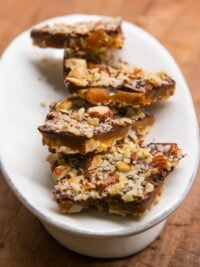
My recipe for Chocolate-Almond Buttercrunch Toffee is easy: You chop nuts, you make a syrup, and then you pour the syrup over the nuts. Sprinkle some chocolate over it, spread it out, and finish it with more nuts. That's it.
There's no fancy techniques and the only special equipment you'll need is a candy thermometer; they're easily found in most supermarkets. (Yes, really. Take it from someone who lurks in supermarkets, searching for things like candy thermometers, late at night.)

I like to add a sprinkle of fleur de sel, French salt, which gives it a pleasant salty edge which is divine with the dark chocolate and toasty nuts (any coarse salt can be used, but I like fleur de sel best.) A few cocoa nibs, available from ScharffenBerger and Dagoba, are really good too. They add a good crackly crunch of chocolate.

When making candy, here's a few tips that'll help:


  • Read the recipe thoroughly before proceeding and have everything ready.

  • Make sure your thermometer is accurate. If you're not sure, bring a pot of water to a boil. It should read 212 degrees if you live at sea level. I use a glass candy thermometer, although the digital ones work as well. (Avoid the Polder thermometers with the cable, they're not intended for candymaking in spite of the packaging which reads to the contrary. If you do, they won't replace it. Trust me on that one too. Even if you tell them you write cookbooks and give cooking equipment recommendations for a living.)

  • Be careful dealing with hot syrups. A good precaution is to have a large bowl of iced water handy. If you spill syrup on your hand, plunge it immediately into the water to stop the burn.

  • The best way to clean a caramelized pan is to fill it with water and bring it to a boil. Let stand until the syrup melts away.

  • Every once in a while, candy doesn't work. Sometimes it's too humid, or the sugar decides to crystallize (don't encourage it by overstirring), or the planets aren't aligned. Don't get discouraged; it happens even to professionals.


freshbuttercrunchchocolate.jpg


Chocolate-Almond Buttercrunch Toffee

2 cups (8 ounces) toasted almonds or hazelnuts, chopped between 'fine' and 'coarse'
2 tablespoons water
1/2 cup (1 stick) salted or unsalted butter, cut into pieces
a nice, big pinch of salt
1 cup granulated sugar
1/4 cup packed light brown sugar
1/4 teaspoon baking soda
1 teaspoon vanilla extract
5 ounces bittersweet or semisweet chocolate, chopped, or 1 cup chocolate chips

optional: Ground cocoa nibs and fleur de sel

1. Lightly oil a baking sheet with an unflavored vegetable oil.
2. Sprinkle half the nuts into a rectangle about 8' x 10" on the baking sheet.
3. In a medium heavy-duty saucepan fitted with a candy thermometer, heat the water, butter, salt, and both sugars. Cook, stirring as little as possible, until the thermometer reads 300 F degrees. Have the vanilla and baking soda handy.
4. Immediately remove from heat and stir in the baking soda and vanilla.
5. Quickly pour the mixture over the nuts on the baking sheet. Try to pour the mixture so it forms a relatively even layer. (If necessary, gently but quickly spread with a spatula, but don't overwork it.)
5. Strew the chocolate pieces over the top and let stand 2 minutes, then spread in an even layer.


spreadthatchocolate.jpg


If using, sprinkle with a small handful of cocoa nibs and a flurry of fleur des sel.
Sprinkle the remaining nuts over the chocolate and gently press them in with your hands.

Cool completely and break into pieces to serve. Store in an airtight container, for up to ten days.

(As if it will last that long.)

Permalink


Tempering Chocolate
line

August 3, 2005 | Comments (6)

During a birthday party the other night, the charming Parisian hostess, after snacking on some homemade chocolates that I brought, asked me the simple, yet complex question;
"How do you temper chocolate and why do you do it?"

After a few glasses of vin rouge followed by a coupe de Champagne (or two...), I'm sure I launched into a not-so-lucid explanation of the process. But it's a question I'm constantly asked and it prompted me to explain the process a bit here on my website.


rockyroad2.jpg

Homemade Rocky Road, from The Great Book of Chocolate, Enrobed in Tempered Chocolate


The short answer is that chemically, chocolate is composed of lots of different little crystals (six to be exact) but the desirable ones are called beta crystals. The development and formation of these beta crystals are what makes well-tempered chocolate.

If the cocoa butter rises to the surface, some people commonly think their chocolate's gotten moldy and toss it out. If you've done that, you've tossed out perfectly good, but unattractive, chocolate.

If you made chicken stock and refrigerated it, would you toss it out when the fat collected on the surface? If you made a vinaigrette and the olive oil rose to the surface, would you throw it away?

Questions we ponder...

So why do we temper chocolate?

To avoid this:

untempered.jpg


As you can see, there is a dull white sheen on the surface.

So that's what happens to chocolate that's not properly tempered: the cocoa fat rises to the surface and "blooms", making it unappealing and unattractive. When you buy chocolate, like a candy bar, the chocolate's been tempered and it should be nice and shiny and snap when you break it. If you leave your candy bar in a warm car and later open it up, often it'll become white and grey. The heat caused your chocolate to lose it's temper. When you buy chocolate for baking, it should arrive well-tempered. But once you chop it up and melt it, the beta crystals change, the chocolate loses its temper, and you'll need to re-temper it again if you plan to use it as a coating. If you're going to cook with it, just use it in your recipe, as indicated.

Pages and volumes of technical research have been written about tempering chocolate, but here are the main reasons for all you home cooks out there:


  • To avoid fat (and sugar) bloom, characterized by unappealing white streaks or blotches on the surface.
  • To raise the melting temperature of finished chocolate so it doesn't melt on contact with your fingers.
  • To preserve the keeping quality of chocolate by stratifying the fat.
  • To cool chocolate quickly. Tempered chocolate cools fast, within 5 minutes.
  • To give chocolate a glossy, shiny appearance, and a crisp, clean snap when you break it.


As I've said, you don't need to temper chocolate is you're going to bake a chocolate cake or make chocolate ice cream. The only time you need to temper chocolate is when you need an attractive, shiny coating for candies that will sit at room temperature. You can get around tempering by dipping chocolates in melted, untempered chocolate and storing them in the refrigerator. Just remove them from the refrigerator a few minutes prior to serving them. The coolness of the refrigerator will stratify the cocoa fat and it's won't bloom.

tablets.jpg

Tablets of Well-Tempered Domori Chocolate


There's many different methods for tempering chocolate.
Some are really complicated, and some are really messy, especially for home cooks.

Many professional pastry chefs and chocolatiers can instinctively tell when chocolate is perfectly tempered by looking at it or touching a smidge it to their lip. However a few years ago I was doing a demonstration tempering a brand-new chocolate and it just didn't temper. I kept stirring and stirring, but I could visually tell them those stubborn crystals wouldn't cooperate. So now I rely on a thermometer, which is foolproof.

After I studied chocolate-making in Belgium and learning from the masters at Callebaut, I developed a simple 3-step method that's a snap for home cooks. All you need is an accurate chocolate thermometer, although a good digital thermometer will work. I bought one of those laser-thermometers just for fun, but there's a too-large margin-of-error and it only measures surface temperature, so mine's been retired to my kitchen cabinet.


Tempering Chocolate

1. The first step is melting the chocolate in a clean, dry bowl set over simmering water, to about 115° F.

2. The second step it to let it cool to the low 80°s F. I drop a good-sized chunk of solid (and tempered) chocolate in, which provides insurance by 'seeding' the melted chocolate with good beta crystals. While cooling, stir frequently. Motion equals good crystallization, aka, tempering.

3. The last step is the most important.

It's bringing the chocolate up to the perfect temperature, where it's chock-full of those great beta crystals. This occurs in most dark chocolates between 88° and 91° F.

4. Remove what's left of the chunk of 'seed' chocolate, and your chocolate is dip-worthy: you can dip all the chocolates you want and all will be perfectly tempered. Don't let it get above 91° F of you'll have to begin the process all over again.


I've explained the tempering and my method in a bit more detail in The Great Book of Chocolate, which John Scharffenberger complimented me as being the simplest, and best method for tempering chocolate for home cooks that he's ever seen.


Want more great chocolate tips, recipes, and information?
Check out The Great Book of Chocolate


GTCH.jpg

... and Happy Dipping!

Permalink


David's Amazon Store


David Lebovitz
Photo courtesy of
Christopher Hirsheimer


BlogHer Ad Network
More from BlogHer
Advertise here
BlogHer Privacy Policy


The Great Book of Chocolate


Subscribe to Receive Periodic Email Updates from David
enter your email address
   subscribe
   unsubscribe


Corner       corner
     

homemy booksbiochocolate toursmy parisschedulerecipeslinks

© 1999 - 2008 David Lebovitz, All Rights Reserved